](https://deep-paper.org/en/paper/file-2307/images/cover.png)
Introduction: The Efficiency Bottleneck
We are currently living in the era of the “Scaling Law.” The logic that has driven AI progress for the last few years is simple: bigger models equal better performance. Whether it’s Llama-3, Qwen2, or Mistral, increasing the parameter count consistently unlocks new capabilities in reasoning, coding, and general knowledge.
However, this intelligence comes with a steep price tag: Inference Latency.
Running a massive 70B or even 8B parameter model is computationally expensive. Every time you ask a chatbot a question, the model has to utilize all of its active parameters to generate a response. This leads to slow generation speeds and high operational costs.
For years, engineers have tried to solve this with three main techniques:
- Quantization: Reducing the precision of weights (e.g., from 16-bit float to 4-bit integer).
- Pruning: Permanently cutting out “unimportant” neurons.
- Distillation: Training a smaller student model to mimic a larger teacher.
While these methods make models faster, they often cause “brain damage”—a noticeable drop in reasoning capability and accuracy.
But what if we could keep the model’s intelligence while drastically reducing the number of parameters active for any single token? This is the promise of Mixture-of-Experts (MoE). However, training MoEs from scratch requires massive resources.
In this post, we are diving deep into a new research paper, “Accelerating Dense LLMs via L0-regularized Mixture-of-Experts” (L0-MoE). This paper introduces a clever way to convert a pre-trained dense model into a sparse MoE model using a tiny fraction of the data (just 30 billion tokens), achieving up to 2.5x speedup with almost zero performance loss.
The High-Level Concept: L0-MoE
The core idea of L0-MoE is to take a standard dense Transformer (where every neuron fires for every input) and retroactively transform its Feed-Forward Networks (FFNs) into a Mixture-of-Experts layer.
Unlike traditional MoE training that starts from scratch, L0-MoE is a post-training acceleration method. It carves specialized “experts” out of the existing dense weights and trains a router to direct traffic.
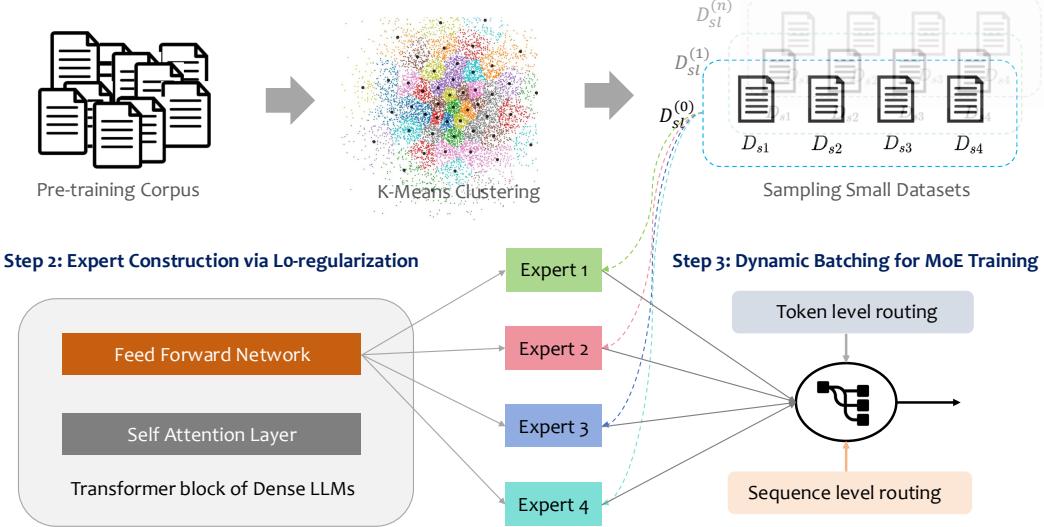
As shown in Figure 1 above, the process is broken down into three sophisticated stages:
- Smart Data Curation: Using a “Cluster Confusion Matrix” to pick the perfect training data.
- Expert Construction: Using L0-regularization to mathematically select which neurons belong to which expert.
- Dynamic Batching: A curriculum learning strategy to train the MoE router effectively.
Let’s break these down step-by-step.
Step 1: Cluster Confusion Matrix (CCM) Based Sampling
One of the biggest challenges in converting a dense model to an MoE is data. You cannot afford to retrain on trillions of tokens. You need a small, high-quality dataset that covers a wide variety of domains (coding, math, literature, etc.) so that different experts can learn to specialize.
Randomly sampling data isn’t good enough; you might end up with too much of one topic and not enough of another. The authors propose a method using K-Means Clustering and a concept called the Cluster Confusion Matrix (CCM).
The Process
- Embed & Cluster: They take a subset of a large corpus (RedPajama) and convert text into semantic vectors using an encoder (BGE-M3).
- K-Means: They cluster these vectors to find distinct semantic domains.
- Iterative Refinement: They don’t just do this once. They iterate to find the most distinct, “confusing” clusters that help separate domains clearly.
The Math of Confusion
How do they know if the data clusters are good? They define a Cluster Confusion Matrix. The goal is to maximize the “Semantic Domain Distance”—essentially ensuring that the chosen data points represent distinct, separate topics rather than a muddy mix.
They calculate a confusion value using inter-clustering and intra-clustering cosine similarity:
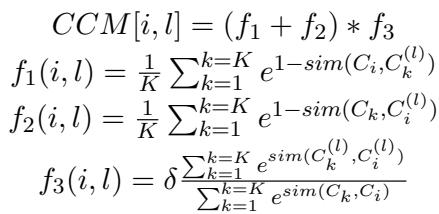
In the equation above:
- \(f_1\) and \(f_2\) represent the similarity between different clusters (inter-cluster).
- \(f_3\) represents the tightness within a cluster (intra-cluster).
By combining these, they derive a score \(d_{ds}\) (domain semantic distance) to rank the datasets:

The datasets with the highest scores are used to train the model. This ensures that the MoE experts are presented with clear, distinct topics, making it easier for them to specialize (e.g., one expert focuses purely on math, another on history).
Step 2: Expert Construction via L0-Regularization
This is the heart of the paper. In a dense model, the Feed-Forward Network (FFN) is a massive matrix of weights. The researchers want to split this matrix into several smaller matrices (experts).
To do this, they use L0-Regularization.
What is L0 Regularization?
In machine learning, “Regularization” usually means adding a penalty to the loss function to prevent overfitting.
- L1 Regularization tries to make weights small (and sometimes zero).
- L2 Regularization tries to keep weights from getting too huge.
- L0 Regularization is the most aggressive: it penalizes the count of non-zero parameters. Ideally, it forces the model to use as few parameters as possible.
However, L0 is computationally difficult because you cannot calculate a gradient for “the number of non-zero items”—it’s a discrete step function, not a smooth curve. You can’t use backpropagation on it.
The “Hard Concrete” Trick
To solve this, the authors use a mathematical trick involving the Binary Hard Concrete distribution. This approximates the L0 norm in a way that is differentiable.
They introduce a mask generation process governed by the following equations:
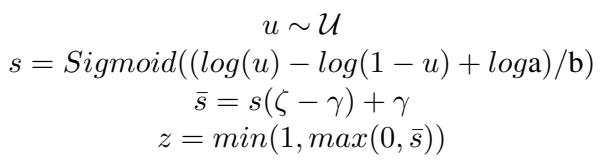
Here’s the intuition:
- They learn a mask \(Z\) (composed of 0s and 1s).
- This mask is applied to the intermediate layer of the FFN.
- The variable \(z\) determines whether a neuron is “on” (kept for an expert) or “off” (pruned).
To control exactly how sparse the model becomes (i.e., how many parameters we keep), they use a Lagrangian loss function:

- \(r\) is the target retention ratio (e.g., “keep only 10% of the weights”).
- \(\hat{r}\) is the current ratio.
- The equation forces the model to converge exactly to the desired size.
By applying this to the dense model while training on the specific domains identified in Step 1, the dense FFN naturally fractures into specialized experts. One subset of neurons stays active for coding data, while another subset stays active for creative writing.
The total loss function for this expert construction phase combines the standard Language Model loss (\(\mathcal{L}_{llm}\)) with the L0 penalty:

Step 3: Dynamic Batching for Router Training
Once the experts are constructed, the model needs a Router (or Gating Network) to decide which expert handles which token.
If you train a router on random data immediately, it gets confused. It’s like trying to teach a student calculus and poetry in the same sentence. To fix this, the authors introduce Dynamic Batching.
The Curriculum Strategy
They use the ordered datasets from Step 1 (ordered by domain distinctness) to create a training schedule:
- Early Training: Batches consist of samples from very distinct, clear domains. This allows the router to easily learn the “broad strokes” (e.g., “This looks like code, send it to Expert A”).
- Late Training: As training progresses, the batches become more mixed and semantically complex. This forces the router to learn finer nuances.
Balancing the Load
A common failure mode in MoE models is Mode Collapse, where the router sends everything to just one expert, ignoring the others. To prevent this, L0-MoE includes auxiliary losses:
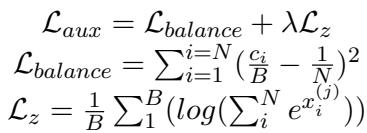
- \(\mathcal{L}_{balance}\): Ensures that all experts get roughly the same amount of work.
- \(\mathcal{L}_z\) (Router Z-Loss): Prevents the router logits from becoming too large, which helps stability.
The final training objective combines the LLM loss with these auxiliary constraints:

Experiments and Results
The researchers applied L0-MoE to three popular open-source models: Llama-3-8B, Mistral-7B, and Qwen2-7B. They compared the results against standard benchmarks (MMLU, GSM8K, HumanEval, BBH).
Performance vs. Dense Models
The results are impressive. As seen in Table 1, the L0-MoE versions of these models achieve performance almost identical to their dense parents, but they run 2.0x to 2.5x faster.
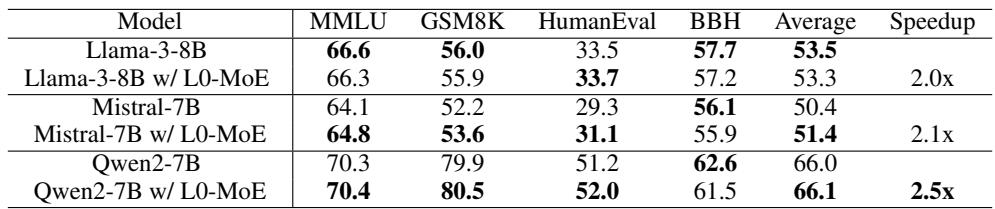
Notably, look at Mistral-7B w/ L0-MoE: it actually improved slightly on benchmarks like MMLU (64.8 vs 64.1) and GSM8K (53.6 vs 52.2). This suggests that the MoE specialization can sometimes filter out noise present in the dense model.
Comparison with Other Acceleration Methods
How does L0-MoE stack up against other ways to speed up models, like Quantization (GPTQ) or Pruning (LLM Shearing)?
Table 2 shows a clear victory for L0-MoE.
- GPTQ (Quantization) achieves a 1.8x speedup but drops the GSM8K score from 79.9 to 73.8.
- LLM Shearing (Pruning) achieves a 2.6x speedup but drops the MMLU score significantly.
- L0-MoE achieves a 2.5x speedup with no drop in MMLU and an increase in GSM8K.
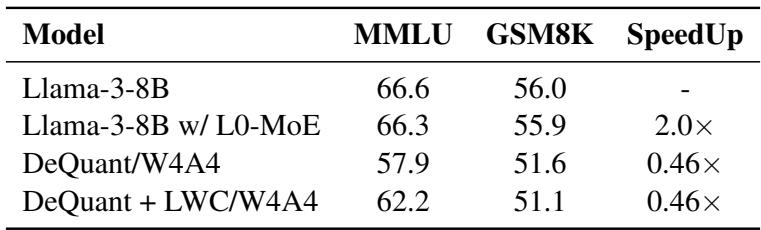
The authors also compared their method to DuQuant, a newer outlier-aware quantization method. As shown in Table 6, L0-MoE significantly outperforms DuQuant in maintaining model intelligence.
Architecture Details
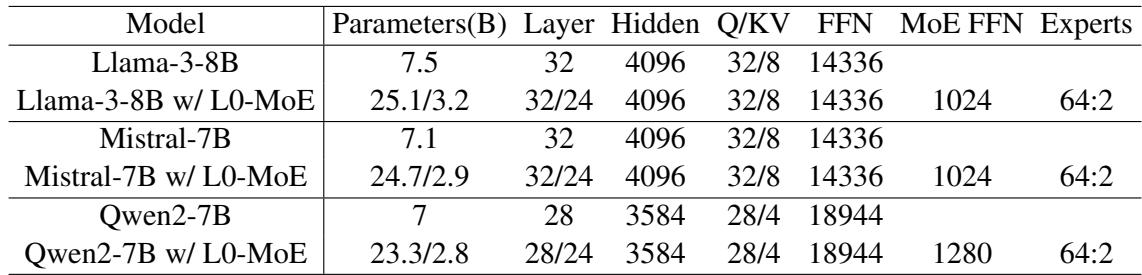
For those interested in the specific configuration, Table 5 details how the models were transformed. For example, in Llama-3-8B, they converted the top 24 layers into MoE layers, keeping the bottom 8 dense. They utilized 64 experts total, with the top-2 active for every token.
Ablation Studies
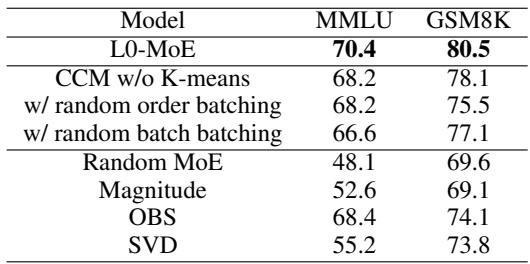
Does the complex “Cluster Confusion Matrix” really matter? The authors tested this in Table 3 (visible in the composite image above).
- Removing K-means clustering caused the MMLU score to drop by over 2 points.
- Using random batching instead of dynamic batching also degraded performance.
- Replacing L0-regularization with random selection or magnitude pruning (standard pruning techniques) caused massive drops in performance (e.g., Random MoE dropped MMLU to 48.1).
This confirms that the combination of L0-regularization and smart data selection is what makes this technique work.
Conclusion & Implications
The L0-MoE paper presents a compelling path forward for deploying Large Language Models. It tackles the inference bottleneck not by making the model “dumber” (quantization) or “smaller” (distillation), but by making it modular.
By using L0-regularization to carve specialized experts out of a dense block, and using a Cluster Confusion Matrix to ensure those experts are trained on distinct concepts, we can achieve the best of both worlds:
- The knowledge capacity of a large dense model.
- The speed and cost-efficiency of a small sparse model.
Perhaps most exciting is the efficiency of the method itself. It requires only 30 billion tokens of training data. In the world of LLMs, where training usually involves trillions of tokens, this is computationally negligible. This democratizes the ability to create highly efficient, specialized MoE models without needing a supercomputer cluster for months.
As we look toward future applications, L0-MoE could allow for even larger models (70B+) to run on consumer hardware, bringing powerful AI to laptops and edge devices.