](https://deep-paper.org/en/paper/file-2323/images/cover.png)
Introduction
In the rapidly evolving landscape of Large Language Models (LLMs), we are witnessing a shift from general-purpose chatbots to highly specialized “domain experts.” We now have models fine-tuned specifically for finance, medicine, coding, and law. These experts can pass board exams and analyze complex fiscal reports with accuracy that far surpasses a standard GPT-4 or Llama-3 model.
However, specialization comes at a steep price. To create an expert, we typically take a base model and fine-tune it heavily on domain-specific data (like medical journals or case law). In doing so, we often break the model’s “safety alignment.” The resulting expert might be a genius at diagnosis, but it forgets the ethical guardrails that prevent it from generating harmful content, toxic responses, or dangerous advice. Conversely, if we try to train these experts to be safe, they often lose their edge—a phenomenon known as the alignment tax, where safety training degrades the model’s utility.
For a long time, this felt like a zero-sum game: you could have a safe model or a smart model, but rarely both at the peak of their potential.
A new research paper, Combining Domain and Alignment Vectors Provides Better Knowledge-Safety Trade-offs in LLMs, proposes a fascinating solution that sidesteps this trade-off entirely. The researchers introduce MERGEALIGN, a method that doesn’t require expensive retraining. Instead, it uses simple arithmetic to “merge” the safety of a generalist model with the knowledge of a specialist.
In this post, we will deconstruct how MERGEALIGN works, why it outperforms traditional training methods, and what it implies for the future of AI development.
The Core Problem: The Expert-Safety Paradox
To understand the innovation here, we must first understand how modern LLMs are built. The process usually happens in stages:
- Pre-training: The model learns language from massive datasets.
- Instruction Tuning / Alignment: The model is trained to follow instructions and adhere to human preferences (safety, helpfulness).
When we want a Domain Expert, we branch off. We take the pre-trained model and flood it with specialized data. The result is a model (\(\theta_d\)) that knows the domain inside out. However, because this domain training often ignores safety data, the model drifts away from human ethical alignment.
If we want to fix this, the standard approach is to perform Preference Alignment (like DPO or ORPO) on the expert model. We show the doctor-bot examples of “safe” vs. “unsafe” answers and update its weights. Unfortunately, this is where the alignment tax hits. As the model adjusts its parameters to be safer, it often overwrites the delicate, specialized knowledge it just learned.
The researchers posed a question: What if we could extract the “safety” from a generalist model and the “expertise” from a specialist model, and just add them together?
Background: The Era of Task Vectors
The mathematical foundation of MERGEALIGN is the concept of Task Vectors.
When you fine-tune a pre-trained model (\(\theta\)) to perform a specific task, you change its weights to a new state (\(\theta_{task}\)). The “Task Vector” is simply the difference between the new weights and the old weights:
\[ \tau = \theta_{task} - \theta \]Think of this vector as a direction in the high-dimensional space of the neural network. It represents the “learning” specific to that task.
Recent research has shown that these vectors are surprisingly modular. If you have a vector that represents “learning to speak French” and another that represents “learning to code,” you can sometimes add them to a base model to get a French-speaking coder. This technique is broadly known as Task Arithmetic.
The authors of this paper extend this logic to two specific types of vectors:
- The Domain Vector (\(\tau_d\)): The direction the model moves to become an expert (e.g., in Medicine).
- The Alignment Vector (\(\tau_a\)): The direction the model moves to become safe and instruction-following.
Methodology: MERGEALIGN
The MERGEALIGN method is elegantly simple. It treats model alignment not as a training curriculum, but as a geometry problem.
The process involves three distinct models, all sharing the same pre-trained ancestor (\(\theta\)):
- The Domain Expert (\(\theta_d\)): A model fine-tuned on specialized data (unsafe but smart).
- The Aligned Model (\(\theta_a\)): A general-purpose model fine-tuned for safety (safe but general).
- The Base Model (\(\theta\)): The common starting point.
The goal is to create a new model (\(\hat{\theta}\)) that possesses the qualities of both \(\theta_d\) and \(\theta_a\).
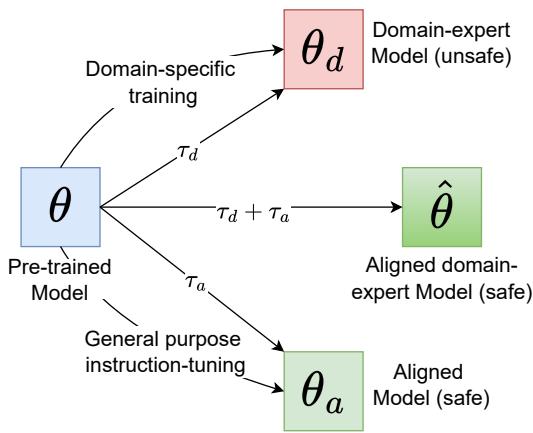
As illustrated in Figure 1, the researchers calculate the “delta” (the change in parameters) for both the expert path and the alignment path.
- \(\tau_d\) (Domain Vector): Represents the knowledge gained during domain fine-tuning.
- \(\tau_a\) (Alignment Vector): Represents the safety behaviors learned during instruction tuning.
Instead of retraining the expert model to learn safety, MERGEALIGN simply adds the safety vector (\(\tau_a\)) to the domain vector (\(\tau_d\)) and applies both to the base model.
The mathematical formulation is straightforward:

Here, \(\hat{\theta}\) is the final merged model. It is the sum of the base pre-trained weights, the knowledge gained by the expert, and the safety behaviors gained by the generalist.
Why Is This Revolutionary?
This approach is a “free lunch” in terms of computational resources.
- No Training Required: You do not need to run expensive GPU-intensive alignment steps (like RLHF or DPO) on the expert model.
- CPU Compatibility: Since this is just element-wise addition of model weights, it can actually be performed on a CPU.
- Modularity: You can reuse the same “Alignment Vector” for multiple different domain experts. If you have a Finance Bot and a Medical Bot derived from the same Llama-3 base, you can apply the same Llama-3 safety vector to both.
Experimental Results
The theory sounds great, but does simply adding weights preserve the delicate performance required for medicine or finance? The researchers tested this using Llama-3-8B models across two high-stakes domains: Medicine and Finance.
They compared MERGEALIGN against several baselines:
- Slerp: Spherical Linear Interpolation, a common method for merging models that accounts for the geometry of the parameter space.
- ORPO: Odds Ratio Preference Optimization, a state-of-the-art training method for explicitly aligning models.
The Knowledge-Safety Trade-off
The most critical evaluation metric in this study is the trade-off between domain performance (how well it answers medical/financial questions) and safety (how well it refuses harmful prompts).
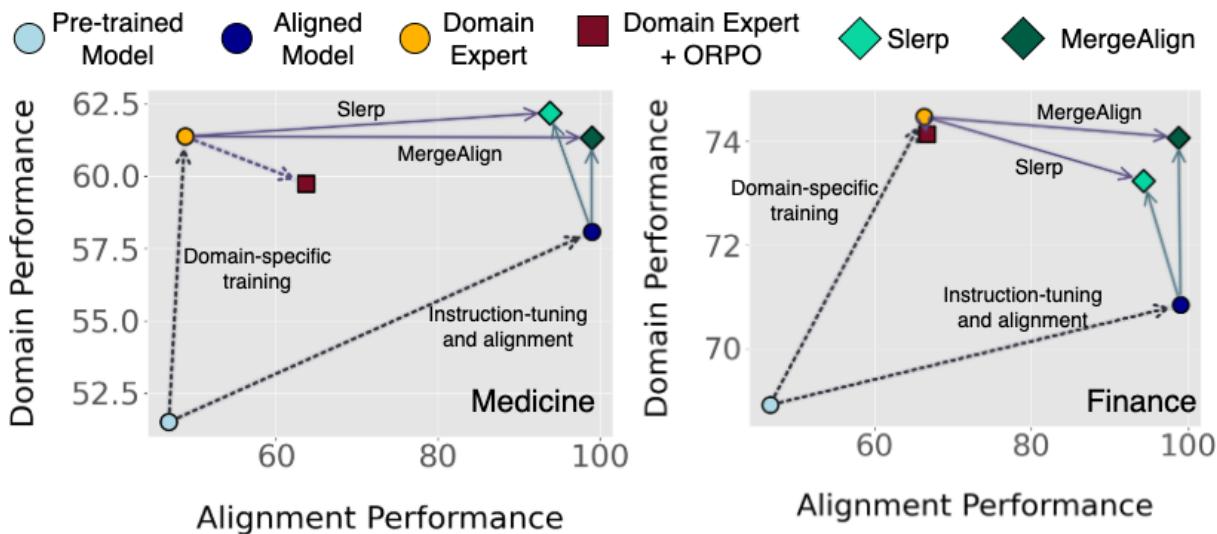
Figure 2 presents the core findings. Let’s analyze the axes:
- X-Axis (Alignment): Measures safety (using the BeaverTails benchmark). Farther right is safer.
- Y-Axis (Domain Performance): Measures expertise. Higher is smarter.
Ideally, we want a model in the top-right corner.
Looking at the plots:
- The Domain Expert (Orange Circle): High on the Y-axis (smart) but distinctively left on the X-axis (unsafe). It knows medicine but lacks guardrails.
- The Aligned Model (Dark Blue Circle): Far right on the X-axis (very safe) but lower on the Y-axis. It has “forgotten” the domain specifics.
- ORPO (Maroon Square): This represents explicitly training the expert to be safe. Notice that while safety improves, the dot drops significantly on the Y-axis. This is the alignment tax in action. The model got safer but dumber.
- MERGEALIGN (Green Diamond): This point is remarkable. It sits almost parallel to the Aligned Model on the X-axis (achieving ~90%+ safety) while staying nearly level with the Domain Expert on the Y-axis.
Key Takeaway: MERGEALIGN achieves the safety of a generalist instruction-tuned model with minimal degradation to domain expertise. It significantly outperforms explicit training (ORPO) and standard interpolation (Slerp) in maintaining this balance.
Model Similarity Analysis
Why does this arithmetic addition work without destroying the model? The researchers analyzed the similarity of the model parameters using L2 distance (Euclidean distance in parameter space).
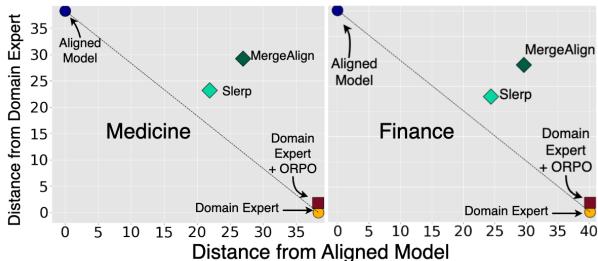
In Figure 3, we see where the resulting models “live” in the parameter space.
- The x-axis shows the distance from the generalist Aligned Model.
- The y-axis shows the distance from the Domain Expert.
The MERGEALIGN model (Green Diamond) sits roughly equidistant from both parents. It has successfully found a “middle ground” in the weight space that captures the essential features of both parents. In contrast, models trained with ORPO (preference alignment) stay very close to the Domain Expert (low y-axis value) but far from the Aligned Model, which explains why they struggle to fully adopt the safety behaviors of the generalist.
Limitations and Generalization
While MERGEALIGN works wonders for Medicine and Finance—domains that rely heavily on knowledge retrieval and semantic understanding—the researchers wanted to see if it applied to “reasoning-heavy” domains like Code and Math.
They tested the method on the Qwen-2.5 suite of models (Coding and Math experts).
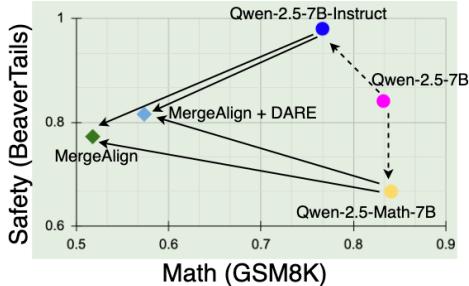
The results, shown in Figures 4 and 5, reveal an interesting boundary:
- Code (Left Graph): MERGEALIGN works well. It improves safety (y-axis) with only a minor drop in coding ability (x-axis).
- Math (Right Graph & Figure 5): The method struggles. When applying MERGEALIGN to the Math expert, the mathematical reasoning capability drops significantly.
Why the difference? The authors hypothesize that mathematical reasoning relies on precise, fragile chains of logic that are highly sensitive to parameter changes. Simply adding a safety vector might disrupt these delicate “reasoning circuits.” In contrast, Medicine, Finance, and Coding share more semantic and linguistic structures with general language, making the parameter addition less destructive.
The researchers experimented with DARE (Drop And REscale) pruning—a technique where random parameters in the delta vector are dropped to reduce interference. As shown in Figure 5 (Light Blue Diamond), using DARE helps recover some performance, suggesting that more advanced merging techniques could eventually solve the “Math problem.”
Weighted Interpolation
One might ask: Should we just add the vectors 1-to-1? What if we weight the safety vector higher?
The researchers explored a weighted version of the equation:
\[ \hat{\theta} = \theta + \alpha \cdot \tau_d + \beta \cdot \tau_a \]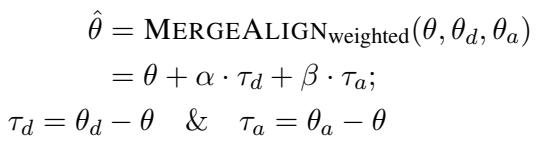
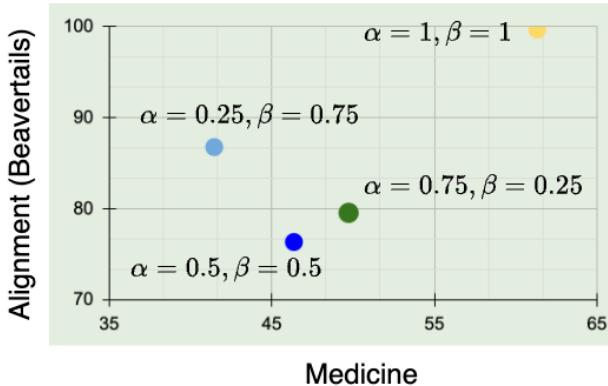
Surprisingly, their experiments (Figure 6) showed that setting \(\alpha=1\) and \(\beta=1\) (simple addition) yielded the best results. Tinkering with the weights caused performance to degrade on both fronts. This suggests that the “Task Vector” hypothesis—that these vectors represent independent, additive functional units—is robust in its simplest form.
Conclusion and Implications
The paper Combining Domain and Alignment Vectors Provides Better Knowledge-Safety Trade-offs in LLMs offers a compelling solution to one of the most persistent headaches in AI deployment.
For students and practitioners, the implications are significant:
- Democratization of Safety: You don’t need a massive GPU cluster to align your custom expert model. If you have a base model and a public instruction-tuned model (like Llama-3-Instruct), you can align your custom fine-tune on a laptop.
- No More Alignment Tax: We can stop accepting the premise that a safe model must be less capable. By treating safety and expertise as separate vectors that can be combined, we retain the best of both worlds.
- The Frontier of Merging: While the method currently struggles with pure reasoning tasks like Math, the success with Code and technical domains proves that Model Merging is not just a hack—it is a legitimate proxy for training.
As we move forward, techniques like MERGEALIGN suggest a future where AI development is modular. Instead of training one giant model to do everything, we might train specialized “skill vectors” and “safety vectors,” mixing and matching them to build the perfect model for any given task.