](https://deep-paper.org/en/paper/file-2337/images/cover.png)
Introduction
In the world of Natural Language Processing (NLP), data is fuel. For tasks like Named Entity Recognition (NER)—where the goal is to identify and classify terms like chemicals, diseases, or genes—performance is strictly tied to the quantity of high-quality, labeled training data. While Large Language Models (LLMs) have shown impressive zero-shot capabilities, full fine-tuning or supervised learning remains the gold standard for achieving top-tier accuracy in specialized domains like biomedicine.
But there is a bottleneck: creating labeled data is expensive and slow.
A logical solution would be to combine existing datasets. If you are building a model to detect chemicals, why not merge the NLMChem dataset with the BioRED dataset? The problem is that these datasets often speak different “languages.” They have different annotation guidelines. For example, “hematoxylin” is labeled as a Chemical in NLMChem, but in BioRED, it is explicitly excluded because it’s a staining reagent.
If you simply merge these datasets, you confuse the model with contradictory signals. Previous solutions involved time-consuming manual editing to align these datasets or using Multi-Task Learning (MTL), which often fails to capture the subtle relationships between different label definitions.
In a recent paper, Enhancing NER by Harnessing Multiple Datasets with Conditional Variational Autoencoders, researchers Taku Oi and Makoto Miwa propose a sophisticated solution. They integrate a Conditional Variational Autoencoder (CVAE) into a span-based NER model. This architecture allows the model to learn from multiple, conflicting datasets by mathematically modeling the “shared” and “unshared” information between labels.
In this post, we will tear down their architecture, explain why CVAEs are the secret weapon for this problem, and look at how this approach improves performance without requiring manual data cleanup.
Background: The Challenges of Multi-Dataset NER
Before diving into the solution, we need to understand two concepts: Span-based NER and the limitations of traditional Multi-Task Learning.
Span-based NER
Traditional NER models often treat the task as a sequence labeling problem (assigning a label to every token). However, recent trends favor span-based models. These models look at a contiguous sequence of words (a span) and decide if that entire chunk represents an entity.
The representation of a span is usually constructed by concatenating the embeddings of the start token, the end token, and an embedding representing the length of the span. This simple representation is surprisingly effective for capturing boundaries.
The “Tower of Babel” Problem
The core issue this paper addresses is the inconsistency between datasets. When two datasets define “Chemical” differently, a standard model trained on both will oscillate between definitions, degrading performance.
Multi-Task Learning (MTL) is the standard fix. in MTL, you share the main “brain” (the encoder, like BERT) across all datasets, but you give each dataset its own “head” (classification layer). This works okay, but it isolates the tasks. The model doesn’t explicitly learn that “Chemical” in Dataset A is mostly the same as “Chemical” in Dataset B. It treats them as completely unrelated classes, missing out on valuable transfer learning opportunities.
The Core Method: Integrating CVAE
The researchers propose a method that doesn’t just separate the tasks; it models the relationship between them. They do this by adding a CVAE branch to the training process.
The Architecture Overview
The model is built on top of a standard encoder (like T5 or BERT). As inputs, it takes the text and a special token indicating the dataset name (to help the model handle dataset-specific quirks).
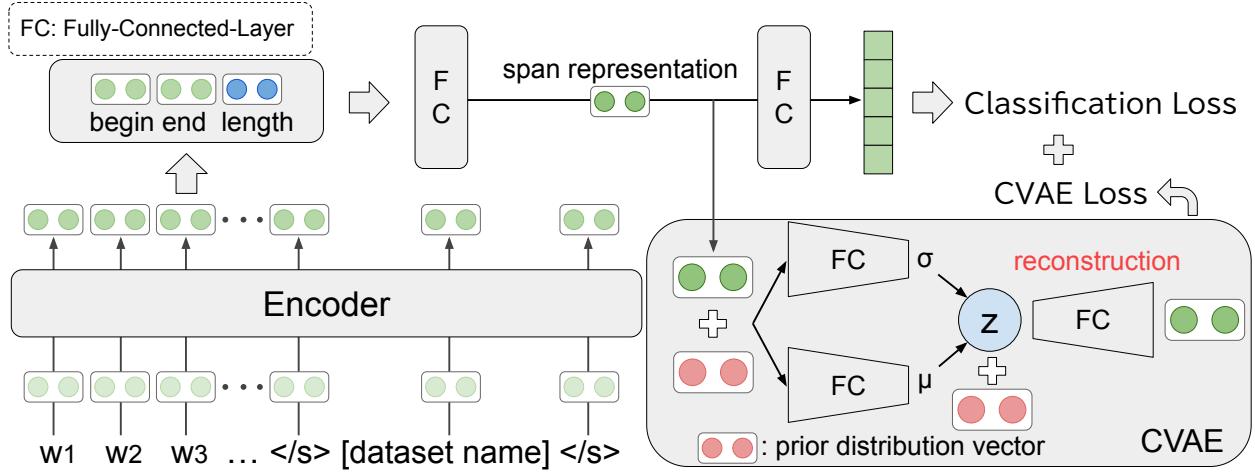
As shown in Figure 1, the architecture splits into two paths after the span representation is created:
- The Classification Path (Left): This is the standard NER predictor. It takes the span representation and outputs the entity class.
- The CVAE Path (Right): This is the novel addition. It uses a Variational Autoencoder to reconstruct the span representation, conditioned on specific label information.
Let’s break down the mathematical components.
1. The Span Representation
First, the model needs a vector representation for every candidate span in the text. Following previous work, the researchers define the span representation (\(\boldsymbol{h}_{span}\)) using the equation below:

Here, \(\boldsymbol{x}_1\) and \(\boldsymbol{x}_n\) are the embeddings of the first and last tokens of the span, and \(\Phi(n)\) is an embedding representing the length of the span. These are concatenated and passed through a linear layer.
2. The Conditional Variational Autoencoder (CVAE)
The CVAE is a generative model. In this context, its job is to act as a regularizer—a mechanism that forces the model to learn better, more robust span representations.
In a standard VAE, you compress data into a latent space (\(z\)) and try to reconstruct it. In a Conditional VAE, you provide a “condition” to guide this process.
Here is the genius part: The condition is a “Prior Distribution Vector” that encodes the relationship between datasets.
This vector is a concatenation of two one-hot vectors:
- Dataset-Specific Label: Which label is this span in the source dataset? (e.g., Protein_Source)
- Shared Target Label: Which label does this correspond to in the target dataset (BioRED)? (e.g., Protein_Target)
By feeding this vector into the CVAE, the model explicitly learns: “This span is a Protein in the source dataset, AND that concept maps to Protein in the target dataset.” This allows the model to align similar concepts across conflicting datasets while keeping distinct concepts separate.
3. The Loss Function
The training objective is a combination of two goals.
First, we have the standard Cross-Entropy Loss (\(L_{CE}\)) from the main classifier, which ensures the model actually predicts the right entities.
Second, we have the CVAE Loss (\(L_{CVAE}\)). This loss forces the latent variable \(z\) to follow a prior distribution defined by the labels. It consists of a reconstruction error (can we recreate the span?) and the Kullback-Leibler (KL) divergence (does our latent distribution match the prior?).

The total loss used to update the model weights is a weighted sum of these two:

The parameter \(\alpha\) controls how much influence the CVAE branch has on the training. Interestingly, during inference (actual use), the CVAE branch is discarded. The model uses only the trained encoder and classifier. This means the complex CVAE machinery improves the weights during training without slowing down the model when it’s deployed.
Experiments & Results
The researchers tested their method using BioRED as the target dataset and 9 additional biomedical datasets as auxiliary training sources. They compared their approach against a Single-dataset baseline and standard Multi-Task Learning (MTL).
Hyperparameters and Setup
They used T5-3B (using only the encoder) and PubMedBERT as backbones. For the CVAE, they carefully tuned the \(\alpha\) parameter (the weight of the CVAE loss).
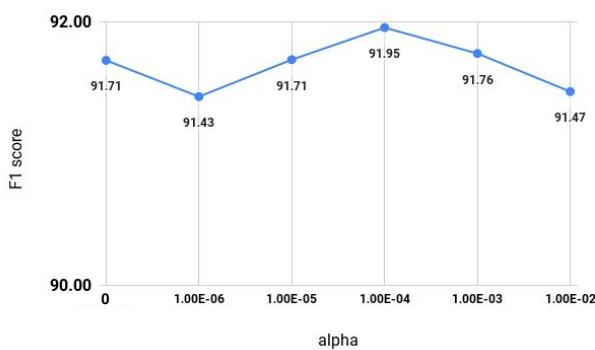
Figure 2 shows the sensitivity of the model to the \(\alpha\) hyperparameter. The performance peaks around \(10^{-4}\). If \(\alpha\) is too high, the CVAE loss overpowers the classification loss; if it’s too low (\(\alpha=0\)), the benefit of the CVAE disappears.
Quantitative Results
The proposed method achieved state-of-the-art results. It outperformed the “Single” model (trained only on BioRED) and the “Multi” model (standard MTL) across almost all entity types.
Notably, the CVAE approach improved F1 scores regardless of whether the encoder was T5 or BERT. This suggests that the method is architecture-agnostic—it’s a general technique for handling data discrepancies, not just a quirk of one specific Transformer.
Visualizing the Latent Space
Numbers in a table are great, but visualizing the embeddings shows us why the method works. The researchers used t-SNE to project the learned embeddings into 2D space.
Figure 4 below compares the embeddings of “Disease” and “Species” entities from different datasets.
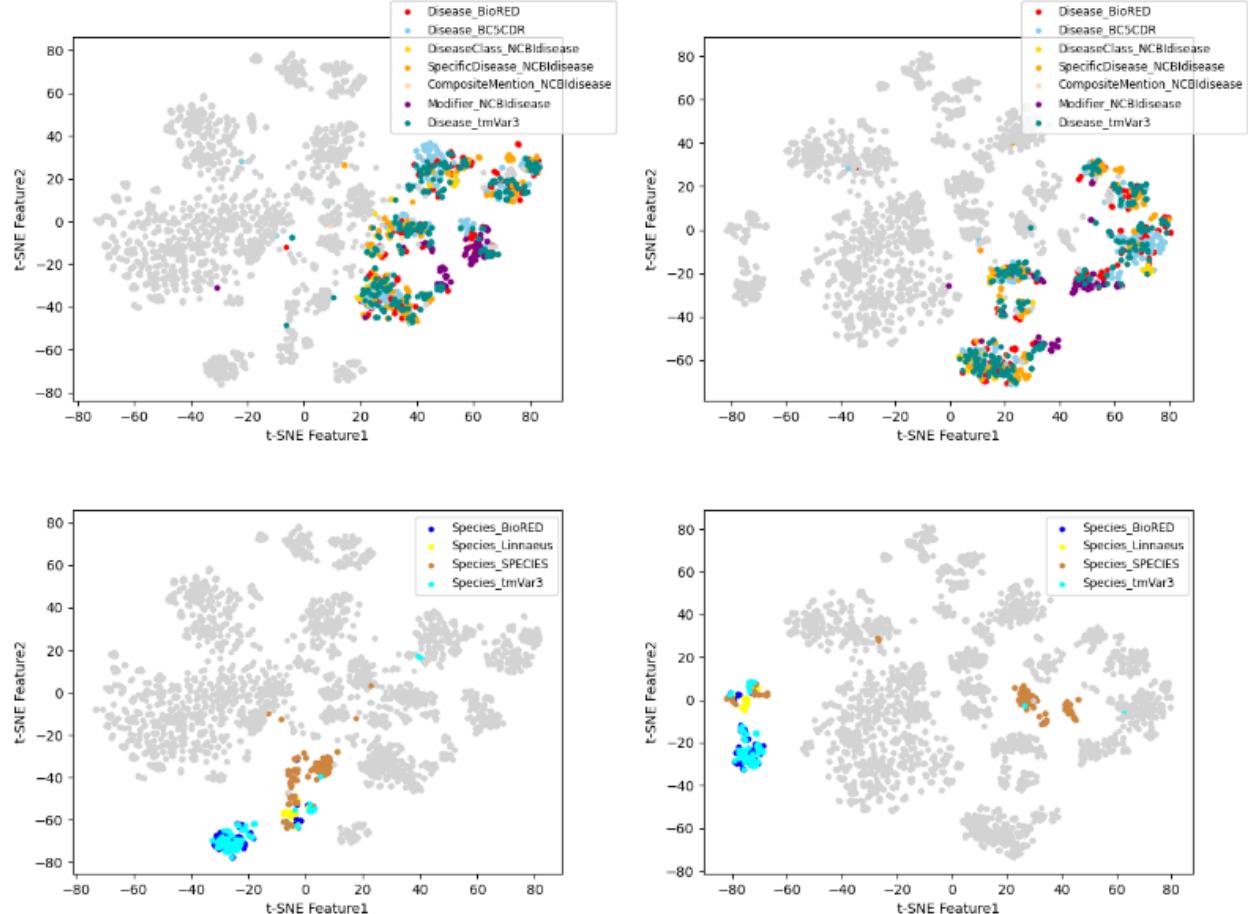
- Right Side (Standard Multi): Notice how the clusters are somewhat loose. The concepts from different datasets are nearby, but not tightly integrated.
- Left Side (Multi + CVAE): The clusters are tighter and more overlapped. For example, in the bottom-left plot (Species with CVAE), the embeddings from the Linnaeus, SPECIES, and BioRED datasets are pulled much closer together.
This visual clustering confirms that the CVAE successfully forced the model to align the representations of “Species” across different datasets, effectively translating the auxiliary data into a language the target model understands.
The Importance of the Prior Vector
To prove that the improvement wasn’t just random luck, the authors visualized the “Prior Distribution Vectors” themselves after training (see Figure 3).
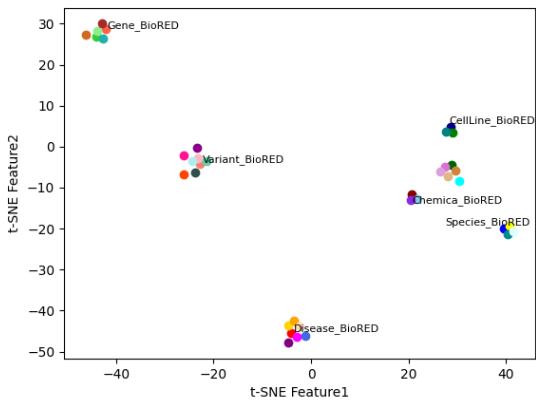
The plot shows that labels corresponding to the same BioRED category (e.g., Gene, Chemical) cluster together, while unrelated labels remain distant. This confirms that the manually defined mappings (the “prior”) were preserved and utilized correctly by the model during the learning process.
Conclusion and Implications
This research addresses a critical practical problem in machine learning: we have lots of data, but it’s messy and inconsistent. Instead of spending months manually re-annotating datasets to match a single standard, this paper proposes a smarter algorithmic approach.
By wrapping a span-based NER model with a Conditional Variational Autoencoder, the researchers created a system that can “digest” conflicting datasets. The CVAE acts as a translator, using a prior distribution vector to identify which parts of the auxiliary datasets are shared with the target task and which are specific to the source.
Key Takeaways:
- Don’t Edit, Model: You don’t always need to manually clean datasets. You can build architectures that model the discrepancies explicitly.
- CVAE as a Regularizer: VAEs aren’t just for generating images; they are powerful tools for structuring the latent space of discriminative models.
- Free Lunch at Inference: Since the CVAE is only used for training, the final model is just as fast as a standard NER model but significantly more accurate.
For students and practitioners, this paper serves as an excellent example of how generative components (like VAEs) can be creatively applied to discriminative tasks (like classification) to solve data quality issues. Future work may focus on automating the creation of the prior vector, removing the need to manually map labels between datasets entirely.