](https://deep-paper.org/en/paper/file-2346/images/cover.png)
Introduction: The Mirror Effect
In the rapidly evolving landscape of artificial intelligence, a massive amount of energy is spent on “alignment.” Researchers, ethicists, and engineers are constantly working to ensure that Large Language Models (LLMs) like GPT-4 align with human values, instructions, and safety guidelines. We want the AI to understand us, speak like us, and serve our needs.
But there is a flip side to this coin that is rarely explored: Are we aligning with them?
When you chat with a customer service bot, or collaborate with ChatGPT on an essay, do you change the way you speak? Do you simplify your vocabulary, alter your sentence structure, or shift your logic to accommodate the machine?
A fascinating research paper titled “Human Alignment: How Much Do We Adapt to LLMs?” by researchers at Ghent University tackles this question head-on. The study moves beyond the typical analysis of AI performance and instead turns the microscope on the human user. Through a clever experimental design involving a cooperative language game, the authors discovered that humans do indeed change their behavior when interacting with AI—and surprisingly, we do it even when we aren’t sure who (or what) we are talking to.
In this deep dive, we will unpack the methodology, the “Word Synchronization Challenge,” and the implications of the finding that our adaptation to AI is driven more by the model’s behavior than by our own biases.
Background: The Dance of Dialogue
To understand why this research matters, we first need to look at how humans communicate with each other. Communication is not just transmitting data; it is a cooperative activity.
Psychologists and linguists refer to this as interactive alignment or grounding. When two people talk, they naturally converge on shared vocabulary, sentence structures, and even pronunciation. If your conversation partner refers to a “sofa” as a “couch,” you are likely to adopt the word “couch” for the duration of that conversation. This alignment reduces cognitive load—it makes communication efficient and helps establish common ground.
Recent neuroscience has even shown that during meaningful social interactions, the electrical oscillations in human brains can synchronize. We are biologically wired to adapt to our partners.
The Missing Piece
We know we adapt to humans. It follows logically that we might adapt to LLMs, which are designed to approximate human dialogue. However, previous research on Human-AI interaction has mostly focused on high-level tasks, like idea generation or scientific writing. We know less about the low-level “social” signaling: how we choose specific words and navigate the flow of a conversation with a machine.
This paper fills that gap by using a “minimal” social interaction setup to measure exactly how humans shift their linguistic strategies when the partner on the other side is an algorithm.
The Core Method: The Word Synchronization Challenge
How do you measure something as subtle as “adaptation”? If you just analyze open-ended chat logs, there are too many variables. The researchers needed a controlled environment where success depends entirely on two parties getting on the same wavelength.
They utilized a game called the Word Synchronization Challenge (WSC).
How the Game Works
The WSC is a cooperative game, similar to the improvisational theater exercise “Mind Meld” or the board game “Codenames Duet.”
- Start: Two players (Player A and Player B) each secretly write down a random word.
- Reveal: Both words are revealed simultaneously.
- The Goal: In the next round, both players must write a new word that acts as a bridge between the previous words, trying to converge on the exact same word.
- Constraint: They cannot repeat any word previously used in the game.
- Victory: The game ends when both players submit the same word at the same time.
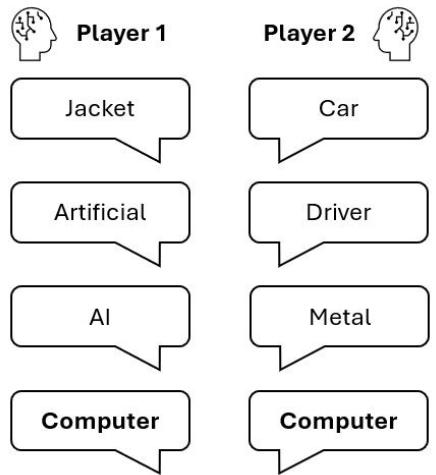
As shown in Figure 1, the game requires “Theory of Mind.” To win, you cannot just think about what connects “Jacket” and “Car.” You have to simulate what your partner thinks connects “Jacket” and “Car.”
In the example above:
- Round 1: Player 1 says “Jacket”, Player 2 says “Car”.
- Round 2: They try to bridge the gap. Player 1 thinks of “Driver” (wearing a jacket, driving a car). Player 2 thinks of “Leather” (material for both). They miss.
- Round 3: They try again based on “Driver” and “Leather.”
- Round 4: They eventually converge on “Computer” (perhaps via “AI” and “Metal”).
This game strips away visual cues and tone of voice, leaving only pure semantic alignment. If you can sync up quickly, it means you are successfully predicting and adapting to your partner’s thought process.
The Experimental Design: A 2x2 Matrix
The researchers recruited 20 participants to play 16 games each. But here is the twist: the researchers manipulated not just who the partner was, but who the partner was presented as.
They used a 2x2 factorial design:
- Partner Identity: The opponent was either a Human or an LLM (GPT-4o).
- Partner Label (Deception): The participant was told the opponent was a Human or an AI.
This resulted in four distinct scenarios:
- Human (Human shown): Truthful control condition.
- Human (AI shown): The participant believes they are playing an AI, but it is actually a human.
- LLM (AI shown): Truthful AI condition.
- LLM (Human shown): The “Turing Test” condition—playing against an AI but believing it is human.
This design allowed the authors to separate bias (how I treat you because I think you are a bot) from behavioral adaptation (how I treat you because you act like a bot).
The AI Implementation
The AI partner was powered by OpenAI’s GPT-4o. The prompts were carefully engineered to ensure the bot played the game naturally. It was instructed to be creative in the first round and then focus on bridging the semantic gap in subsequent rounds.
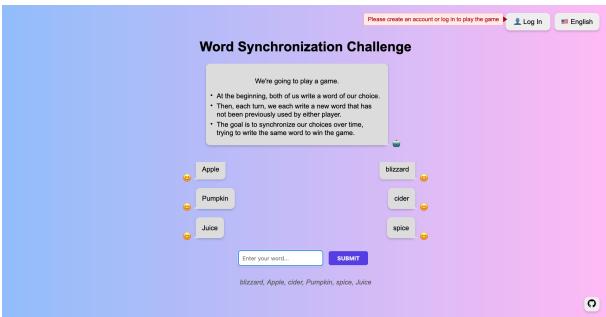
Figure 5 shows the interface used by participants. It is clean and simple, focusing entirely on the word association task.
Experiments & Results
After filtering out incomplete sessions, the researchers analyzed 89 Human-Human games and 139 Human-LLM games. They looked at three main areas: success rates, semantic strategies, and the players’ own perceptions.
1. Humans Sync Faster with Humans
The most immediate metric of alignment is how long it takes to win. If we “get” each other, we should converge quickly.
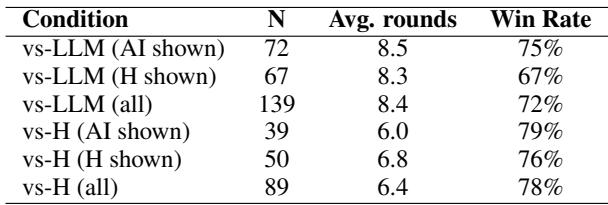
As seen in the table above (referred to as Table 1 in the study), there was a significant difference in convergence speed:
- Human-Human games: converged in roughly 6.4 rounds.
- Human-LLM games: converged in roughly 8.4 rounds.
This difference was statistically significant. Humans are simply better at synchronizing with other humans than with GPT-4o.
The Critical Finding: The “Label” didn’t matter. When researchers compared the “Human (AI shown)” condition against the “Human (Human shown)” condition, the number of rounds was statistically similar. The same applied to the LLM conditions.
This means participants did not play worse just because they thought they were playing a bot. The slowdown was caused by the actual behavior of the partner, not the human’s prejudice or expectations.
2. Semantic Strategy: Who Moves Toward Whom?
To understand why Human-LLM games were slower, the researchers analyzed the words using Conceptual Linking (CL) scores. Using ConceptNet (a knowledge graph), they calculated how semantically close a player’s new word was to the previous words.
They asked: “Is the player choosing a word close to their own previous word (sticking to their guns), or close to their partner’s previous word (accommodating)?”

Figure 2 reveals a fascinating behavioral shift. Look at the “Score to Partner Word” column:
- vs-Human: The score is roughly 0.17 - 0.18.
- vs-LLM: The score drops to 0.12 - 0.13.
This indicates that when playing against an LLM, humans made less effort to bridge the gap toward the partner’s word. They stayed semantically closer to their own previous ideas.
Why? The authors suggest that humans might subconsciously notice that the LLM is behaving differently—perhaps the LLM makes larger semantic jumps or tries very hard to converge—and in response, the human “holds their ground,” letting the AI do the work of coming to them.
Again, this happened regardless of whether they knew it was an AI. The adaptation was a reaction to the conversation dynamics, not the identity label.
3. Perception vs. Reality
After each game, participants were asked to guess what strategy their partner was using:
- Mirroring: Picking a word close to the partner’s word.
- Staying Close: Picking a word close to their own word.
- Averaging: Picking a word in the middle.

As shown in Figure 3, participants’ subjective reports were messy. There was no statistically significant difference in how they perceived the strategies across the four conditions.
This highlights a disconnect: Humans behaved differently (as shown by the CL scores and round counts), but they didn’t realize they were doing it. They couldn’t articulate a difference in strategy, even though their gameplay data proved there was one.
4. Visualizing the “Mind Meld”
To qualitatively illustrate what this adaptation looks like, the researchers plotted the semantic “trajectory” of a single game. They used word embeddings (mathematical representations of words) to map the game into 3D space.
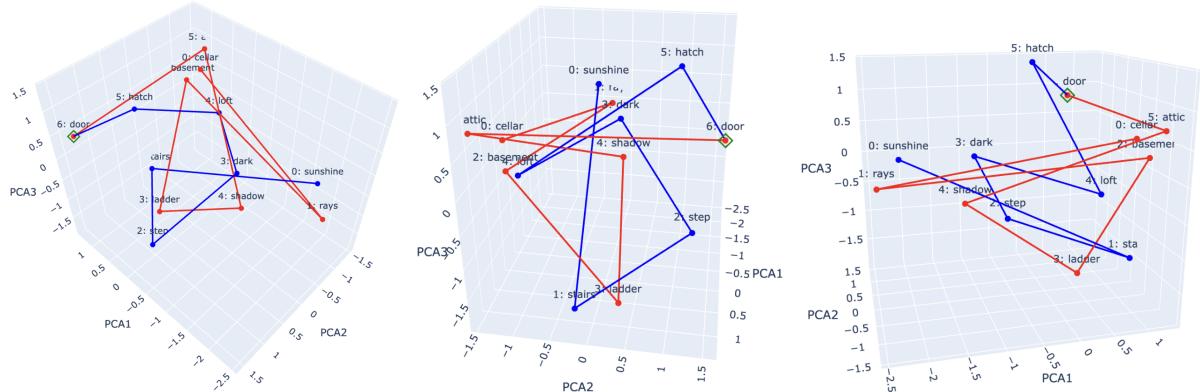
Figure 4 tells a story of convergence.
- Top Table: We see the game flow. The Player goes from “Sunshine” to “Stairs.” The LLM (Red) responds with “Cellar” and “Rays.”
- The Dance: As the game progresses, they move through concepts of light/darkness and eventually architecture (Attic, Loft, Hatch).
- Convergence: They finally meet at the word “Door.”
The 3D visualizations (bottom) show the blue path (Human) and red path (LLM) spiraling around each other, navigating semantic clusters until they intersect. This visualizes the “shared control” of the dialogue. The LLM is actively adapting to the human, and the human is adapting to the LLM, creating a unique co-evolved path.
Discussion: The Reciprocal Loop
The implications of this study extend far beyond a simple word game.
1. Behavior Over Belief
The most robust finding is that human adaptation is driven by interaction, not categorization. We don’t change our language just because we see a label that says “AI.” We change our language because the entity on the other side is using language in a statistically distinct way (different frequency profiles, different vocabulary distributions). We subconsciously detect these subtle anomalies and adjust our own output to match or compensate.
2. The “Homogenization” Risk
The authors raise an important ethical consideration: Homogenization.
In human-human interaction, alignment is good; it builds social bonds and efficiency. But if we increasingly interact with LLMs, and we subconsciously adapt to their style, do we risk losing the richness and diversity of human language?
LLMs are trained on massive averages of human text. They tend to speak in a “standardized” way. If humans begin to align with this standardized output, we might see a feedback loop where human language becomes less creative and more “machine-like” over time.
3. AI Literacy
This study underscores the need for AI literacy. We need to be aware that these systems are not passive tools; they are active communicative partners that exert a gravitational pull on our own cognition. Understanding that we subconsciously change our behavior when talking to machines is the first step in maintaining our own distinct human voice.
Conclusion
The paper “Human Alignment: How Much Do We Adapt to LLMs?” provides empirical evidence that the influence of AI is a two-way street. While we train models to align with us, we are simultaneously, and unconsciously, aligning with them.
Through the Word Synchronization Challenge, the researchers demonstrated that this adaptation is subtle, reciprocal, and driven by the mechanics of the conversation rather than our beliefs about the partner. As AI becomes an integral part of our daily social and professional lives, recognizing this “mirror effect” is crucial. We must ensure that as we build machines that can talk like humans, we don’t forget how to talk like ourselves.