](https://deep-paper.org/en/paper/file-2397/images/cover.png)
When we communicate, we rarely say exactly what we mean. We rely on the listener to fill in the gaps. If someone says, “The new rate is payable Feb. 15,” and follows it with, “A record date hasn’t been set,” a human immediately understands the connection. There is a conflict here: the payment date is set, but the necessary record date isn’t. We infer a relationship of Concession (e.g., “however”).
In Natural Language Processing (NLP), this ability to infer unwritten connections is called Implicit Discourse Relation Recognition (IDRR). It is notoriously difficult because the connective words (like “however,” “because,” or “therefore”) are missing.
A recent research paper, “Using Subtext to Enhance Generative IDRR,” proposes a fascinating solution: if the text doesn’t explicitly state the connection, why don’t we force a Large Language Model (LLM) to write out the “subtext”—the metaphorical or hidden meaning—and use that to solve the problem?
In this post, we will tear down this paper, exploring how the researchers constructed a Subtext-based Confidence-diagnosed Dual-channel Network (SCDN) to significantly improve how machines understand implicit relationships.
The Challenge: Implicit Discourse Relation Recognition
IDRR classifies the semantic relation between two arguments (Arg1 and Arg2) when the connective is absent.
Consider the example mentioned in the introduction:
- Arg1: “The new rate will be payable Feb. 15.”
- Arg2: “A record date hasn’t been set.”
- Target Relation: Concession (implies “but” or “however”).
Traditional models, such as those based on RoBERTa or older neural networks, try to map the semantic features of Arg1 and Arg2 directly to a label. However, these models often struggle because they are limited to the surface-level text. They miss the connotative “vibe” or the logical leap that a human makes effortlessly.
The researchers argue that the missing link is subtext. The subtext for the example above might be: “The rate should be recorded earlier, though it hasn’t been.” If a model could generate this subtext, recognizing the “Concession” relation becomes much easier because the subtext makes the conflict explicit.
The Solution: SCDN Architecture
The researchers introduce a framework called SCDN. The core philosophy is simple yet robust: use an LLM to generate subtext, but—and this is the crucial part—don’t trust it blindly. Subtexts can be hallucinated or irrelevant. Therefore, the system needs a mechanism to decide when to rely on the subtext and when to ignore it.
The architecture is composed of three distinct LLM-based components and a diagnosis module.
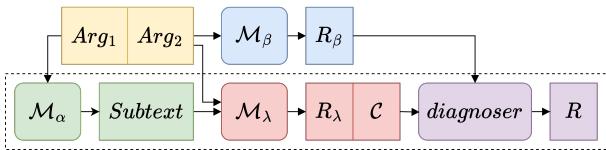
As shown in Figure 1, the pipeline operates as follows:
- \(\mathcal{M}_\alpha\) (The Subtext Generator): This model looks at the arguments and generates the hidden subtext (labeled Subtext in the diagram).
- \(\mathcal{M}_\beta\) (The Direct Reasoning Model): This model tries to predict the relation (\(R_\beta\)) based only on the original arguments. This represents the “standard” way of doing IDRR.
- \(\mathcal{M}_\lambda\) (The Subtext-Enhanced Model): This model takes the arguments plus the generated subtext to predict the relation (\(R_\lambda\)).
- The Diagnoser: This component acts as a gatekeeper. It looks at how confident \(\mathcal{M}_\beta\) is. If \(\mathcal{M}_\beta\) is highly confident, the system ignores the subtext path (which might introduce noise). If \(\mathcal{M}_\beta\) is unsure, the system falls back to the subtext-enhanced prediction \(R_\lambda\).
1. Generating the Subtext (\(\mathcal{M}_\alpha\))
The first challenge the authors faced was the lack of training data. Standard datasets like the Penn Discourse TreeBank (PDTB) provide arguments and relations, but they do not provide “ground truth” subtexts.
To solve this, they employed Knowledge Distillation.
- Teacher: They used GPT-3.5-turbo, a powerful model, to generate subtexts for the training data using a prompt asking “what is the implicit meaning?”.
- Student: They trained LLaMA3-8B-Instruct (\(\mathcal{M}_\alpha\)) to mimic GPT-3.5’s subtext generation.
This allows the system to run locally using the smaller, efficient LLaMA3 model while retaining some of the reasoning capabilities of GPT-3.5.
2. The Dual Channels (\(\mathcal{M}_\beta\) and \(\mathcal{M}_\lambda\))
The system utilizes two parallel reasoning channels, both powered by LLaMA3-8B-Instruct.
Channel 1: Out-of-Subtext (\(\mathcal{M}_\beta\)) This is the baseline channel. It formats the input as a Question Answering (QA) task:
“What is the relation between arguments: [Arg1] and [Arg2]?”
Channel 2: In-Subtext (\(\mathcal{M}_\lambda\)) This channel leverages the output from the generator. It formats the input as:
“What is the relation between arguments given subtext: [Arg1], [Arg2], and [Subtext]?”
The hypothesis is that \(\mathcal{M}_\lambda\) will perform better on difficult cases where the relation is subtle, provided the generated subtext is high quality.
3. The Confidence Diagnoser
This is the most technically interesting part of the paper. You might ask: Why not just always use the subtext?
The answer is hallucination. LLMs can generate plausible-sounding but factually incorrect or irrelevant subtexts. If the relation between two sentences is obvious, forcing the model to consider a potentially noisy subtext might actually confuse it.
To handle this, the authors implemented a Confidence Diagnoser. It evaluates the reliability of the direct model (\(\mathcal{M}_\beta\)). If the direct model is confident enough, its prediction is accepted. If not, the system defers to the subtext model (\(\mathcal{M}_\lambda\)).
How is confidence measured? The confidence score \(C\) is calculated as the average log probability of the tokens generated by the model for the relation label.
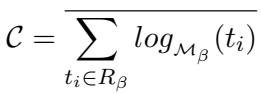
Here, \(t_i\) represents the tokens in the predicted relation label \(R_\beta\). The model calculates the non-normalized probability (logistic function) for each token.
The Thresholding Strategy The system compares this confidence score \(C\) against a pre-determined threshold \(\theta\).
- If \(C > \theta\): The standard model is trusted. Result = \(R_\beta\).
- If \(C \le \theta\): The standard model is uncertain. Result = \(R_\lambda\).
Crucially, the authors found that a single threshold doesn’t work for all relation types (Comparison, Contingency, Expansion, Temporal) because different words have different probability distributions. Therefore, they calculated a specific threshold \(\theta_T\) for each relation type.
To find the optimal threshold, they analyzed the accuracy on the training set across a range of potential threshold values.
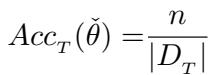
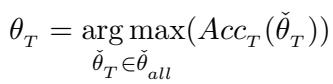
They plotted the accuracy curves to visualize where the “sweet spot” for confidence lay.
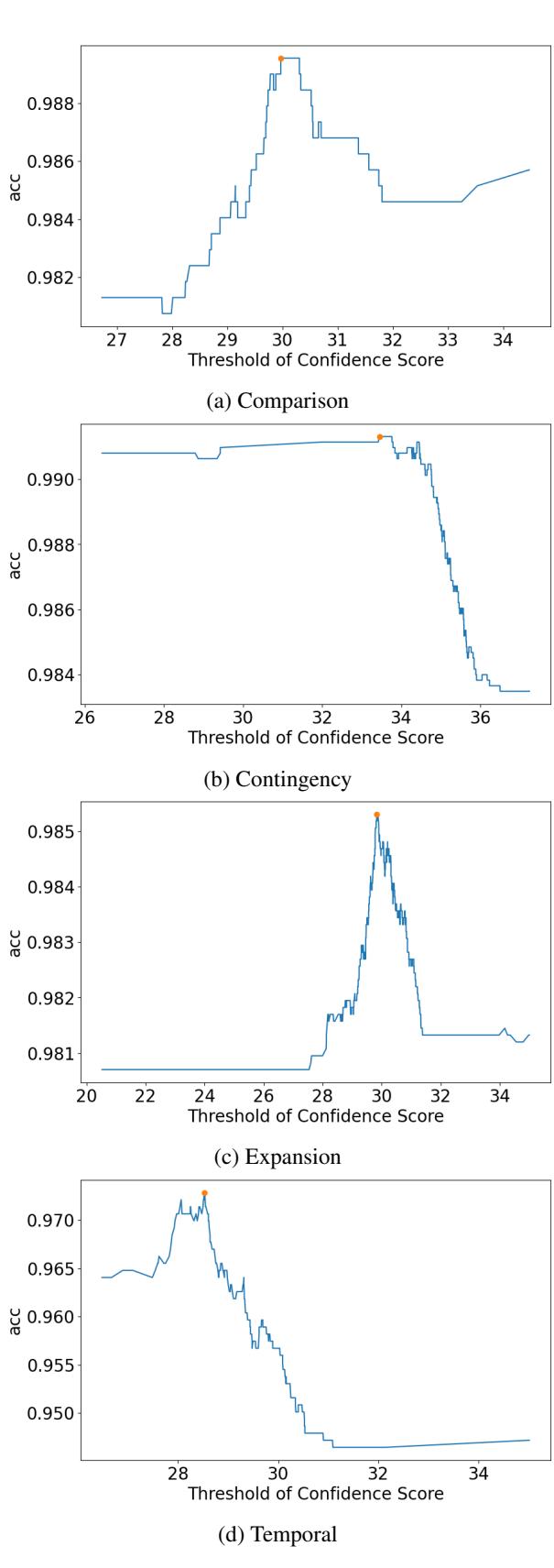
In Figure 2, the red dots indicate the optimal thresholds. You can see distinct behaviors for different relations. For example, “Contingency” (b) maintains high accuracy until the confidence threshold becomes very aggressive, whereas “Temporal” (d) relations show a sharper drop-off, indicating that high confidence is harder to achieve or correlates differently with accuracy for that class.
Experimental Results
The researchers tested SCDN on the two standard benchmarks for this task: PDTB-2.0 and PDTB-3.0. They compared their method against various baselines, including:
- Decoder-only models: ChatGPT, PIDRA.
- Encoder-only models: RoBERTa-based methods (FCL, CP-KD).
- T5-based models: DiscoPrompt, IICOT.
Main Performance
SCDN achieved higher F1-scores than previous decoder-only models and T5-based models. While it didn’t strictly outperform the very best encoder-only (RoBERTa) models—likely due to the inherent hallucination risks of generative LLMs—it significantly closed the gap and set a new standard for generative approaches in IDRR.
Ablation Study: Does Subtext Work?
The most critical question is whether the subtext mechanism actually drives the performance or if LLaMA3 is just a good model. The ablation study in Table 2 breaks this down clearly.
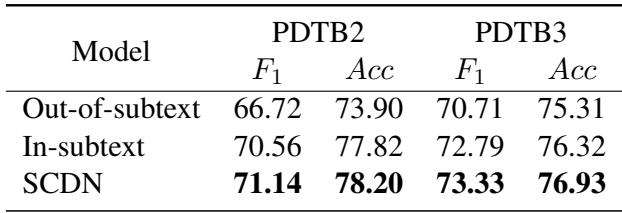
- Out-of-subtext: This is the LLaMA3 model acting alone. It scores 70.71 on PDTB 3.0.
- In-subtext: This model always uses subtext. It scores 72.79. This proves that having subtext is generally better than not having it.
- SCDN: This is the combined model using the diagnoser. It scores 73.33.
This result confirms the hypothesis: Subtext helps, but selective use of subtext via the diagnoser helps even more.
The Impact of Subtext Generators
The quality of the subtext matters. The researchers compared using GPT-3.5 directly versus using LLaMA3 with and without distillation.
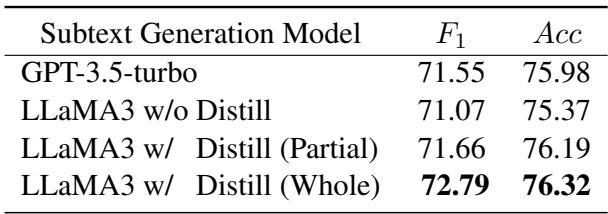
Table 3 reveals an interesting finding.
- GPT-3.5-turbo (the teacher) achieves a score of 71.55 when generating subtexts.
- LLaMA3 without distillation scores lower (71.07), suggesting it’s not naturally as good at finding implicit meanings.
- LLaMA3 with Whole Distillation scores 72.79, actually outperforming its teacher (GPT-3.5).
This “student surpassing the teacher” effect likely happens because LLaMA3 is optimized specifically for the distribution of the training data during the distillation process, making its generated subtexts more consistent for the downstream classifier.
Prompt Engineering Matters
How do you ask an LLM for subtext? It turns out the prompt wording is vital. The authors tested three variations:
- P1: Simple Question + Answer.
- P2: Using synonyms (replacing “subtext” with “implicit meaning”).
- P3: A complex chain-of-thought prompt asking “whether there is a subtext” first.
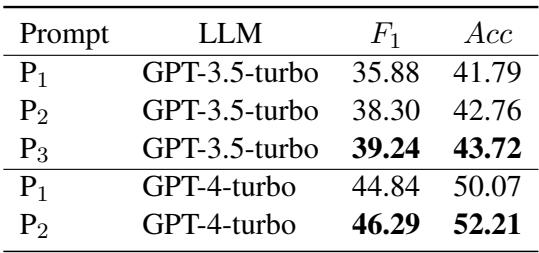
Surprisingly, the more complex prompt (P3) actually hurt performance (Table 4 only shows P1 and P2, but the paper text details the failure of P3). The researchers found that P3 caused the model to be too conservative, often generating no subtext at all. P2 (using synonyms) yielded the best results, proving that for this specific task, direct but semantically clear prompting works best.
Conclusion and Implications
This paper makes a compelling case for SCDN, a method that mimics human intuition by making implicit information explicit. By generating subtext, the model bridges the gap between disconnected arguments. However, by using a confidence diagnoser, it acknowledges that AI intuition (hallucination) is not always reliable.
Key Takeaways:
- Subtext is Evidence: Hidden meanings can be generated and used as concrete evidence for classification.
- Dual-Channel Processing: It is often better to have two “experts”—one literal and one interpretive—and a manager (diagnoser) to decide who to listen to.
- Distillation Efficacy: A smaller model (LLaMA3) can learn to generate high-quality subtext from a larger model (GPT-3.5) and eventually outperform the teacher in the specific downstream task.
The authors note that future work will look at default subtexts—meanings derived from common sense rather than just the text provided. This would move IDRR from binary argument analysis to a triplet structure (Arg1, Arg2, Common Sense), potentially unlocking even deeper levels of text understanding.