](https://deep-paper.org/en/paper/file-2675/images/cover.png)
Introduction
In the evolving landscape of Artificial Intelligence, we often find ourselves managing two distinct types of “brains.” on one side, we have Knowledge Graphs (KGs). These are structured, logical databases that map the world into entities (nodes) and relations (edges). They are precise and factual but often brittle; if a connection is missing, the system fails to see the relationship. On the other side, we have Large Language Models (LLMs) like GPT-4 or Llama 3. These possess vast, general-world knowledge and can generate human-like text, but they can be prone to “hallucinations” and are computationally expensive to update or fine-tune.
For years, researchers have tried to merge these two worlds. Specifically, in the field of Knowledge Graph Reasoning (KGR), the goal is to predict missing links in a graph. For example, if we know Steve Jobs founded Apple and Apple makes the iPhone, a KGR model should infer that Steve Jobs is associated with the iPhone.
However, conventional KGR models struggle when the graph is sparse or incomplete. Recently, the trend has been to “fine-tune” LLMs to understand graph structures, essentially forcing the LLM to become a graph reasoner. But this comes with significant drawbacks: it requires massive computational resources, and it is impossible for closed-source models (like ChatGPT) where we don’t have access to the weights.
Today, we are diving deep into a new research paper that proposes a clever workaround. The researchers have developed a three-stage pipeline that leverages the power of LLMs to enhance Knowledge Graph Reasoning without a single step of fine-tuning. By treating the LLM as a knowledge consultant rather than a trainable network, they achieve state-of-the-art results on incomplete datasets.
Background: The Problem of Incompleteness
Before we dissect the new method, let’s establish the context. A Knowledge Graph stores facts as triples: (Head Entity, Relation, Tail Entity). For instance: (Paris, is_capital_of, France).
Traditional KGR models fall into two broad categories:
- Embedding-based models (e.g., RotatE): These map entities and relations into a vector space. They use mathematical operations (like rotation in complex space) to calculate the likelihood of a connection.
- Path-based models (e.g., MultiHopKG): These use reinforcement learning to “walk” across the graph, hopping from node to node to find a target.
The Achilles’ heel for both types is incompleteness. If the KG is missing too many edges (which is almost always the case in real-world data), embedding models can’t learn accurate representations, and path-based models hit dead ends.
LLMs theoretically have the knowledge to fill these gaps. If you ask ChatGPT, “What is the relationship between Paris and France?”, it knows the answer immediately. The challenge is integrating this textual knowledge into the structured mathematical framework of KGR models without the expensive process of fine-tuning the LLM.
The Core Method: A Three-Stage Pipeline
The researchers propose a pipeline that acts as a bridge between the textual world of LLMs and the structural world of KGs. The process is divided into three distinct stages: Knowledge Alignment, KG Reasoning, and Entity Reranking.
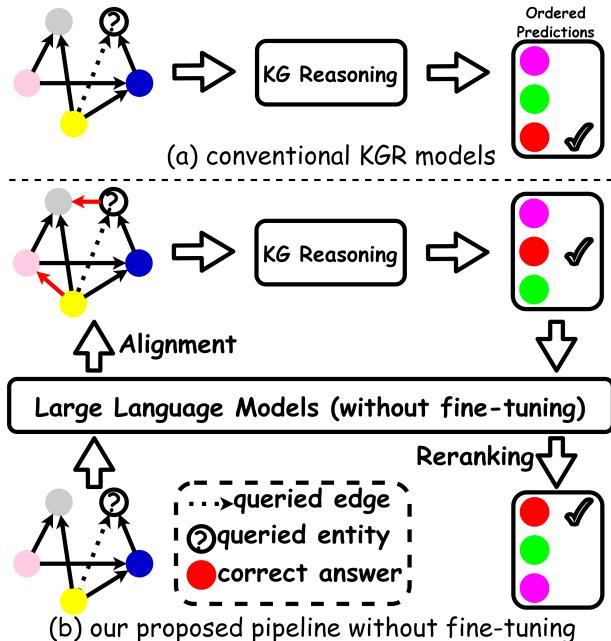
As shown in Figure 1, the pipeline transforms a sparse graph into an enriched one before performing reasoning, and then refines the results. Let’s break down each stage.
Stage 1: Knowledge Alignment
The first and most critical stage is Knowledge Alignment. The goal here is to use an LLM to “fill in the blanks” of the incomplete KG. The researchers take pairs of entities that are currently unconnected in the graph and ask the LLM: “Is there a relationship here?”
However, LLMs speak natural language, while KGs speak in specific schemas (predefined relations). To bridge this gap, the paper introduces three different strategies to extract knowledge from the LLM.
1. Closed Domain Strategy
In this strategy, the LLM is restricted to the specific relations that already exist in the Knowledge Graph. It acts like a student taking a multiple-choice test.
The prompt provided to the LLM lists the available relations (the schema) and asks the model to select the best fit for a pair of entities. This is highly effective for KGs with concrete, well-defined relations, such as facts about countries or films.
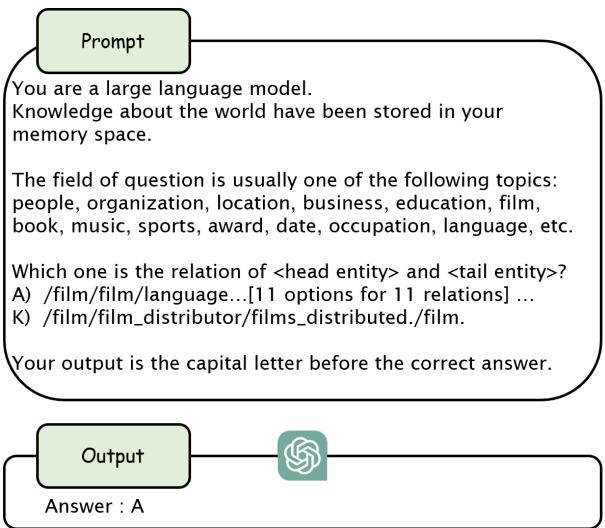
As seen in Figure 7 (applied to the FB15K-237 dataset), the LLM is given the context and a list of options (A through K) and must output the corresponding letter. This ensures that the new edges added to the graph perfectly match the existing structure.
2. Open Domain Strategy
Sometimes, the relationship between two entities is too nuanced to fit into a predefined box. In the Open Domain strategy, the researchers remove the constraints. They ask the LLM to describe the relationship in natural language.
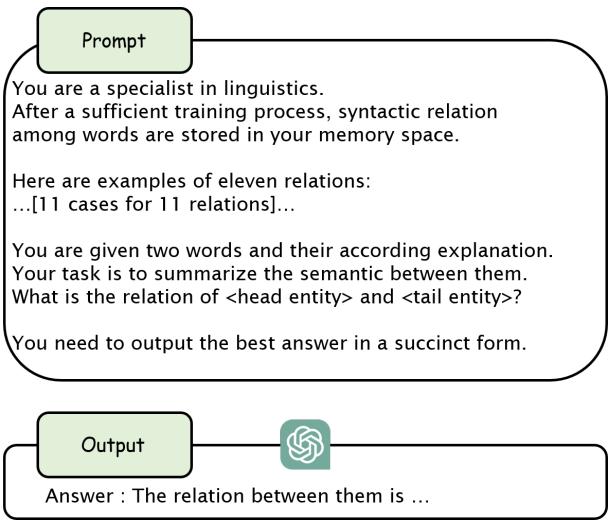
In Figure 6 (applied to the WN18RR dataset), the prompt simply asks, “What is the relation…?” The LLM generates a short sentence or phrase.
How is this used in the graph? Since “natural language” isn’t a graph relation, the researchers use a technique called Word2Vec to convert the LLM’s textual answer into a vector embedding. When the KGR model is trained later, it uses this vector as the representation of the relationship edge. This allows the graph to contain rich, fine-grained semantic information that wasn’t possible with just the predefined schema.
3. Semi-Closed Domain Strategy
This strategy attempts to get the best of both worlds. The LLM is queried in an Open Domain format (generating free text), but then a secondary step maps that text back to the nearest predefined relation in the KG schema.
They use Sentence-BERT to calculate the semantic similarity between the LLM’s output and the list of valid KG relations. The relation with the highest similarity score is chosen. This maintains the structural integrity of the graph (like the Closed Domain) but allows for interpretable analysis of why a relation was chosen.
Stage 2: KG Reasoning
Once the Knowledge Alignment phase is complete, we no longer have a sparse, hole-filled graph. We have an enriched KG containing both the original facts and the new facts (or semantic vectors) generated by the LLM.
Now, the pipeline brings in standard, structure-aware KGR models. In this paper, they utilized:
- RotatE: To learn embeddings based on the enriched structure.
- MultiHopKG: To learn reasoning paths over the enriched connections.
Because the graph is now denser and contains “common sense” knowledge provided by the LLM, these traditional models can learn much better representations of the entities. They are no longer guessing in the dark; they are reasoning over a map that has been updated by an expert.
Stage 3: Entity Reranking
After the KGR model runs, it outputs a list of potential answers for a query, ranked by probability. For example, for the query (Steve Jobs, founded, ?), the KGR model might output:
- Microsoft (Score: 0.9)
- Apple (Score: 0.8)
- NeXT (Score: 0.7)
Structural models sometimes get confused by similar graph patterns (Steve Jobs and Bill Gates look structurally similar in a graph). This is where the LLM comes back in for a final quality check.
The pipeline takes the top-K candidates (e.g., top 10 or 20) proposed by the KGR model and feeds them back into the LLM.
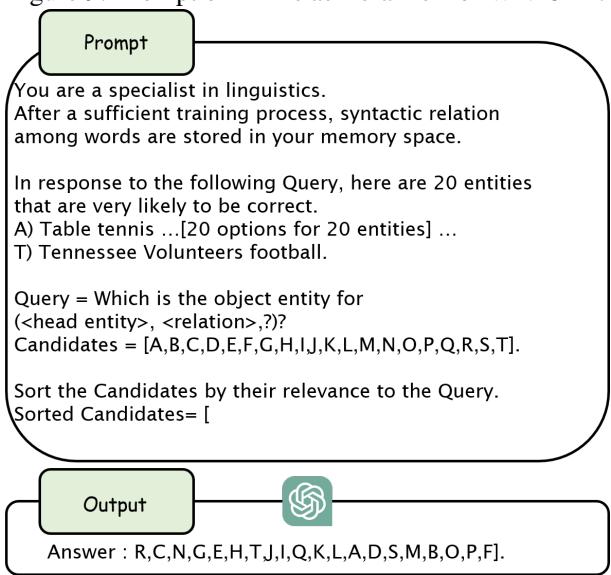
As illustrated in Figure 9, the prompt acts as a “linguistic specialist” or a logic checker. It asks the LLM to re-sort the candidate list based on its internal world knowledge. The LLM might recognize that while Microsoft is structurally probable, “Apple” is the factually correct answer for “founded.” This reranking step significantly boosts the precision of the final predictions (Hits@1).
Experiments and Results
To validate this pipeline, the researchers tested it on two standard datasets:
- WN18RR: Based on WordNet, focused on linguistic relations (e.g., hypernyms, synonyms).
- FB15K-237: Based on Freebase, focused on real-world facts (e.g., movies, sports, geography).
Crucially, they created sparse versions of these datasets (retaining only 10%, 40%, or 70% of the data) to simulate the “incomplete KG” problem.
Performance Analysis
The results demonstrated that the pipeline consistently outperformed baselines, including using LLMs in a zero-shot capacity and standard KGR models on their own.
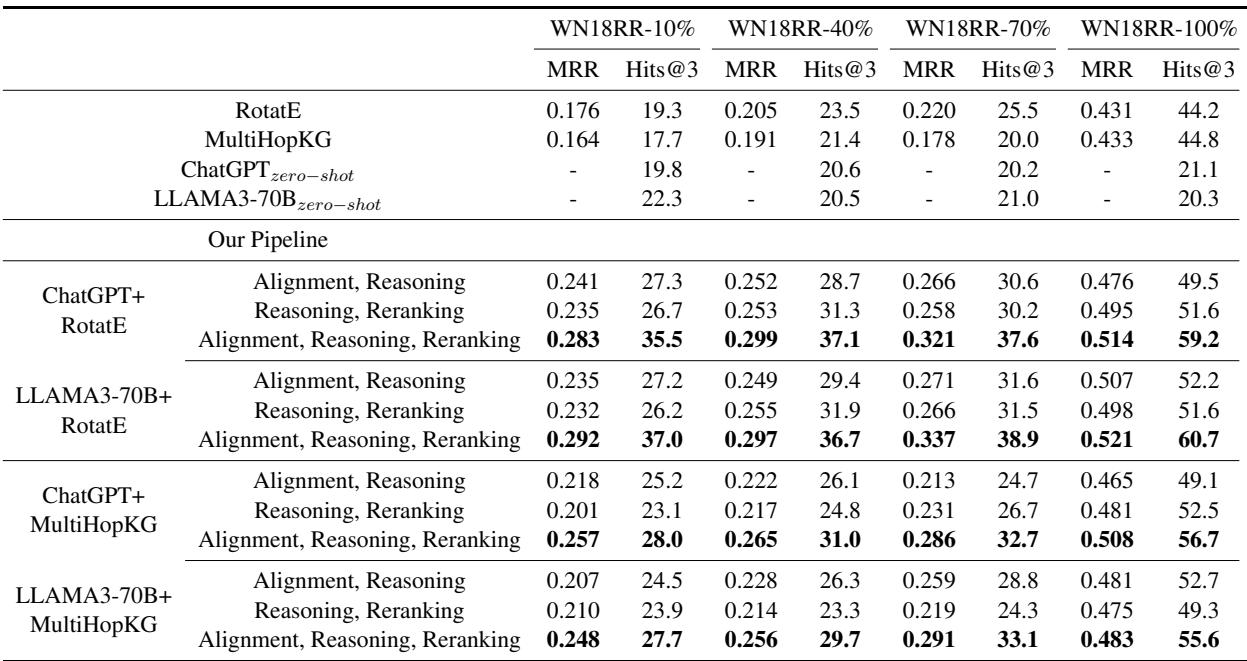
In Table 2 (results for WN18RR), we can see the progression of improvement.
- RotatE (Baseline): Struggles at low sparsity (10%).
- Alignment + Reasoning: Significant jump in MRR (Mean Reciprocal Rank).
- Alignment + Reasoning + Reranking: The full pipeline achieves the best performance across the board.
The data confirms that both the input (Alignment) and output (Reranking) interventions by the LLM are valuable.
Accuracy of Alignment
One might wonder: “What if the LLM adds wrong edges?” The researchers analyzed the accuracy of the edges generated by the LLM during the alignment phase.
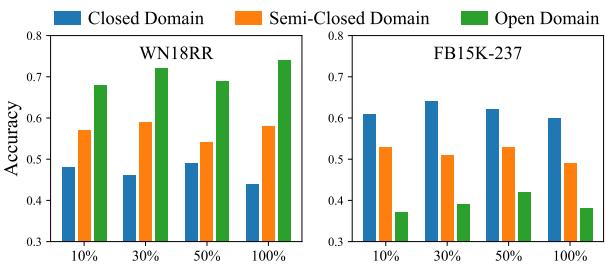
Figure 2 reveals an interesting dichotomy:
- Left (WN18RR): The Open Domain strategy (green bars) generally performed best. Since WordNet relations are abstract (linguistic concepts), the flexibility of free text allowed the LLM to capture nuances better than rigid categories.
- Right (FB15K-237): The Closed Domain strategy (blue bars) was superior. Freebase relations are concrete facts (e.g., specific film genres). The LLM performed better when forced to pick from the specific list of options.
Stability of Knowledge
A major concern when injecting external knowledge into a graph is “Knowledge Stability” (KS). Does adding new edges confuse the model regarding facts it already knew?
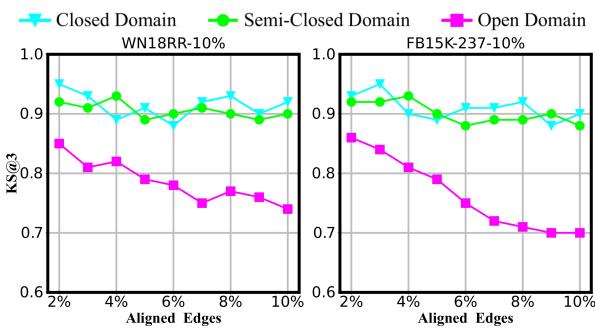
The researchers defined Stability (KS@k) as the ratio of entities correctly predicted after alignment compared to before.
Figure 3 shows the stability trends. The Closed and Semi-Closed strategies (which adhere to the schema) remained highly stable (near 1.0), meaning they didn’t break existing knowledge. The Open Domain strategy showed a slight decline in stability as more edges were added. This makes sense: Open Domain introduces new vocabulary and semantics, which effectively dilutes the original graph structure, requiring the model to adapt more drastically.
Visualizing the Semantics
Finally, to prove that the Open Domain strategy was actually learning meaningful concepts, the researchers visualized the embeddings trained by the RotatE model.
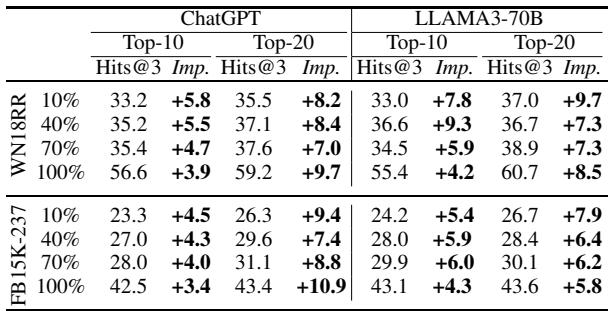
Figure 4 illustrates the embedding space. The red stars represent the predefined relations in the original KG. The blue dots are the keywords generated by the LLM in the Open Domain strategy.
You can see that the LLM-generated terms cluster tightly around the relevant predefined relations. For example, terms like “derived from,” “cause,” and “form” cluster near the relation for derivation. This proves that even without being told the schema, the LLM generated semantic concepts that mathematically aligned with the graph’s ground truth.
Conclusion and Implications
This research presents a compelling step forward for Knowledge Graph Reasoning. By accepting that fine-tuning massive LLMs is often impractical, the authors designed a modular pipeline that treats the LLM as a “plug-and-play” knowledge enhancer.
Key Takeaways:
- No Fine-Tuning: The approach works with closed-source models like ChatGPT via simple API calls.
- Versatility: The three alignment strategies (Closed, Open, Semi-Closed) allow the pipeline to adapt to different types of data—concrete facts favor Closed Domain, while abstract concepts favor Open Domain.
- Holistic Improvement: Improving the graph before training (Alignment) and filtering the results after training (Reranking) yields the best performance.
For students and practitioners, this highlights an important trend in AI: we don’t always need to retrain giant models to solve specific problems. sometimes, the clever engineering of how we interact with these models—guiding their inputs and curating their outputs—can yield state-of-the-art results with a fraction of the computational cost. This “hybrid” approach of combining structured logic (KGs) with probabilistic knowledge (LLMs) is likely the future of robust AI reasoning.