](https://deep-paper.org/en/paper/file-2682/images/cover.png)
In the current era of Natural Language Processing (NLP), Large Language Models (LLMs) often feel like magic. You feed in a sentence, and out comes a translation, a summary, or a poem. However, despite their prowess, these neural models remain “black boxes.” They rely on statistical probabilities rather than explicit understanding, which can lead to hallucinations, logical inconsistencies, or a lack of interpretability.
This brings us to a pivotal question: How do we inject structure, logic, and explicit meaning into these systems?
The answer may lie in Abstract Meaning Representation (AMR). While AMR has been around for over a decade, its utility has shifted from a theoretical linguistic exercise to a robust engineering tool. In a comprehensive study titled “A Survey of AMR Applications,” researchers Shira Wein and Juri Opitz categorize over 100 papers to uncover how this symbolic representation is being used to ground neural networks, improve data scarcity issues, and solve complex downstream tasks.
This article breaks down their findings, explaining what AMR is, how it is being integrated into modern engineering pipelines, and why it might be the missing link between symbolic logic and neural generation.
What is Abstract Meaning Representation (AMR)?
To understand why AMR is useful, we first need to understand what it actually does. At its core, AMR is a semantic representation that captures the meaning of a sentence as a rooted, directed graph.
Language is often messy. We have synonyms, different syntactic structures, and morphology (tense, pluralization) that can obscure the core meaning. AMR abstracts away from these surface-level variations to focus on the “who does what to whom” of a sentence.
Consider the sentence: “After 3 days and much deliberation, the jury rendered a guilty verdict.”
A standard text processor sees a sequence of tokens. An AMR parser, however, sees a structure of concepts and relations.
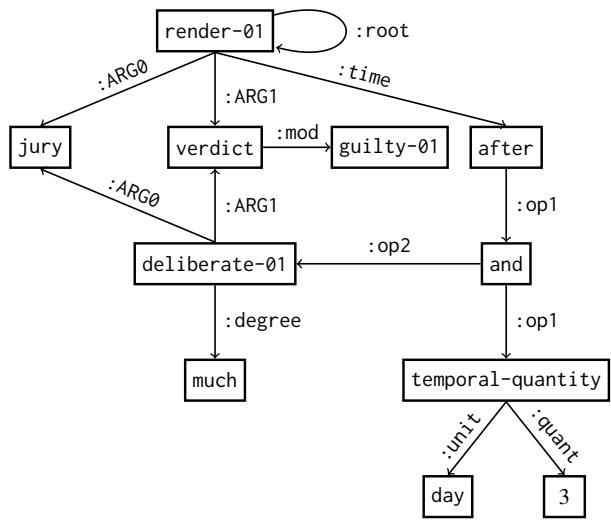
As shown in Figure 1 above, the AMR schema centers on predicate-argument relations:
- The Graph Structure (Top): The root of the graph is
render-01. This is the main event. From this root, edges branch out to define the participants. The:ARG0is the agent (the jury, labeledj), and the:ARG1is the patient (the verdict, labeledv). - Abstraction: Notice that “guilty” is not just an adjective attached to “verdict”; it is represented as a concept
guilty-01modifying the verdict. Similarly, time is handled logically with:timeand:opoperators. - PENMAN Notation (Bottom): To make these graphs machine-readable, they are often serialized into a text-based format called PENMAN notation. This allows the graph to be processed as a string while retaining its hierarchical structure.
The beauty of this system is that two sentences with different wording but identical meaning (e.g., “The jury rendered a guilty verdict” vs. “A guilty verdict was rendered by the jury”) would ideally map to the exact same AMR graph. This property makes AMR a powerful tool for normalization in NLP tasks.
The Explosion of AMR Applications
For years, the use of AMR was limited by the difficulty of producing it. However, recent advancements in text-to-AMR parsing (converting sentences to graphs) and AMR-to-text generation (converting graphs back to sentences) have fueled a surge in downstream applications.
The researchers analyzed publication trends over the last decade, revealing a significant shift in the field.
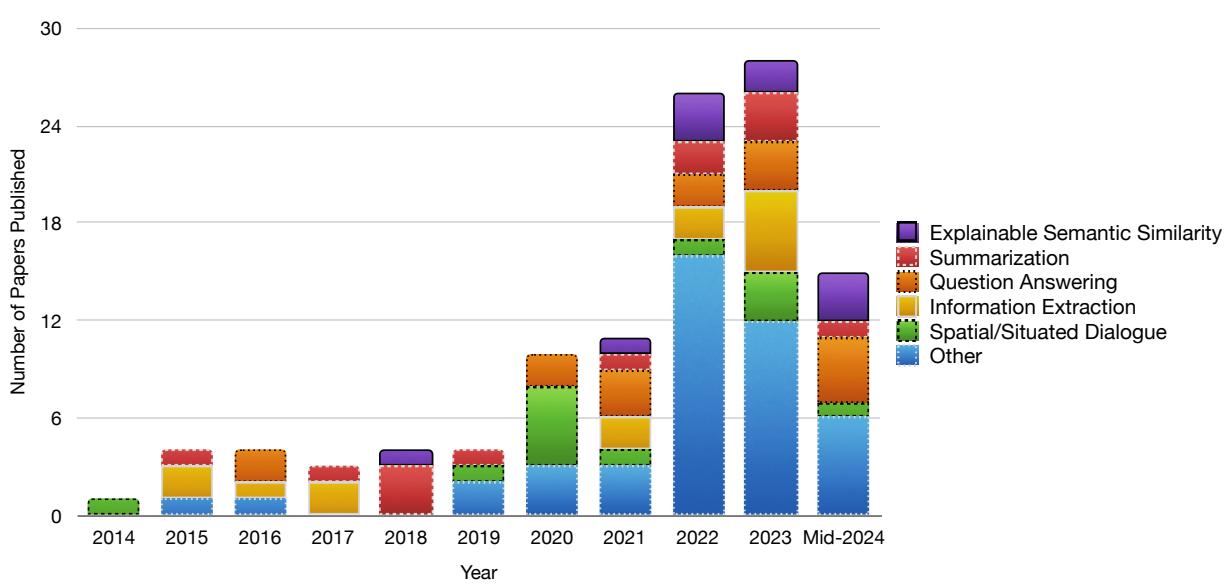
As Figure 2 illustrates, interest in AMR applications remained relatively niche until roughly 2019. Since 2020, there has been a dramatic upward trend, culminating in a peak in 2023. This correlation aligns with the rise of Transformer-based models, suggesting that as neural models became more powerful, the desire to combine them with structured representations grew.
The survey categorizes these applications into several key domains:
1. Meaning-Focused Tasks
The most intuitive use of AMR is in tasks that require a deep understanding of entities and events, such as Information Extraction (IE) and Question Answering (QA).
- Biomedical Domain: In complex medical texts, understanding interaction is critical. Researchers have used AMR to identify subgraphs representing biomolecular events, significantly outperforming models that rely solely on text.
- Event Extraction: By using the
:ARGstructures in AMR, systems can better predict the compatibility between an event (e.g., a “sale”) and its arguments (e.g., “buyer,” “price”). - Question Answering: AMR helps in multi-hop reasoning. If a question requires combining facts from two different sentences, merging their AMR graphs can reveal the path to the answer.
2. Summarization
Summarization models often struggle with redundancy or missing key information. AMR offers a structural solution:
- Graph Merging: Instead of summarizing text directly, some systems parse the source text into AMR graphs, merge the most important subgraphs into a single “summary graph,” and then generate the final text from that graph.
- Factuality: AMR is used to verify that a summary contains the same semantic relations as the source document, acting as a “fact-checker” to prevent the model from inventing information.
3. Abstracting Away Surface Forms
Because AMR ignores the “style” of a sentence (active/passive voice, specific word choice), it acts as a neutral intermediate representation. This is incredibly useful for Style Transfer and Paraphrase Generation.
- The Process: Text \(\rightarrow\) AMR \(\rightarrow\) New Text.
- Application: To change the style of a sentence, a model can parse it into AMR (stripping the original style) and then use a generator trained on a different style (e.g., Shakespearean or formal) to produce the output. Since the core meaning is locked in the graph, the semantic content remains preserved while the surface form changes.
4. Human-Robot Interaction
Robots do not understand ambiguity; they need precise instructions.
- Spatial/Situated Dialogue: AMR has been adapted into “Dialogue-AMR” to handle human-robot communication. The clear graph structure helps map natural language commands to specific executable actions, bridging the gap between vague human speech and rigorous robotic logic.
Core Method: Engineering with AMR
The survey’s most significant contribution is the categorization of how engineers actually implement AMR into their systems. It is not enough to simply have a graph; one must know how to feed it into a neural network.
The authors identify two primary processing paradigms:
Paradigm 1: Neuro-Symbolic Fusion
In this approach, the goal is to enhance a text-based model by “fusing” it with AMR data. The model receives two streams of information: the raw text and the linearized AMR graph.
- Joint Encoders: The text and the AMR string are concatenated and fed into a Transformer.
- Dual Encoders: Two separate encoders process the text and the graph independently. Their representations are then merged at a later layer (e.g., using an attention mechanism) to inform the final decision. This method is popular for tasks like Machine Translation and Information Extraction, where the graph provides an additional “signal” or constraint that guides the neural network toward the correct answer.
Paradigm 2: AMR as an Intermediate Representation
This approach uses AMR as a distinct step in a pipeline, separating the “understanding” phase from the “generation” phase.
- Parse: Convert input text into an AMR graph.
- Manipulate: Perform operations on the graph. This could involve pruning nodes (for summarization), swapping concepts (for data augmentation), or checking logic.
- Generate: Use an AMR-to-text model to produce the final output.
This paradigm offers linguistic control. If you want to generate a paraphrase, you can slightly alter the graph structure (e.g., changing the root node) and regenerate the text. This guarantees that the output remains semantically valid, something that is hard to control in pure text-to-text models.
Preparation Techniques
Before AMR can be used in either paradigm, it often undergoes engineering transformations:
- Splitting/Merging: For document-level tasks, individual sentence graphs are often merged into a massive document graph. Conversely, for QA, a graph might be split to isolate specific clauses.
- Reification: This transforms edge labels into nodes. For example, instead of a labeled edge representing a complex relationship, the relationship becomes a node itself. This standardizes the graph structure, making it easier for neural networks to process.
Trends and Implications
The survey highlights several crucial trends that define the current state of AMR research.
Performance in Low-Resource Settings: One of the most robust findings across multiple papers is that AMR is particularly beneficial when data is scarce. Large neural networks require massive amounts of text to learn patterns. However, because AMR explicitly structures the relationships between concepts, it provides a “dense” learning signal. Models augmented with AMR often outperform text-only baselines in few-shot or low-resource scenarios.
Interpretability and Evaluation: As NLP models become more complex, evaluating them becomes harder. Traditional metrics (like BLEU scores) only look at word overlap. AMR-based metrics (like Smatch) allow researchers to evaluate the semantic accuracy of a model. Did the model get the “who” and the “what” right, even if it used different words? This capability is becoming essential for measuring the faithfulness of summaries and translations.
The Neuro-Symbolic Future: The paper positions AMR as a key component of Neuro-Symbolic AI—systems that combine the learning capabilities of neural networks with the logical reasoning of symbolic AI. While LLMs are powerful generalized learners, they lack a formal “world model.” AMR provides a structured scaffolding that helps ground these models in reality, reducing hallucinations and improving consistency.
Conclusion
The work of Wein and Opitz demonstrates that Abstract Meaning Representation has graduated from a linguistic curiosity to a vital engineering asset. By providing a structured, logic-driven view of language, AMR complements the statistical power of modern LLMs.
Whether it serves as a sanity check for summarization, a translation layer for robotics, or a mechanism for controllable text generation, AMR offers a way to look inside the black box. As the field moves forward, the combination of deep learning with structured representations like AMR appears to be the most promising path toward AI that is not just fluent, but also factually and semantically grounded.