](https://deep-paper.org/en/paper/file-2702/images/cover.png)
Introduction
Imagine you are trying to text a friend in Chinese. You want to say, “I slept so deeply,” but you accidentally type a character that sounds similar but means something completely different. In Chinese, where thousands of characters share similar pronunciations (homophones) or visual structures, this is a constant struggle. This is the domain of Chinese Spelling Check (CSC).
For years, the standard approach to solving this problem involved “traditional” deep learning models like BERT. These models are excellent at following rules—specifically, they know that if you input a 10-character sentence, you expect a 10-character correction back. They treat the task as a sequence labeling problem: look at character \(A\), decide if it’s wrong, and if so, replace it with character \(B\).
Then came the era of Large Language Models (LLMs) like GPT-4. These models possess incredible world knowledge and semantic understanding. Ideally, they should be perfect for spelling checks. However, applying them to CSC has proven to be a “double-edged sword.” LLMs are creative and chatty; they often rewrite entire sentences, change lengths, or “fix” words that were actually correct just because they are rare.
In this post, we will dive deep into a paper that proposes a clever solution to this dilemma: the Alignment-and-Replacement Module (ARM). This research introduces a plug-and-play module that allows us to harness the semantic power of LLMs while enforcing the strict constraints required for accurate spelling correction, all without the need to retrain the underlying models.
The Problem: Why LLMs Struggle with Spelling Checks
To understand why we need a specialized module like ARM, we first need to look at why raw LLMs aren’t quite enough for the job.
Chinese Spelling Check has a strict requirement: alignment. Unlike grammatical error correction in English, where you might add or remove words to fix a sentence, CSC typically requires that the corrected sentence maintains the exact same length as the original. Corrections are made strictly via substitution.
LLMs are autoregressive generative models. They generate text token by token and don’t inherently respect fixed-length constraints. When asked to correct a sentence, an LLM might:
- Alter Sentence Length: It might replace a two-character word with a three-character synonym.
- Output Invalid Formats: It might include conversational filler like “Here is the corrected sentence: …”
- Over-Correction: It might see a rare but correctly used idiom and “dumb it down” to a more common phrase.
The authors of the paper illustrate these specific shortcomings in the figure below:
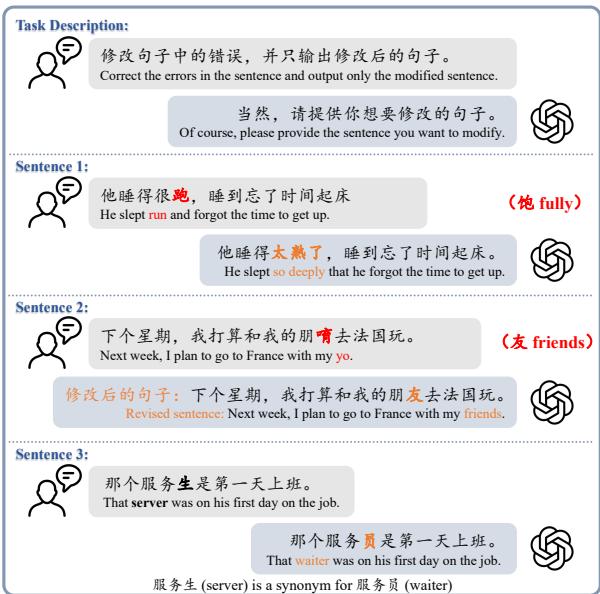
As shown in Figure 1:
- Sentence 1: The LLM changes the meaning and length significantly (replacing “run” with “so deeply” but using different phrasing).
- Sentence 2: The LLM fixes the error but adds conversational prefix text (“Revised sentence is…”).
- Sentence 3: The LLM replaces “server” (服务生) with “waiter” (服务员). Both are correct, but the LLM unnecessarily changed a valid word, which counts as a false positive in strict evaluation metrics.
The Solution: The ARM Architecture
To bridge the gap between rigid traditional models and fluid LLMs, the researchers proposed ARM.
ARM is designed to be model-agnostic. It works alongside any existing CSC model (like SoftMask-BERT or SCOPE). The core idea is simple but powerful: use the LLM to generate a candidate correction, force that candidate to align with the original sentence length, and then selectively swap characters only when the traditional model is unsure.
The architecture is composed of two main engines:
- ERS (Error Recovery System): An alignment method that tames the LLM’s output.
- SCP (Semantic Correction Pipeline): A replacement strategy that decides which characters to keep.
Let’s look at the high-level architecture:
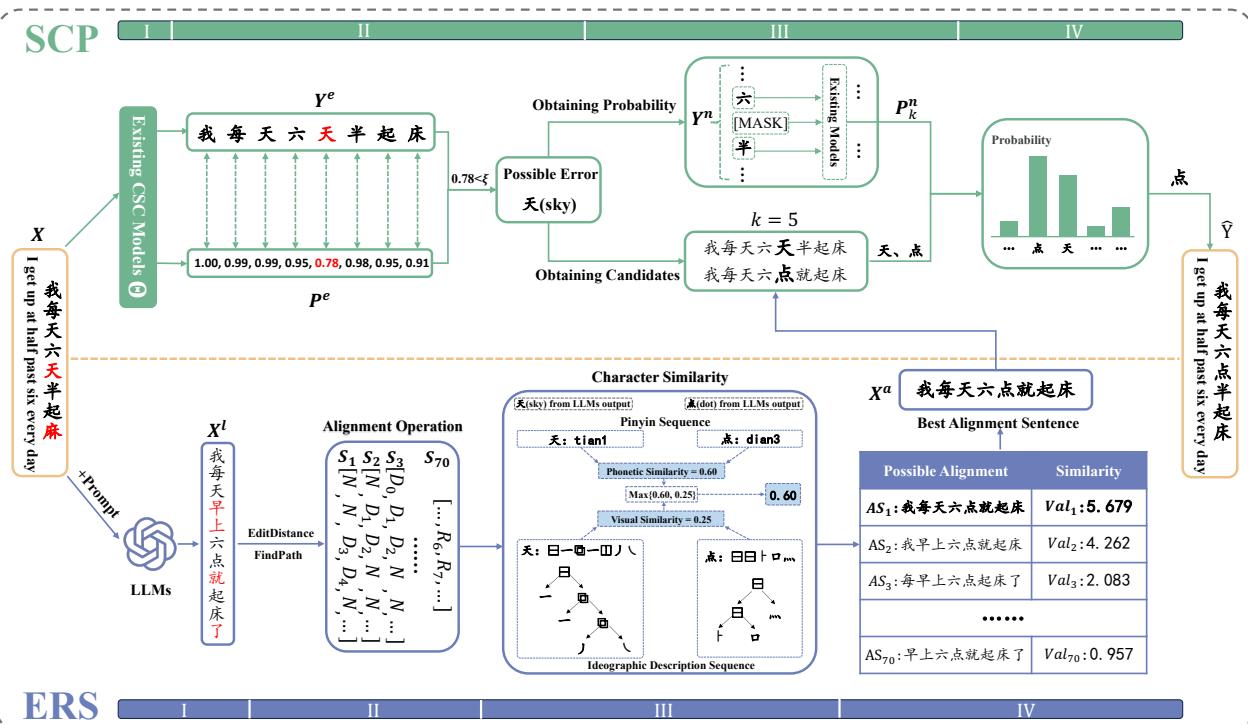
In Figure 2, you can see the flow. The bottom half represents the Alignment (ERS) process, transforming a messy LLM response into a neat, aligned sentence (\(X^a\)). The top half represents the Replacement (SCP) process, where the aligned sentence helps the traditional model (\(Y^e\)) fix errors it missed (like the character “天” being corrected to “点”).
Core Method: How It Works
This is the heart of the paper. Let’s break down the mathematics and algorithms that make this “plug-and-play” module work.
Part 1: ERS - The Alignment Method
The first challenge is dealing with the LLM’s output, which might be a different length than the input. We need to map the LLM’s suggestion back to the original sentence structure.
Step 1: Get the LLM Response
First, the input sentence \(X\) is fed into the LLM with a specific prompt to get a response \(X^l\).

Step 2: Find Alignment Operations (Edit Distance)
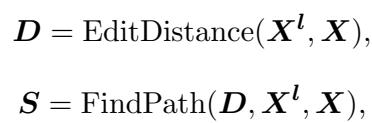
Since \(X^l\) (LLM output) and \(X\) (Original input) might differ in length, the system calculates the Edit Distance. This is a classic dynamic programming algorithm that counts the minimum number of operations (insertions, deletions, substitutions) needed to turn one string into another.
The system calculates a distance matrix \(D\) and then finds all possible paths (\(S\)) to transform the strings.
By analyzing these paths, the system can generate a set of aligned sentences (\(AS\)). For example, if the LLM added a word, the alignment step identifies that addition and removes it to restore the length. If the LLM deleted a word, the alignment step might pull the original character back in to fill the gap.
Step 3: Calculate Character Similarity
At this stage, we might have multiple ways to align the sentences. To pick the best one, we need to know which characters are actually related. In Chinese, characters can be similar phonetically (sound alike) or visually (look alike).
The researchers define a similarity function ChSim that considers both.
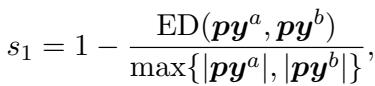
First, they calculate Phonetic Similarity (\(s_1\)) based on Pinyin (the romanization of Chinese characters):
Next, they calculate Visual Similarity (\(s_2\)) based on the Ideographic Description Sequence (IDS), which breaks characters down into their component strokes and parts:
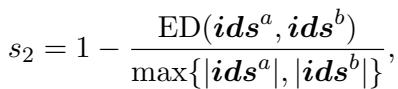
The final similarity score for any two characters \(a\) and \(b\) is the maximum of their phonetic or visual scores:

Step 4: Choose the Best Alignment
Finally, the system scores every potential aligned sentence in the set \(AS\). The score (\(Val_j\)) is the sum of similarity scores between the characters in the aligned sentence and the original input \(X\).
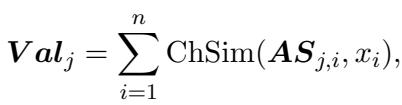
The sentence with the highest similarity score is selected as the Best Alignment Sentence (\(X^a\)).
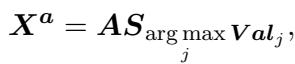
At the end of this process, we have a sentence \(X^a\) that incorporates the LLM’s semantic corrections but strictly adheres to the length and structure of the original input.
Part 2: SCP - The Replacement Strategy
Now we have two “opinions” on how to fix the sentence:
- \(Y^e\): The output from the traditional CSC model (e.g., BERT).
- \(X^a\): The aligned output from the LLM (from the ERS step above).
How do we combine them? We shouldn’t blindly trust the LLM because of its tendency to over-correct. Instead, we use a confidence-based approach.
Step 1: Check Baseline Confidence
We look at the probability distribution output by the traditional model (\(\Theta\)).
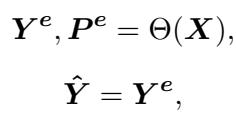
If the traditional model is very confident about a character (probability \(> \xi\), a threshold like 0.9), we trust it. However, if the probability is low, it indicates a potential error or uncertainty.
Step 2: The “Tie-Breaker” (Masked Prediction)
If the confidence for a character at position \(k\) is low, ARM brings in the LLM’s suggestion (\(X^a_k\)) as a candidate. To decide between the traditional model’s choice (\(Y^e_k\)) and the LLM’s choice (\(X^a_k\)), the system uses a Masked Language Model technique.
They take the sentence, mask the position in question, and ask the model to predict the probability of the characters filling that blank.

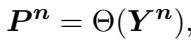
Here, \(Y^n\) is the sentence with the \(k\)-th position masked. \(P^n\) is the probability distribution output for that mask.
Step 3: Final Decision
The system compares the probability of the character suggested by the traditional model against the probability of the character suggested by the LLM.

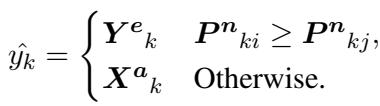
Simply put: If the masked model thinks the traditional model’s character is more likely, keep it. Otherwise, swap it for the LLM’s suggestion. This prevents the LLM from making unnecessary changes (over-correction) while allowing it to fix errors that the traditional model was confused about.
Alternative for Models without [MASK]
Some CSC models don’t use the [MASK] token during training. For those, the researchers proposed a slight variation. Instead of masking, they substitute the candidate characters directly into the sentence and sum the probabilities.
They create a version of the sentence using the LLM’s candidate (\(X^a_k\)):

They calculate the probability of this new sentence:
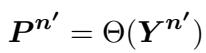
And compare the combined probabilities to make the decision:

Experiments and Results
The researchers tested ARM on the standard benchmarks for this field: SIGHAN13, SIGHAN14, and SIGHAN15. They integrated ARM into three different baseline models: SoftMask-BERT, MDCSpell, and SCOPE.
Main Results
The performance was measured using Precision, Recall, and F1 scores. The results were impressive.
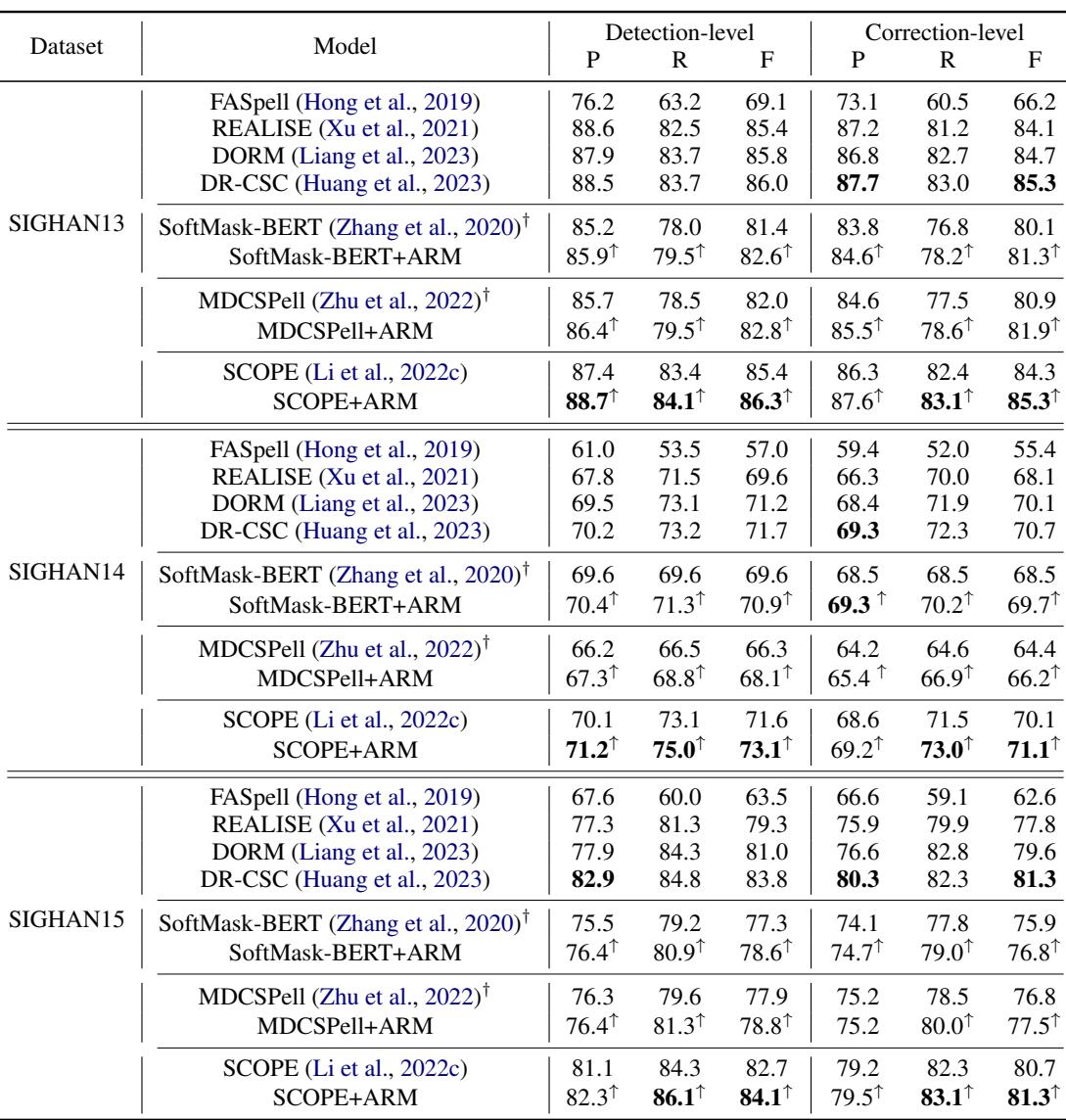
As shown in Table 1, adding ARM improved the F1 scores (the most important metric balancing precision and recall) across the board.
- SoftMask-BERT + ARM saw improvements of up to 1.2%.
- MDCSpell + ARM improved by up to 1.8%.
- SCOPE + ARM achieved state-of-the-art results, surpassing all previous methods.
This confirms that ARM isn’t just a theoretical fix; it consistently boosts the performance of various underlying architectures.
Multi-Domain Capabilities
One of the theoretical advantages of LLMs is their broad “world knowledge.” Traditional CSC models are often trained on specific datasets (like news or student essays) and struggle when faced with medical, gaming, or novelistic text.
To test this, the researchers used the LEMON dataset, which covers diverse topics like Car (CAR), Medical (MEC), and Games (GAM).
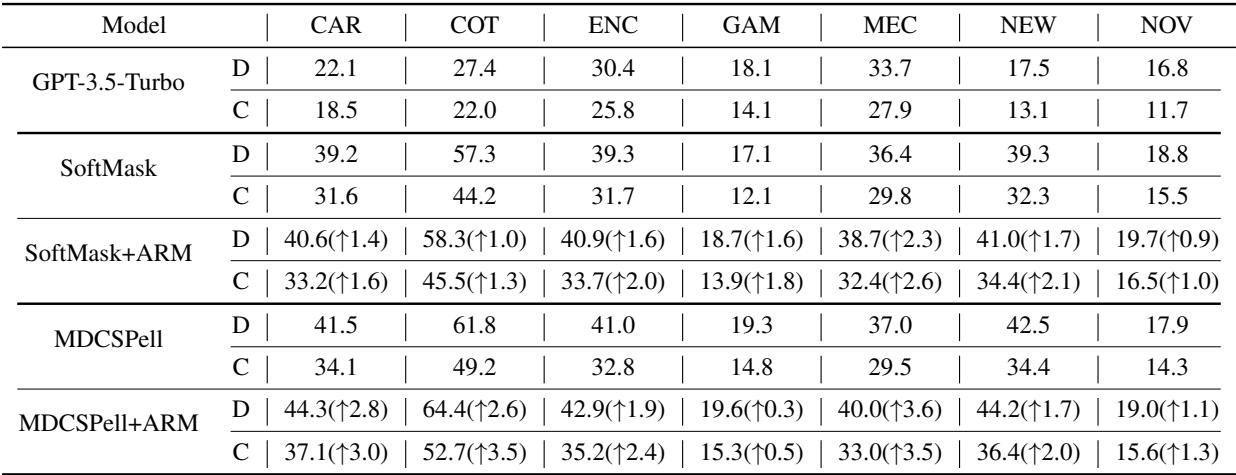
Table 2 reveals two key findings:
- Pure LLMs (GPT-3.5) are weak: On their own, GPT-3.5 performs poorly compared to specialized models (see the top rows vs. SoftMask).
- ARM bridges the gap: When SoftMask-BERT is equipped with ARM, performance jumps significantly across domains (e.g., +3.6 correction F1 score in the News domain). This proves that ARM effectively transfers the LLM’s domain adaptability to the specialized CSC model.
Rigorousness of the Method
The researchers also wanted to prove that their Alignment (ERS) and Replacement (SCP) methods were actually doing the heavy lifting. They ran ablation studies comparing their method against random candidates (“Ran”) and simple truncation (“Tru”).
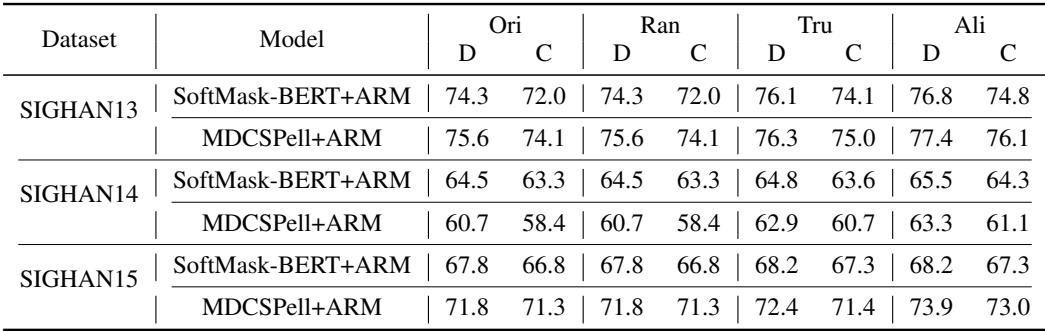
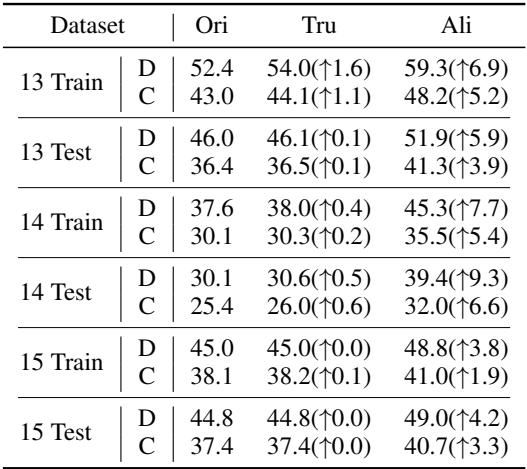
Table 3 and Table 4 show that the “Ali” (Alignment via ERS) method vastly outperforms simple truncation. It demonstrates that you can’t just chop off the end of an LLM sentence and expect it to work; you need intelligent alignment based on phonetic and visual similarity.
Case Study: Putting it Together
Let’s look at a real-world example to see how ARM saves the day.
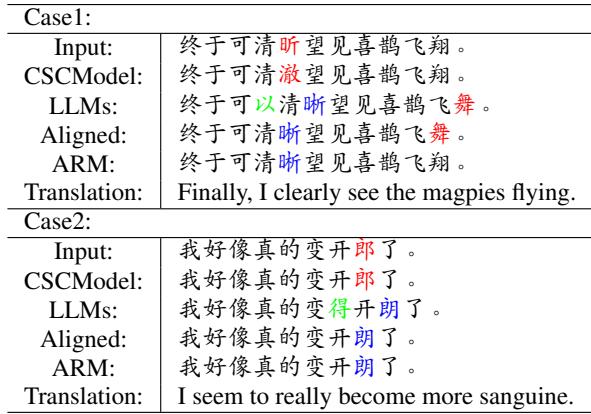
In Case 1 (Table 5):
- Input: “Finally, I clearly (清昕) see the magpies flying (飞翔).” Note: “清昕” is a typo.
- CSC Model: Changes “limpid dawn” (清听) to “pellucidly” (清澈). It misses the mark slightly.
- LLM: Correctly identifies “clearly” (清晰), BUT it arbitrarily changes “flying” (飞翔) to “dancing in the air” (飞舞). This is the over-correction problem.
- ARM: It takes the “clearly” correction from the LLM but rejects the “dancing” change because the traditional model likely had high confidence in the original word “flying.”
The result is a perfect sentence that neither the base model nor the LLM could achieve on their own.
Conclusion & Implications
The ARM paper presents a compelling strategy for the future of Natural Language Processing. Rather than discarding older, specialized models in favor of massive LLMs, or trying to force LLMs to behave like strict specialized models, it proposes a hybrid approach.
Key Takeaways:
- LLMs are powerful but unruly: They understand context better than BERT, but they struggle with the strict formatting rules of Chinese Spelling Check.
- Alignment is crucial: You cannot use LLM outputs for CSC without mathematically aligning them to the source (using Edit Distance and Phonetic/Visual similarity).
- Selective Replacement: Trust the specialized model first. Only ask the LLM for help when the specialized model is uncertain.
- Plug-and-Play: The biggest advantage of ARM is that it improves existing systems without requiring expensive retraining.
This “Alignment-and-Replacement” concept could likely be extended beyond spelling checks to other tasks where LLMs need to operate under strict constraints, such as code repair or structured data extraction. By treating the LLM as a supplementary “consultant” rather than the sole decision-maker, we can achieve state-of-the-art results today.