](https://deep-paper.org/en/paper/file-2880/images/cover.png)
Introduction: Shifting the Focus from Blocking to Building
For the past two decades, the intersection of Natural Language Processing (NLP) and social media has largely focused on a digital form of waste management. Researchers and engineers have built sophisticated classifiers to detect and remove the “garbage”—hate speech, toxicity, misinformation, and spam. While this work is vital for digital hygiene, it represents a somewhat one-sided view of online discourse. We have spent immense energy teaching machines what humans shouldn’t say, but very little time teaching them what healthy communication actually looks like.
This brings us to a compelling question: If we can train AI to flag toxic comments, can we also train it to identify “connective” comments? Can we detect language that bridges divides, admits uncertainty, and invites genuine dialogue?
A recent study by researchers from the University of Texas at Austin and The University of Hong Kong addresses this gap. They introduce the concept of Connective Language—language that facilitates engagement and understanding—and attempt to build a classifier to detect it. In a fascinating showdown between established methods and the latest generative AI, they compare a fine-tuned BERT model against GPT-3.5 to see which architecture better understands the nuances of constructive digital dialogue.
For students of data science and computational social science, this paper offers a masterclass in the trade-offs between traditional fine-tuning and modern prompt engineering, while also defining a novel linguistic metric that could reshape how we analyze online political discourse.
Background: Defining the “Good” in Discourse
To understand why this research matters, we have to look at the current landscape of “Pro-Democratic NLP.”
Historically, assessing the quality of online talk has relied on Deliberative Theory. Ideally, a good political discussion involves rationality, evidence citation, and reciprocity (people actually replying to one another). However, anyone who has scrolled through a comment section knows that this ideal is rarely met.
Researchers have previously identified attributes like Politeness and Civility. While these are positive traits, they aren’t synonymous with connectivity. You can be exceedingly polite while completely shutting down a conversation (e.g., “With all due respect, I have no interest in your incorrect opinion”).
What is Connective Language?
The authors define Connective Language not just as being nice, but as being open. It includes language features that express a willingness to talk with people who are not ideologically aligned. Key markers include:
- Intellectual Humility: Admitting you might be wrong or that an issue is complex.
- Hedging: Using phrases like “In my opinion” (IMO) or “As I see it,” which signal that a statement is a subjective view rather than an absolute fact.
- Validation: Phrases like “I see where you’re coming from” or “Thanks for sharing.”
The hypothesis is that identifying and amplifying this type of language could reduce affective polarization—the tendency to dislike and distrust those from opposing political parties.
Core Method: Building the Classifier
The core technical challenge of the paper was to operationalize this sociological concept into a machine-learning pipeline. The researchers took a rigorous path: creating a custom dataset, establishing a human baseline (gold standard), and then training models to replicate that human judgment.
1. Data Collection and Curation
The researchers didn’t just scrape random tweets. They used an inductive approach to find high-quality discourse. They identified specific accounts and subreddits known for cross-cutting discussions (like r/ChangeMyView or the Twitter account of Braver Angels). They also used keyword queries for phrases likely to appear in connective posts, such as “correct me if I’m wrong” or “I appreciate your feedback.”
Data was collected from three major platforms to ensure robustness:
- Reddit (Discussions, often anonymous)
- Twitter (Short-form, public figures)
- Facebook (Groups and pages)
2. Human Annotation (The Ground Truth)
Before a computer can learn, humans must teach it. Four undergraduate students were trained to code posts as either “Connective” (1) or “Non-Connective” (0).
- Connective (1): Encourages engagement, uses hedging (“IMHO”), expresses openness (“I never thought about it like that”).
- Non-Connective (0): Lacks those elements, or includes hate speech, demonization, or is simply a statement without invitation for dialogue.
The coders achieved a reliability score (Krippendorff’s \(\alpha\)) of 0.73, which is considered reliable for this type of subjective social science task. They labeled a total of over 14,000 posts.
3. The BERT Classifier (Fine-Tuning)
The first contender in this classification task was BERT (Bidirectional Encoder Representations from Transformers). Specifically, the bert-base-uncased model.
For students familiar with NLP, BERT represents the “pre-train and fine-tune” paradigm. BERT has already read a massive amount of English text to understand syntax and context. The researchers then “fine-tuned” it—essentially giving it a specialized crash course using their specific labeled dataset of connective language.
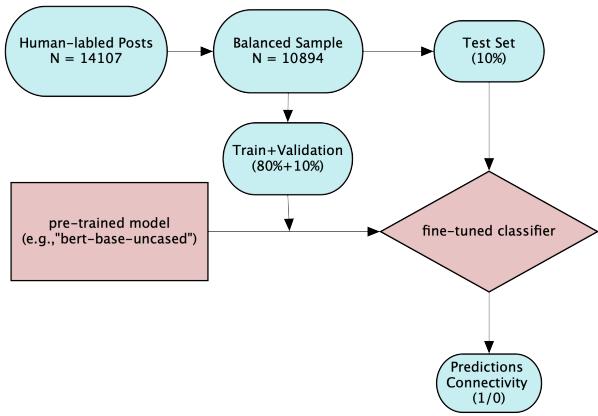
Figure 1 above illustrates the rigorous pipeline used for the BERT model:
- Balancing: They created a balanced sample (N=10,894) to ensure the model didn’t just guess “Non-Connective” every time.
- Splitting: The data was divided into Training (80%), Validation (10%), and Testing (10%).
- Fine-Tuning: They used the
TFBertForSequenceClassificationarchitecture with an Adam optimizer. This updates the weights of the neural network specifically to minimize the error in predicting connective labels.
This approach allows the model to learn the specific, often subtle, patterns in the training data that denote connectivity.
4. The GPT-3.5 Classifier (Few-Shot Learning)
The second contender was OpenAI’s GPT-3.5 Turbo. Unlike the BERT approach, the researchers did not fine-tune GPT. Instead, they used it as a Zero-shot/Few-shot classifier via prompt engineering.
This represents the modern “Generative AI” paradigm. You don’t update the model’s weights; you simply explain the task to the model in plain English and ask it to perform.
The prompt went through several iterations (prompt engineering) to get the best results. The final prompt explicitly defined connectivity:
“Connectivity indicates the tone of a message. A post is considered connective if it shows a willingness to engage in conversation with others… respond only with ‘1’ for connective or ‘0’ for non-connective.”
They fed the model 1,000 posts and compared its output against the human labels.
Experiments and Results
The researchers analyzed the data distribution and then pitted the two models against each other.
Data Distribution
First, it is interesting to look at where connective language was found. As shown in Table 2 below, the distribution varied by platform.
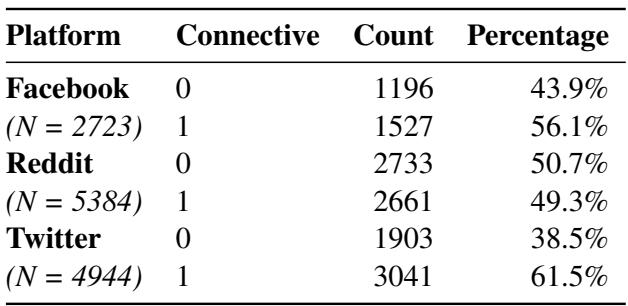
Interestingly, Twitter had the highest percentage of connective posts in this specific sample (61.5%). However, students should note this is likely due to the sampling strategy—the researchers specifically queried accounts known for constructive dialogue. The key takeaway here is that connective language exists across all platforms, but its prevalence varies.
The Showdown: BERT vs. GPT
Which model understood human connection better? The results were decisive.
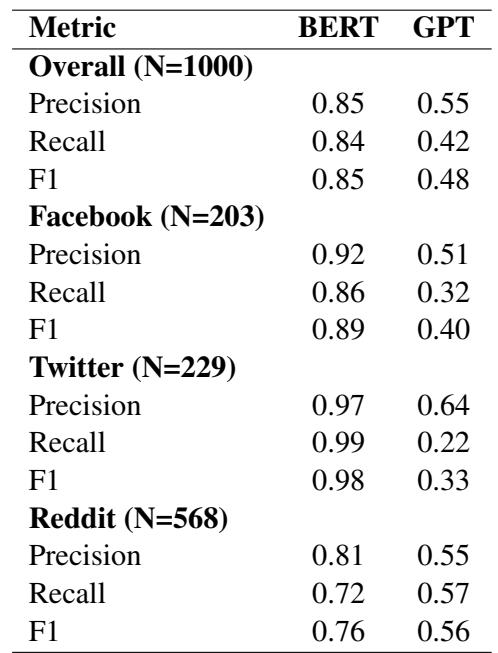
As Table 3 illustrates, the BERT classifier significantly outperformed GPT-3.5 Turbo across every metric and every platform.
- Overall F1-Score: BERT achieved 0.85, while GPT struggled at 0.48.
- Recall: GPT had a very low recall (0.42), meaning it missed more than half of the posts that were actually connective.
Why the disparity? This result highlights a crucial lesson for NLP students: Generative Large Language Models (LLMs) are not always the best tool for specific classification tasks.
- Specificity: BERT was fine-tuned on the exact definition and examples provided by the researchers. It learned the “flavor” of the dataset.
- Generalization Bias: GPT-3.5 relies on its general training. It might have a different internal “idea” of what connectivity means, or it might be biased toward more formal definitions of politeness rather than the specific operationalization of “connective language” (e.g., using “IMHO”).
- Complexity: Connectivity is a nuanced, latent variable. It’s harder to prompt for than simple sentiment (positive/negative). Fine-tuning allows a model to learn these latent patterns mathematically.
Is “Connectivity” Just “Politeness”?
A skeptic might ask: “Aren’t you just building a politeness detector?” The researchers anticipated this and compared their BERT connectivity scores against existing classifiers for Toxicity, Politeness, and Constructiveness.
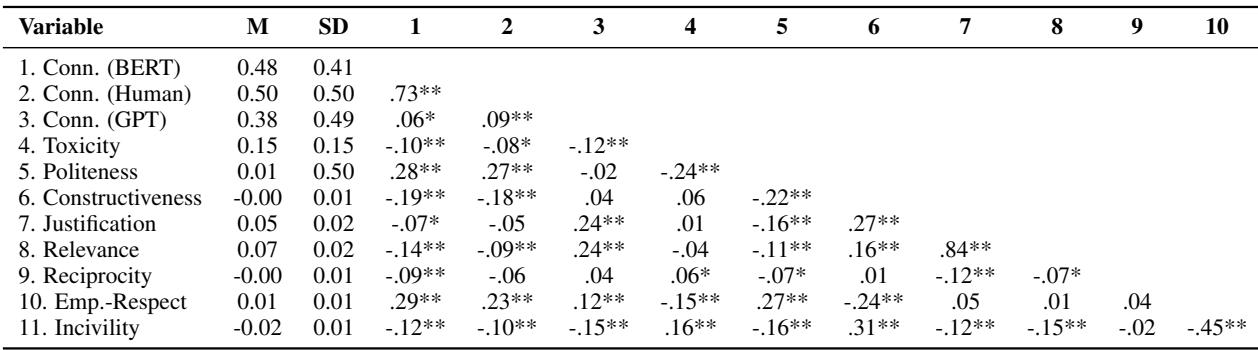
Table 4 reveals the distinct nature of Connective Language:
- Toxicity: There is a negative correlation (-0.10 for BERT), which makes sense. Connective posts are rarely toxic.
- Politeness: There is a positive correlation (0.28), but it is weak. This confirms that while connective language is often polite, they are not the same thing. You can be connective without being formally polite (e.g., using slang but being open-minded), and you can be polite without being connective.
- Incivility: Interestingly, incivility had a weak negative correlation.
The authors also compared their metric to the “Bridging” attributes from Google’s Perspective API (Table 5 below).
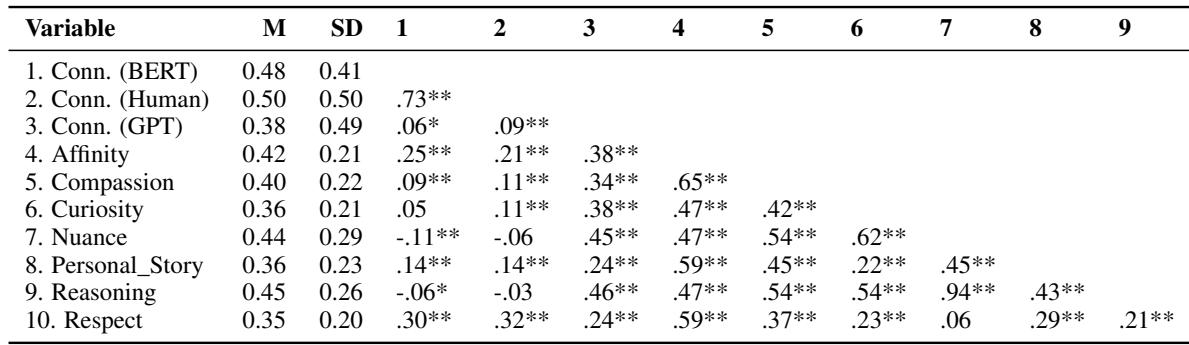
Here, we see stronger correlations with attributes like Affinity (0.25) and Respect (0.30), but again, the correlations are not high enough to suggest they are measuring the exact same thing. Connective language is a unique construct.
Conclusion and Implications
This study provides a roadmap for shifting the focus of computational social science from the negative to the positive.
Key Takeaways for Students:
- Task-Specific Beats Generalist: For specialized classification tasks with specific definitions, a smaller, fine-tuned model (like BERT) often beats a massive, prompted model (like GPT-3.5). Bigger isn’t always better.
- Defining the Concept: The success of an NLP project often depends on how well you define your variable before you touch the code. The rigorous definition of “Connective Language” allowed for high inter-coder reliability and a successful model.
- Nuance Matters: The study proves that “Connective Language” is mathematically distinct from “Politeness” or “Lack of Toxicity.”
The Future of Connective AI
The implications of this work are profound. Currently, recommender systems largely optimize for engagement, which often amplifies outrage. Imagine a recommender system that uses this BERT classifier as a signal—boosting content that scores high on Connectivity.
We could see platforms where users earn badges for being “Connective,” or filters that allow you to read comments sorted by “Most Connective” rather than “Most Controversial.” By teaching machines to recognize the language that bridges divides, we take a step toward building digital spaces that actually serve democracy, rather than just hosting its arguments.