](https://deep-paper.org/en/paper/file-2906/images/cover.png)
Teaching Models to Reason: How LLM-Generated Knowledge Solves Cross-Domain NER
Imagine you have trained a brilliant assistant to read the New York Times and highlight the names of politicians and companies. They get really good at it. Then, you hand them a technical paper on quantum physics or a fan forum about K-Pop and ask them to do the same thing. Suddenly, they struggle. “Is ‘superposition’ a location? Is ‘BTS’ an organization or a movement?”
This is the classic problem of Cross-Domain Named Entity Recognition (CD-NER). Models trained on general data (source domain) often fail spectacularly when applied to specialized fields (target domains).
Traditionally, researchers have tried to solve this by scraping massive amounts of text from the target domain—think Wikipedia articles or web pages—to “teach” the model the new vocabulary. But a new paper, “Cross-domain NER with Generated Task-Oriented Knowledge,” argues that this approach is inefficient. Instead of dumping raw text on the model, what if we used Large Language Models (LLMs) to generate specific, reasoning-based explanations?
In this deep dive, we will explore the TOPT (Task-Oriented Pre-Training) framework. We will uncover how researchers are using LLMs not just as chatbots, but as data generators that teach smaller models how to identify entities. We will also explore a fascinating concept called Information Density to understand mathematically why this new method works better than simply reading the internet.
The Problem: Why Traditional Transfer Learning Fails
Named Entity Recognition (NER) is a foundational task in Natural Language Processing (NLP). It involves scanning text and classifying spans into categories like [Person], [Location], or [Organization].
When you have plenty of labeled data in your target field, NER is easy. But in the real world, you rarely do. You might have a model trained on news data (CoNLL03), but you need it to work on AI research papers (CrossNER).
The “DAPT” Trap
The standard solution has been Domain-Adaptive Pre-Training (DAPT). The idea is simple: if you want your model to understand the “AI domain,” you retrieve thousands of documents containing AI terms from the web and pre-train your model on them.
However, the authors of this paper identify a critical flaw in DAPT: Relevance.
When you scrape web data based on keywords (e.g., “Hinge Loss”), you mostly get definitions or Wikipedia entries. While these sentences contain the target words, they don’t necessarily show the model how to identify them in a messy, real-world sentence. A definition tells you what something is; it doesn’t always provide the context clues needed to spot it in a paragraph of flowery text. The existing methods are time-consuming, labor-intensive, and often weakly correlated with the actual task of entity extraction.
The Solution: TOPT (Task-Oriented Pre-Training)
The researchers propose a new paradigm: TOPT. Instead of finding existing text, they generate new text designed specifically to teach the NER task.
The workflow consists of three main stages:
- Generating Task-Oriented Knowledge (GTOK) using an LLM.
- Task-Oriented Pre-Training using Masked Span Language Modeling.
- Text-to-Text Generation for the final entity recognition.
Let’s look at the overall architecture of this framework:
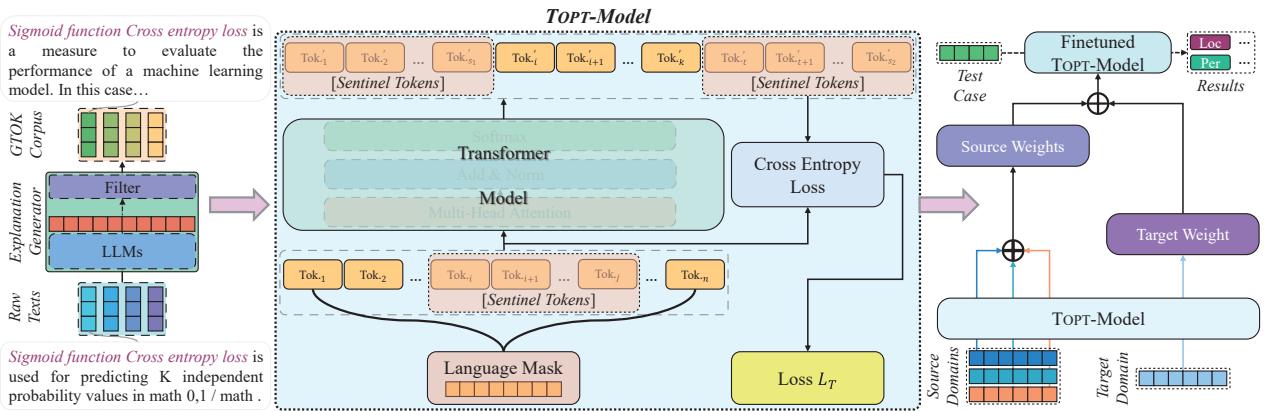
As shown in Figure 2 above, the process starts on the left with an “Explanation Generator” (an LLM) creating the corpus, which feeds into the TOPT-Model for pre-training, and finally leads to fine-tuning on the specific source and target domains.
Step 1: Generating Knowledge (GTOK)
The core innovation here is replacing “found” data with “generated” reasoning. The researchers utilize a Large Language Model (like Llama-2) to create the GTOK Corpus.
They don’t just ask the LLM for sentences containing entities. They ask for the reasoning process. They constructed a prompt that instructs the LLM to explain why a specific text span is labeled as an entity.
The instruction looks something like this:
Take the text <x> and give an explanation of why the text span <x_start:end> can be labeled as <t> in the domain <d>.
Mathematically, they are modeling the probability of a generated explanation sequence (\(Y\)) given the instruction (\(X\)) and the entity slots (\(E\)):
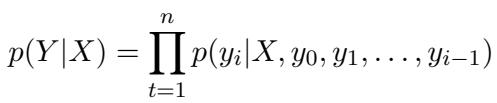
By freezing the LLM, they ensure consistent generation:

Why does this matter? Instead of a sentence like “Hinge loss is a function used in SVMs” (Definition), the GTOK corpus might contain: “In the sentence ‘We minimize the hinge loss to optimize the model,’ the term ‘hinge loss’ is a Metric because it is the object being minimized to improve performance.”
This exposes the logic of extraction—identifying the verb “minimize” as a clue that the following noun phrase is a metric. This is far more valuable for training an NER model than a static definition.
Step 2: Masked Span Language Modeling (MSLM)
Once the GTOK corpus is generated, the researchers train a smaller model (specifically, a T5 model) on this data. However, they don’t use standard masking (where you hide random words). They use Masked Span Language Modeling.
In NER, entities are often multi-word phrases (e.g., “Natural Language Processing”). Masking a single word like “Language” might make the task too easy or irrelevant. Masking the whole span forces the model to use the surrounding context to predict the entity type.
The masking process is defined by a Bernoulli distribution to create a mask matrix \(M\):


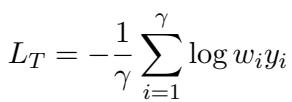
The model is trained to minimize the Cross-Entropy Loss (\(L_T\)) by predicting these masked spans:
Step 3: Text-to-Text Generation
Finally, the researchers fundamentally change how the NER task is performed. Most NER models use “Sequence Labeling,” where they assign a tag (like B-PER, I-PER) to every single word in a sentence.
The TOPT framework reformulates NER as a Text-to-Text Generation problem. The model is given an instruction, a list of possible entity types (Options), and the sentence. It is then asked to generate the list of entities as a text string.
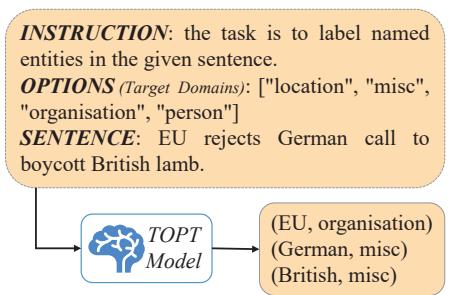
As visualized in Figure 3, the input includes instructions and specific options. The output is a natural language string: (EU, organisation), (German, misc)....
The generation function is formally defined as:

This reformulation allows the model to handle different domains more flexibly. It doesn’t need to change its output layer structure every time the set of entity tags changes (e.g., moving from 4 tags in News to 15 tags in Science). It just generates text.
The Theory: Why is GTOK Better? (Uniform Information Density)
One of the most impressive parts of this paper is that the authors don’t just show that it works; they use Information Theory to explain why. They introduce the concept of Uniform Information Density (UID).
What is UID?
The UID hypothesis suggests that communication is most efficient when information is distributed evenly throughout a signal. In the context of language modeling, “information” is quantified by surprisal—how unexpected a word is given the previous context.
- High Surprisal: The model is shocked by the word. It’s hard to process.
- Low Surprisal: The word is obvious. The model learns nothing.
- Uniform Surprisal: The “Goldilocks” zone. The model is constantly engaged and learning efficiently.
The authors define UID using the variance of surprisal in the text. They approximate this using a Bi-Gram language model:
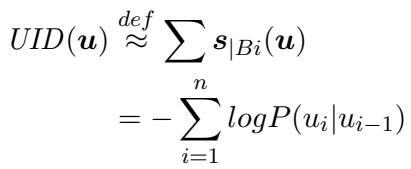
They hypothesize that the GTOK (Generated) corpus has a more uniform information density than the DAPT (Retrieved) corpus.
The Analysis
The paper compares the UID of their generated corpus against the traditional scraped DAPT corpus. A lower UID variance suggests a smoother, more effective learning signal.
Look at the distributions in Figure 4:
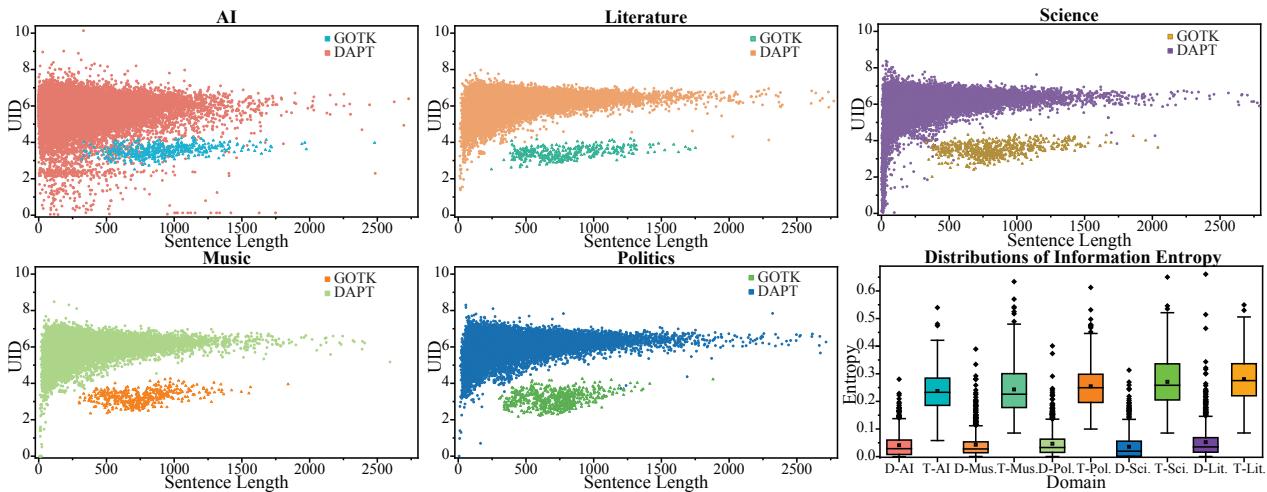
In the scatter plots, you can see the distribution of UID values. The DAPT corpus (often shown with wider spreads or higher variance in analysis) tends to be “spiky.” Wikipedia articles alternate between dense jargon (high surprisal) and simple connector words (low surprisal).
In contrast, the generated GTOK explanations are written in a consistent, logical, explanatory style. This creates a “smoother” signal for the model to learn from.
The variance scores confirm this mathematically:
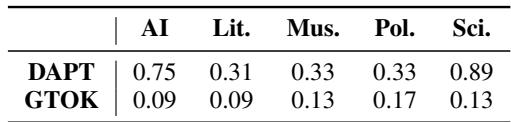
In Table 5, look at the difference! The UID variance for GTOK is consistently lower (better) than DAPT across all domains (AI, Literature, Music, etc.). For example, in the AI domain, GTOK has a variance of 0.09, while DAPT is 0.75. This suggests the generated data is mathematically superior for efficient training.
Experiments and Results
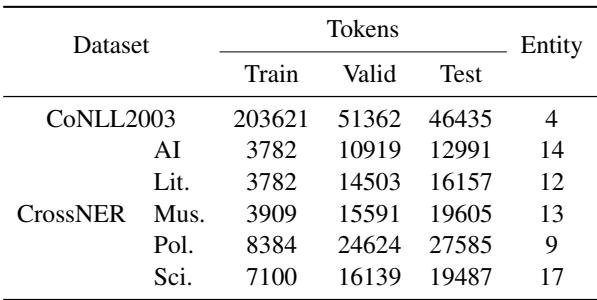
Does this theory hold up in practice? The researchers tested TOPT on the CrossNER benchmark, transferring from a generic source (CoNLL2003) to five distinct domains: AI, Literature, Music, Politics, and Science.
Here are the dataset statistics:
Comparing Efficiency
First, let’s look at data efficiency. The DAPT approach typically requires scraping millions of tokens. The GTOK approach generates significantly less data.
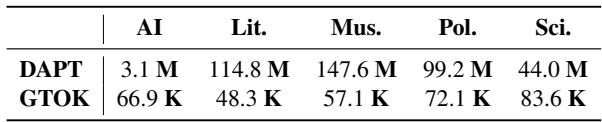
As shown in Table 1, DAPT uses millions (M) of tokens. GTOK uses only thousands (K). In the AI domain, GTOK uses 66.9K tokens compared to DAPT’s 3.1M. Despite being roughly 1/50th the size, we will see that GTOK performs better.
Main Performance
The researchers compared TOPT against state-of-the-art models like CP-NER and even GPT-4.
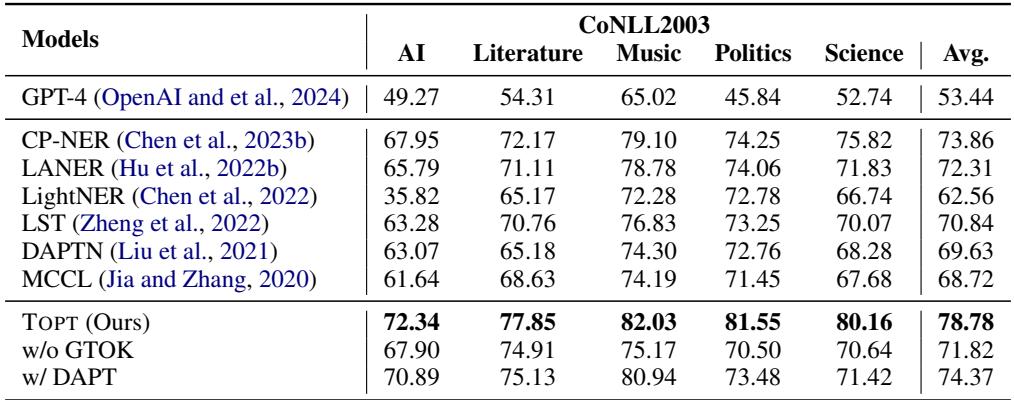
In Table 2 (Single Source Domain), TOPT (Ours) achieves the highest average F1 score (78.78), beating the previous best CP-NER (73.86) by a significant margin.
Interestingly, look at GPT-4. It scores an average of only 53.44. This highlights a crucial insight: generalized LLMs, while smart, are not specialized for strict entity extraction tasks without specific fine-tuning or few-shot guidance. A smaller model (T5-base) trained with the right data (TOPT) outperforms the massive GPT-4.
The results hold up when using multiple source domains as well:
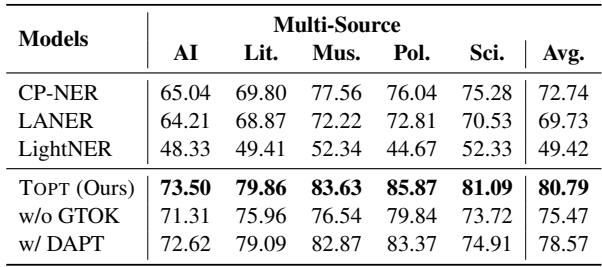
Table 4 shows TOPT achieving an average of 80.79, again outperforming CP-NER (72.74).
Impact of Different LLMs
Does it matter which LLM generates the data? The authors tested generating the GTOK corpus with Llama-2 versus Vicuna.
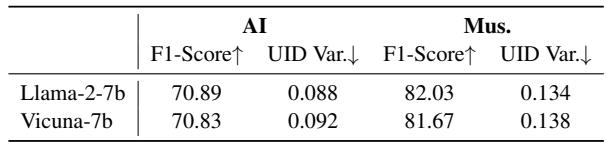
Table 6 shows almost identical performance (70.89 vs 70.83 in AI). This is great news for reproducibility—the framework is robust and doesn’t rely on one specific “magic” LLM.
Case Study: Logic vs. Memorization
To truly understand why TOPT wins, we have to look at the qualitative examples.
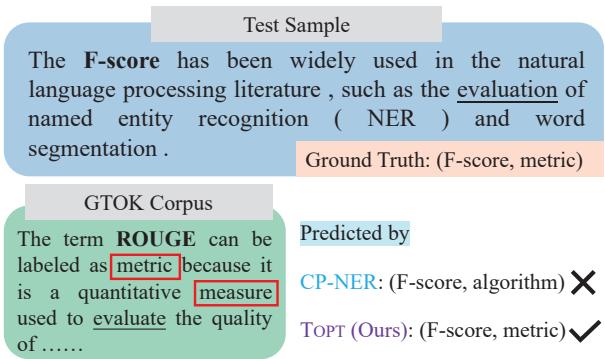
In Figure 5, look at the second example regarding “ROUGE.”
- The sentence: “The term ROUGE can be labeled as metric because it is a quantitative measure used to evaluate…”
- CP-NER Prediction: It labels “F-score” as an algorithm (Incorrect).
- TOPT Prediction: It labels “F-score” as a metric (Correct).
Why? Because the GTOK corpus contained reasoning chains connecting terms like “measure,” “evaluate,” and “quantitative” to the label “Metric.” The model learned the logic of the domain, not just the vocabulary.
Conclusion
The “Cross-domain NER with Generated Task-Oriented Knowledge” paper represents a shift in how we approach low-resource NLP tasks. It moves us away from the era of “Big Data” (scraping the whole web) toward the era of “Smart Data” (synthesizing high-quality, dense instruction).
Key Takeaways:
- Generation > Retrieval: Generative explanations from LLMs provide better training signals than retrieved sentences from the web.
- Reasoning Transfer: By training on the why (explanations), models learn to identify entities based on context clues rather than memorization.
- Information Density Matters: The UID theory provides a solid mathematical backing for why generated text—which is usually more uniform and coherent—is more efficient for machine learning than noisy raw text.
- Size Isn’t Everything: TOPT outperforms models trained on corpora 50x larger, proving that data quality reigns supreme.
For students and practitioners, this implies a new workflow: when facing a new domain, don’t just search for data—ask an LLM to create a textbook for your model.