](https://deep-paper.org/en/paper/file-2909/images/cover.png)
The world of cryptocurrency is often described as the “Wild West” of finance. It is characterized by extreme volatility, a 24/7 news cycle, and a unique layer of transparency known as “on-chain data.” For researchers and traders alike, the Holy Grail has always been predicting these market movements.
In recent years, Large Language Models (LLMs) like GPT-4 have revolutionized how we process information. We’ve seen them write code, pass bar exams, and analyze stock market sentiment. However, applying LLMs to cryptocurrency trading presents a specific set of challenges. Unlike the stock market, where quarterly reports and standard news cycles drive prices, crypto is driven by a chaotic mix of technical indicators, social media hype, and blockchain network activity.
In this post, we will deep dive into CryptoTrade, a research paper from the National University of Singapore. The researchers propose a fascinating framework that doesn’t just ask an AI to predict a price number. Instead, they build a team of LLM-based agents that act like a digital hedge fund—analyzing news, reading the blockchain, making decisions, and, crucially, reflecting on their own mistakes to improve over time.
The Problem with Traditional Prediction
Before we dismantle the CryptoTrade architecture, we need to understand why this is a hard problem to solve.
Traditionally, financial predictions rely on Time-Series Forecasting. Models like LSTM (Long Short-Term Memory) or Transformer-based architectures (like Informer or PatchTST) look at a sequence of historical numbers (prices) to predict the next number.
While this works reasonably well for stable assets, it fails in crypto because it ignores the context. If Bitcoin drops 10% in an hour, a time-series model only sees the numbers dropping. It doesn’t know that the SEC just announced a new regulation or that the Ethereum network is congested.
Furthermore, most existing LLM financial agents focus on the stock market. They read financial news and look at price history. But they miss a data source unique to crypto: On-chain data. In cryptocurrency, every transaction, every wallet movement, and every gas fee is public. Ignoring this is like trying to forecast the weather without looking at a barometer.
Enter CryptoTrade: A Holistic Approach
The core contribution of this paper is a framework that combines three distinct pillars of information:
- Market Data: Historical prices and volumes (the standard stuff).
- Off-chain Data: News, social sentiment, and regulatory updates.
- On-chain Data: Transaction statistics, gas fees, and active wallet counts.
The researchers didn’t just feed this data into a single prompt. They architected a workflow involving multiple specialized agents.
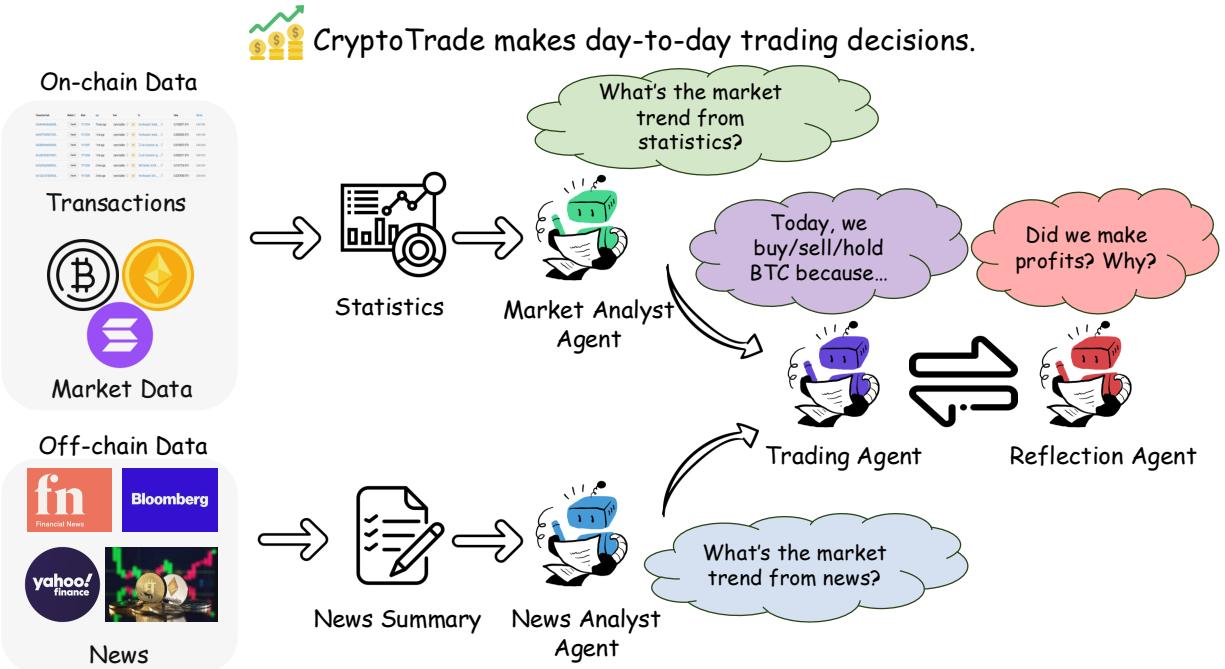
As shown in Figure 1, the system operates in a loop. Data is collected and processed, passed to analyst agents, synthesized by a trading agent, and finally reviewed by a reflection agent to improve future performance.
Let’s break down the “brains” of this operation.
1. The Data Foundation
The system relies on a rich diet of data. For market data, it pulls daily price, volume, and market cap for major coins like Bitcoin (BTC), Ethereum (ETH), and Solana (SOL).
For On-chain data, the researchers extract granular metrics from blockchain databases (like Dune). These include:
- Number of Transactions & Active Wallets: Indicators of network adoption.
- Total Value Transferred: How much money is actually moving?
- Gas Prices: High gas fees on Ethereum, for example, indicate network congestion and high demand.
For Off-chain data, the system aggregates news from major financial outlets like Bloomberg and Yahoo Finance, as well as crypto-specific sources.
2. The Specialist Agents
The “magic” of CryptoTrade lies in its role-playing capability. The LLM is instructed to adopt specific personas to analyze different aspects of the market.
The Market Analyst Agent
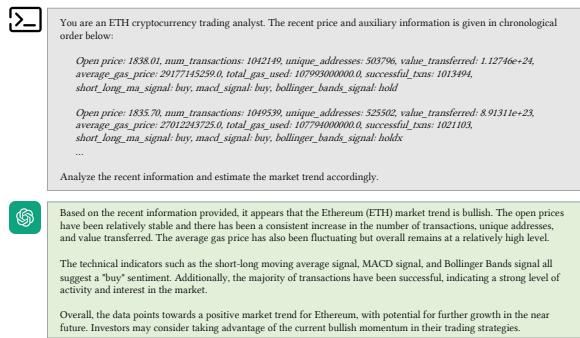
This agent acts as the “technical analyst.” It doesn’t care about the news; it cares about the numbers. It calculates technical indicators like Moving Averages (MA), MACD (Moving Average Convergence Divergence), and Bollinger Bands.
As seen in Figure 4 below, this agent takes raw data—transaction counts, gas prices, and technical signals—and synthesizes a report on the market direction. It looks at the “health” of the blockchain network alongside the price action.
The News Analyst Agent
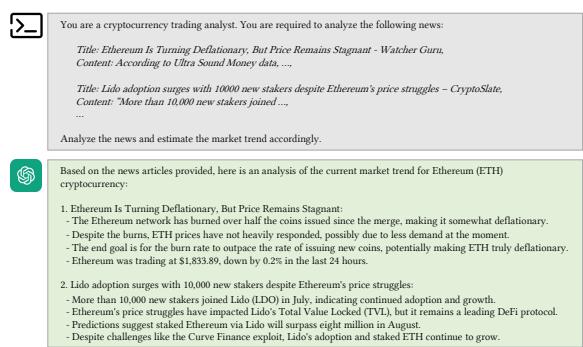
While the Market Analyst looks at charts, the News Analyst reads the headlines. Its job is to assess “social hype” and sentiment.
In Figure 5, you can see how this agent operates. It ingests headlines—such as Ethereum becoming deflationary or a surge in staking protocols—and interprets what this means for the price. It filters out the noise and summarizes the potential impact of off-chain events.
3. The Decision Maker: The Trading Agent
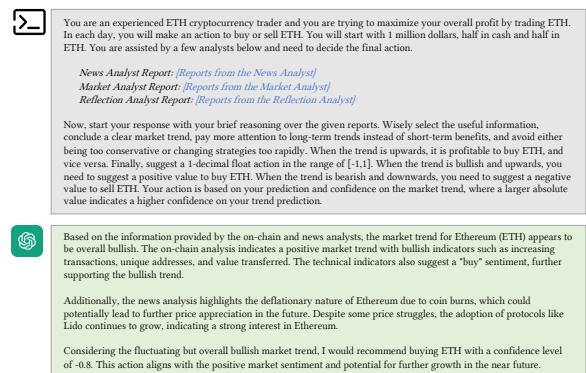
Once the Market Analyst and News Analyst have filed their reports, the Trading Agent steps in. This agent acts as the portfolio manager. It has access to the current cash balance and asset holdings.
The Trading Agent must synthesize the (sometimes conflicting) reports from the analysts. For example, the technicals might say “Sell” because the price is high, but the news might say “Buy” because a major ETF was just approved.
The agent outputs a decision: Buy, Sell, or Hold, along with a rationale. It also determines the sizing of the position (e.g., “use 50% of available cash to buy”).
4. The Secret Weapon: The Reflection Agent
This is arguably the most innovative part of the CryptoTrade framework. In a standard automated trading bot, if the bot loses money, it keeps making the same mistake until a human changes the code.
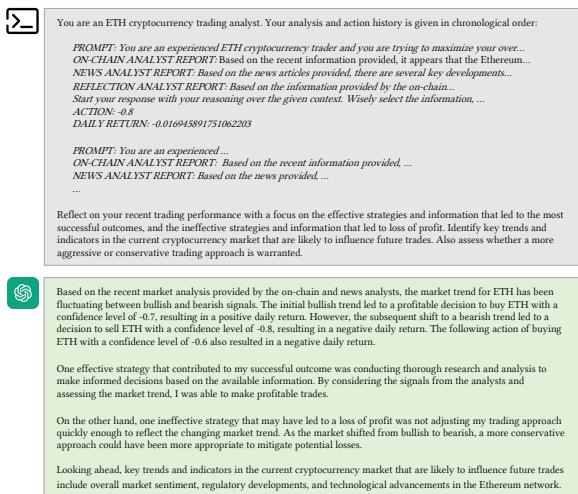
CryptoTrade utilizes a Reflective Mechanism. The Reflection Agent looks at the decisions made in the previous week. It compares the Trading Agent’s reasoning against the actual market outcome.
- Did we buy? Yes.
- Did the price go up? No, it crashed.
- Why? Perhaps we ignored a bearish news signal, or we were too aggressive on a technical breakout that failed.
The Reflection Agent generates “feedback” that is fed into the next day’s prompt. This allows the system to engage in “in-context learning,” effectively refining its strategy without needing to be re-trained or fine-tuned on new data.
Experiments and Performance
The researchers put CryptoTrade to the test using historical data from 2023, covering Bitcoin (BTC), Ethereum (ETH), and Solana (SOL). Crucially, they tested across three distinct market conditions:
- Bull Market: Prices generally rising.
- Bear Market: Prices generally falling.
- Sideways Market: Prices fluctuating without a clear trend.
They compared CryptoTrade (powered by GPT-4 and GPT-4o) against two types of baselines:
- Traditional Strategies: Buy and Hold, MACD, Moving Averages.
- Deep Learning Time-Series Models: LSTM, Informer, AutoFormer, PatchTST.
The Results
The results were revealing. The first major takeaway is that LLM-based agents significantly outperformed the deep learning time-series models.
Time-series models (like Informer and PatchTST) struggle with the erratic nature of crypto because they treat it purely as a numerical sequence prediction task. They lack the semantic understanding of why the market is moving.
However, when compared to traditional trading signals (like Buy and Hold or MACD), the results were mixed but promising.
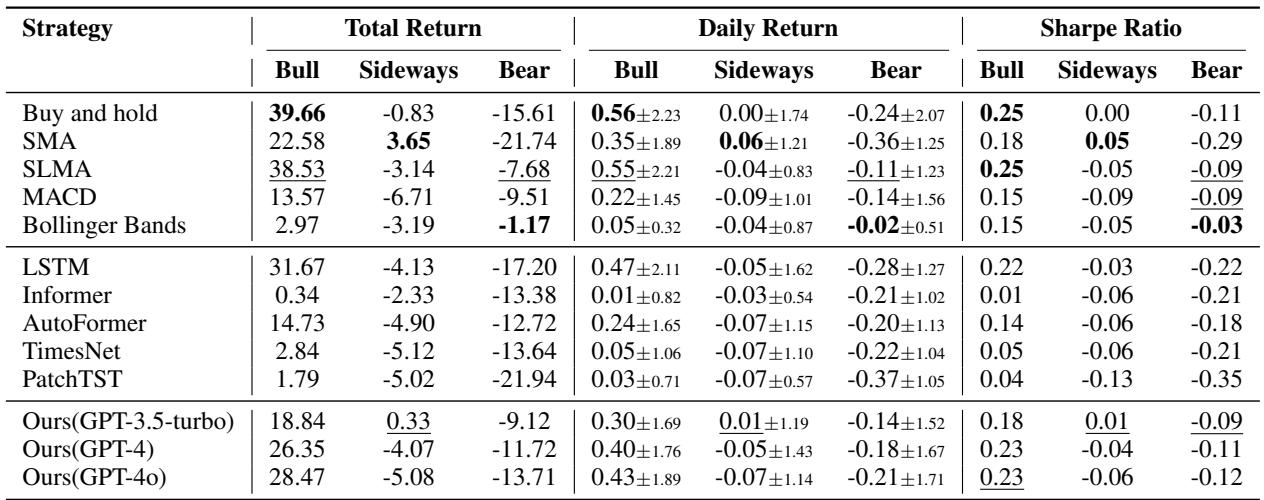
As shown in Table 2 (focusing on Bitcoin), CryptoTrade (GPT-4o) achieved a 28.47% return in the Bull market, which was competitive. More importantly, in the Sideways market—which is notoriously difficult to trade because there is no clear trend—CryptoTrade managed to minimize losses better than almost all time-series baselines.
Navigating Volatility: An Ethereum Example
To visualize how the agent behaves, look at the Ethereum trading chart in Figure 2.
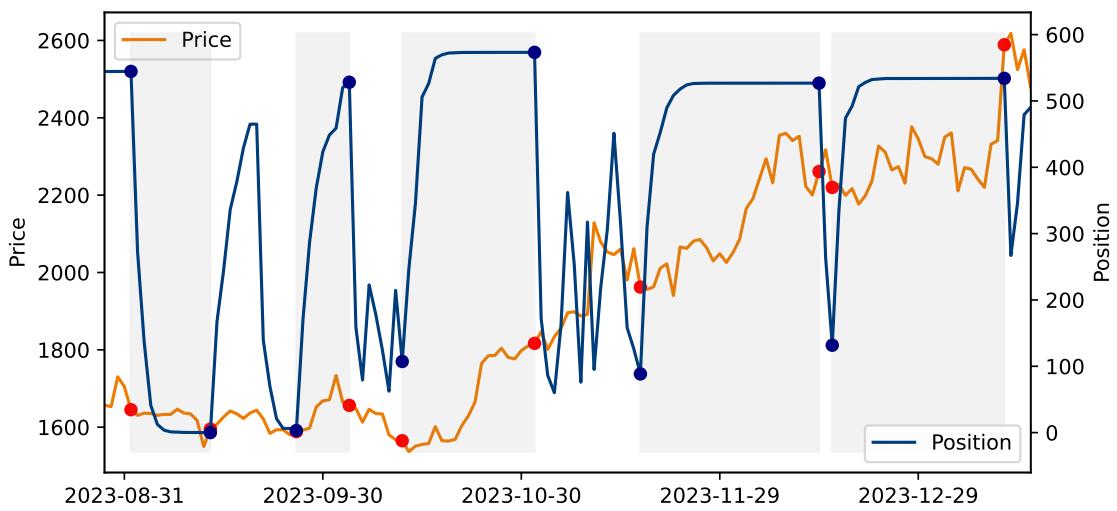
The blue line represents the agent’s position (how much ETH it holds), and the yellow line is the price.
- Notice the shaded gray areas. These represent periods where the agent made significant strategic moves.
- The agent successfully identifies local bottoms to buy in (accumulating position) and sells off inventory as the price peaks.
- This dynamic adjustment allows it to capture profit from volatility, rather than just passively holding.
Does the “Full Package” Matter? (Ablation Study)
You might wonder: Do we really need the news? Do we really need the on-chain data? Or is the LLM just guessing based on the price?
The researchers performed an Ablation Study, systematically removing parts of the system to see how performance changed.
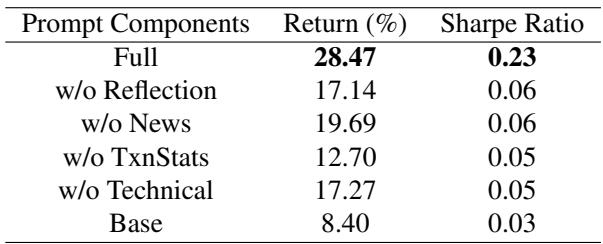
Table 5 is critical. It shows the performance on ETH during a Bull market:
- Full CryptoTrade: 28.47% Return.
- Without Reflection: Drops to 17.14%. This proves the self-correction loop is massive.
- Without News: Drops to 19.69%. The agent loses the ability to sense market sentiment.
- Without Transaction Stats (On-chain): Drops to 12.70%.
This is a key finding: Removing on-chain data caused the biggest drop in performance. This validates the hypothesis that blockchain transparency is a critical edge for crypto trading agents.
Case Study: “Buy the Rumor, Sell the News”
One of the most sophisticated behaviors in trading is navigating major news events. A classic phenomenon is “Buy the rumor, sell the news”—where prices rise before an event due to anticipation, and drop after the event as traders cash out.
The researchers analyzed CryptoTrade’s behavior during the Bitcoin ETF approval in early 2024.
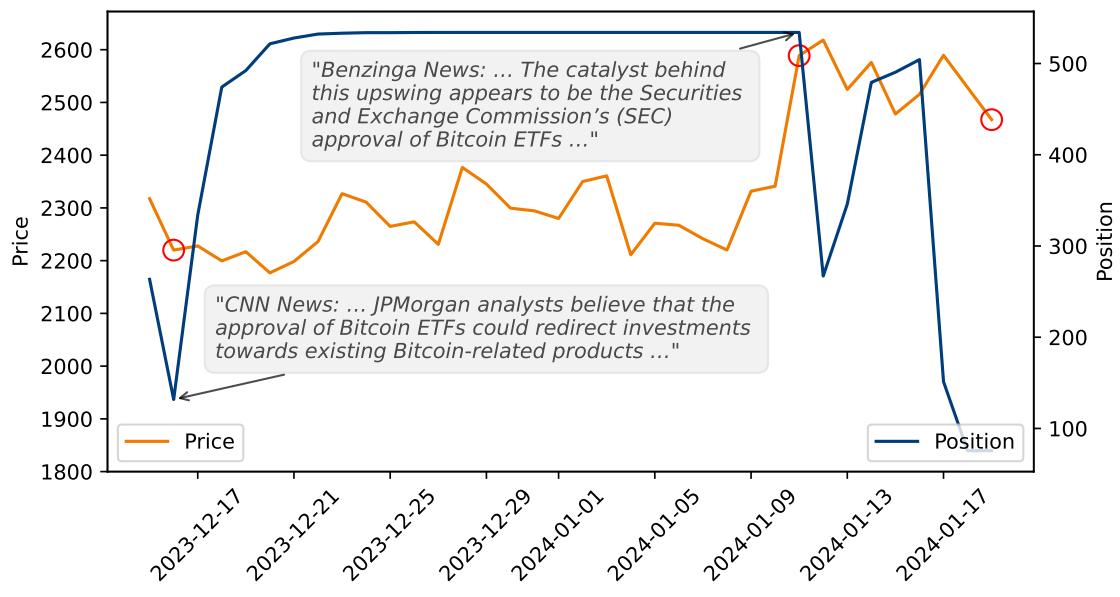
As Figure 3 illustrates:
- The Rumor: In late December and early January, news outlets buzzed about the SEC likely approving the ETF. The News Analyst picked this up. The Trading Agent started buying aggressively (the blue line spikes up).
- The Event: On Jan 11, the ETF was approved. The price peaked.
- The Sell: The agent recognized the peak of the hype cycle and sold off its position immediately.
- The Result: The price dropped shortly after the approval (a classic “sell the news” event), but the agent had already secured its profits.
This level of reasoning is virtually impossible for a standard numerical model like LSTM to achieve because it requires semantic understanding of what an “ETF Approval” means for market psychology.
Conclusion and Future Implications
The CryptoTrade paper demonstrates that LLMs can be powerful financial agents, not just because they are smart, but because they can integrate multimodal data. By combining the hard math of technical indicators, the social sentiment of news, and the “truth” of on-chain data, CryptoTrade creates a comprehensive view of the market.
Key takeaways for students and researchers:
- On-Chain Data is Vital: In crypto, looking at price without looking at the blockchain is insufficient. The ablation study proved that transaction stats are a major performance driver.
- Reflection Drives Improvement: The ability of the agent to critique its past trades allowed it to adapt to changing market conditions without retraining.
- Zero-Shot Capabilities: Remarkably, this performance was achieved in a “Zero-shot” manner. The model wasn’t fine-tuned on years of trading data; it was simply prompted with the right data and context.
While the agent didn’t beat every traditional strategy in every scenario (Buy and Hold is hard to beat in a massive bull run), its ability to outperform specialized time-series models suggests that the future of algorithmic trading lies in Semantic Intelligence—understanding the story behind the numbers, not just the numbers themselves.
As LLMs continue to evolve, we can expect agents that move from daily trading to real-time, minute-by-minute execution, potentially reshaping the landscape of high-frequency trading in the cryptocurrency markets.