](https://deep-paper.org/en/paper/file-2911/images/cover.png)
Introduction
In the world of human education, we don’t teach calculus to kindergarteners. We follow a curriculum: a structured path that starts with simple concepts and gradually introduces complexity as the student’s proficiency grows. This approach ensures that the learner builds a solid foundation before tackling difficult problems.
In the realm of Artificial Intelligence, specifically Conditional Sentence Generation (CSG)—which covers tasks like machine translation, image captioning, and Large Language Model (LLM) instruction tuning—training often lacks this nuance. Models are frequently exposed to a barrage of data without regard for the difficulty of specific examples or the model’s current capability.
One specific technique, Consistency Learning (CL), has become a gold standard for making these models robust. It forces a model to provide similar outputs for similar inputs, preventing it from being “flaky.” However, CL comes with a cost: it is computationally expensive and can slow down convergence significantly because the model is trying to satisfy multiple objectives at once.
What if we could combine the robustness of Consistency Learning with the efficiency of a human-like curriculum?
This is the question addressed in the paper “Curriculum Consistency Learning for Conditional Sentence Generation.” The researchers introduce Curriculum Consistency Learning (CCL), a novel framework that dynamically adjusts training based on the model’s current proficiency. By identifying “hard” samples and weighing them appropriately during different stages of training, CCL achieves faster convergence and superior performance across tasks ranging from text translation to multimodal generation.
Background: The Consistency Challenge
To understand why CCL is necessary, we first need to understand the mechanism it optimizes: Consistency Learning.
What is Consistency Learning?
In standard training, we use Negative Log-Likelihood (NLL) loss. Simply put, we show the model an input (like a sentence in English) and penalize it if it doesn’t predict the correct output (the sentence in German).
However, models can be brittle. A tiny change in the input (like adding a drop of noise to an image or changing a single pixel) might cause the model to output something completely different. Consistency Learning (CL) addresses this by creating two slightly different “views” of the same sample—perhaps by masking a few words or using “dropout” within the model itself. The model is then penalized not just for getting the wrong answer, but for giving different answers to these two similar views.
The total loss function generally looks like this:
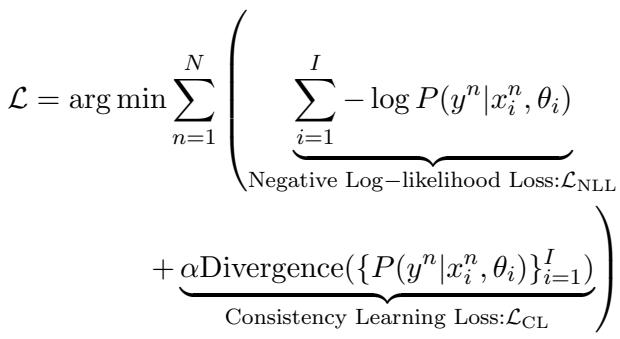
Here, the loss (\(\mathcal{L}\)) is the sum of the standard NLL loss and the Consistency Learning loss (\(\mathcal{L}_{CL}\)), weighted by a factor \(\alpha\).
A popular implementation of this is R-Drop, which uses Kullback–Leibler (KL) divergence to measure the distance between two probability distributions. The math looks like this:
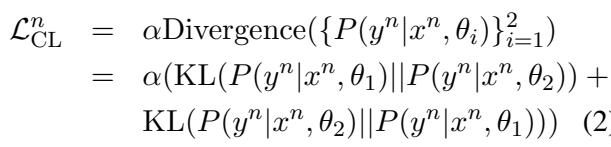
As shown in Equation 2, the model tries to minimize the difference between prediction 1 (\(\theta_1\)) and prediction 2 (\(\theta_2\)).
The Problem with “Vanilla” Consistency Learning
While effective, traditional CL treats every training example equally from the very first epoch. This is inefficient. Early in training, a model struggles just to learn basic features (the NLL loss). Forcing it to also minimize consistency loss on difficult examples can confuse the optimization process.
Furthermore, implementing a “curriculum” (easy-to-hard training) has historically been difficult because defining “difficulty” is subjective. Is a long sentence harder than a short one? Is an image with three cats harder than an image with one dog? Usually, this requires human-designed metrics that vary from task to task.
The Core Method: Curriculum Consistency Learning (CCL)
The researchers propose a method that eliminates the need for human-designed difficulty metrics. Instead, they let the model tell us what is difficult.
The CCL framework consists of three main components, as illustrated below:
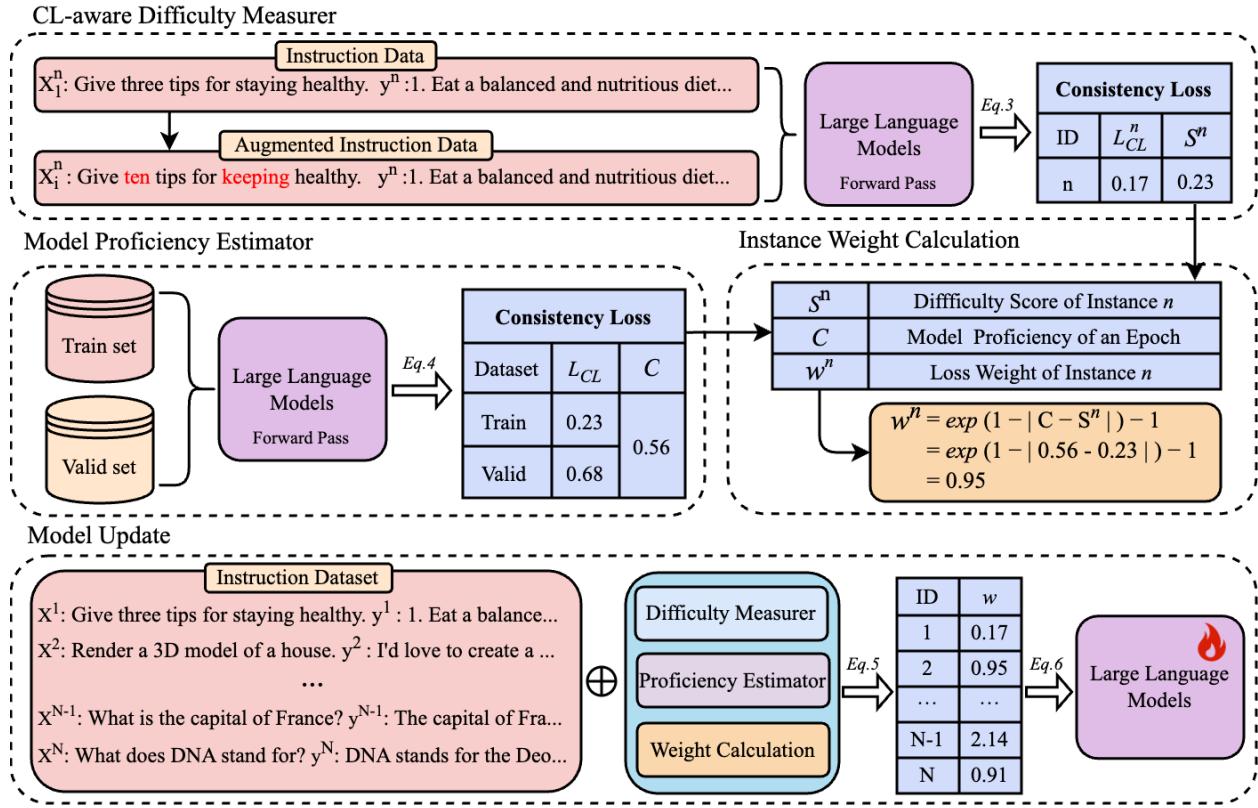
As shown in Figure 1, the process flows from measuring difficulty to estimating proficiency, and finally to adjusting the weights of training examples. Let’s break down these three pillars.
1. The CL-Aware Difficulty Measurer
The authors discovered a crucial insight: Consistency Loss (\(L_{CL}\)) itself is a great proxy for difficulty.
If a model produces vastly different outputs for two slightly varied versions of an input, it likely hasn’t learned the underlying features of that example yet. Therefore, that example is “hard” for the model at that moment.
Instead of counting words or pixels, the system calculates a difficulty score (\(S^n\)) based on the normalized consistency loss of a sample:

In this equation, a higher \(L_{CL}\) results in a higher difficulty score \(S^n\) (ranging from 0 to 1). This metric is dynamic and requires no external domain knowledge.
2. The Model Proficiency Estimator
Knowing how hard a problem is only matters if we know how smart the student is. The researchers needed a way to measure the model’s “Consistency Proficiency” (\(C\)).
They observed an interesting phenomenon: during training, the consistency loss on the training set usually remains stable, but the consistency loss on the validation set rises as the model generalizes. The gap between the validation CL loss and the training CL loss serves as a signal of the model’s growing capacity.
The proficiency \(C\) is calculated as:
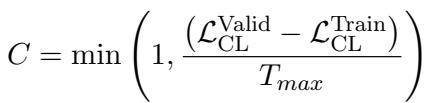
This formula provides a value \(C\) that grows from 0 to 1 as the training progresses, representing the model’s readiness to handle difficult consistency constraints.
3. Dynamic Weight Calculation
Now comes the curriculum strategy. The goal is to match the instance difficulty (\(S^n\)) with the model’s proficiency (\(C\)).
- If a sample’s difficulty matches the model’s current proficiency, it is highly valuable for learning right now.
- If a sample is too hard (far above proficiency) or too easy (far below), it contributes less to the learning process at this specific moment.
The model assigns a weight (\(w^n\)) to each training example using a Gaussian-like function:

When \(C \approx S^n\), the weight \(w^n\) is maximized (\(>1\)). This means the model pays more attention to examples that are “just right” for its current stage of learning—a concept famously known in education as the “Zone of Proximal Development.”
The Final Loss Function
Finally, this dynamic weight is applied to the total loss function. The model optimizes the following:
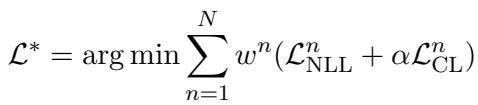
By re-weighting the loss based on the curriculum, the model focuses its energy efficiently, leading to faster and better convergence.
Experiments and Results
To prove that CCL is universally effective, the researchers tested it across four distinct Conditional Sentence Generation tasks:
- Instruction Tuning (IT): Teaching LLMs (like LLaMA-2) to follow user instructions.
- Textual Machine Translation (TMT): German-to-English and English-to-Chinese.
- Multimodal Machine Translation (MMT): Translating image descriptions.
- Speech-to-Text Translation (ST): Translating audio directly to text.
Instruction Tuning Performance
For Large Language Models, the ability to follow instructions is critical. The researchers applied CCL to the LLaMA-2-7B and 13B models.
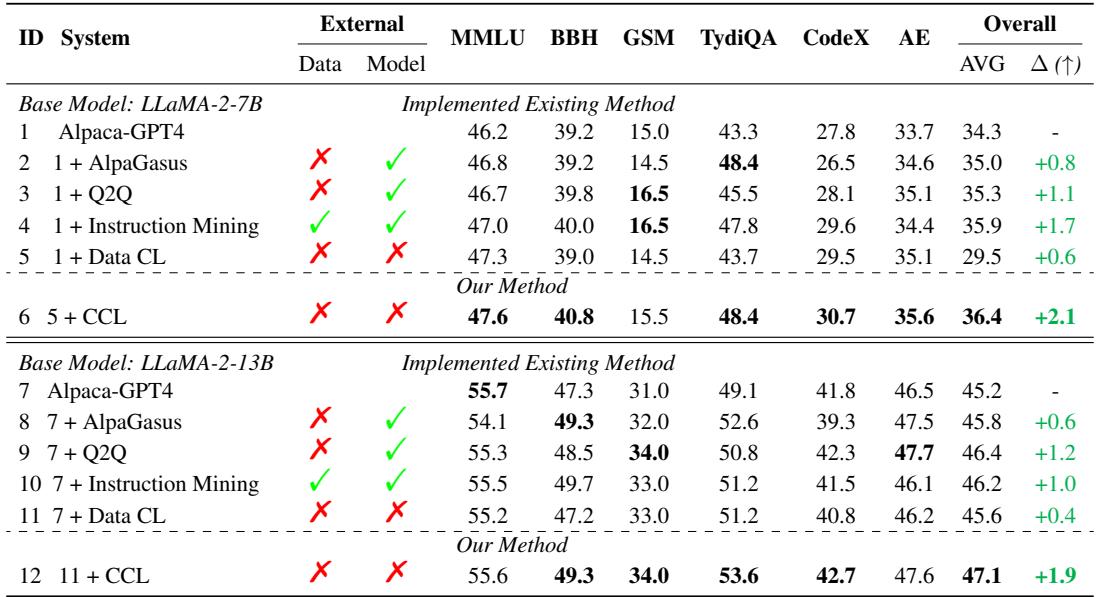
As shown in Table 1, CCL significantly outperforms vanilla instruction tuning and other data selection methods. For the LLaMA-2-7B model, CCL achieved a +2.1 point average improvement across benchmarks like MMLU, GSM (math), and Codex (coding). This suggests that by dynamically prioritizing the right instruction data, the model learns human alignment much more effectively.
Machine Translation Across Modalities
The results were equally impressive for translation tasks involving text, images, and speech.
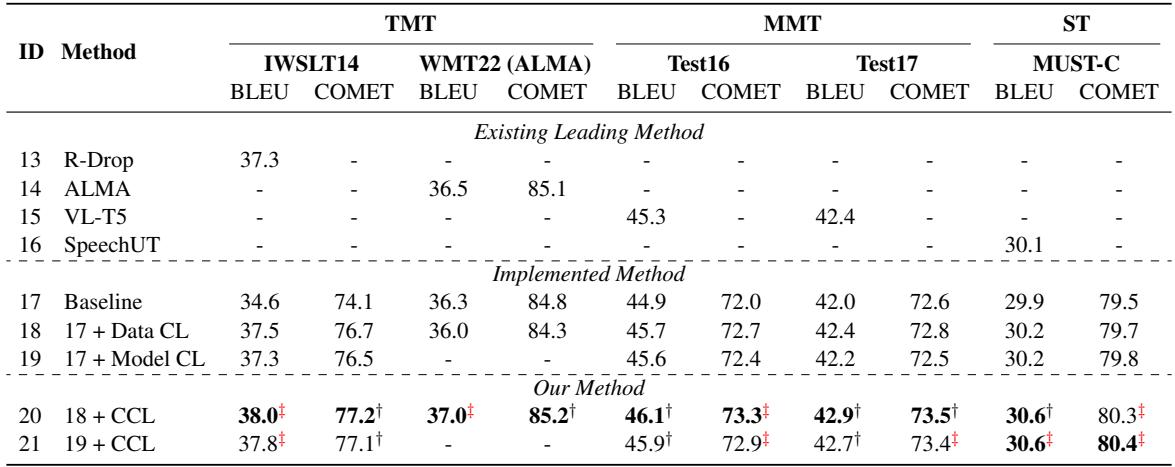
Table 2 highlights that CCL consistently beats the baselines and standard Consistency Learning (R-Drop). Notably, the COMET scores (a metric highly correlated with human judgment) increased by an average of +0.7. This indicates that the translations weren’t just lexically correct (matching words) but semantically richer and more accurate.
Efficiency and Speed
One of the primary motivations for this research was the slow convergence of traditional Consistency Learning. Did CCL fix it?

The learning curves in Figure 2 show a clear trend: CCL (solid lines) rises faster and reaches a higher plateau than standard CL (dashed lines).
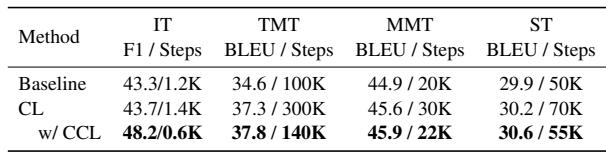
Table 4 quantifies this speedup. In Instruction Tuning, CCL reached the baseline performance in less than half the steps (0.6K vs 1.4K). Across all tasks, the method provided an approximate 1.79x speedup in training time required to reach comparable performance.
Analysis: Why Does It Work?
The researchers dug deeper to understand where the improvements were coming from.
Handling “Hard” Cases
The hypothesis was that CCL helps models tackle difficult examples by scheduling them for later in the training process when the model is proficient enough to handle them.

Figure 3 confirms this. While performance on “Simple” examples is similar between CL and CCL, the CCL method (red/green solid lines) shows a distinct advantage in the “Hard” buckets. By not forcing the model to learn hard consistency constraints too early, the model reserves capacity to master them later.
Validating the “Self-Measured” Difficulty
A skeptic might ask: Is the Consistency Loss really a good measure of difficulty? Maybe we should just stick to sentence length?
The researchers compared their automatic, internal difficulty metric against traditional human-defined metrics (like sentence length, parse tree depth, or number of objects in an image).

Figure 5 shows a strong correlation. As sentence length or image complexity increases, the CL loss naturally increases. This validates that CL loss is a universal, data-driven difficulty measurer that works across text, vision, and speech without requiring manual configuration.
Progression of Learning
Finally, let’s look at when the model actually learns these different samples.
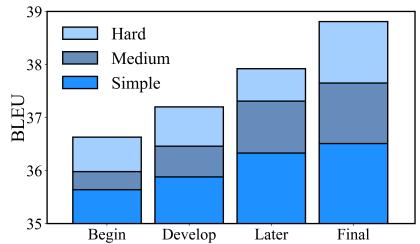
As shown in Figure 4, the model improves on “Simple” and “Medium” samples relatively early (the “Develop” stage). However, the “Hard” samples (light blue bars) see their massive jump in performance during the “Final” stage. This perfectly reflects the curriculum strategy: the model builds a foundation first and tackles the complex nuances at the end.
Conclusion
Curriculum Consistency Learning (CCL) represents a significant step forward in training generative AI models. By treating model training as a pedagogical process—where the “student” (model) is given problems that match their current “proficiency”—we can achieve two things that usually don’t go together: better performance and faster training.
The beauty of CCL lies in its autonomy. It doesn’t need a human to label data as “hard” or “easy.” It uses the model’s own internal consistency struggles to guide the learning process. As models continue to grow in size and multimodal capabilities, efficient, self-guided training strategies like CCL will be essential for the next generation of robust AI.