](https://deep-paper.org/en/paper/file-2916/images/cover.png)
In the fast-paced world of conversational AI, the ability of a system to understand human speech is paramount. When we speak to digital assistants like Siri, Alexa, or customer service bots, we rarely stick to simple, single commands. We combine requests, add constraints, and switch contexts mid-sentence. For a machine, distinguishing “Book a flight to New York” from “Book a flight to New York and find me a hotel near the airport” involves complex reasoning.
This capability is known as Multi-intent Spoken Language Understanding (SLU). While Large Language Models (LLMs) have revolutionized this field, they often struggle with the nuances of highly structured tasks where multiple goals overlap.
In this post, we will dive deep into a recent research paper titled “DC-Instruct: An Effective Framework for Generative Multi-intent Spoken Language Understanding.” The researchers propose a novel framework that teaches LLMs not just to predict labels, but to understand the relationship between tasks and the subtle differences between similar sentences.
By the end of this article, you will understand:
- The dual challenges of Intent Detection and Slot Filling.
- How DC-Instruct uses “Dual-task Inter-dependent Instructions” to make tasks help each other.
- How “Supervised Contrastive Instructions” teach models to spot semantic differences.
- Why this approach outperforms current state-of-the-art generative models.
The Problem: Understanding Complicated Commands
To understand the innovation of DC-Instruct, we first need to understand the task at hand. Spoken Language Understanding typically involves two sub-tasks:
- Multiple Intent Detection (MID): Identifying the high-level goals of the user (e.g.,
BookFlight,BookHotel). - Slot Filling (SF): Extracting specific details or entities (e.g.,
New Yorkis aDestination,tomorrowis aDate).
In the real world, these don’t happen in isolation. Consider the utterance: “Show me the cheapest fare… then where is General Mitchell Intl located.”
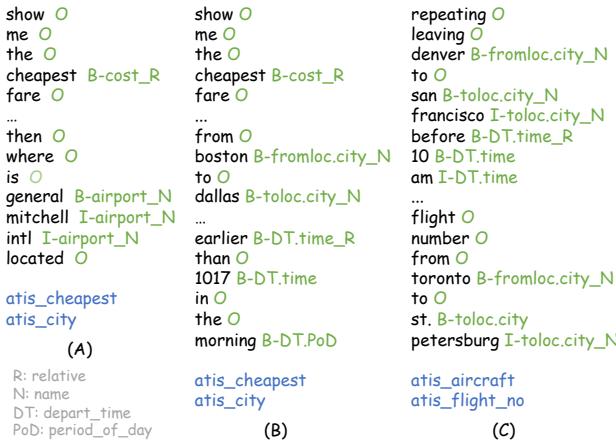
As shown in Figure 1 above (Column A), this single sentence contains two distinct intents: finding an airfare (airfare) and finding airport information (airport). Simultaneously, it contains specific slots like “cheapest” (cost_relative) and “General Mitchell International” (airport_name).
The Limitations of Current Methods
Traditional approaches often treat these two tasks—finding the intent and filling the slots—as separate problems or link them loosely via a shared encoder. More recently, researchers have moved toward generative frameworks (like UGEN), where an LLM is prompted to output the answers.
However, existing generative frameworks suffer from two major “blind spots”:
- Lack of Dependency Modeling: They ask the model to find intents, and then separately ask it to find slots. They don’t explicitly teach the model that knowing the slots (e.g., “airport name”) strongly hints at the intent (e.g., “Find Airport”).
- Ignoring Semantic Differences: They don’t teach the model to compare sentences. For example, in Figure 1, Utterance B ("…from Boston to Dallas") shares the same intent as Utterance A but has very different slot values. Current prompts don’t leverage these similarities and differences to sharpen the model’s reasoning.
This is where DC-Instruct comes in.
The Solution: DC-Instruct Framework
The researchers propose a method that introduces two new types of instructions to the prompting process: Dual-task Inter-dependent Instructions (DII) and Supervised Contrastive Instructions (SCI).
The overall architecture is visualized in Figure 2.
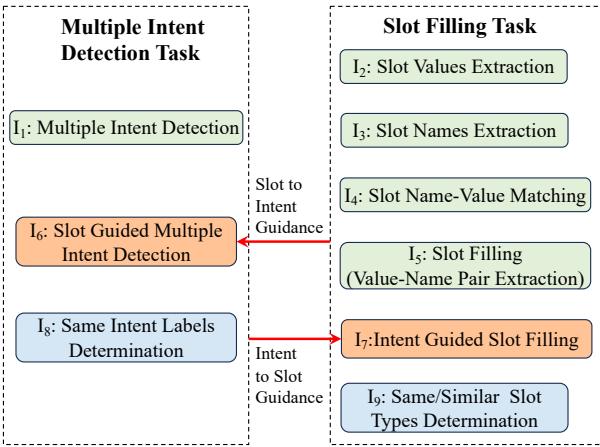
This diagram might look complex, but it breaks down into a logical flow. On the left, we have the inputs (various instruction types \(I_1\) to \(I_9\)). In the center, the Large Language Model (LLM) processes these prompts. On the right, we get the outputs.
Let’s break down the logic behind these new instructions.
1. Dual-task Inter-dependent Instructions (DII)
The core insight here is that Intent Detection and Slot Filling are not independent; they are deeply entangled. If you know a user is talking about a “departure time” (Slot), the intent is likely related to a “Flight.” Conversely, if the intent is “Restaurant Booking,” the model should be looking for slots like “cuisine” or “party size.”
DC-Instruct models this explicitly through instructions \(I_6\) and \(I_7\).
How It Works
Instead of just giving the model the raw sentence, DII embeds the golden labels (the correct answers) of one task into the prompt for the other task during training.

As illustrated in Figure 4, the framework creates a cycle of guidance:
- Slot-Guided Multiple Intent Detection (\(I_6\)): The prompt includes the list of slot types found in the sentence.
- Prompt: “This utterance includes these slot types: cost relative, airport name. What are the intents?”
- Reasoning: The model learns that the presence of
airport nameis a strong signal for theairportintent. - Intent-Guided Slot Filling (\(I_7\)): The prompt includes the list of intents.
- Prompt: “This utterance expresses these intents: cheapest, city. Which words are the slot values?”
- Reasoning: Knowing the intent narrows down the universe of possible slot labels, reducing ambiguity.
This mechanism forces the LLM to learn the alignment between the two tasks. It doesn’t just guess; it reasons based on the interdependent clues provided in the context.
2. Supervised Contrastive Instructions (SCI)
The second innovation addresses the “understanding” gap. Standard supervised learning teaches a model what a label is. Contrastive learning teaches a model why a label is assigned by comparing it to other examples.
In traditional deep learning, contrastive learning works by mathematically pulling similar vector representations together and pushing dissimilar ones apart. But you can’t easily do vector manipulation inside a text-generation prompt.
DC-Instruct solves this by converting contrastive learning into a Question-Answering format (\(I_8\) and \(I_9\)).
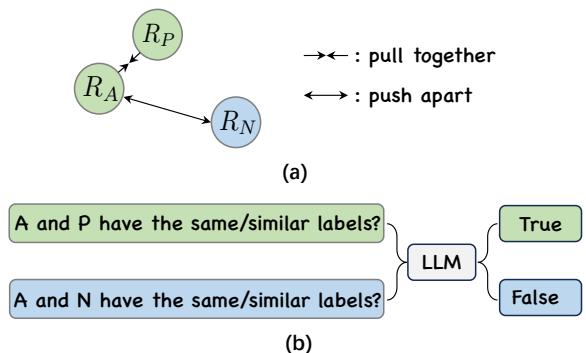
Figure 5 shows the difference. In traditional methods (a), we manipulate vectors (\(R_A, R_P, R_N\)). In DC-Instruct (b), we use natural language questions.
The Contrastive Prompts
The model is presented with pairs of utterances: an Anchor (the current sentence) and a Comparison sentence (either a Positive or Negative sample).
Same Intent Determination (\(I_8\)):
Prompt: “Utterance U1: [Sentence A]. Utterance U2: [Sentence B]. Do U1 and U2 express the same intents? True or False.”
This forces the model to look past the surface words and evaluate the underlying goal of the user.
Same/Similar Slot Types Determination (\(I_9\)):
Prompt: “Do U1 and U2 express the same or similar slot types? True or False.”
This teaches the model to recognize structural similarities even if the specific words (e.g., “Boston” vs. “Dallas”) are different.
By training the LLM to answer “True” or “False” to these comparisons, the model implicitly learns to discriminate between subtle semantic differences, sharpening its ability to categorize correctly during the actual prediction tasks.
Experiments and Results
The researchers tested DC-Instruct on two benchmark datasets: MixATIS and MixSNIPS. They used various LLM backbones, including T5 (Base and Large) and Llama-2 (7B and 13B).
Main Performance Comparison
The results, shown in Table 1, are impressive.
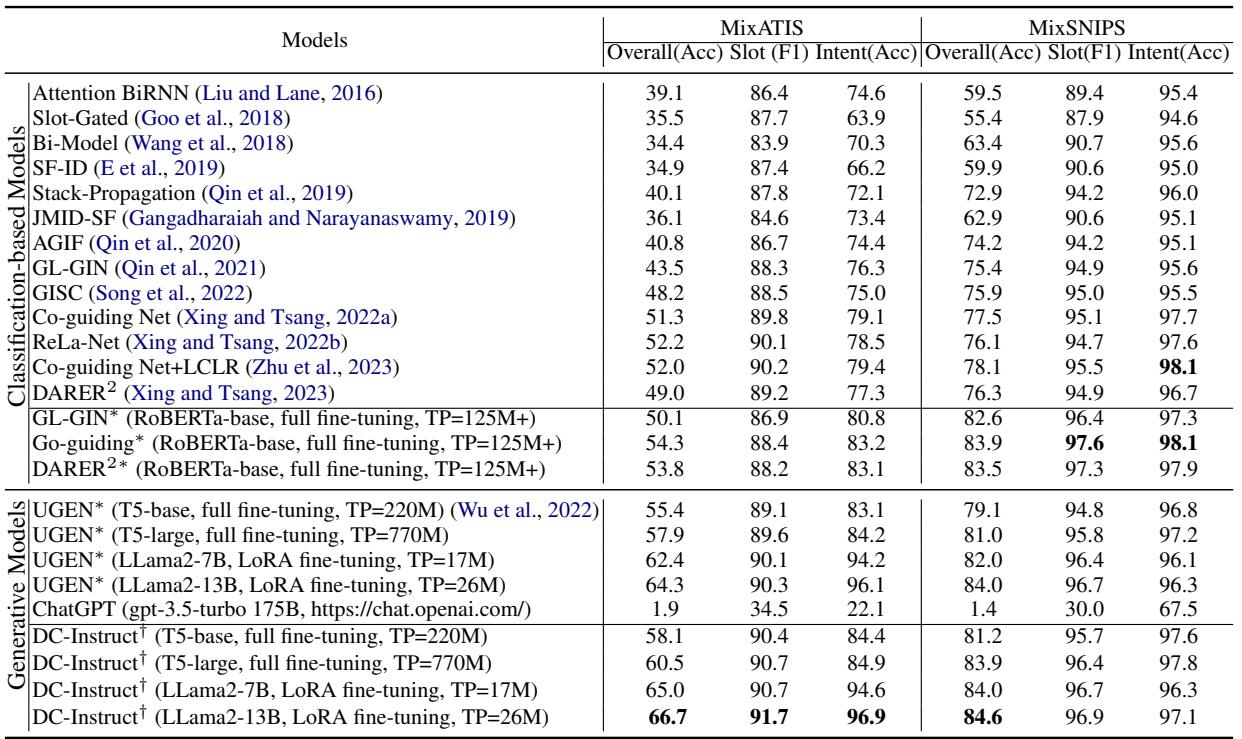
Key takeaways from the data:
- State-of-the-Art: DC-Instruct consistently outperforms the baseline UGEN model across all metrics (Overall Accuracy, Slot F1, and Intent Accuracy).
- Scaling: The improvements hold true whether using a smaller model like T5-Base or a larger model like Llama-2 13B.
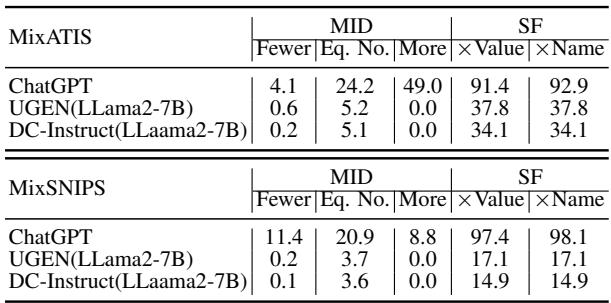
- ChatGPT’s Struggle: Interestingly, the table shows that standard ChatGPT (gpt-3.5-turbo) performs poorly on this specific multi-intent task (Overall Accuracy of 1.9% on MixATIS). This highlights that general-purpose conversational ability does not automatically translate to structured semantic parsing without specific fine-tuning or prompting strategies.
Low-Resource Settings
One of the biggest challenges in AI is training models when you don’t have much data. The researchers simulated this by training on only a fraction of the data (1-shot, 5-shot, 5%, 10%).
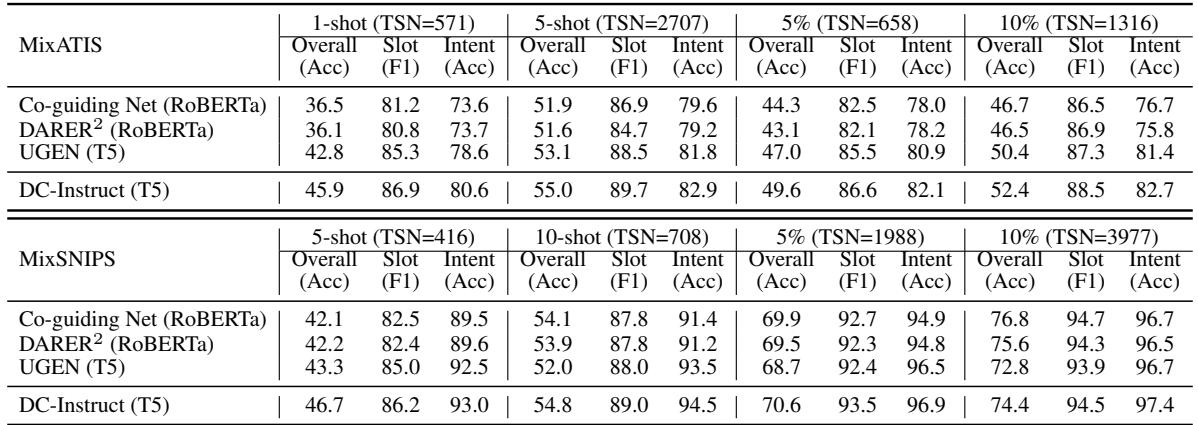
As seen in Table 2, DC-Instruct shines in these “data-poor” environments. In the 1-shot setting on MixATIS (where the model sees very few examples), DC-Instruct achieves an Overall Accuracy of 45.9% compared to UGEN’s 42.8%. This suggests that the Contrastive Instructions (SCI) are highly effective at helping the model generalize from limited examples by teaching it how to compare.
Ablation Study: Do we really need all these parts?
To prove that both the Dual-task Instructions (DII) and Contrastive Instructions (SCI) are necessary, the authors performed an ablation study, removing components one by one.
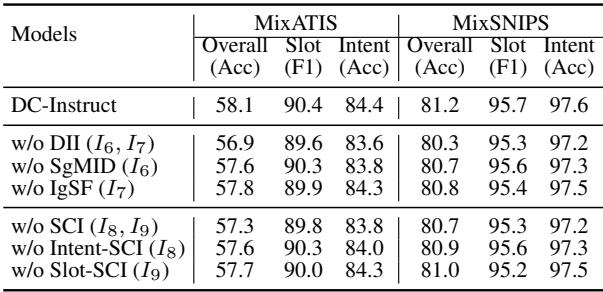
Table 3 reveals:
- Removing DII (\(I_6, I_7\)) causes a significant drop in accuracy. This confirms that explicitly linking the two tasks helps the model perform better on both.
- Removing SCI (\(I_8, I_9\)) also hurts performance. Without the contrastive training, the model loses its sharp discriminative ability.
- The best performance is achieved only when all components are active, demonstrating that these strategies complement each other.
Case Study: Seeing the Reasoning in Action
Numbers are great, but looking at actual predictions helps us understand why the model works better. Figure 6 provides a clear comparison between DC-Instruct and UGEN.
Case A Breakdown
- Utterance: “what’s the fare for a taxi to denver and are meals ever served on tower air”
- UGEN Failure: It predicts the intent as
aircraft+meal. It misses the taxi part entirely and hallucinatesaircraft. - DC-Instruct Success: It correctly identifies
ground fare+meal. - Why? The Slot-Guided (\(I_6\)) instruction likely helped the model associate the slot “taxi” (transport type) with the intent
ground fare, preventing the error.
Case B Breakdown
- Utterance: “what does q mean”
- UGEN Failure: It spots the intent (
abbreviation) but fails to extract any slots. It misses that “q” is the code being asked about. - DC-Instruct Success: It extracts “q” as a
fare basis code. - Why? The Intent-Guided (\(I_7\)) instruction tells the model: “The intent is abbreviation, so look for the term being abbreviated.” This context makes extracting the single letter “q” much easier.
Why This Matters
The DC-Instruct framework represents a significant step forward in how we use Large Language Models for structured tasks. It moves beyond simple “input-output” prompting and introduces structured reasoning into the generation process.
- Interdependency is Key: By forcing the model to verify how slots and intents align, we reduce hallucinations and inconsistencies.
- Comparison equals Understanding: By teaching the model to distinguish between similar and different utterances (via True/False questions), we create a more robust semantic representation, even with less training data.
For students and researchers in NLP, DC-Instruct demonstrates that prompt engineering is not just about writing better sentences—it’s about designing training frameworks that mirror the logical dependencies of the task itself.
The implications extend beyond just booking flights or hotels. This “dual-task” and “contrastive” approach could be applied to any domain where complex, multi-part reasoning is required, from medical diagnosis extraction to legal document analysis.
This blog post summarizes the findings of “DC-Instruct: An Effective Framework for Generative Multi-intent Spoken Language Understanding” by Bowen Xing et al. All figures and tables presented are from the original research paper.