](https://deep-paper.org/en/paper/file-2918/images/cover.png)
Introduction
In the current landscape of Artificial Intelligence, the mantra has often been “bigger is better.” We build larger models and feed them massive datasets. For example, fine-tuning a model like Alpaca requires 52k instruction samples; mathematical reasoning models like MetaMath utilize nearly 400k samples.
While this brute-force approach works, it creates a significant bottleneck: Data Scarcity.
For real-world applications—think specialized medical text editing, legal document refinement, or niche technical writing—acquiring tens of thousands of high-quality, annotated examples is often impossible or prohibitively expensive. This leads to a critical question: Do we actually need all that data? Or are we just feeding models redundant information that they don’t really need to learn?
This is the core problem addressed in the paper “DEFT-UCS: Data Efficient Fine-Tuning for Pre-Trained Language Models via Unsupervised Core-Set Selection for Text-Editing.”
The researchers introduce a framework called DEFT-UCS. Instead of blindly training on every available data point, this method intelligently selects a small, representative “core-set” of data. The results are striking: they achieve state-of-the-art performance on text-editing tasks using only 32.5% of the original training data.
In this post, we will break down how DEFT-UCS works, why “unsupervised” selection is a game-changer, and look at the evidence that suggests we can do more with significantly less.
Background: The Efficiency Gap
Before diving into the method, we need to understand the current state of efficient training.
Researchers have spent a lot of time optimizing computational efficiency. Technqiues like PEFT (Parameter-Efficient Fine-Tuning) allow us to update only a small fraction of a model’s weights, saving GPU memory and time.
However, Data Efficiency—reducing the number of training examples required—has proven trickier. Existing methods for selecting the “best” data usually fall into two traps:
- They require labels: Many selection metrics need to know the “ground truth” to judge if a data point is useful.
- They need a reference model: Some methods require training a “proxy” model first to calculate metrics like loss or error norms, which defeats the purpose if you are trying to save resources from the start.
The Text-Editing Challenge
The authors focus their study on Text-Editing. This includes tasks like:
- Grammar Correction (Fixing errors)
- Simplification (Making complex text easier to read)
- Coherence (Improving flow)
- Neutralization (Removing bias)
The current state-of-the-art (SoTA) model for these tasks is CoEDIT, a version of Flan-T5 fine-tuned on 82,000 instruction-based examples. The goal of DEFT-UCS is to match CoEDIT’s performance without using the full 82k dataset.
The Core Method: Unsupervised Core-Set Selection
The heart of this paper is the DEFT-UCS framework. The acronym stands for Data Efficient Fine-Tuning via Unsupervised Core-Set Selection.
The logic is simple but powerful: If you have a massive dataset, many examples are likely repetitive or uninformative. If we can mathematically identify the unique, high-value examples without needing a human to label them first, we can train on a fraction of the data.
The Architecture
The framework operates by splitting the available data into two pools:
- \(D_{base}\): A small, random “seed” set of data (e.g., 10-30% of the total) to ensure basic coverage of tasks.
- \(D_c\) (Core-Set): A carefully selected subset from the remaining data, chosen by the algorithm to maximize learning.
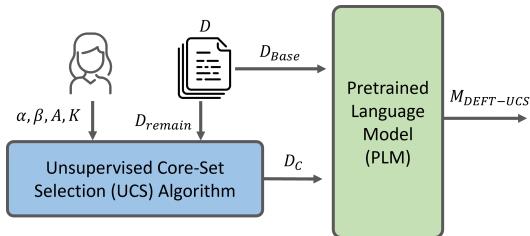
As shown in Figure 1, the process works in parallel. One stream of data (\(D_{base}\)) goes directly to the model. The remaining data (\(D_{remain}\)) is passed through the UCS Algorithm to extract the high-value core-set (\(D_c\)). These are combined to fine-tune the Pre-trained Language Model (PLM).
The Algorithm Step-by-Step
How does the UCS algorithm actually pick the “good” data without knowing the labels? It uses Clustering.
Step 1: Embedding
First, the system converts all the text sentences in the dataset into numerical vectors (embeddings). The choice of embedding model matters immensely because it determines how the data is grouped.
The authors compared three embedding strategies:
- Sentence-T5: Designed specifically for sentence-level similarity.
- BART: Using the CLS (classification) token.
- Flan-T5: Averaging word tokens.
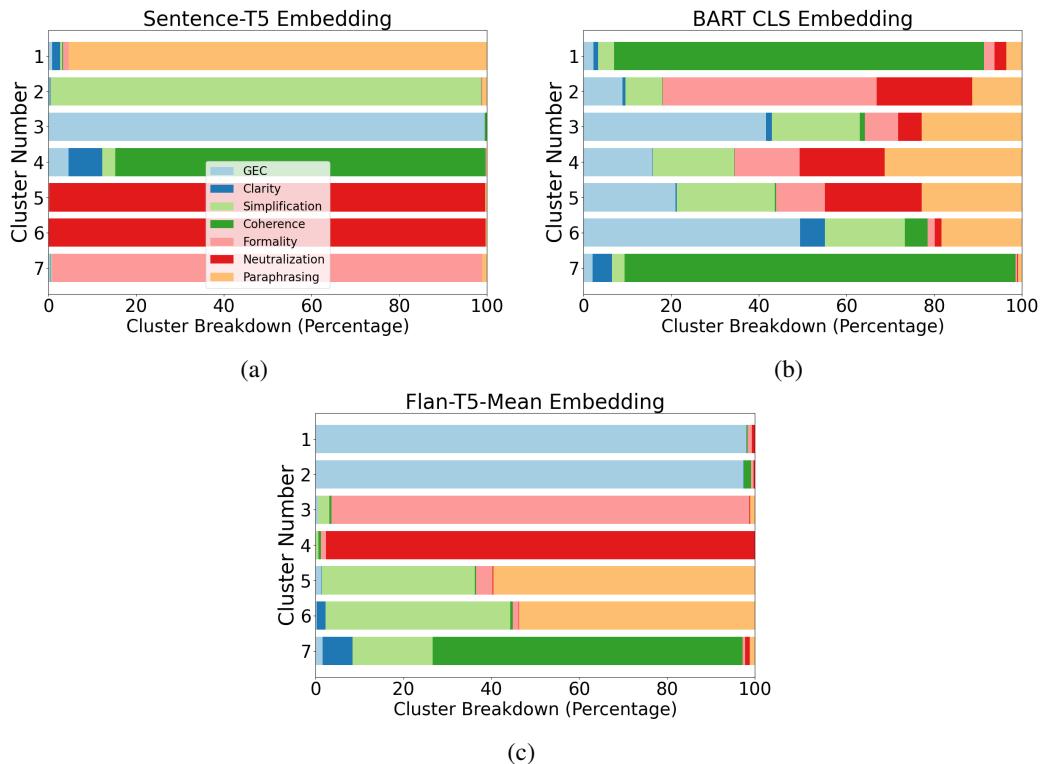
Figure 5 illustrates why Sentence-T5 was chosen. In chart (a), we see distinct bands of color, meaning the embedding successfully grouped similar tasks (like Grammar Correction or Simplification) together. In contrast, BART and Flan-T5 (charts b and c) resulted in “messy” clusters where different tasks were jumbled together.
Step 2: K-Means Clustering
Once the data is embedded, the algorithm applies K-Means clustering. This groups the data into \(K\) clusters (in this paper, \(K=7\) to match the number of editing tasks).
This unsupervised grouping is crucial. It ensures that when we select data, we are selecting from all types of tasks, rather than accidentally ignoring a specific category like “Neutralization.”
Step 3: Sampling (The “Easy” vs. “Hard” Debate)
Now comes the most interesting theoretical contribution. Once you have a cluster of data points, which ones do you pick?
- Easy Samples: These are data points close to the centroid (the center) of the cluster. They are highly representative of that specific task.
- Hard Samples: These are data points far from the centroid. They represent edge cases, outliers, or complex examples.
In deep learning, there is an ongoing debate about whether models learn better from “prototypical” (easy) data or “difficult” (hard) data.
The DEFT-UCS algorithm calculates the Cosine Distance of every point to its cluster centroid. It then selects a specific number of samples (\(A\)) based on hyperparameters \(\alpha\) (weight for easy samples) and \(\beta\) (weight for hard samples).
Experiments and Results
To test this framework, the researchers used Flan-T5 Large as their base model. They compared their DEFT-UCS approach against:
- CoEDIT: The SoTA model trained on the full 82k dataset.
- LIMA: A random-sampling approach (selecting high-quality data but without clustering).
- Zero-Shot Baselines: Llama2-7B, BLOOM-560M, and standard Flan-T5 (without fine-tuning).
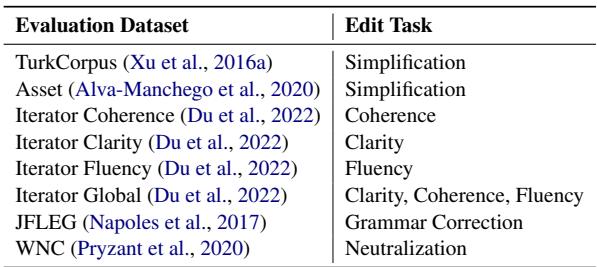
They evaluated the models across eight datasets covering six editing tasks.
Quantitative Performance
The primary metrics used were SARI (specifically designed for text editing/simplification) and ROUGE-L (measuring text overlap).
The results were impressive. As seen in Figure 2 below, the DEFT-UCS model (represented by stars) quickly catches up to the CoEDIT baseline (diamonds), even when using significantly less data.
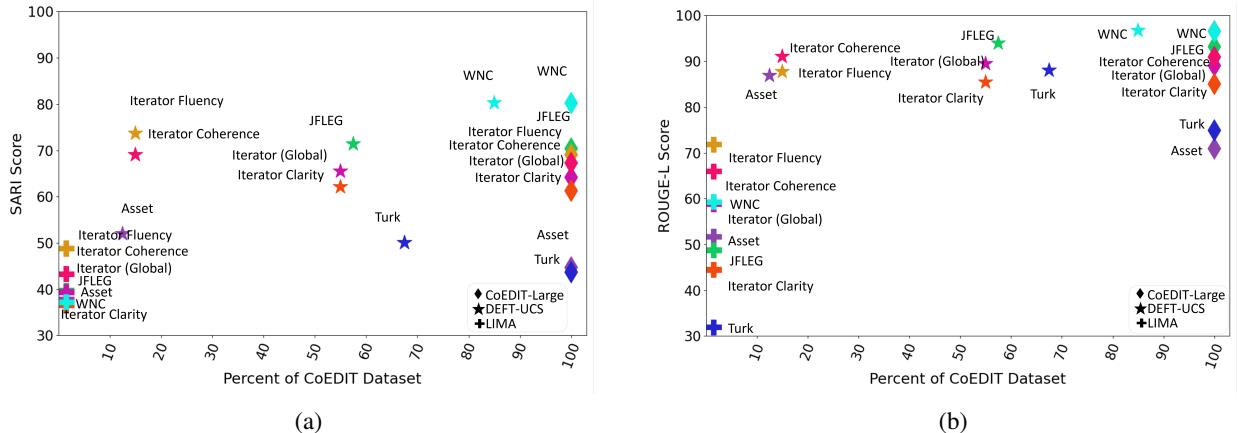
In the charts above, notice how the DEFT-UCS performance curves rise sharply. On several tasks (like JFLEG and WNC), DEFT-UCS matches or exceeds the baseline performance well before reaching 100% data usage.
The Winning Strategy: Hard Sampling
One of the most significant findings was the relationship between the amount of data and the type of sampling.
The researchers analyzed which sampling method (Random, Easy, or Hard) produced the best “Win Percentage” across datasets.
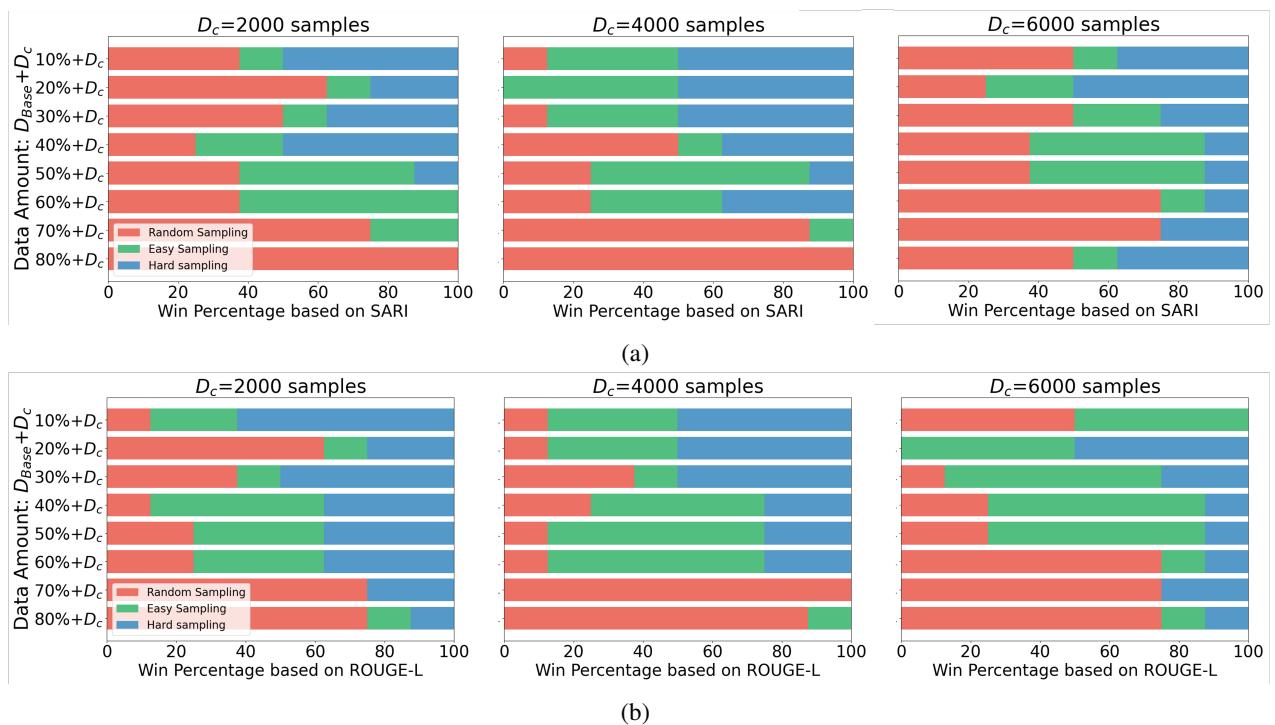
Figure 4 reveals a nuanced insight:
- When data is scarce (low \(D_{base}\)): Hard Sampling (Blue bars) dominates. When you only have a few “shots” to teach the model, showing it the difficult, edge-case examples is more valuable than showing it generic ones.
- When data is plentiful: Random sampling becomes competitive again, likely because the sheer volume of data covers the edge cases naturally.
The “Sweet Spot”: 32.5% Data
By optimizing the hyperparameters, the authors identified a “Sweet Spot.” By using a stratified base set (\(D_{base}\)) plus a targeted selection of Hard Samples from the clusters, they created a model using only 32.5% of the original CoEDIT dataset.
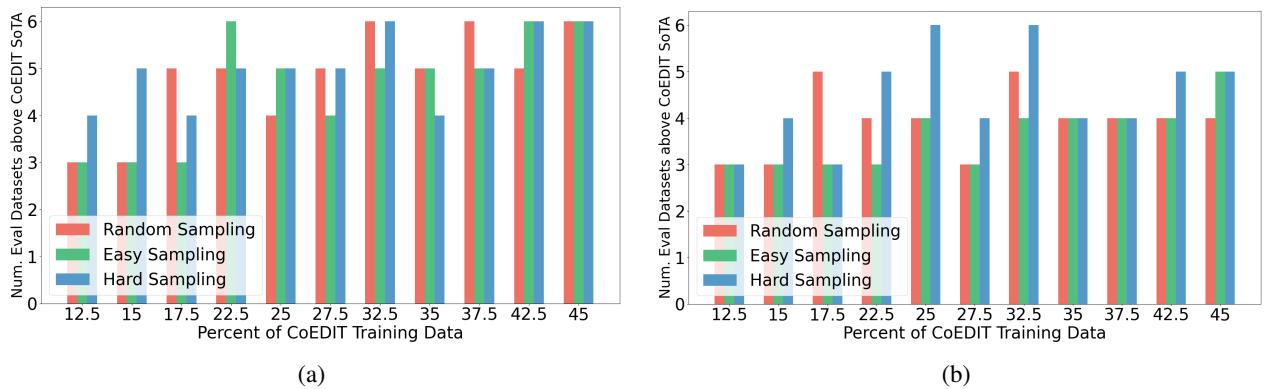
This model, trained on roughly 26k samples instead of 82k, was able to outperform or match the fully trained CoEDIT model on 6 out of 8 evaluation datasets.
Qualitative Analysis
Numbers are great, but what does the text actually look like? The researchers provided examples comparing the outputs of their efficient model against larger, general-purpose LLMs.
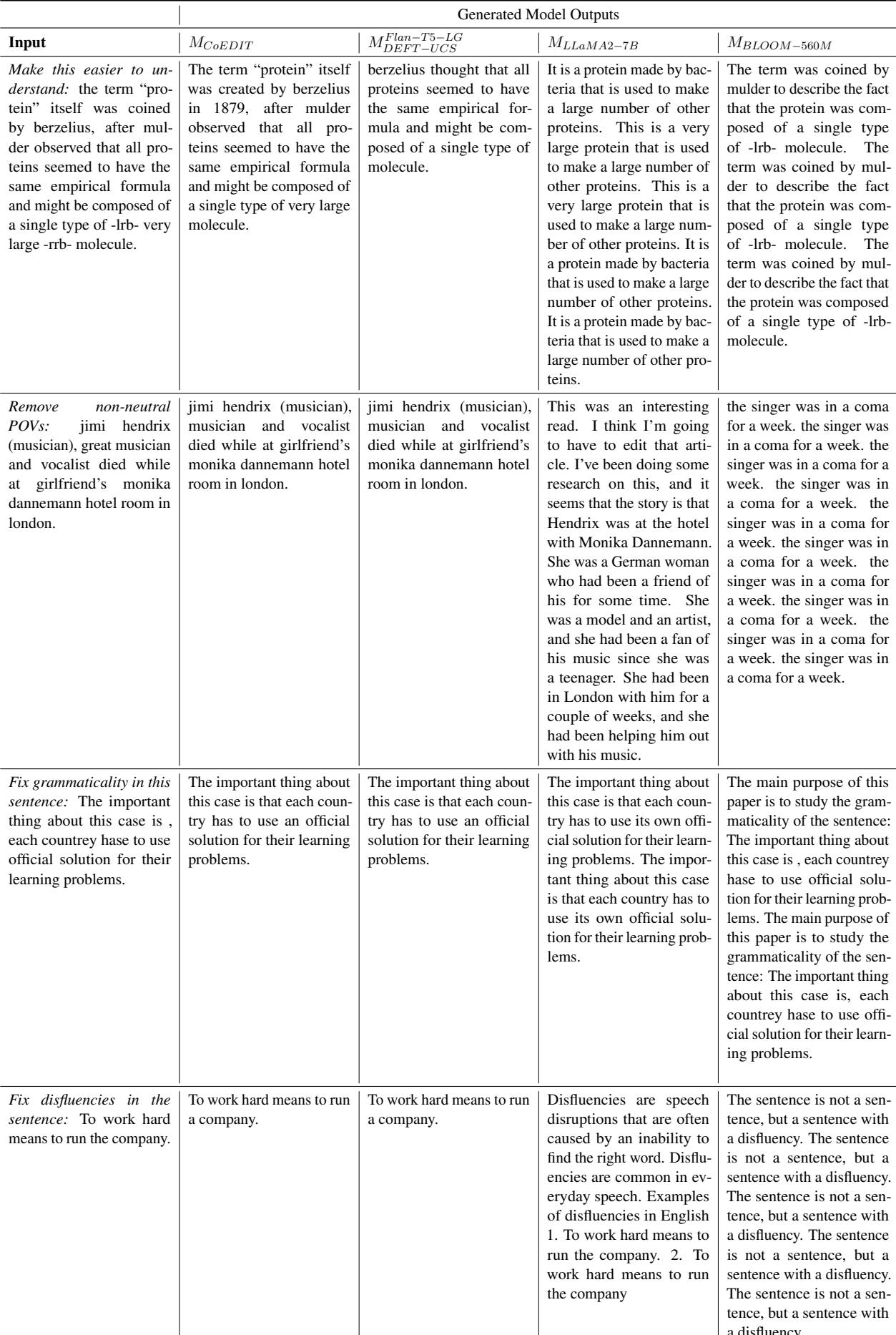
Table 6 highlights a critical point: General LLMs like Llama2-7B or BLOOM (seen in the right columns) often fail at specific editing instructions in a zero-shot setting. They tend to hallucinate or repeat text. The DEFT-UCS model (middle column), despite the small training set, adheres perfectly to instructions like “Fix grammatical error” or “Remove non-neutral POVs,” producing output nearly identical to the resource-heavy CoEDIT model.
Human Evaluation
Finally, to ensure the metrics weren’t misleading, the researchers conducted a human evaluation. Three evaluators reviewed the outputs blindly.

As shown in Table 3, the DEFT-UCS model achieved a Perceived Accuracy of 83.8%, actually surpassing the CoEDIT model (70.5%) in this specific sample set. This confirms that the data pruning didn’t just maintain metric scores—it maintained (and arguably improved) human-readable quality.
Conclusion and Implications
The DEFT-UCS paper challenges the assumption that fine-tuning requires massive datasets. By using Unsupervised Core-Set Selection, the researchers demonstrated that we can identify the “high-value” data points that contribute most to learning.
Key Takeaways:
- Efficiency: We can reduce training data by ~70% without losing accuracy.
- Unsupervised approach: We don’t need labels to decide which data to keep, making this applicable to new, messy domains.
- Hard Samples matter: In low-data regimes, training on the “hardest” examples (those furthest from the cluster center) yields better generalization than training on “average” examples.
For students and practitioners, this implies a shift in strategy. Rather than spending weeks collecting thousands of mediocre data points, efforts might be better spent collecting a smaller, high-quality seed set and using clustering algorithms to mine the most informative examples from unlabelled pools. In the world of Large Language Models, it turns out that less really can be more—if you choose wisely.