](https://deep-paper.org/en/paper/file-2931/images/cover.png)
Social media has fundamentally changed how we consume information. It is a double-edged sword: while it democratizes information, it also serves as a breeding ground for rumors and misinformation. In the “post-truth” era, the challenge isn’t just about identifying false statements; it is about navigating a chaotic environment full of noise, subjectivity, and malicious intent.
For researchers and data scientists, rumor detection is notoriously difficult. Why? Because belief is subjective. As psychologists Tversky and Kahneman noted with the “anchoring effect,” people are willing to believe information that aligns with their pre-existing cognitive anchors. A rumor spreads not just because it is sensational, but because it resonates with the disseminator’s intent.
In this post, we are diving deep into a fascinating paper: “Deciphering Rumors: A Multi-Task Learning Approach with Intent-aware Hierarchical Contrastive Learning.” The researchers propose a novel architecture, IRDNet, which doesn’t just look at the text of a tweet. It attempts to mathematically model the intent behind the rumor and uses psychological concepts to build a more robust detection system.
If you are a student of machine learning or NLP, this paper offers a masterclass in combining Multi-Task Learning (MTL), Capsule Networks, and Hierarchical Contrastive Learning. Let’s break it down.
The Core Problem: Noise and Subjectivity
Traditional rumor detection methods often treat the task as a simple binary classification problem: True or False. They rely heavily on feature engineering or standard deep learning models (like RNNs or CNNs) to parse text.
However, these methods face three significant hurdles:
- Subjectivity: They ignore the “willingness to believe.” They fail to capture the latent intent of the user spreading the information.
- Robustness: Social media data is noisy. A slight change in phrasing or a typo can fool a brittle model.
- Consistency: Existing data augmentation techniques (used to train models) often change the semantic meaning of a sentence, introducing noise rather than helpful training signals.
The Limitation of Traditional Data Augmentation
To understand why a new approach is needed, we must look at how models are typically trained. To make models robust, engineers use “data augmentation”—creating slightly modified versions of a sentence to expand the training set.
However, traditional augmentation (like random deletion or reordering) can inadvertently change the intent of a sentence.
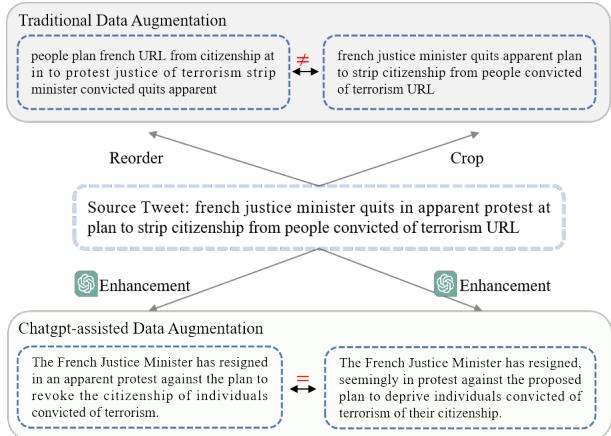
As shown in Figure 1, traditional methods (top branch) might chop up a sentence about a minister resigning, potentially losing the context of why they resigned. In contrast, the researchers propose using Large Language Models (specifically ChatGPT) for augmentation (bottom branch). This ensures that the generated examples maintain the original intent and semantic meaning, serving as better “anchors” for the model to learn from.
The Solution: Intent-Aware Rumor Detection Network (IRDNet)
The researchers propose IRDNet, a framework that treats rumor detection as a dual challenge: distinguishing the truthfulness of the content while simultaneously mining the latent intent of the user.
High-Level Architecture
The model operates on a Multi-Task Learning framework. This means it optimizes two objectives at once:
- Supervised Learning: The primary task of classifying the rumor (True, False, Unverified, Non-Rumor).
- Self-Supervised Learning: A contrastive learning task that aligns representations based on event and intent similarity.
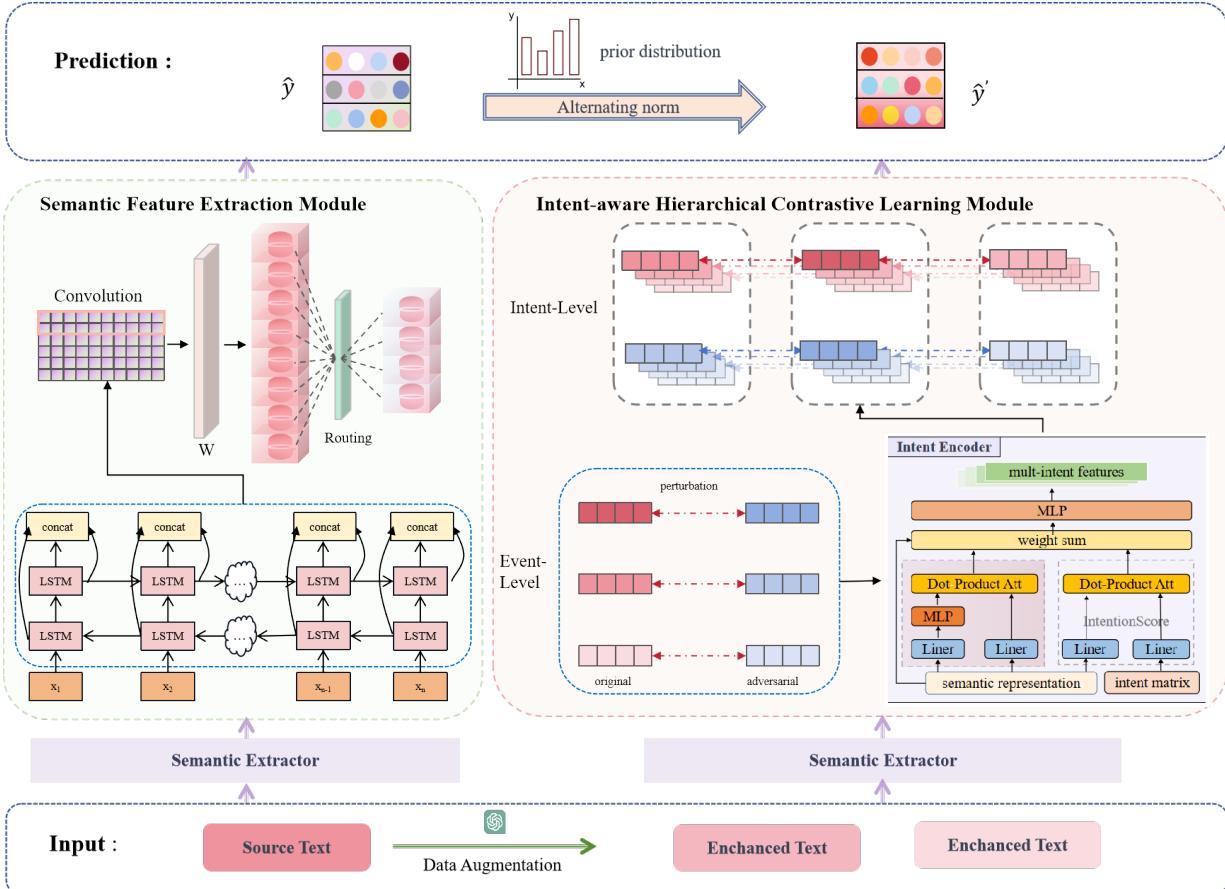
Figure 2 provides the roadmap for the architecture. The process begins with the source text, which undergoes augmentation. It is then fed into two parallel modules: the Semantic Feature Extraction Module (left) and the Intent-aware Hierarchical Contrastive Learning Module (right).
Let’s dissect these modules to understand the engineering beneath the hood.
Part 1: Semantic Feature Extraction
The goal of this module is to convert raw text into a rich, deep numerical representation. The researchers don’t rely on a single technique; they stack three powerful technologies to capture different aspects of language.
Step 1: Context with BERTweet
First, the tweet \(s_i\) is passed through BERTweet, a pre-trained language model optimized for English tweets. Unlike standard BERT, BERTweet understands the idiosyncrasies of social media language (hashtags, handles, slang). This outputs a sequence of embeddings \(e_i\).
Step 2: Sequential Features with BiLSTM
Language is sequential. The meaning of a word depends on what came before and after it. To capture this, the embeddings are fed into a Bidirectional Long Short-Term Memory (BiLSTM) network.

As seen in the equation above, the hidden state \(H_i\) is a concatenation of the forward LSTM (reading left-to-right) and the backward LSTM (reading right-to-left). This ensures the model captures the complete sequential context.
Step 3: Hierarchical Features with Capsule Networks
This is where the model gets interesting. Convolutional Neural Networks (CNNs) are good at finding local features (like key phrases), but they lose spatial information due to pooling layers. To fix this, the authors use Capsule Networks.
Capsule Networks group neurons into “capsules” that represent specific features. Instead of standard pooling, they use a “dynamic routing” mechanism to decide how information flows from lower-level features to higher-level concepts.
First, the features are passed through a 1D convolution and normalized using a Squash Function:

The squash function preserves the direction of the vector (which represents the property of the feature) while squashing its length to between 0 and 1 (representing the probability that the feature exists).
Next, the model uses Dynamic Routing to determine the connection between the primary capsules and higher-level capsules.
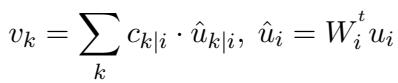
The output \(v_k\) is a weighted sum of prediction vectors, where the weights \(c_{k|i}\) are determined by how much the lower capsule “agrees” with the higher capsule. These coefficients are updated iteratively:
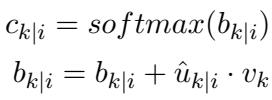
By the end of this process, the Capsule Network outputs a vector \(v_k\) that encapsulates multi-level, hierarchical semantic features—capturing not just what words are present, but the structural relationship between them.
Part 2: Intent-Aware Hierarchical Contrastive Learning
While feature extraction is standard in many models, the Contrastive Learning (CL) module is the core innovation of IRDNet.
The intuition here is based on the psychological “Anchoring Effect.” The model tries to create “anchors”—stable representations of rumors—and pull similar instances closer together while pushing dissimilar ones apart. The researchers do this at two levels: the Event Level and the Intent Level.
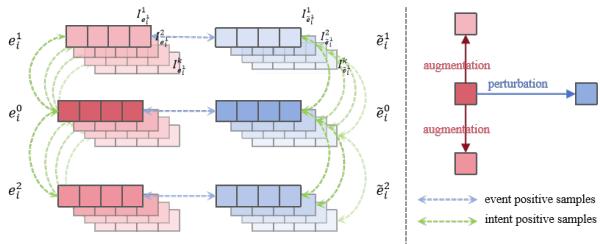
Figure 3 illustrates this dual-stream approach. Let’s look at both levels.
Level 1: Event-Level Contrastive Learning
This level focuses on Robustness. The goal is to ensure that the model recognizes a rumor even if the text is noisy or slightly altered.
To achieve this, the researchers use two techniques:
- Data Augmentation: As mentioned earlier, they use ChatGPT to generate high-quality variations (\(e_i^1, e_i^2\)) of the original tweet (\(e_i^0\)).
- Adversarial Training: They deliberately inject mathematical noise into the embeddings to fool the model. This is known as the Fast Gradient Sign Method (FGSM).

Here, \(r_i\) is the perturbation added to the embedding. It is calculated based on the gradient of the loss function. Essentially, the model asks: “What small change would confuse me the most?” and then adds that change to the training data.
The Event-Level Loss Function forces the model to treat the original tweet, the ChatGPT-augmented version, and the adversarial version as the same “event.”
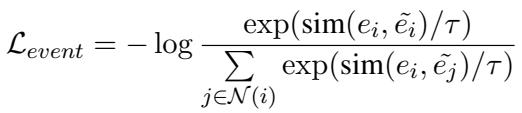
This equation minimizes the distance between positive pairs (the tweet and its augmented/adversarial versions) while maximizing the distance from negative pairs (unrelated tweets).
Level 2: Intent-Level Contrastive Learning
This level focuses on Subjectivity. It attempts to capture the latent motivation behind the post.
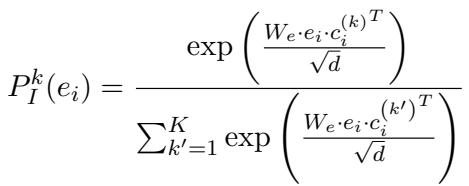
The researchers introduce a “Latent Intent Matrix” \(C\), which represents \(K\) different types of potential user intentions. The model learns to map the tweet to these intentions.
Saliency Weight: First, the model calculates a “Saliency Weight” to determine which parts of the tweet are actually important, filtering out noise.


These are combined to form an attention mechanism:
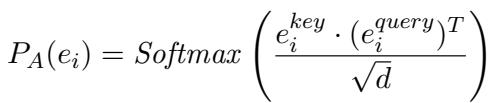
Intent Score: Next, the model calculates an Intent Score, \(P_I^k(e_i)\), which measures the probability that tweet \(e_i\) belongs to the \(k\)-th latent intention.
Finally, the specific intent representation is generated by combining the intent probability, the saliency weight, and the original embedding:

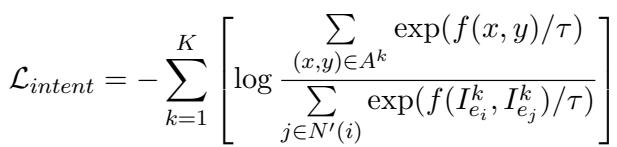
The Intent Loss Function: Similar to the event level, the model uses a contrastive loss function here. It pulls together samples that share the same latent intent and pushes apart those that have different intents.
Joint Optimization
The final magic happens when all these pieces are trained together. The total loss function combines the standard Cross-Entropy classification loss (\(\mathcal{L}_{CE}\)) with the contrastive losses, weighted by a parameter \(\lambda\).

This ensures the model is learning to classify rumors accurately (supervised) while simultaneously learning robust, intent-aware features (self-supervised).
Experiments and Results
Does this complex architecture actually work? The researchers tested IRDNet on two real-world datasets: Twitter15 and Twitter16. These datasets contain tweets labeled as Non-rumor (N), False rumor (F), True rumor (T), and Unverified (U).
Comparison with Baselines
IRDNet was compared against several state-of-the-art models, including Deep Learning methods (GRU-RNN), Graph Neural Networks (BiGCN), and other Contrastive Learning methods (RAGCL).
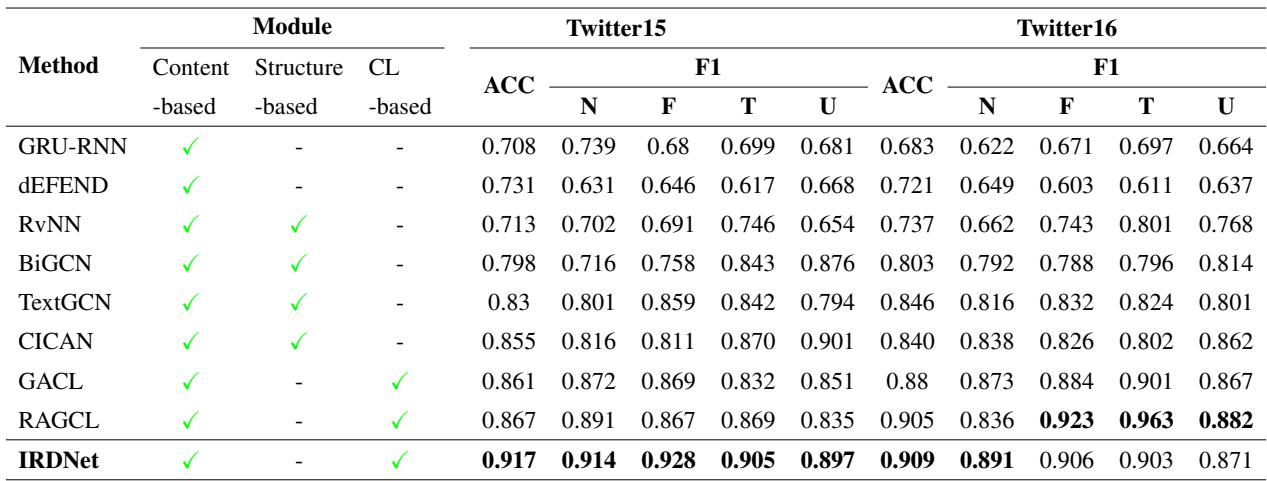
As shown in Table 1 (above), IRDNet achieves the highest accuracy on both datasets (0.917 on Twitter15 and 0.909 on Twitter16).
- vs. Content-based models (GRU-RNN): IRDNet wins significantly because it captures deeper semantic and hierarchical features.
- vs. Structure-based models (BiGCN): While Graph networks are good, they struggle with noise. IRDNet’s adversarial training gives it the edge in robustness.
- vs. Contrastive Learning models (RAGCL): IRDNet outperforms them by explicitly modeling intent rather than just structural or textual similarity.
Ablation Studies: Do we need all the parts?
To prove that every component matters, the researchers removed parts of the model one by one.
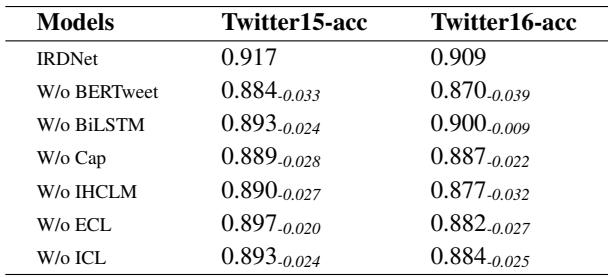
Table 2 reveals:
- W/o BERTweet: Performance drops significantly (~3-4%), showing the importance of a domain-specific pre-trained model.
- W/o IHCLM: Removing the Intent-aware Hierarchical Contrastive Learning Module causes a substantial drop, proving that the contrastive learning strategy is the core driver of performance.
- W/o ECL vs. W/o ICL: Both Event-Level (ECL) and Intent-Level (ICL) contrastive learning contribute to the score. Removing either hurts the model, confirming they are complementary.
Early Rumor Detection
One of the most critical requirements for a rumor detection system is speed. You need to catch a rumor before it spreads, when there are very few comments or retweets.
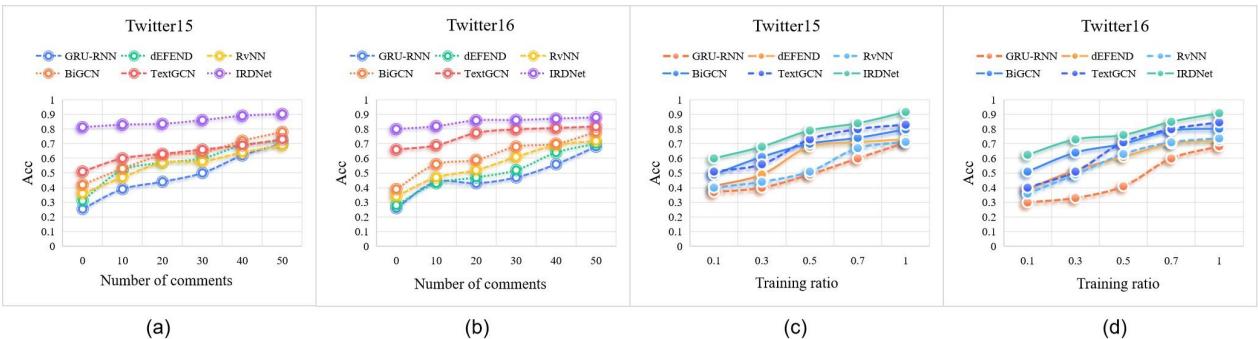
Figure 4 demonstrates the model’s efficiency:
- Charts (a) and (b): The x-axis represents the number of comments available. IRDNet (the red line) achieves high accuracy very quickly, even with limited comments.
- Charts (c) and (d): These show performance based on the ratio of training data. Even when trained on only 10-20% of the data, IRDNet maintains a significant lead over competitors like TextGCN (purple line). This “data efficiency” is a direct result of the contrastive learning, which squeezes more information out of every training example.
Hyperparameter Sensitivity
How many “intents” should the model look for? The researchers analyzed the parameter \(K\) (number of latent intentions).
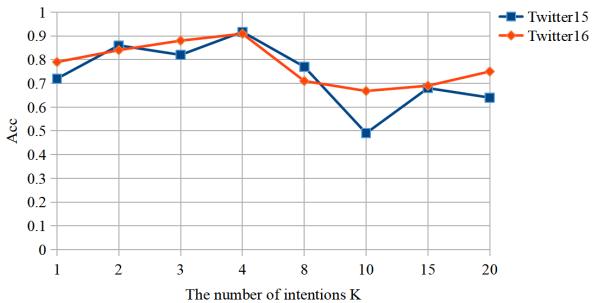
Figure 5 shows that performance peaks at \(K=4\).
- If K is too low (K=1): The model fails to distinguish between different types of user motives.
- If K is too high (K>4): The intents become too fragmented and fine-grained, introducing noise. This suggests that for these datasets, there are roughly four distinct underlying “intentions” driving rumor propagation.
Why This Matters
The IRDNet paper is a significant step forward because it acknowledges a fundamental truth about social media: Context and Intent are King.
By moving beyond simple text analysis and incorporating psychological concepts like the Anchoring Effect, the researchers have built a model that is:
- More Human-Like: It considers why something was posted.
- More Robust: It uses adversarial training to prepare for the messy reality of the internet.
- Data Efficient: It works well even in the early stages of a rumor’s life cycle.
For students and practitioners, this paper highlights the power of Multi-Task Learning. By forcing a model to solve a difficult auxiliary task (like figuring out user intent) alongside the main task (classification), you often end up with a much stronger, more generalized system.
As we continue to battle misinformation, architectures like IRDNet—which blend cognitive science with advanced deep learning—will likely become the standard for digital immune systems.