](https://deep-paper.org/en/paper/file-2974/images/cover.png)
In the modern digital landscape, we are swimming in a sea of documents. Every day, millions of PDFs, scanned images, and slides are generated. To a human, these documents have a clear structure: a title at the top, followed by sections, subsections, paragraphs, and figures. We intuitively understand that a “Section Header” is the parent of the “Paragraph” beneath it.
To a computer, however, a scanned PDF is often just a bag of pixels or, at best, a disorganized stream of text and bounding boxes.
This disconnect is a major bottleneck for Artificial Intelligence. If we want machines to truly understand documents—for tasks like information retrieval, database storage, or Retrieval-Augmented Generation (RAG)—we need them to understand Document Hierarchy Parsing (DHP).
In this post, we will dive deep into a recent paper titled “DocHieNet: A Large and Diverse Dataset for Document Hierarchy Parsing.” The researchers from Zhejiang University and Alibaba Group have tackled two massive problems in this field: the lack of realistic training data and the inability of current models to handle long, multi-page documents.
The Problem: Why DHP is Harder Than It Looks
Document Hierarchy Parsing is the task of reconstructing the “tree” structure of a document. Imagine a Table of Contents; DHP aims to generate that structure automatically for every element on every page.
While Optical Character Recognition (OCR) gives us the text, and Layout Analysis gives us the boxes (where the paragraphs and images are), neither tells us how they relate to each other.
The Data Deficit
For years, the research community has been hindered by a lack of good data. Previous datasets were:
- Too Small: Datasets like arXivdocs contained only a few hundred pages.
- Too Simple: They often focused on single pages, ignoring the complexity of documents that span 50+ pages.
- Too Homogenous: They relied heavily on scientific papers (which have very predictable layouts) and ignored the chaotic variety of real-world documents like financial reports, magazines, or government tenders.
This lack of diversity meant that models trained on existing data would fail spectacularly when faced with a glossy magazine layout or a complex legal contract.
Contribution 1: The DocHieNet Dataset
To solve the data problem, the authors introduce DocHieNet. It is currently the largest and most diverse dataset for document hierarchy parsing.
Key Stats:
- 1,673 Documents: Covering diverse domains (legal, financial, educational, etc.).
- Multi-Page: Documents run up to 50 pages long.
- Bilingual: Includes both English and Chinese documents.
- Complex Layouts: It moves beyond the standard single-column text.
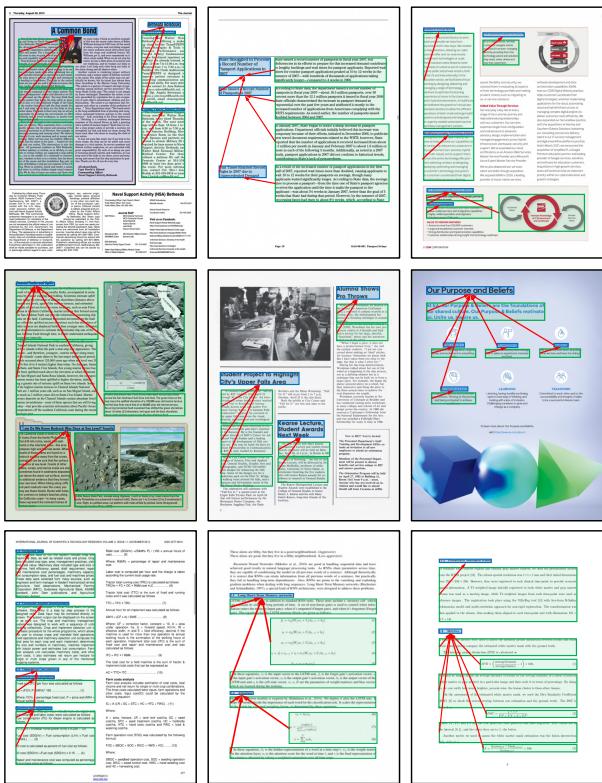
As shown in Figure 1, the diversity is striking. We aren’t just looking at academic papers anymore; we see web pages, slides, complex diagrams, and multi-column newsletters. The red lines illustrate the hierarchical relationships the model needs to predict.
A New Standard for Annotation
One of the subtle but critical contributions of this paper is how they chose to label the data. In the past, datasets used inconsistent standards. Some labeled hierarchy at the text-line level (which is too granular and creates massive trees) while others used vague block definitions.
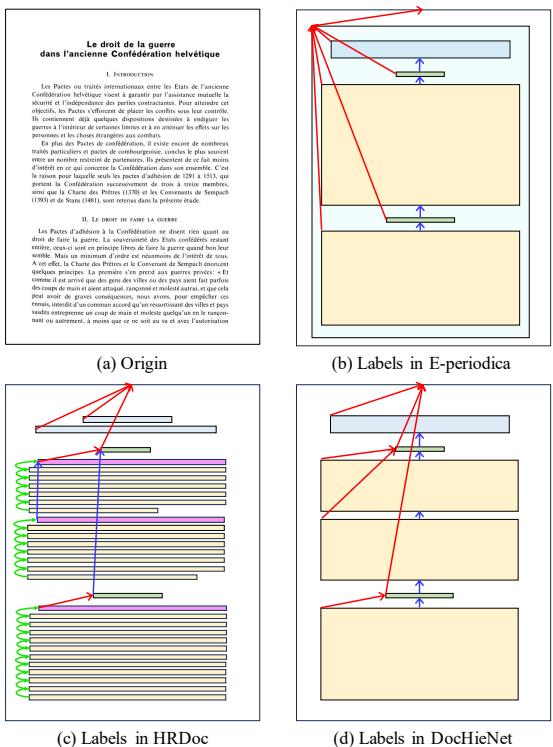
Figure 2 illustrates this evolution:
- (a) & (b): Previous attempts often struggled with logical flow or were limited to single pages.
- (c) HRDoc: Used line-level annotations (green lines connect lines into paragraphs). This confuses the task of “grouping text” with “understanding hierarchy.”
- (d) DocHieNet: Annotates at the layout element level. This assumes an OCR system has already grouped text into blocks (paragraphs, titles), allowing the DHP model to focus purely on the high-level tree structure (red lines).
This design choice makes the dataset much more reflective of real-world applications, where we usually care about how a whole paragraph relates to a section title, not how line 1 relates to line 2.
The complexity of DocHieNet compared to previous benchmarks is evident in the data distribution:
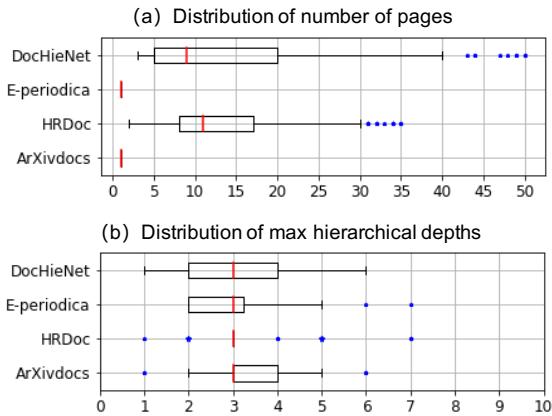
As seen in Figure 3, DocHieNet (blue bars) has a much wider distribution of page counts (Plot a) and supports deeper hierarchical structures (Plot b) compared to datasets like arXivdocs or E-Periodica.
Contribution 2: The DHFormer Framework
Having a great dataset is only half the battle. The researchers also needed a model capable of processing these long, complex documents.
Standard Transformer models (like BERT or RoBERTa) generally have a limit on input length (often 512 tokens). A 50-page document might have tens of thousands of tokens. If you try to feed that into a standard Transformer, you run out of memory immediately because attention mechanisms scale quadratically (\(O(N^2)\)).
To solve this, the authors propose DHFormer.
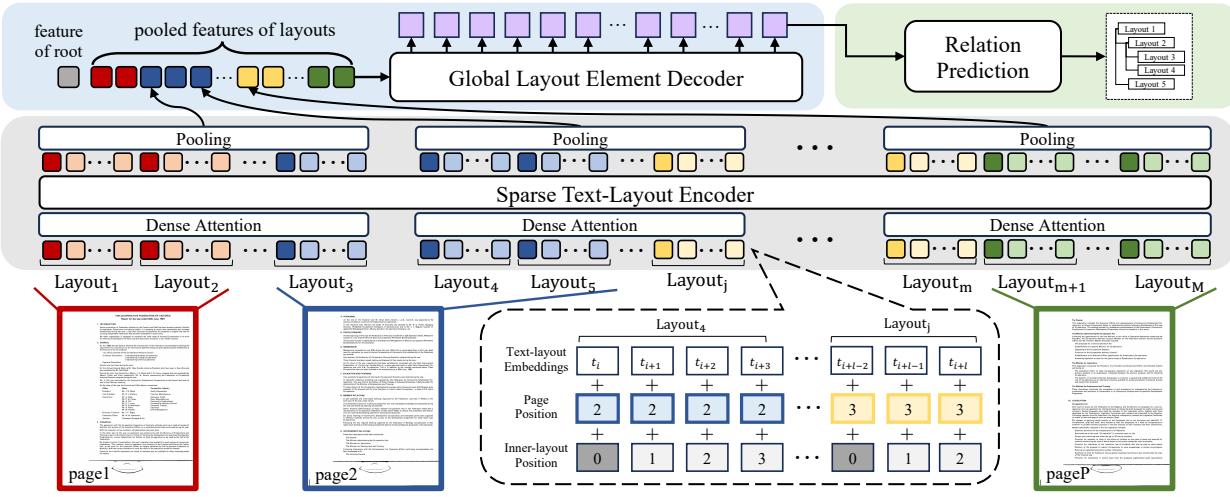
Figure 4 outlines the architecture, which consists of two main stages: a Sparse Text-Layout Encoder and a Global Layout Element Decoder.
1. The Sparse Text-Layout Encoder
Instead of calculating attention between every single word on Page 1 and Page 50 (which is computationally expensive and usually unnecessary), DHFormer uses a chunk-based strategy.
The document is broken down into chunks (sub-sections). Dense attention is calculated only within these chunks. This allows the model to understand the fine-grained context of the text (what the words mean) without blowing up the memory usage.
The mathematical formulation for this factorized attention is:
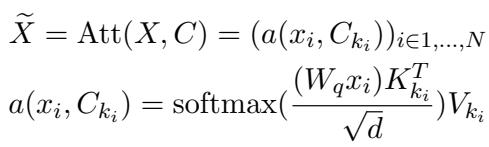
Here, the attention \(Att(X, C)\) is computed for input embeddings \(X\) within their specific chunks \(C\). The Key (\(K\)) and Value (\(V\)) matrices are derived as follows:

This approach reduces the complexity from quadratic \(O(N^2)\) to linear \(O(l \cdot N)\), where \(l\) is the chunk size.
2. Specialized Position Embeddings
Standard language models use 1D position embeddings (word 1, word 2, word 3). LayoutLMs add 2D position embeddings (x, y coordinates).
However, for multi-page hierarchy, the authors argue this isn’t enough. They introduce two new embeddings:
- Page Embeddings: Explicitly tell the model which page a layout element is on. This is crucial for linking a title on Page 4 to a subtitle on Page 5.
- Inner-Layout Position Embeddings: Help the model understand the boundaries of layout elements within the text sequence.
3. Global Layout Element Decoder
Once the sparse encoder processes the text, the features are “pooled” (summarized) into representations for each layout element (e.g., one vector representing a whole paragraph).
These layout vectors are then fed into a Global Decoder. Because we are now working with layout elements rather than individual tokens, the sequence is much shorter. This allows the decoder to look at the entire document at once to reason about the global structure.

Finally, the model predicts the relationship between any two elements \(i\) and \(j\) using a bilinear layer and a sigmoid function. This effectively asks: “Is element \(i\) the parent of element \(j\)?”

Experiments and Results
So, does it work? The authors compared DHFormer against several state-of-the-art baselines, including DocParser and DSPS. They used two primary metrics:
- F1 Score: Measures the correctness of the predicted parent-child pairs.
- TEDS (Tree-Edit-Distance-based Similarity): A stricter metric that looks at the accuracy of the entire tree structure.
Quantitative Performance
The results on the DocHieNet dataset and older datasets are summarized in Table 2:
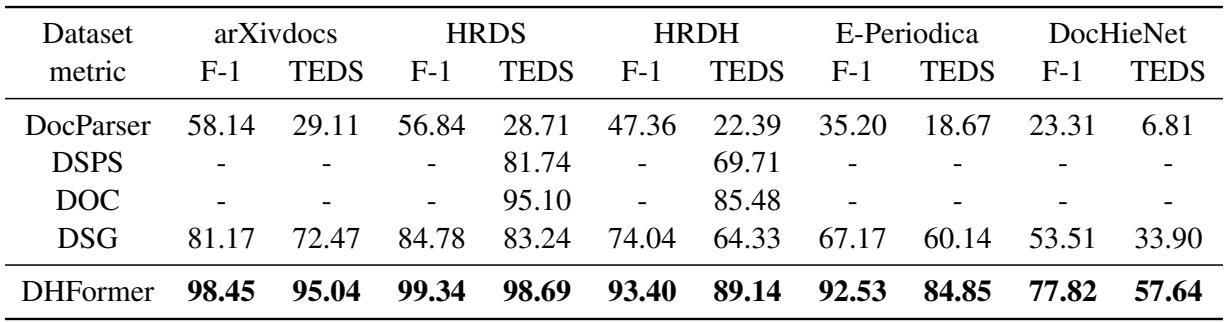
Key Takeaways from Table 2:
- DocHieNet is Hard: Notice that all models score significantly lower on DocHieNet (rightmost columns) than on arXivdocs or HRDoc. This confirms that DocHieNet is indeed a more challenging, realistic benchmark.
- DHFormer Dominates: DHFormer achieves an F1 score of 77.82 on DocHieNet, vastly outperforming the next best model (DSG), which scored 53.51. It also achieves state-of-the-art results on the older datasets.
Can’t LLMs Just Do This?
A common question in 2024 is: “Why train a specific model? Can’t GPT-4 or Llama-2 just figure this out?”
The authors tested this by feeding the layout information into LLMs via prompting. The results, shown in Figure 5, are revealing.
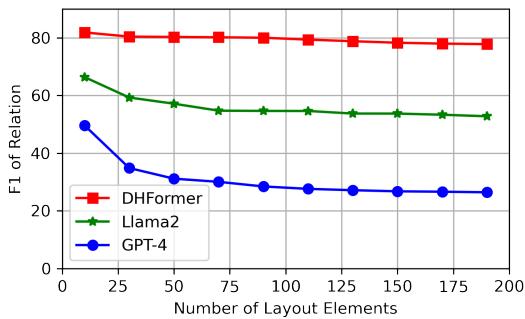
The red line represents DHFormer, while the blue and green lines represent GPT-4 and Llama-2 respectively.
- Short Docs: LLMs perform okay on very short documents.
- Long Docs: As the number of layout elements increases (x-axis), the performance of LLMs collapses. They struggle to maintain the spatial and hierarchical context over long sequences.
- Stability: DHFormer maintains high accuracy regardless of document length.
This highlights that while LLMs are powerful generalists, specialized architectures are still superior for structural tasks involving long, visual-heavy inputs.
Ablation Studies
To prove that their design choices mattered, the authors ran ablation studies.
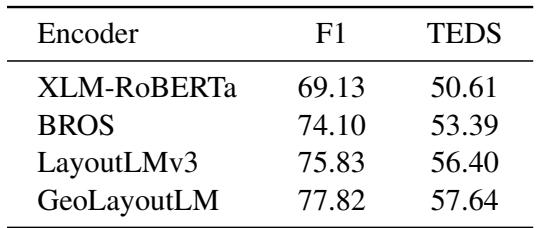
Encoder Choice: They tested different backbones for the encoder. As seen in Table 4, using a geometric-aware model (GeoLayoutLM) provided the best results compared to text-only models like XLM-RoBERTa.
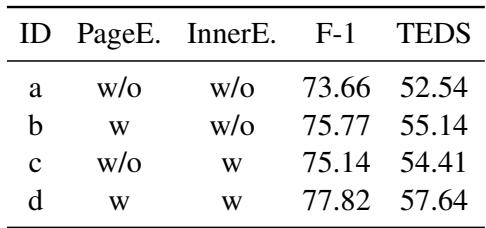
Embedding Impact: They also verified the importance of their custom embeddings. Table 7 shows that removing Page Embeddings or Inner-layout Embeddings dropped performance, and removing both caused a significant decline.
Conclusion
The DocHieNet paper makes a compelling case that we need better data and specialized models to truly solve document understanding. By creating a dataset that reflects the messiness of the real world—multi-page, multi-domain, and complex layouts—they have set a new benchmark for the field.
Furthermore, the DHFormer framework demonstrates that we can’t just rely on standard Transformers or off-the-shelf LLMs for this task. Handling the geometry and hierarchy of long documents requires specific architectural choices, like sparse attention and hierarchy-aware embeddings.
For students and researchers in Document AI, this work opens the door to more sophisticated applications. Imagine a world where you can upload a 100-page financial audit and your AI instantly understands not just the words, but the exact structural logic of the report. That is the future DocHieNet is helping to build.