](https://deep-paper.org/en/paper/file-2977/images/cover.png)
The Brain Within the Machine: Hunting for Task-Specific Neurons in LLMs
When we think about the human brain, we often think in terms of specialization. Neuroscience has long established that specific regions of our brain are responsible for distinct functions—the frontal lobe handles reasoning and decision-making, while other areas manage language processing or motor skills.
For years, researchers have wondered if Large Language Models (LLMs) operate on a similar principle. We know LLMs are incredibly versatile; a single model like Llama-2 can translate French, summarize a legal document, and analyze the sentiment of a tweet. But how does it manage this switching? Does the entire neural network fire for every request, or are there specific “circuits” dedicated to specific tasks?
A fascinating research paper, “Does Large Language Model Contain Task-Specific Neurons?”, tackles this question head-on. The researchers propose that, much like the human brain, LLMs contain Task-Specific Neurons—distinct groups of neurons that activate primarily for specific types of work, such as sentiment analysis or question answering.
In this deep dive, we will explore how they discovered these neurons, the clever method they used to find them, and what happens when you manually control the “brain” of an AI.
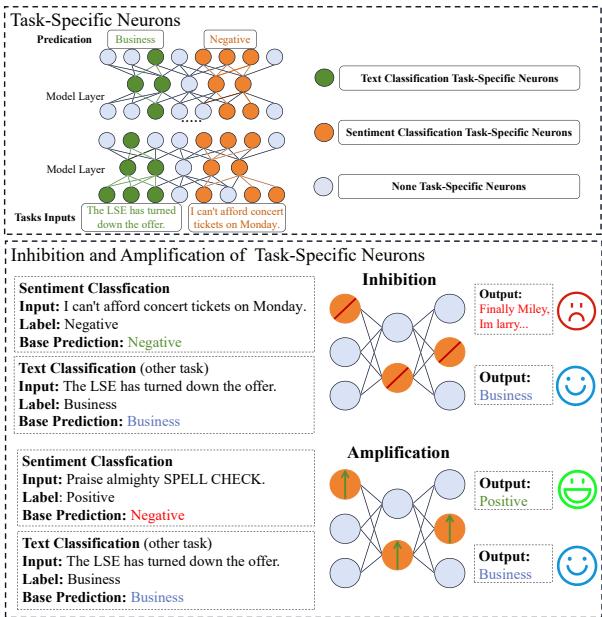
The Theory: Specialized Neurons for Specialized Tasks
Before we get into the detection method, we need to understand the landscape of “neuron studies” in AI. Previous research has already identified two types of specialized neurons:
- Knowledge Neurons: These store factual information (e.g., knowing that Paris is the capital of France).
- Language Neurons: These handle the mechanics of language, such as grammar, syntax, and translation.
However, identifying Task-Specific Neurons is much harder. Tasks are abstract. A “Sentiment Analysis” task requires understanding adjectives and emotional context. A “Text Classification” task requires understanding domain-specific terminology. These aren’t simple facts or grammar rules; they are complex functional competencies.
The researchers hypothesized that if LLMs are truly modular, different tasks should light up different parts of the network. As illustrated in Figure 1 above, a “Sentiment” task should activate orange neurons, while a “Business Classification” task should activate green neurons. If this hypothesis is true, inhibiting (suppressing) the orange neurons should make the model bad at sentiment analysis but shouldn’t break its ability to talk about business.
The Challenge of Localization
Finding these neurons is like finding a needle in a haystack. A model like Llama-2 has billions of parameters. How do you find the tiny subset responsible for “question answering”?
Traditional methods look at the whole input, but this is noisy. If you feed the model the sentence “The movie was terrible,” and look for active neurons, you will find neurons firing for the word “The,” neurons firing for the period, and neurons firing for the concept of “movie.” Which ones are actually doing the sentiment analysis?
To solve this, the authors introduce a novel method called Causal Gradient Variation with Special Tokens (CGVST).
The Insight: Not All Tokens Are Equal
The core insight of the CGVST method is that LLMs rely heavily on Special Tokens during In-Context Learning (ICL). When we prompt an LLM, we usually provide a structure like this:
“Review: I loved it. Label: Positive. Review: It was bad. Label: ->”
The arrow -> or the special separators used by the model are not just formatting; they are the “triggers” that tell the model what task to perform.
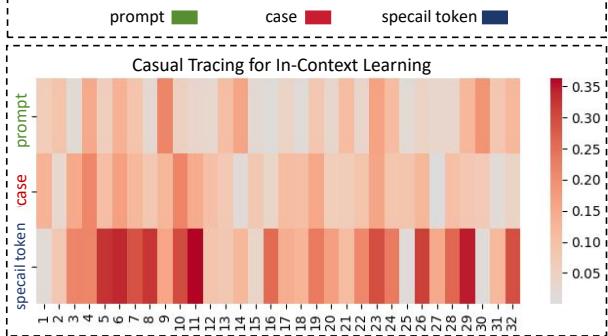
The researchers proved this using Causal Tracing (Figure 2). They added noise to different parts of the input (the prompt, the example cases, and the special tokens) to see which corruption confused the model the most.
As shown in the heatmap above, perturbing the Special Tokens (the bottom row in dark blue) had the most dramatic impact on the model’s ability to predict the correct label. This suggests that the “memory” of the task pattern is aggregated into these specific positions.
The Solution: CGVST
Based on this discovery, the researchers developed the CGVST algorithm. Instead of analyzing every neuron for every word, they focus exclusively on the gradients of the special tokens.
Here is the simplified workflow:
- Forward Pass: Feed the model a task (e.g., a sentiment analysis prompt).
- Focus on Special Tokens: Calculate the loss function specifically at the positions where special tokens appear.
- Gradient Calculation: Measure how much the “gate” parameters in the Feed-Forward Network (FFN) change with respect to this specific loss.
- Selection: The neurons that show the highest gradient variation are identified as the Task-Specific Neurons.
This method acts like a “fluorescent dye” in biology. By tagging the special tokens (the crucial control points), the researchers can trace the specific neural pathways activated to solve the task, filtering out the noise of general language processing.
Experiments: Proving the Neurons Exist
To validate their method, the team tested it on 8 distinct NLP tasks using the Llama-2-7b model. The tasks ranged from Sentiment Analysis (SA) and Question Answering (QA) to Law Text Categorization (LTC) and Emotion Classification (EC).
The verification process was simple but rigorous: if we have truly found the neurons responsible for a task, we should be able to control the model’s performance by manipulating only those neurons.
1. The Inhibition Test (Turning them off)
First, they tried inhibiting the identified neurons—essentially dampening their signal. If these neurons are truly task-specific, the performance on the target task should crash, while other tasks should remain relatively unaffected.

Table 1 presents the results. The column P represents the performance on the inhibited task, while R represents the performance on other tasks.
- Look at the CGVST (ours) row: When they inhibited the neurons identified by their method, the performance (P) dropped catastrophically (e.g., QA dropped to 3.4, SA to 3.3).
- Precision: Crucially, the performance on other tasks (R) remained relatively higher. This confirms that the neurons were specific to the task at hand.
- Comparison: Compare this to the “Random” or “PV” methods. Inhibiting random neurons barely dents performance (dropping from ~38 to ~37). Inhibiting neurons found by other methods (like LAPE or GV) causes some damage, but nowhere near the precision of CGVST.
2. The Amplification Test (Turning them up)
Next, they did the opposite: amplifying the signal of these neurons.
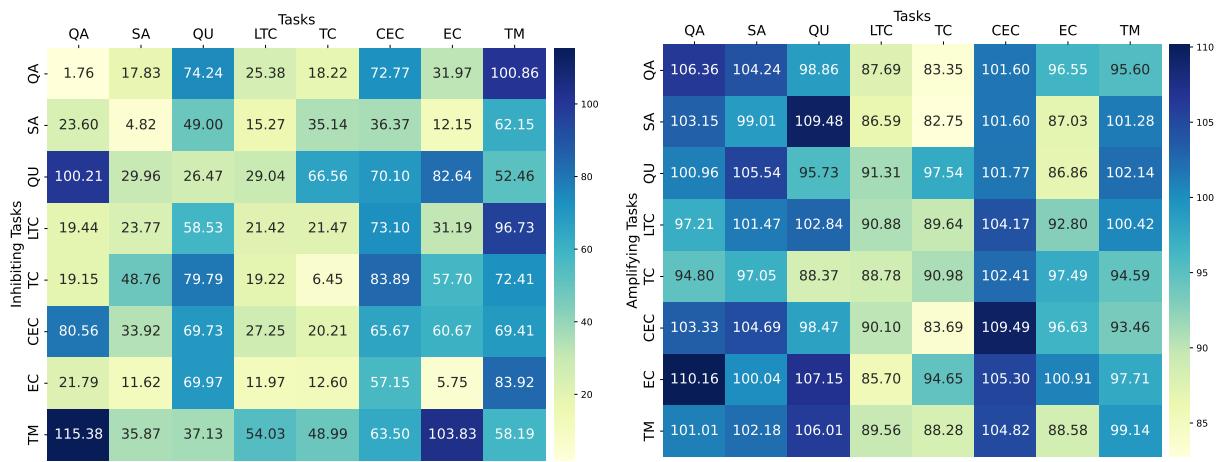
Figure 3 visualizes the cross-task performance. The left matrix shows inhibition (blue/cold means performance loss), and the right matrix shows amplification (red/hot means performance gain).
- Inhibition (Left): The diagonal line is deep blue. This visually confirms that inhibiting “Task X” neurons specifically destroys “Task X” performance.
- Amplification (Right): The diagonal is red. Boosting these neurons improves the model’s ability to handle the specific task. Interestingly, for some tasks like Question Answering (QA) or Cause Effect Classification (CEC), amplifying the neurons also helped other tasks slightly. This suggests that some reasoning capabilities are shared across different logical tasks.
3. Case Studies: Fixing Hallucinations
The most tangible proof comes from looking at actual model outputs. The researchers found that amplifying task-specific neurons could fix errors where the base model failed.
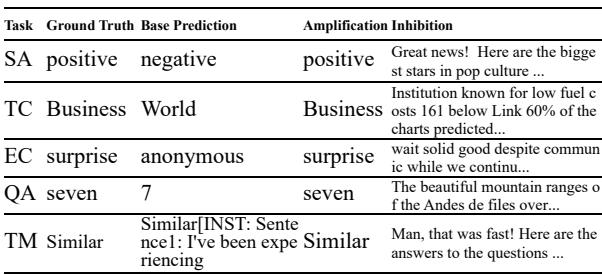
In the Sentiment Analysis (SA) example from Table 3:
- Input: A review text.
- Base Prediction: “Negative” (Incorrect).
- Amplification: When the Sentiment neurons were boosted, the model correctly predicted “Positive”.
- Inhibition: When those neurons were suppressed, the model started hallucinating nonsense (“Great news! Here are the biggest stars…”), completely losing the thread of the task.
Where Do These Neurons Live?
One of the most interesting findings of the paper is the location of these neurons.
The researchers visualized the distribution of task-specific neurons across the layers of the Llama-2 model.
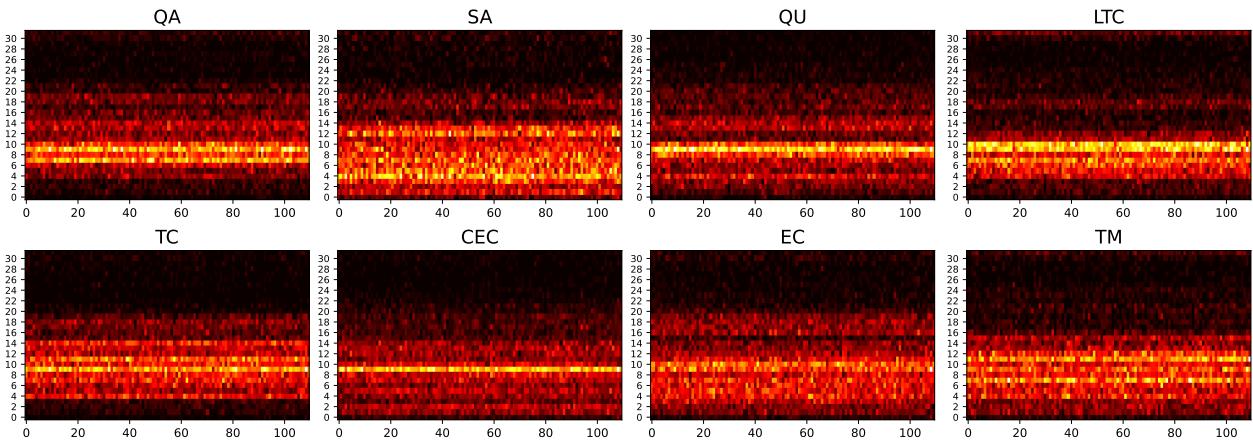
As shown in Figure 5, task-specific neurons (indicated in red) are not evenly distributed. They are predominantly concentrated in the middle layers (Layers 5 to 11).
This is a significant distinction:
- Bottom Layers: Usually handle basic syntax and word embeddings.
- Top Layers: Usually handle the final language generation and output formatting.
- Middle Layers: This appears to be the “cognitive engine” of the LLM, where abstract task processing—like determining if a tweet is angry or happy—actually happens.
Compare this to previous methods like LAPE (shown below), which tend to focus on the very last layers.
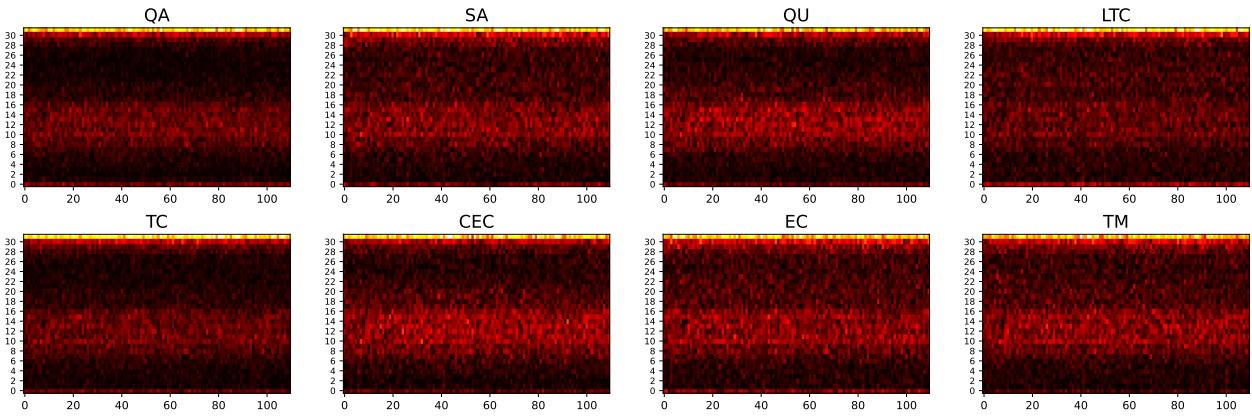
The LAPE method (Figure 7) identifies neurons almost exclusively at the top of the model. These are likely “Language Neurons” responsible for generating words, not “Task Neurons” responsible for understanding the job. This explains why the CGVST method is so much more effective at pinpointing the functional core of the task.
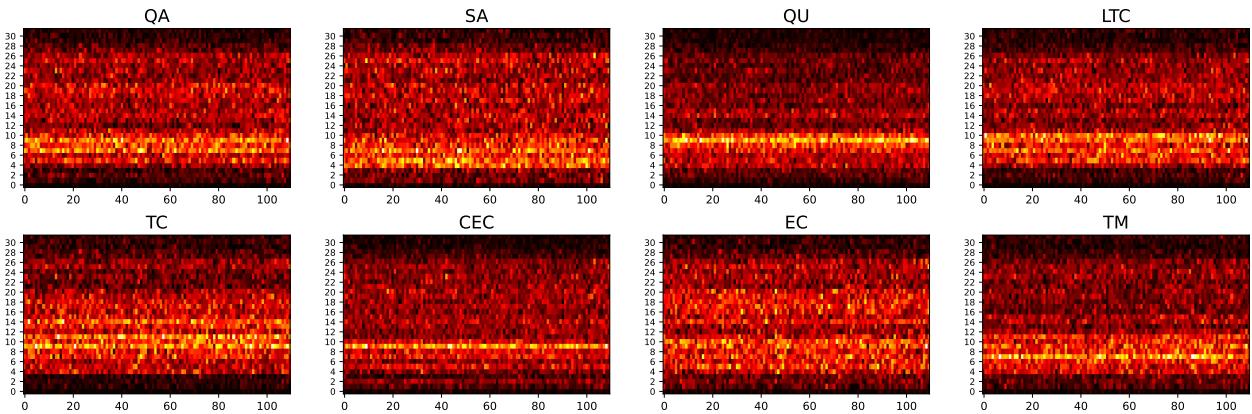
Similarly, the “Knowledge Neuron” detection method (GV) produces a very noisy signal (Figure 6, below), scattering potential candidates everywhere without a clear pattern.
Conclusion: The Modularity of AI
The implications of this paper extend beyond just better metrics. It provides a structural map of how Large Language Models “think.”
By demonstrating the existence of Task-Specific Neurons, the authors have shown that LLMs are not just monolithic blobs of math. They are modular systems where specific sub-networks activate to handle specific problems. The CGVST method gives us a surgical tool to locate these sub-networks by following the gradients of special tokens—the control switches of the model.
This opens up exciting possibilities for the future:
- Model Editing: Could we “delete” a model’s ability to generate toxic content without hurting its ability to answer medical questions?
- Efficient Fine-Tuning: If we know exactly where the “Sentiment Analysis” neurons are, we could fine-tune only those layers, saving massive amounts of compute.
- Debugging: When a model fails, we can check if the specific task neurons fired correctly, moving us away from “black box” AI toward interpretable systems.
Just as neuroscience mapped the specialized regions of the human brain, work like this is beginning to map the specialized regions of the digital mind.