](https://deep-paper.org/en/paper/file-2984/images/cover.png)
In human communication, what we say is often less important than how we say it. A phrase like “Great job” can be a genuine compliment or a sarcastic critique depending on the speaker’s tone of voice and facial expression. For Artificial Intelligence, distinguishing between these nuances is the holy grail of Multimodal Intent Detection.
To build systems that truly understand us—whether it’s a customer service bot or a smart home assistant—we need models that can process text, audio, and video simultaneously. While recent advances have improved how these modalities are fused, two significant problems remain:
- Entanglement: The “meaning” (semantics) often gets hopelessly mixed up with the “medium” (modality-specific noise).
- Lack of Causal Reasoning: Models are great at finding correlations but terrible at understanding cause and effect. They often rely on spurious shortcuts rather than true understanding.
In this post, we will deep-dive into a fascinating paper: “Dual-oriented Disentangled Network with Counterfactual Intervention for Multimodal Intent Detection” (DuoDN). We will explore how the researchers used disentangled representation learning to separate the signal from the noise, and causal inference to teach the model to double-check its own reasoning.
The Problem with Vanilla Fusion
Before we get into the solution, we need to understand why current methods struggle.
In a standard multimodal setup, an AI extracts features from text (BERT), audio (WavLM), and video (Swin Transformer). It then mashes these vectors together—a process called “fusion”—to predict an intent.
The issue is that these modalities are fundamentally different. Text is discrete and symbolic; audio and video are continuous and noisy. When you simply concatenate them, the unique characteristics of the modality (like the background noise in an audio clip) become intertwined with the semantic meaning (the user is angry).
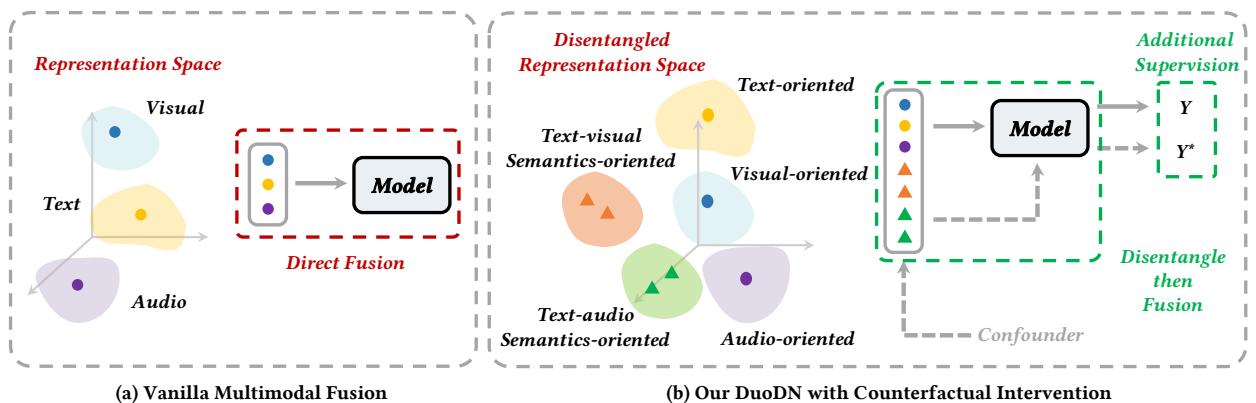
As shown in Figure 1 (a) above, “Vanilla Multimodal Fusion” takes clusters of Visual, Text, and Audio data and forces them into a single space. This often results in a “poly-semantic” mess where the model can’t tell if it’s predicting “anger” because the user used an angry word, or simply because the microphone volume was loud.
The researchers propose a new paradigm, shown in Figure 1 (b): Disentangle then Fusion. Instead of mixing everything immediately, they first separate the features into two specific buckets:
- Semantics-oriented: The shared meaning across modalities.
- Modality-oriented: The unique characteristics of the specific sensor (camera, microphone, text).
The Solution: DuoDN Architecture
The proposed model, DuoDN (Dual-oriented Disentangled Network), is a sophisticated architecture designed to treat these data streams with the nuance they deserve.
Let’s look at the high-level architecture:
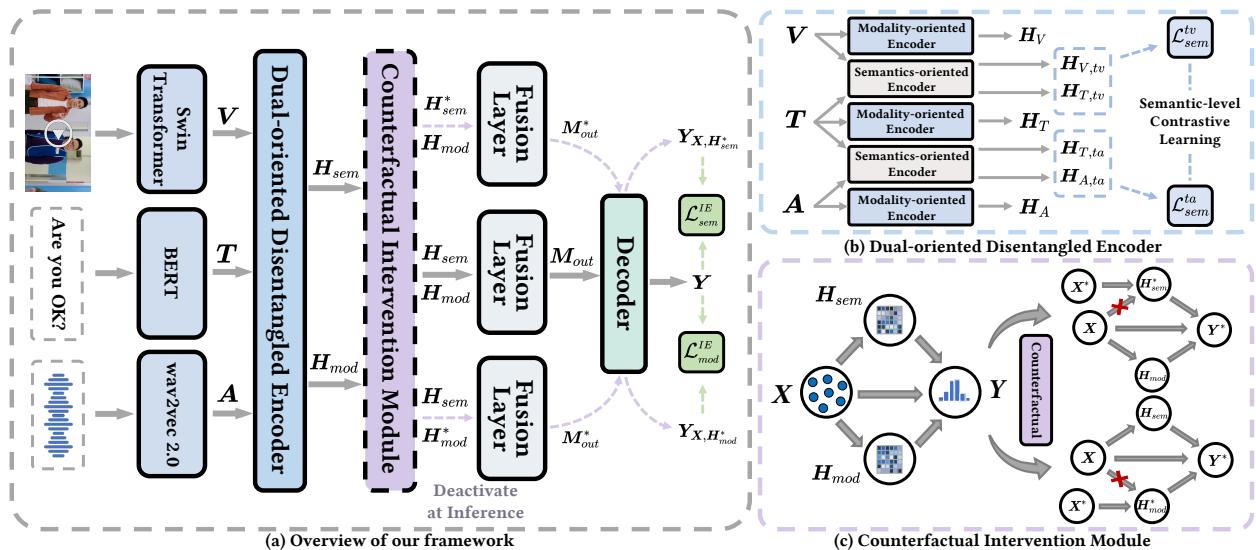
Figure 2 (a) shows the flow:
- Input: Video, Text, and Audio are passed through their respective feature extractors.
- Dual-oriented Disentangled Encoder: This is the brain of the operation. It splits the features.
- Counterfactual Intervention: This is the “critic.” It uses causal inference to ensure the features are actually useful.
- Fusion & Decoder: The cleaned, verified features are finally combined to make a prediction.
Let’s break down the two main innovations: the Disentanglement and the Causal Intervention.
1. The Dual-oriented Disentangled Encoder
The goal here is to learn two distinct types of representations for each modality.
Semantics-Oriented Representation
Even though text, video, and audio are different, they often share a common motive. If a user is shouting “Help!”, the text says “Help,” the audio is loud/urgent, and the video might show waving hands. These are different signals pointing to the same semantic concept.
To capture this, the model projects the features into a shared subspace using Multi-Layer Perceptrons (MLPs). Specifically, it looks at pairs: Text-Video and Text-Audio.

Here, \(\boldsymbol{H}\) represents the hidden states (features). \(MLP_{sem}\) denotes the specific neural network layers dedicated to extracting semantic meaning. The model creates specific representations for the text as it relates to video (\(H_{T,tv}\)) and text as it relates to audio (\(H_{T,ta}\)).
Semantic Alignment via Contrastive Learning
Just projecting the features isn’t enough. We need to force the model to acknowledge that the video representation of “Help” and the text representation of “Help” are mathematically similar.
To achieve this, the authors use Contrastive Learning. The intuition is simple: Pull matching pairs (positive examples) closer together in vector space, and push non-matching pairs (negative examples) apart.
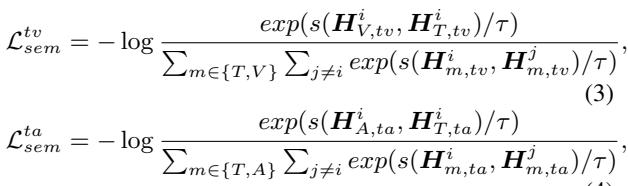
In this equation:
- The numerator calculates the similarity between the matched pair (e.g., Video and Text from the same sample).
- The denominator sums the similarity of the current sample against all other samples in the batch (negative examples).
- By minimizing this loss (\(\mathcal{L}_{sem}\)), the model aligns the semantic “soul” of the different modalities.
Modality-Oriented Representation
While shared meaning is great, we don’t want to throw away the unique flavor of the modality. The raspiness of a voice or the specific lighting in a video might carry context that isn’t strictly “semantic” but is crucial for intent detection.
The model extracts these distinct features using separate encoders:

This results in a clean separation. We now have \(\boldsymbol{H}_{sem}\) (shared meaning) and \(\boldsymbol{H}_{mod}\) (modality-specific details).
2. The Counterfactual Intervention Module (CIM)
This is the most innovative part of the paper. Most deep learning models are purely correlational. If “loud audio” correlates with “anger” in the training data, the model learns that rule. But what if the user is just in a noisy room?
To fix this, the researchers use Causal Inference. They treat the model as a causal system where \(X\) (input) causes \(H\) (hidden representation) which causes \(Y\) (prediction).
The problem with standard training is that end-to-end optimization doesn’t explicitly teach the model how much \(H\) contributes to \(Y\). The model might rely on “confounders”—spurious patterns that look like causal links but aren’t.
The Intervention
To reveal the true causal effect, the researchers use a technique called Counterfactual Intervention.
Think of it like a science experiment. To know if a drug works, you use a control group (placebo). Here, the researchers generate a “counterfactual” version of the input to act as a control.
They define the Indirect Effect (IE). This measures the difference between the model’s prediction using the real features versus the model’s prediction using intervened (noisy) features.
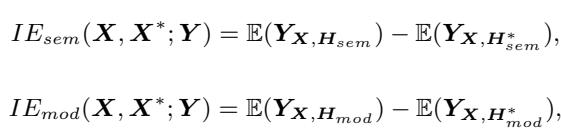
- \(\mathbb{E}(Y_{\boldsymbol{X}, H})\): The prediction with the real data.
- \(\mathbb{E}(Y_{\boldsymbol{X}, H^*})\): The prediction when we swap the hidden representation with a “confounder” (\(H^*\)).
Injecting Confounders
How do we create this “confounder”? We can’t just delete the data; the network expects an input. Instead, the authors inject noise derived from the statistical distribution of the original data.

They create a noisy version of the input, \(X^*\), by sampling from a Gaussian distribution based on the mean (\(\mu\)) and standard deviation (\(\sigma\)) of the batch. This noisy input generates the confounder representations \(H^*_{sem}\) and \(H^*_{mod}\).
The Optimization Goal
Here is the clever part: When the model sees the real features, it should predict the correct label. When it sees the confounder (noise), its prediction should degrade significantly.
If the prediction doesn’t change when we switch from real data to noise, it means the model wasn’t actually using those features to make its decision!
To enforce this, the authors maximize the Indirect Effect. They do this by minimizing the cross-entropy loss on the IE term:

This forces the model to learn representations (\(\boldsymbol{H}_{sem}\) and \(\boldsymbol{H}_{mod}\)) that are causally significant. The model “realizes” that these specific features are the drivers of the correct prediction.
3. Fusion and Interaction
Now that we have high-quality, disentangled, and causally-verified representations, we need to combine them. The researchers use a Transformer-based attention mechanism.
They perform Semantic-level Fusion using cross-attention. For example, the text features query the video features to see what is relevant.


The Keys (\(\boldsymbol{K}\)) and Values (\(\boldsymbol{V}\)) are concatenations of the text and paired modality (video or audio):


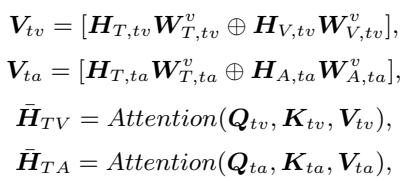
They also perform Modality-level Interaction using self-attention on the modality-specific features:

Finally, all these processed features are concatenated into a massive vector, \(M_{out}\), and passed through a final MLP classifier to predict the intent \(\hat{Y}\).

The total loss function combines all these objectives: the contrastive loss for alignment, the causal intervention loss, and the standard classification loss.

Experiments and Results
Does this complex architecture actually work? The researchers tested DuoDN on three benchmark datasets: MIntRec, MELD-DA, and MIntRec 2.0.
Comparison with State-of-the-Art (SOTA)
The results are impressive. As shown in Table 1, DuoDN consistently outperforms existing methods like MAG-BERT and typical multimodal transformers (MulT).

- MIntRec: DuoDN achieves a 1.38% improvement in Accuracy over the previous best (SDIF-DA).
- MELD-DA: This dataset is particularly hard because it contains ambiguous dialogue actions (like “Backchanneling” or “Acknowledge”). DuoDN shows a significant jump in performance here as well.
The model also shines on the newer MIntRec 2.0 dataset, which includes “Out-of-Scope” (OOS) samples—data that doesn’t fit into known categories. This simulates real-world scenarios where users say unexpected things.
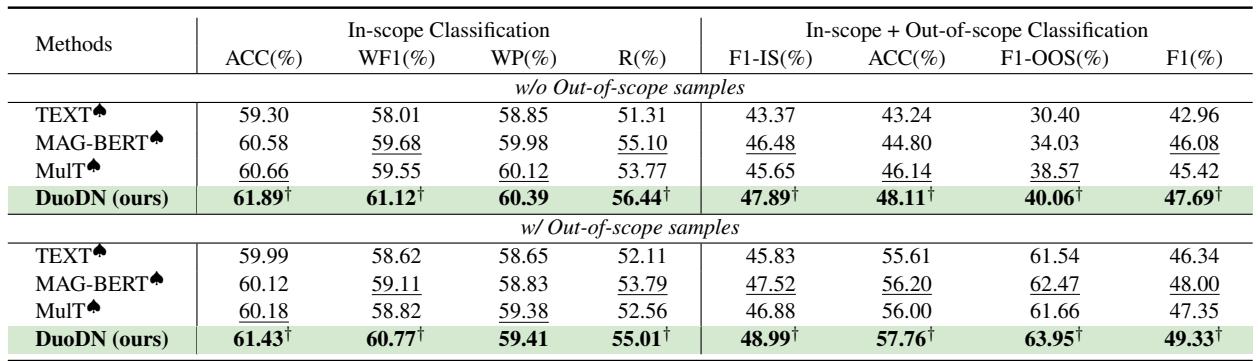
Table 2 shows that DuoDN maintains high performance even when dealing with these OOS samples, suggesting the causal intervention helps the model generalize better rather than overfitting to known classes.
Ablation Study: Do we need all the parts?
You might be wondering, “Do we really need the causal stuff? Or is the disentanglement enough?” The authors performed an ablation study to find out.
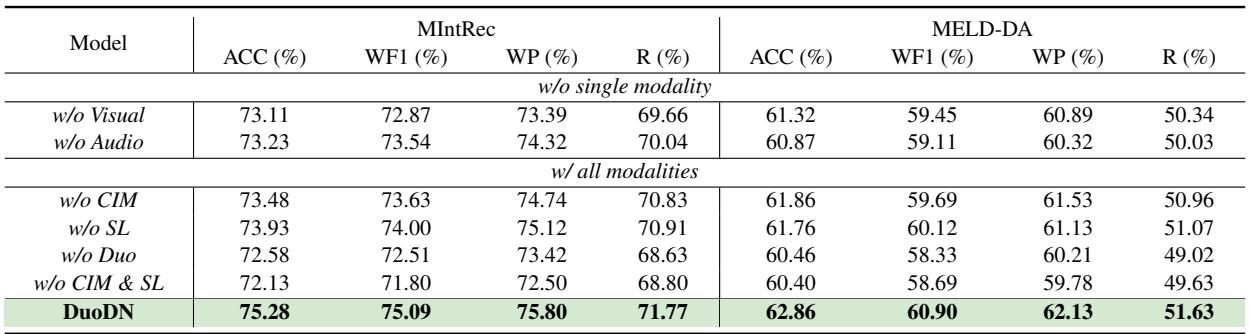
- w/o CIM (Counterfactual Intervention): Performance drops significantly (approx. 2% drop in F1 score). This proves that the causal “check” is crucial.
- w/o SL (Semantic-level Contrastive Learning): Performance also drops. Aligning the semantics is vital.
- w/o Duo: Using a simple MLP instead of the disentangled encoder hurts performance the most.
Visualization: Seeing the Disentanglement
Numbers in a table are one thing, but visualizing the data provides a deeper intuition. The researchers used UMAP to project the feature spaces before and after training.
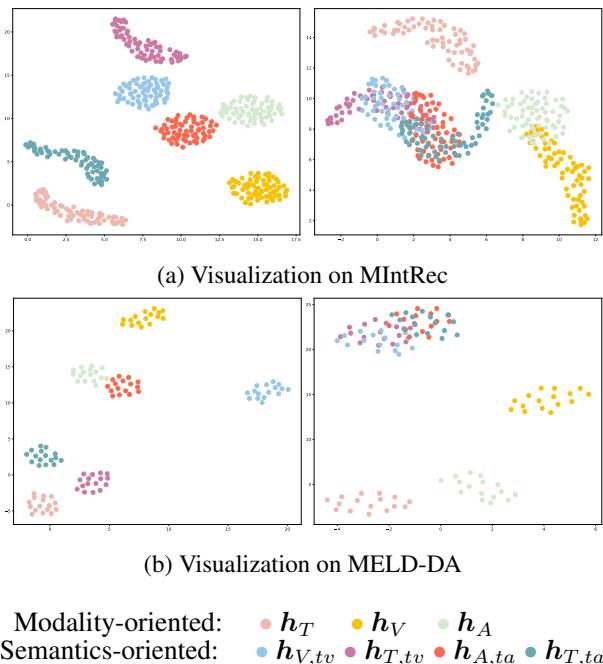
Look at Figure 3.
- Left (Raw): The data points are scattered. There is no clear structure between text, video, and audio features.
- Right (After Training):
- Notice how the Modality-oriented features (Blue, Pink, Green dots) form distinct, separable clusters. The model successfully isolated the unique “flavor” of each modality.
- Notice how the Semantics-oriented features (Orange, Red dots) cluster tightly together. The model successfully aligned the meaning of the text and video inputs.
Fine-Grained Analysis
The model isn’t perfect, of course. The researchers broke down performance by specific intent categories.
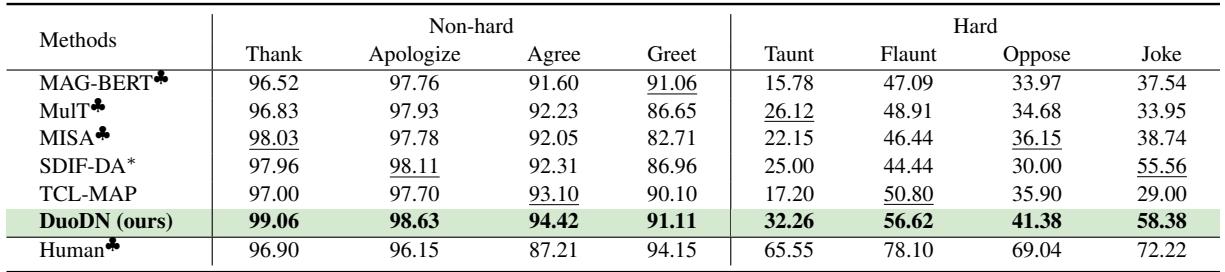
DuoDN excels at standard intents like “Thank,” “Apologize,” and “Agree.” However, it struggles with “Hard” intents like “Taunt” or “Joke.” Sarcasm remains a massive challenge for AI because the semantic meaning (words) often directly contradicts the modality meaning (tone), requiring extremely subtle disentanglement.
This struggle is visualized in the confusion matrices below:
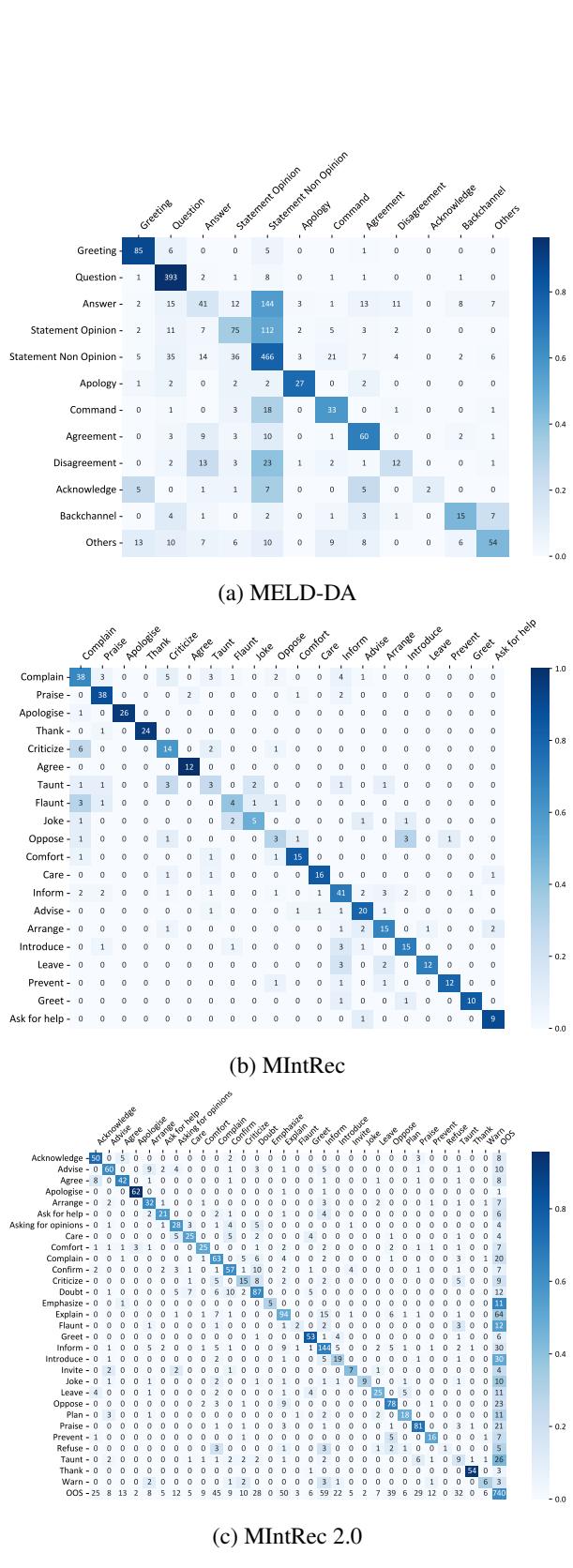
In (b) MIntRec, you can see a strong diagonal line, indicating correct predictions. However, looking at the fainter squares off the diagonal reveals where the model gets confused—often between nuanced social cues.
Conclusion and Future Implications
The DuoDN paper presents a compelling step forward for multimodal AI. By acknowledging that data is not just a soup of numbers, but a structured combination of shared meaning and unique modality traits, the authors built a more robust system.
The addition of Counterfactual Intervention is particularly exciting for students and researchers. It moves deep learning away from simple pattern matching toward a form of reasoning. By asking “What if this feature was just noise?”, the model learns to rely on causal links rather than convenient correlations.
Key Takeaways:
- Don’t just fuse; Disentangle. Separating the “what” (semantics) from the “how” (modality) clarifies the signal.
- Causality matters. Forcing the model to verify its features via intervention prevents it from learning lazy shortcuts.
- Alignment is key. Contrastive learning ensures that different senses (sight, sound, text) agree on the reality they are perceiving.
While AI still struggles with the subtleties of a “Joke” or a “Taunt,” architectures like DuoDN bring us closer to machines that don’t just process data, but truly understand intent.