](https://deep-paper.org/en/paper/file-3005/images/cover.png)
Introduction
Imagine walking into a library that contains every book ever written. Now, imagine that for millions of those books, the pages are riddled with gibberish. “The cat sat on the mat” might read as “The c@t s4t on tbe mAt.” This is the current reality of Digital Humanities.
While Optical Character Recognition (OCR) technology has allowed us to digitize vast archives of historical texts—from 19th-century novels to ancient newspapers—it is far from perfect. Faded ink, complex layouts, and unusual typefaces often confuse OCR engines, resulting in “noisy” text that is difficult for humans to read and even harder for computers to analyze.
Correcting these errors manually is impossible at scale. We need automated systems, known as Post-OCR Correction models, to fix the text. But these models face a “Catch-22”: to learn how to fix errors, they need massive amounts of training data (pairs of messy text and clean text), which simply doesn’t exist in large enough quantities.
In this post, we are deep-diving into a fascinating paper titled “Effective Synthetic Data and Test-Time Adaptation for OCR Correction.” The researchers propose a clever two-pronged approach:
- Smart Synthetic Data: Using “weak supervision” to generate millions of artificial training examples that mimic real-world errors.
- Test-Time Adaptation (SCN-TTA): A novel method where the model “reads” a specific book, learns the character names and unique words, and self-corrects on the fly.
If you are a student of NLP or computer science, this paper offers a masterclass in how to deal with low-resource domains and how to make models adapt to data they’ve never seen before.
The Background: OCR as a Translation Task
To understand the solution, we first need to frame the problem. Modern research treats Post-OCR correction as a Sequence-to-Sequence (Seq2Seq) task, very similar to Neural Machine Translation (NMT).
In NMT, you might translate French to English. In Post-OCR, you translate “Noisy English” to “Clean English.”
- Input:
I lov3 y0u. - Output:
I love you.
The dominant architecture for this is the Transformer. Specifically, models like ByT5 (a byte-level version of T5) are incredibly effective here because they operate on individual characters (bytes) rather than whole words, making them robust to the garbled spellings found in OCR errors.
However, NMT models are hungry for data. If you train them on a single type of noise (e.g., only 5% of characters are wrong), they fail miserably when they encounter a document with 20% errors. Furthermore, historical novels are full of Proper Nouns (PNs)—names of people and places like “Mr. Darcy” or “Middlemarch.” If a model hasn’t seen “Darcy” in training, it might “correct” it to a common word like “Dairy” or “Dark.”
The authors of this paper tackle these issues by engineering better data and a smarter inference process.
Core Method Part 1: Generating Effective Synthetic Data
Since we don’t have enough real-world paired data (noisy vs. clean), we have to fake it. This is called Synthetic Data Generation.
The standard approach in the field has been simple: take clean text and randomly swap letters to create noise. However, OCR errors aren’t random. An OCR engine might confuse ‘c’ with ’e’, but it rarely confuses ‘x’ with ’m’.
Weak Supervision for Realistic Noise
The researchers used a technique called Weak Supervision. They took existing datasets (like ICDAR2017/2019) that contain OCR text and Ground Truth (GT) text. Crucially, these datasets are known to be imperfect—the alignment between the noisy and clean text isn’t always right.
Instead of discarding this “imperfect” data, the researchers used it to calculate the probability of specific errors. For example, what is the probability that the letter ‘a’ becomes ‘@’ or ‘4’?
They defined a Data Generator (DG) that uses these probabilities to inject errors into clean text. To control how messy the synthetic data is, they introduced an Error Level (\(e\)) parameter.
The weight \(W(j|i)\) determines the likelihood of replacing character \(i\) with string \(j\) at a specific error level \(e\):

- \(P(j|i)\): The probability observed in the source data.
- \(e\): The error level scalar. As \(e\) increases, the probability of the character remaining unchanged (\(i=j\)) decreases, and the probability of it turning into a typo increases.
By tuning \(e\), the authors could generate synthetic datasets ranging from “slightly dusty” (Low CER) to “unreadable garbage” (High CER).
The “Effective” Range and the Optimal Alignment Curve
Here is the million-dollar question: How much noise should we put in our training data?
If the training data is too clean, the model won’t correct difficult errors. If it’s too noisy, the model might start hallucinating corrections where none are needed.
To find the sweet spot, the researchers conducted an extensive experiment. They trained models on various Training Error Levels (TrEL) and tested them against various Test Error Levels (TeEL).
The results, visualized as a heatmap in the table below, reveal an interesting pattern:
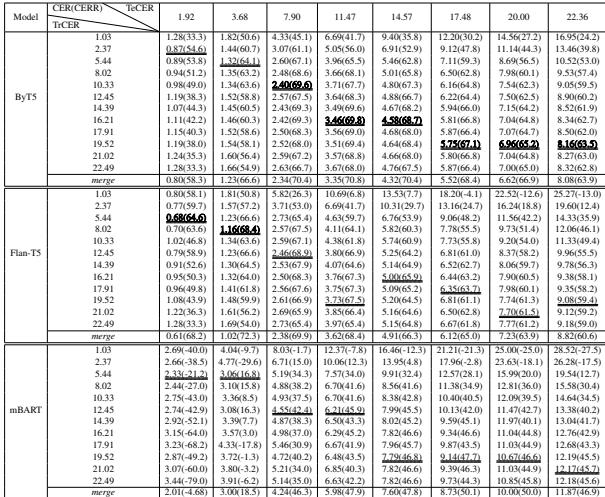
Look at the merge row (bottom). Merging multiple noise levels usually yields the best performance. However, look at the columns for high error levels. Models trained on extremely high noise (e.g., TrEL 21.02) often perform worse on cleaner test sets.
To formalize this, the authors plotted the Optimal Alignment Curve (OAC). This curve maps the relationship between the test data’s error rate and the optimal training data error rate.
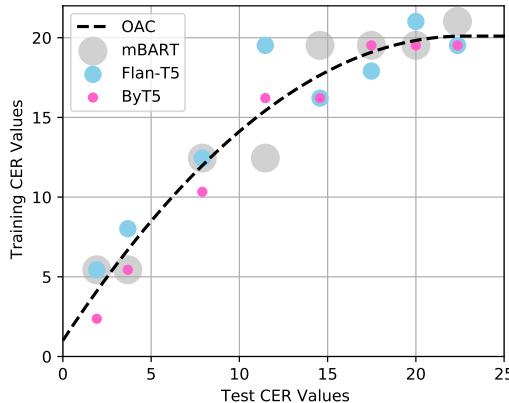
The dashed line represents the OAC. The authors found a threshold—specifically, a Character Error Rate (CER) of roughly 20.1.
The Takeaway: Synthetic data is considered “effective” if its error rate is below 20.1%. Data noisier than this threshold is “ineffective” and actually hurts the model’s ability to generalize. Therefore, the best strategy is to create a Merged Dataset containing various noise levels, but capped at that effective threshold.
Core Method Part 2: Self-Correct-Noise Test-Time Adaptation (SCN-TTA)
Even with the best synthetic data, models still struggle with Proper Nouns (PNs). If the OCR reads “The Duke of Wellingtun,” a generic model might not know if it should be “Wellington” or something else, especially if “Wellington” wasn’t in the training data.
This is where the paper’s second major contribution comes in: SCN-TTA.
The idea is to adapt the model to the specific book currently being corrected. The model essentially “teaches itself” the vocabulary of the book before doing the final exam.
The 7-Step Workflow
The SCN-TTA process is a cycle of extraction, masking, and fine-tuning. Let’s look at the architecture:
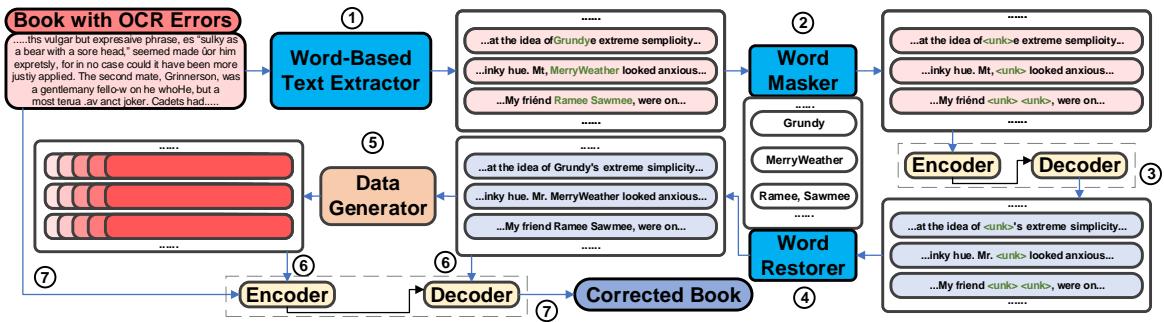
Here is the step-by-step breakdown of how the model adapts to a new book:
- PN Extraction: The system scans the noisy book and identifies potential Proper Nouns (names, places) and their context.
- Masking: This is the clever part. The system takes these sentences and replaces the Proper Nouns with an
<unk>(unknown) token.
- Why? Because the PNs might have OCR errors. We want the model to look at the context surrounding the name to ensure the sentence structure is correct, without getting confused by the typo in the name yet.
- Self-Correction (Repair): The pre-trained model (from Part 1) corrects the context words around the
<unk>token. - Word Restorer: The original PNs (even if potentially noisy) are put back into the now-clean sentences.
- Data Generator (DG): Now, the system generates new synthetic noise versions of these specific sentences. This creates a mini-training set derived from the book itself.
- Second Fine-Tuning: The model is fine-tuned on this new synthetic data. This forces the model to learn the specific PNs and vocabulary distribution of this specific book.
- Final Correction: The fully adapted model processes the entire book.
By the end of this pipeline, the model has “seen” the characters’ names in various noisy contexts and learned to predict them correctly.
Experiments and Results
The researchers tested their methods on several benchmarks, including the RETAS dataset (19th-century novels). They compared their approach against standard baselines, including Hunspell (a standard spellchecker) and the massive Llama 2 (Large Language Model).
Does Multi-Noise Training Work?
First, they validated the synthetic data strategy. The table below shows the Character Error Rate (CER) on real-world data (Original CER: 6.64%).
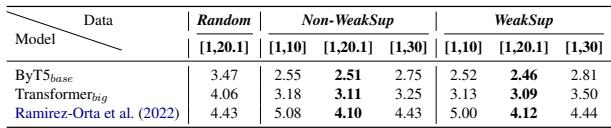
You can see that ByT5 trained on the effective range [1, 20.1] achieves a CER of 2.51, significantly lower than the original 6.64. This confirms that training on a mix of “effective” noise levels is superior to random noise or ranges that include “ineffective” (too high) noise.
The Impact of SCN-TTA
Next, they performed an ablation study to see how much the SCN-TTA process actually helps. They introduced two specific metrics for Proper Nouns:
- CWRR (Correct Word Retention Rate): How often does the model keep a correct name correct?
- IWCR (Incorrect Word Correction Rate): How often does it fix a broken name?
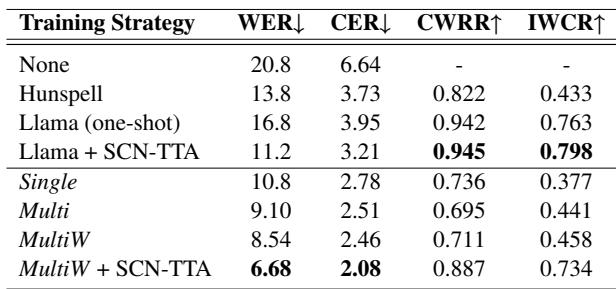
Key Observations:
- Multi W (Multi-level Weak Supervision): Reduced CER to 2.46.
- Multi W + SCN-TTA: Further reduced CER to 2.08.
- Proper Noun Performance: The CWRR jumped from 0.711 to 0.887 with SCN-TTA. This proves the adaptation phase effectively stops the model from accidentally “correcting” unique names into generic words.
While Llama 2 (one-shot) had a high retention rate, it struggled to reduce the overall error rate (CER) as effectively as the specialized ByT5 model.
Visual Proof
Numbers are great, but what does the output actually look like?
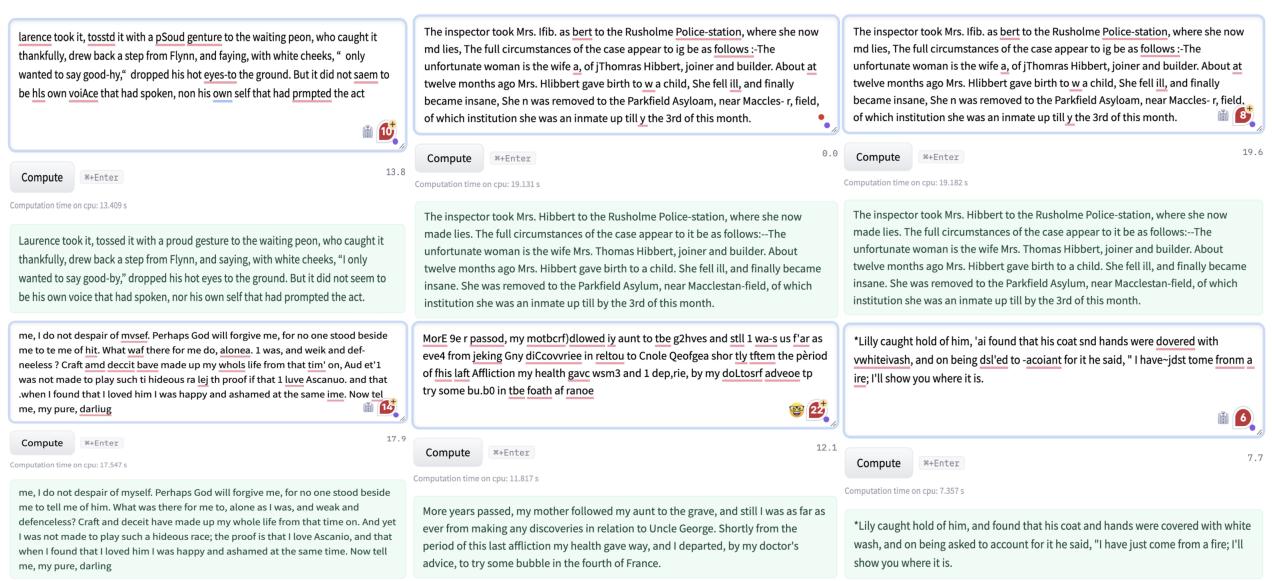
In the samples above, notice how the model recovers complex sentences. In the first example, the noisy input “psoud genture” is correctly identified as “proud gesture.” In the third example, the input is severely degraded (“Mrs. Ifib. as bert”), yet the model successfully recovers “Mrs. Hibbert” by understanding the context.
Conclusion and Implications
This paper provides a blueprint for handling noisy data in the real world. The authors demonstrated that how you construct your synthetic training data matters immensely. Simply throwing more noise at the problem isn’t the answer; the noise must be “effective” (below a certain threshold) and diverse.
Furthermore, the SCN-TTA method offers a powerful way to handle the “long-tail” problem in NLP—rare words and proper nouns that don’t appear in general training sets. By dynamically generating data from the test instance itself, the model acts less like a static dictionary and more like an intelligent editor that learns as it reads.
Key Takeaways for Students:
- Weak Supervision turns imperfect data into a valuable resource.
- Curriculum Learning: Providing the model with the “right amount” of difficulty (the OAC curve) is better than overwhelming it.
- Test-Time Adaptation: You don’t have to stop learning after training. Adapting to the specific test input can squeeze out significant performance gains, especially for domain-specific terms.
With methods like these, the dream of a fully digitized, error-free global library is getting closer to reality.