](https://deep-paper.org/en/paper/file-3011/images/cover.png)
In the world of Natural Language Processing (NLP), Multilingual Pre-trained Language Models (mPLMs) like BERT and XLM-R are the polyglots of the AI world. They are trained on text from approximately 100 different languages, allowing them to perform tasks—like sentiment analysis or topic classification—across borders.
However, there is a catch. There are over 7,000 languages spoken worldwide. What happens when we need to use these models on a “low-resource” language that wasn’t included in their original training data? This is the problem of unseen language adaptation.
Traditionally, adaptation meant re-training or heavily fine-tuning the entire massive model, which is computationally expensive and inefficient. In a recent paper, researchers from National Taiwan University propose a smarter solution: Soft-Prompt Tuning. Their method allows these massive models to understand languages they’ve never seen before by tweaking only a tiny fraction of the parameters.
In this post, we’ll explore how this method works, why it outperforms traditional fine-tuning, and what it implies for the future of inclusive AI.
The Problem: The “Unseen” Language Gap
The standard approach to cross-lingual NLP is Zero-Shot Cross-Lingual Transfer. Here is the general workflow:
- Take a pre-trained multilingual model (e.g., XLM-R).
- Fine-tune it on a specific task (like news classification) using data in a source language (usually English).
- Test the model directly on a target language (e.g., Swahili or Quechua).
This works surprisingly well if the target language was part of the model’s pre-training data. But for unseen languages, performance collapses.
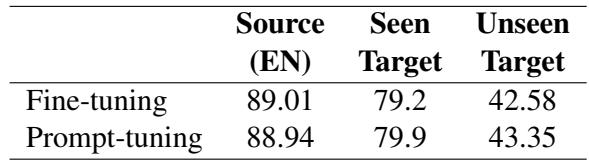
As shown in Table 1 above, the drop is drastic. When transferring to a “seen” language, models maintain high accuracy (around 79%). When transferring to an “unseen” language, accuracy plummets to roughly 43%.
The naive solution is to continue training the entire model on data from the new language. However, as models grow to billions of parameters, this becomes a resource nightmare. Furthermore, low-resource languages often lack enough data to retrain a massive model without causing “catastrophic forgetting”—where the model overfits the new data and forgets everything else it knew.
The Solution: Soft-Prompt Language Adaptation
The researchers propose a two-stage framework that adapts the model to the new language and the specific task without changing the model’s core weights. Instead, they use Soft Prompts.
What are Soft Prompts?
Think of a standard prompt as a text instruction you give an AI, like “Translate this sentence.” A Soft Prompt is similar, but instead of human-readable words, it consists of learnable vectors (numbers) inserted into the model’s input layers. The model learns the best possible “vectors” to guide its attention, while the rest of the massive model remains frozen.
The Two-Stage Framework
The core innovation lies in how these prompts are trained. The process is visualized below:
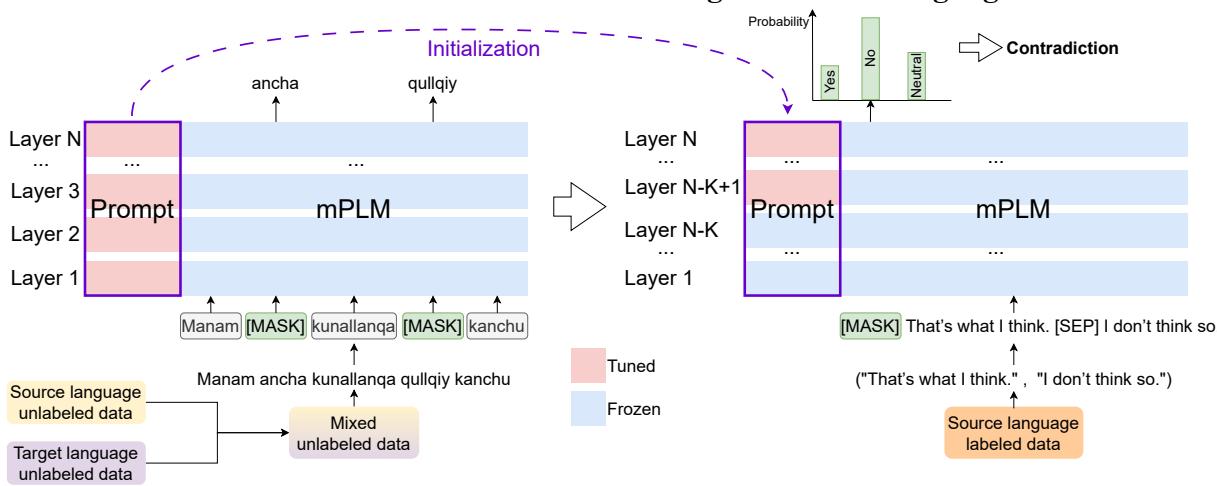
Let’s break down the two stages illustrated in Figure 2.
Stage 1: Adaptation via Masked Language Modeling (MLM)
Goal: Teach the model the structure of the new language.
In the first stage (left side of the figure), the researchers take unlabeled data from the unseen target language (and some English data). They freeze the entire pre-trained model. They then insert soft prompts (tunable vectors) into the layers of the model.
They train only these soft prompts using a Masked Language Modeling (MLM) objective. This is the classic “fill-in-the-blank” game. The model sees a sentence with missing words and tries to guess them. By optimizing the soft prompts to help solve this task, the prompts capture the linguistic features—vocabulary and grammar—of the unseen language.
Stage 2: Tuning on the Downstream Task
Goal: Teach the model the specific job (e.g., classification).
Now that the prompts “understand” the language, the researchers move to Stage 2 (right side of the figure). They take the soft prompts learned in Stage 1 and use them as initialization.
Here, they use labeled data from the source language (English). For example, if the task is Natural Language Inference (NLI), they feed the model English pairs of sentences labeled as “Contradiction,” “Neutral,” or “Entailment.”
The Critical Twist: Top-K Layers Notice in Figure 2 that the bottom layers are shaded differently. In Stage 2, the researchers freeze the soft prompts in the lower layers and only fine-tune the prompts in the Top-K layers (the layers closest to the output).
Why?
- Lower Layers tend to capture general linguistic information (grammar, syntax). We want to preserve the knowledge of the unseen language acquired in Stage 1.
- Upper Layers tend to be more task-specific and language-independent. These are the ones that need to change to learn the classification task.
How the Model Predicts: Templates and Verbalizers
To make the soft prompts work for classification, the researchers treat the classification task like a missing-word problem. They use a Template and a Verbalizer.
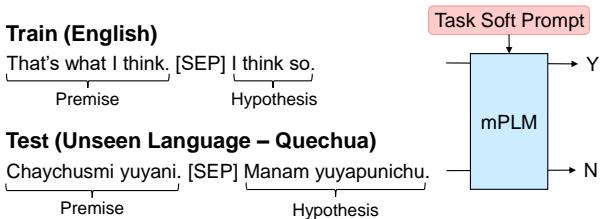
As shown in Figure 1, the input isn’t just “Classify this text.” It is formatted as a cloze question (a fill-in-the-blank sentence).
- Template:
Premise [SEP] Hypothesis\(\rightarrow\)That's what I think. [SEP] I think so. - Verbalizer: This maps the label to a word. If the label is “Entailment,” the verbalizer might expect the word “Yes.” If it’s “Contradiction,” it expects “No.”
Mathematically, the model tries to maximize the probability of the correct verbalizer token (like “Yes”) given the input \(x\) and the soft prompts \(\theta\):

The optimization objective during Stage 2 is to find the best parameters for the soft prompts in the top \(K\) layers:

This elegant formulation allows the model to leverage its pre-trained “fill-in-the-blank” capability to solve complex classification tasks.
Experimental Results
The researchers tested their method on two challenging datasets containing low-resource languages: MasakhaNEWS (African languages like Igbo, Yorùbá, and Luganda) and AmericasNLI (Indigenous languages of the Americas like Quechua, Guarani, and Bribri). None of these languages were in the original training set of XLM-R.
1. Superior Performance with Tiny Parameters
The results were compared against standard Fine-Tuning (updating all weights) and MAD-X (a popular adapter-based method).
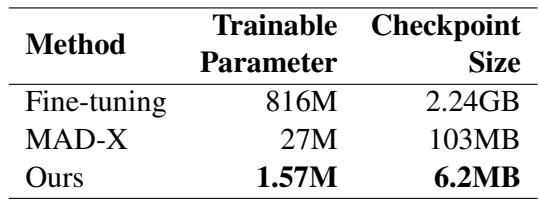
Table 2 (top) shows the accuracy. The proposed method (“Ours”) consistently outperforms standard fine-tuning and is highly competitive with MAD-X, achieving the highest average scores in many cases.
But the real shocker is Table 3 (bottom). Look at the “Trainable Parameter” column:
- Fine-tuning: Requires updating 816 Million parameters.
- MAD-X: Requires 27 Million parameters.
- Ours: Requires only 1.57 Million parameters.
This method achieves state-of-the-art results using only 0.28% of the parameters required for fine-tuning. This translates to massive savings in storage. A checkpoint for a new language in the baseline method is over 2GB; for this method, it’s a mere 6.2MB.
2. Efficiency with Unlabeled Data
How much text do you need in the unseen language for this to work? The researchers varied the amount of unlabeled target language data used in Stage 1.
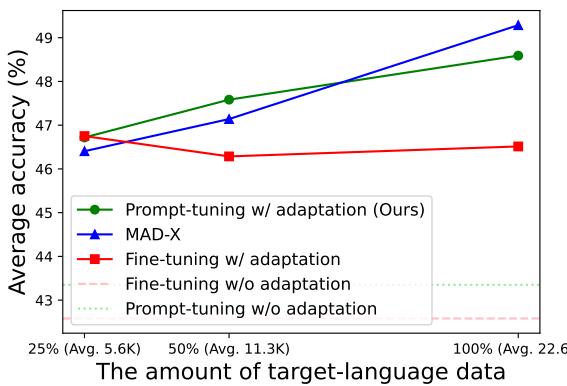
Figure 3 illustrates that Prompt-tuning (green line) scales beautifully. Even with smaller amounts of data (25%), it outperforms fine-tuning. As more unlabeled data becomes available, the performance gap widens, surpassing MAD-X. This makes it ideal for truly low-resource languages where digitised text is scarce.
3. Few-Shot Learning Capabilities
What if we also lack labeled data for the task itself? The researchers tested “Few-Shot” scenarios, where the model only sees a handful of examples (5, 10, 20) in the source language.
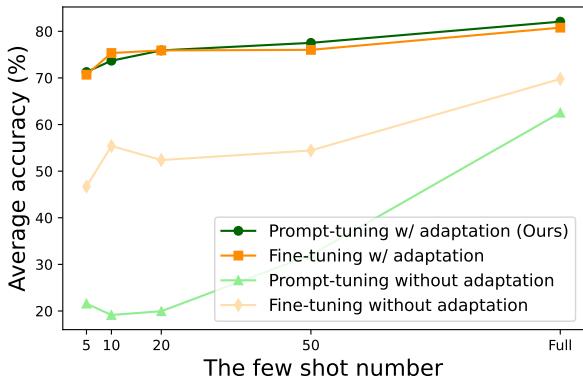
Figure 4 shows that Prompt-tuning with adaptation (solid green line) is the clear winner in the low-data regime (the left side of the chart). It learns faster and more effectively from just a few examples compared to fine-tuning, likely because the massive parameters of the full model make it prone to overfitting when data is this scarce.
Why Does It Work? The Layer Analysis
The researchers hypothesized that the top layers are task-specific while bottom layers are language-specific. They validated this with two interesting analyses.
First, they looked at how much the soft prompt parameters actually changed during training across the layers.
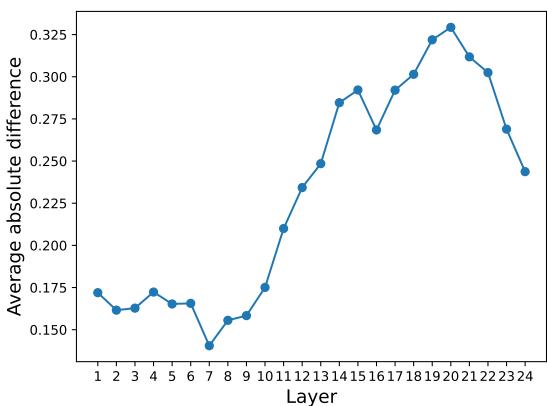
Figure 5 confirms the hypothesis. The “Average absolute difference” (change in values) is much higher in the upper layers (Layers 15-24). This suggests the model naturally relies on these upper layers to adapt to the specific downstream task.
Second, they compared training the Top K layers versus the Bottom K layers.
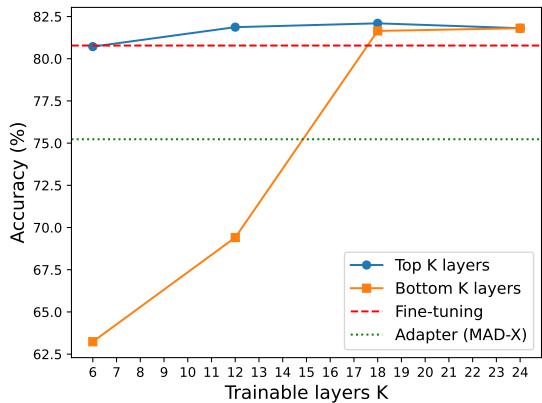
Figure 6 is definitive. The blue line (Top K layers) significantly outperforms the orange line (Bottom K layers). If you only tune the bottom layers, you disrupt the linguistic knowledge established in Stage 1, and performance suffers. By freezing the bottom and tuning the top, you get the best of both worlds: robust language understanding and accurate task performance.
Conclusion
The “Unseen Language” problem has long been a barrier to making AI truly global. This research provides a compelling solution that is both effective and efficient. By utilizing Soft-Prompt Tuning, we can adapt massive multilingual models to new languages without the need for massive computational resources or vast datasets.
Key takeaways from this work:
- Don’t retrain the whole brain: You can teach an old model a new language just by tuning a few prefix vectors.
- Separate Language from Task: Learning the language (Stage 1) and learning the task (Stage 2) should be treated as separate optimization steps.
- Efficiency unlocks accessibility: Because this method creates tiny checkpoints (6MB vs 2GB), it becomes much easier for communities with low-resource languages to share and deploy AI models tailored to their needs.
This approach represents a significant step toward democratizing NLP, ensuring that the benefits of AI are not reserved solely for the world’s most widely spoken languages.