](https://deep-paper.org/en/paper/file-3069/images/cover.png)
Introduction: The Hidden Logic of Human Argumentation
Imagine you are listening to a political debate. One candidate says, “We need to build a new, modern electric grid.” Another candidate replies, “This will generate a lot of new economic activity.”
To you, the connection is obvious. Building infrastructure requires labor and materials, which creates jobs and stimulates the economy. You processed that relationship instantly because you possess background knowledge—a mental map of how the world works.
Now, imagine an Artificial Intelligence trying to understand that exchange. It sees two sentences: one about an “electric grid” and one about “economic activity.” Without an explicit link stated in the text, a standard machine learning model might struggle to understand why the second sentence supports the first. It misses the invisible chain of reasoning: Electric grid \(\rightarrow\) Infrastructure project \(\rightarrow\) Job creation \(\rightarrow\) Economic activity.
This is one of the most significant hurdles in Argument Mining (AM) today. While Large Language Models (LLMs) like GPT-4 are impressive, they often struggle to reliably identify these implicit, context-dependent relationships without hallucinating or losing focus.
In the research paper “External Knowledge-Driven Argument Mining: Leveraging Attention-Enhanced Multi-Network Models,” researchers Debela Gemechu and Chris Reed propose a novel solution. They argue that to truly understand arguments, AI models need to step outside the text. By integrating external knowledge sources—specifically WordNet, ConceptNet, and Wikipedia—directly into neural network architectures, they enable machines to “read between the lines.”
In this post, we will tear down their methodology, explore the “Multi-Network” architectures they built, and analyze why Wikipedia turned out to be the secret weapon for teaching AI to argue.
Background: The Challenge of Implicit Relations
Argument Mining is a sub-field of Natural Language Processing (NLP) focused on extracting the structure of arguments from unstructured text. A core task within AM is Argument Relation (AR) Identification.
Given two pieces of text, known as Argumentative Discourse Units (ADUs), the goal is to classify their relationship into one of three categories:
- Inference (RA): One ADU supports the other.
- Conflict (CA): One ADU attacks the other.
- None: There is no argumentative relation.
The Context Gap
The difficulty lies in context. Arguments rarely spell out every step of their logic. They rely on “local coherence”—the assumption that the listener can bridge the gap between concepts.
As shown in the examples from the paper below, identifying a relation requires external knowledge.
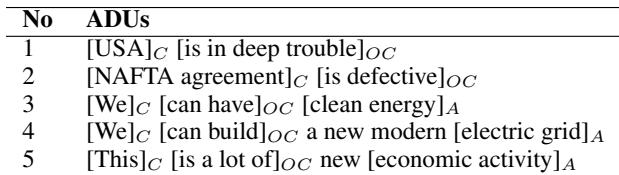
Look at examples (4) and (5) in the table above. To connect “build electric grid” (ADU 4) with “economic activity” (ADU 5), you need to know that grid construction involves innovation and clean energy development, which are economic drivers.
Existing methods often rely solely on the text provided or the internal weights of pre-trained LLMs. While LLMs capture some common sense, they are “black boxes” that struggle with complex, multi-hop reasoning chains. They lack a structured way to look up information. This paper proposes that we shouldn’t just ask the model to guess; we should give it a map.
Core Methodology: Constructing the Knowledge Bridge
The researchers developed a pipeline that does not just read the argument; it actively researches the concepts mentioned within it. This process involves three distinct phases: Decomposition, Path Extraction, and Multi-Network Modeling.
Phase 1: Decomposition and Alignment
Before the model can look up information, it needs to know what to look for. The system first decomposes ADUs into functional components:
- Target Concepts (C): The main topics (e.g., “NAFTA agreement”).
- Aspects (A): Specific features of the topic (e.g., “defective”).
By focusing on these components rather than the whole sentence, the system reduces noise. The researchers analyzed four diverse datasets (AAEC, AMT, US2016, and AbstRCT) to identify these concepts.
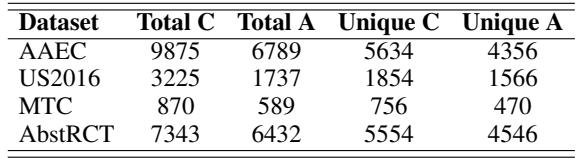
As seen in the table above, thousands of unique concepts and aspects were extracted, providing a rich vocabulary for the model to investigate.
Phase 2: Knowledge Path Extraction
Once the concepts are identified, the system acts like a navigator. It looks for a “path” connecting the concepts in the Premise ADU to the concepts in the Conclusion ADU. The researchers experimented with three external knowledge sources:
- WordNet: A lexical database (ontology) grouping words by meaning.
- ConceptNet: A semantic network of common sense knowledge.
- Wikipedia: A semi-structured encyclopedia.
How Wikipedia Pathfinding Works
While WordNet and ConceptNet are structured graphs, Wikipedia offers a unique advantage: Hyperlinks.
The system treats Wikipedia as a massive graph where pages are nodes and hyperlinks are edges. If ADU 1 mentions “Taxes” and ADU 2 mentions “Jobs,” the system performs a search (specifically, a Breadth-First Search) through Wikipedia to find a chain of hyperlinks connecting the two pages.
For example, a path might look like this:
- Job \(\rightarrow\) Working hour system \(\rightarrow\) Income tax \(\rightarrow\) Tax
The system doesn’t just grab the links; it extracts the semantic relation between them. It looks at the sentence containing the hyperlink and uses Semantic Role Labeling (SRL) to understand the verb or phrase connecting the terms (e.g., “leads to,” “involves,” “results in”).
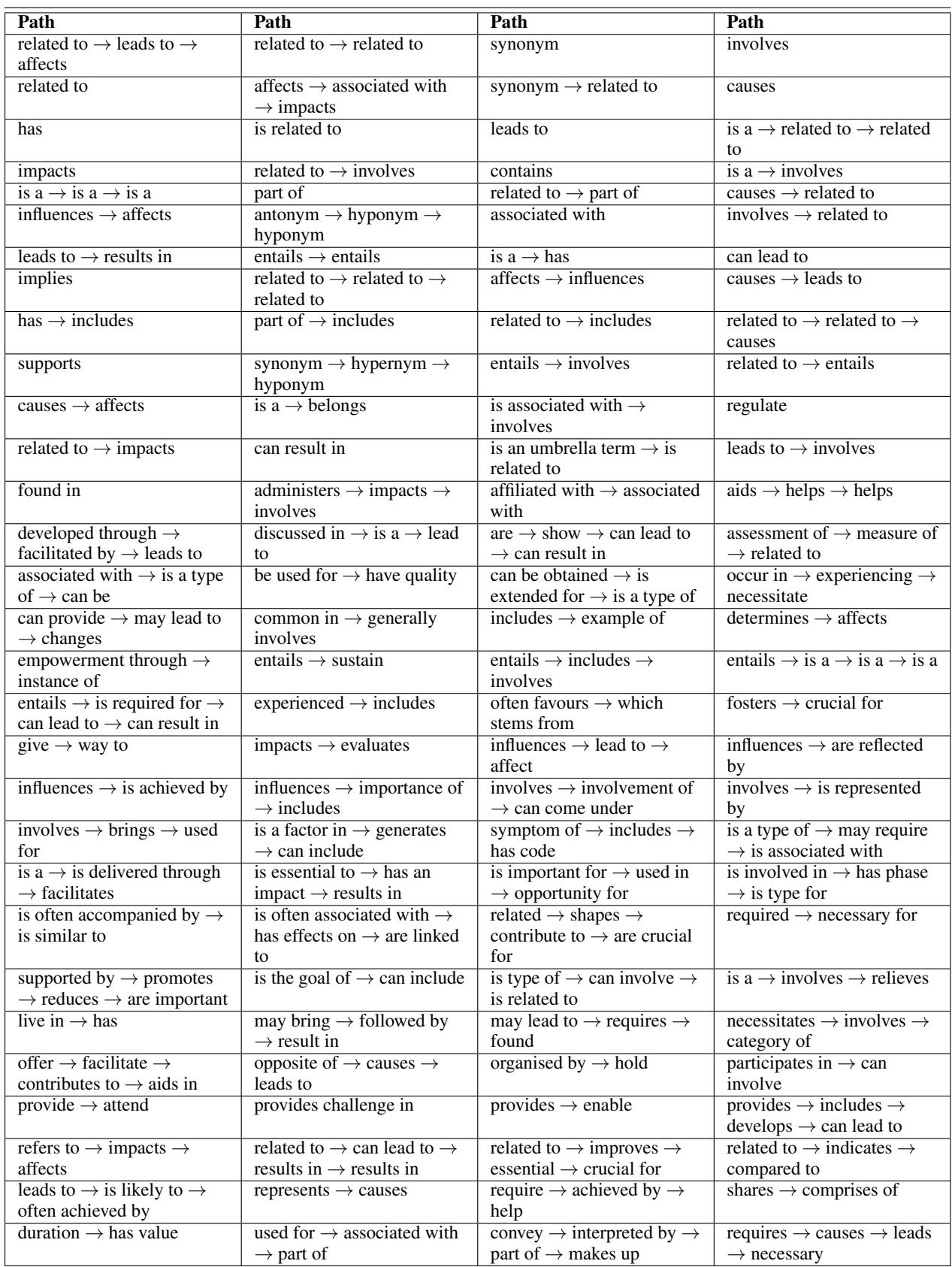
The table above illustrates the variety of paths extracted. Notice how some are simple synonyms, while others represent complex causal relationships (e.g., “developed through” \(\rightarrow\) “facilitated by” \(\rightarrow\) “leads to”).
Phase 3: Attention-Based Multi-Network Architectures
This is the heart of the paper’s contribution. The researchers didn’t just append these knowledge paths to the text as extra words. They designed specific neural architectures to process the argument text and the external knowledge in parallel.
They leveraged BERT (a powerful pre-trained language model) as the foundation but restructured how it processes inputs using two main architectures: the Siamese Network and the Triplet Network.
The Siamese Network with Attention
In a standard Siamese network, two identical subnetworks process two different inputs. Here, the researchers tweaked the design:
- Encoder 1 (E1): Processes the ADUs (Premise + Conclusion).
- Encoder 2 (E2): Processes the External Knowledge (The extracted paths).
Crucially, they added an Attention Layer (ED-att-1).
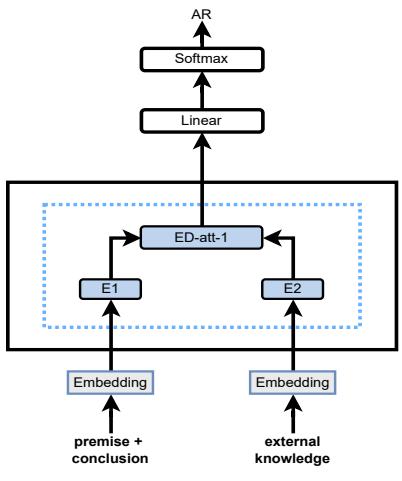
How it works: The output of E1 (the argument text) acts as the Query. The output of E2 (the external knowledge) acts as the Key and Value. In simple terms, the model asks: “Given this argument between concepts A and B, which parts of this external knowledge path are actually relevant?” This allows the model to filter out noise from the external data and focus only on the knowledge that helps classify the relation.
The Triplet Network with Attention (The Winner)
The researchers took it a step further with a Triplet Network. This architecture splits the processing into three distinct streams.
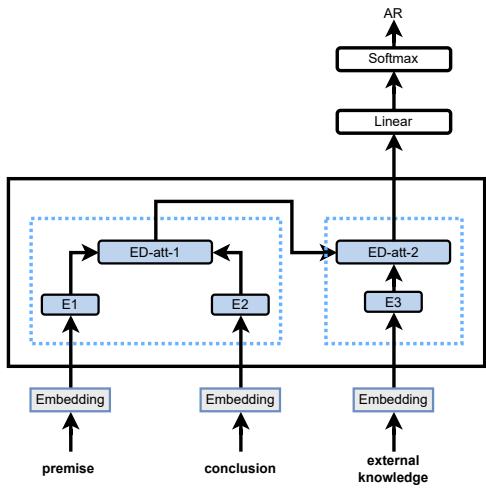
The Three Encoders:
- E1: Encodes the Premise alone.
- E2: Encodes the Conclusion alone.
- E3: Encodes the External Knowledge Paths.
The Double Attention Mechanism: This architecture is more sophisticated because it uses two attention layers:
- ED-att-1 (Argument Alignment): This layer looks at the Premise and Conclusion. It helps the model understand how the two text units relate to each other linguistically, without looking at external knowledge yet.
- ED-att-2 (Knowledge Integration): This layer takes the output of the first attention layer (the aligned argument) and uses it to query the external knowledge from E3.
Why this matters: This hierarchical approach mimics human reasoning. First, we understand what the two people are saying (Premise vs. Conclusion). Then, we apply our background knowledge to see if the logic holds up. By separating these steps, the Triplet Network ensures that the external knowledge is applied specifically to the relationship between the premise and conclusion, rather than just the general topic.
Experiments & Results: Does Knowledge Power Accuracy?
The researchers evaluated their models against several baselines, including standard BERT models (without external knowledge) and GPT-4. They used four datasets representing different domains, from student essays (AAEC) to biomedical abstracts (AbstRCT).
Key Findings
The results were compelling. The integration of external knowledge consistently improved performance across the board.
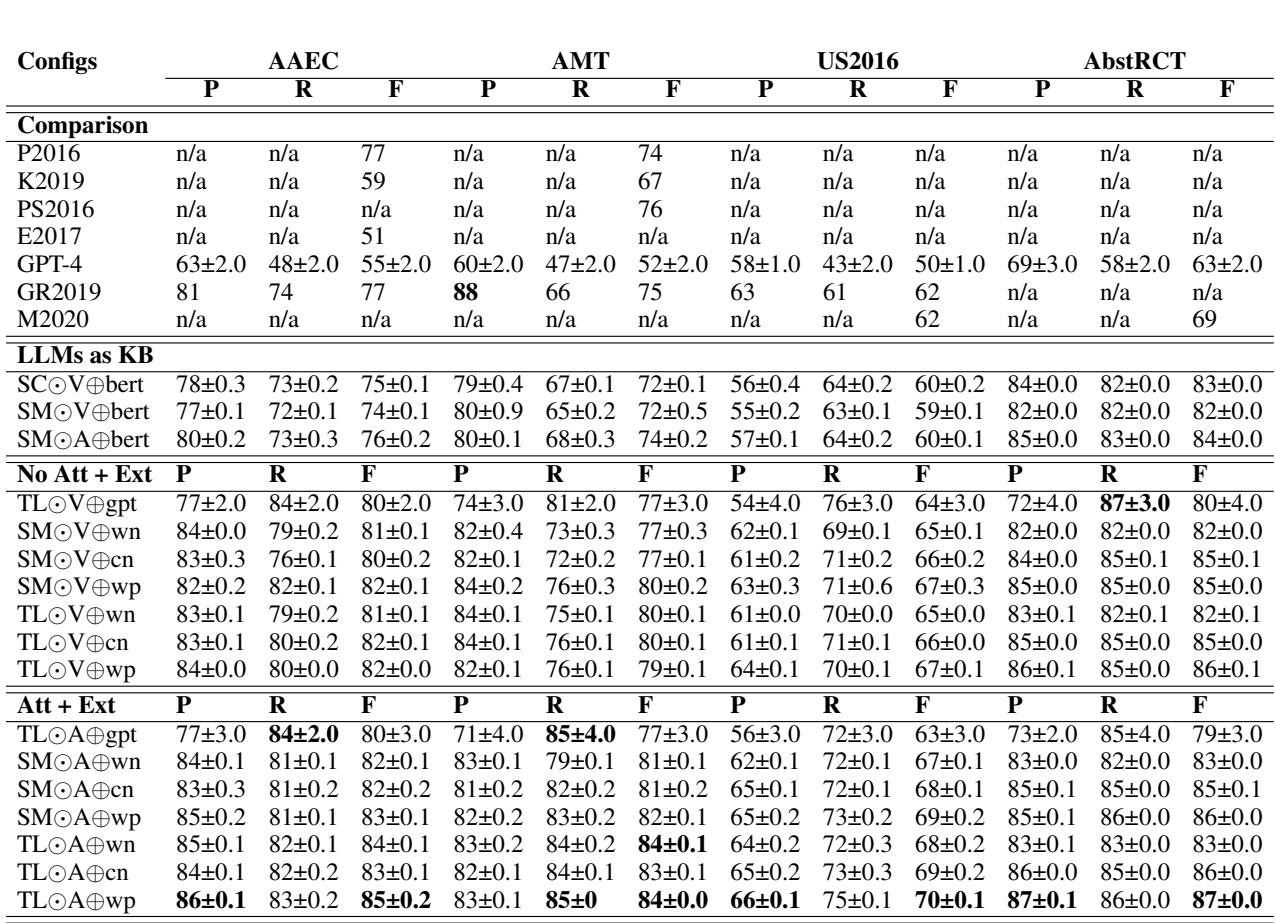
Let’s break down the key takeaways from the results table above:
- External Knowledge Wins: Models with external knowledge (marked with \(\oplus\) wn, \(\oplus\) cn, \(\oplus\) wp) consistently outperformed the baseline LLMs (LLMs as KB).
- Wikipedia is King: The Wikipedia-based configurations (ending in
wp) achieved the highest scores. For example, on the AbstRCT dataset, the Triplet Network with Wikipedia paths (TL⊙A⊕wp) reached an F-score of 0.87, significantly higher than models using only WordNet or ConceptNet.
- Why? Wikipedia covers a broader range of concepts and relation types (hyperlinks) than the rigid structures of WordNet. It captures “world knowledge” better than “dictionary knowledge.”
- Attention is Critical: The rows labeled “No Att + Ext” (No Attention) performed worse than “Att + Ext” (With Attention). This proves that simply feeding knowledge into the model isn’t enough; the model needs the attention mechanism to select the relevant information.
- Triplet > Siamese: The Triplet architecture generally outperformed the Siamese architecture. The separation of Premise and Conclusion allows for finer-grained analysis of the argument structure.
The GPT-4 Comparison
Interestingly, the researchers also compared their model against paths generated by GPT-4 (TL⊙A⊕gpt). While GPT-4 is powerful, the models trained on GPT-generated paths had high recall but lower precision.
Human analysis revealed that while GPT-4 generates logical paths, it often hallucinates connections that are irrelevant to the specific argument context. This highlights a limitation of generative models: they can be too creative. The structured retrieval from Wikipedia provided more reliable, grounded constraints for the Argument Mining model.
Conclusion & Implications
The research presented in “External Knowledge-Driven Argument Mining” offers a significant step forward in making AI reasoning more robust.
The authors demonstrated that while LLMs capture linguistic patterns, they often lack the explicit “connective tissue” required to understand complex arguments. By mechanically injecting external knowledge—particularly from the rich, interlinked structure of Wikipedia—and using attention mechanisms to filter that knowledge, we can build models that reason more like humans.
Why does this matter?
To build AI that can debate, verify facts, or analyze legal and medical texts, we cannot rely on surface-level text processing. An argument is never just about what is said; it is about what is understood.
By moving from simple text classification to Attention-Enhanced Multi-Network Models, this paper provides a blueprint for the future of interpretable AI. It suggests that the path to better AI reasoning isn’t necessarily just bigger models, but smarter architectures that know how to look up the answers they don’t have.
In the end, the most argumentative AI might just be the one that spends the most time reading Wikipedia.