](https://deep-paper.org/en/paper/file-3084/images/cover.png)
Introduction
Imagine you are planning a road trip. You ask your co-pilot, “How much gas do we have left?”
If your co-pilot is a computer, it might say: “We have 14.2 liters remaining in a 50-liter tank.” If your co-pilot is a human, they might say: “We have a small amount left.”
Both answers are “correct,” but they operate on different planes of logic. The computer uses precise reasoning, dealing with exact numbers and deterministic rules. The human uses fuzzy reasoning, handling imprecise categories and linguistic ambiguities. While Large Language Models (LLMs) like GPT-4 and Llama-3 have become exceptional at the former—solving complex calculus and coding problems—how good are they at the latter?
This question is the driving force behind the research paper “FROG: Evaluating Fuzzy Reasoning of Generalized Quantifiers in Large Language Models.”
In this post, we will explore the FRoG benchmark, a novel framework designed to test whether LLMs can bridge the gap between hard numbers and fuzzy language. The results are surprising: models that excel at math often fail at vague descriptions, and making a model “smarter” or larger doesn’t always make it better at understanding concepts like “few,” “some,” or “most.”
Background: The Precision Bias
To understand why this paper is significant, we first need to look at how we currently evaluate AI. The standard benchmarks for reasoning, such as GSM8K (Grade School Math) or MATH, rely on precision.
- Input: “If John has 5 apples and buys 3 more, how many does he have?”
- Expected Output: “8.”
There is no room for interpretation. However, human language is dominated by Generalized Quantifiers (GQs). These are words that express quantity without precision: few, many, most, several, a tiny amount.
Fuzzy logic is vital for real-world decision-making. If a medical report says there is a “slight chance” of complications, or a financial advisor notes “moderate growth,” understanding the underlying semantics of those fuzzy words is just as important as calculating the exact percentages.
The researchers identified a gap: we know LLMs can do the math, but can they map that math to the fuzzy concepts humans use every day?
The Core Method: Introducing FRoG
Testing fuzzy reasoning is difficult. If you simply ask an LLM, “Is 20% a ‘small amount’?” the answer is subjective. To create a rigorous benchmark, the authors developed FRoG (Fuzzy Reasoning of Generalized Quantifiers).
The genius of FRoG lies in its construction. Rather than writing new fuzzy questions from scratch, the researchers took existing, real-world math word problems and “reverse-engineered” them into fuzzy reasoning tasks.
The Construction Workflow
The process involves transforming precise math problems into multiple-choice fuzzy logic puzzles.
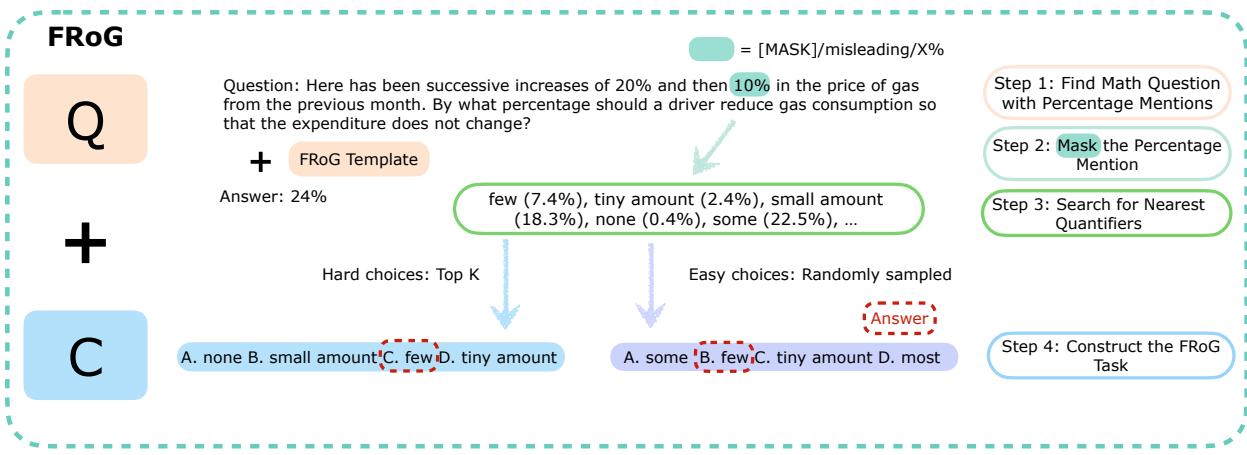
As illustrated in Figure 1, the workflow proceeds in four steps:
- Identify Math Questions: The system pulls questions from datasets like GSM8K that involve percentage calculations.
- Mask the Percentage: The precise percentage (e.g., “20%”) is hidden and replaced with a
[MASK]token. - Provide the Answer: Crucially, the model is given the final numerical answer to the problem.
- The Task: The model must use the context and the final answer to infer which Generalized Quantifier (GQ) fits in the
[MASK].
For example:
- Original: “Gas prices increased by 20%…”
- FRoG Task: “Gas prices increased by [MASK]. The final price is $X… Does [MASK] mean ‘few’, ‘some’, or ‘most’?”
This forces the model to perform two distinct cognitive steps:
- Precise Reasoning: Reverse-calculate the missing percentage (e.g., determine the missing value is 20%).
- Fuzzy Mapping: Map that numerical value (20%) to the most appropriate semantic term provided in the multiple-choice options.
The Quantifier Spectrum
To standardize what words like “few” or “moderate amount” actually mean in numbers, the researchers aligned their data with human-annotated quantifier strengths.
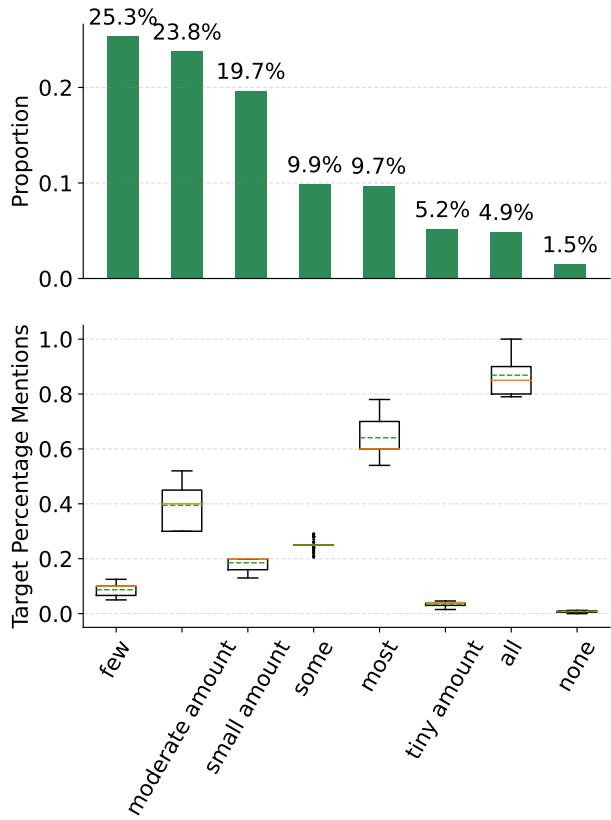
Figure 2 shows the distribution of these concepts. You can see that “tiny amount” usually correlates with very low percentages (near 5%), while “most” hovers closer to high percentages. However, there is overlap, which makes the task challenging. The benchmark includes both an “Easy” mode (where the wrong answers are clearly incorrect) and a “Hard” mode (where the wrong answers are semantic neighbors, like distinguishing “few” from “tiny amount”).
Experiments & Results
The researchers evaluated a wide array of open-source LLMs, including Llama-2, Llama-3, Mistral, Qwen, and specialized math/code models. The results revealed that fuzzy reasoning is a significant stumbling block for current AI.
1. The General Struggle
Overall, performance on FRoG is low. While random guessing would yield 25% accuracy on a 4-choice question, many powerful models barely exceed this baseline, particularly on the “Hard” setting.
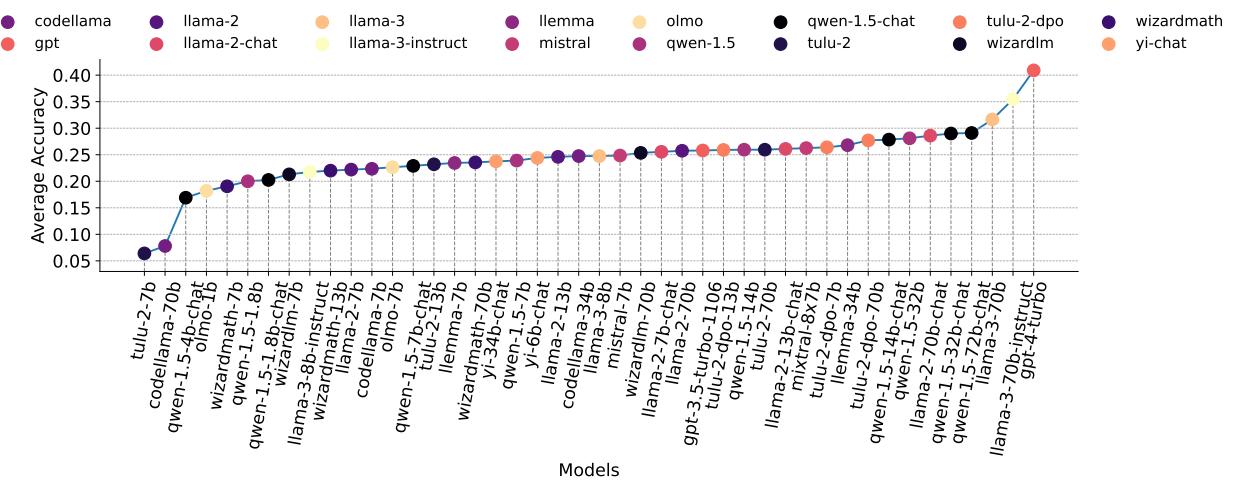
Figure 3 provides a high-level overview. Notice that even sophisticated models struggle to break past 40% accuracy on hard tasks. This confirms that fuzzy reasoning is a distinct capability from standard language generation.
2. Specialized Training Doesn’t Help
A common assumption in AI is that “Instruction Tuning” (training a model to follow instructions) or training on math data will strictly improve reasoning. FRoG challenges this assumption.
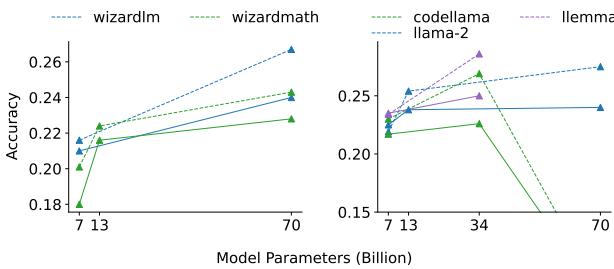
As shown in Figure 5, models trained specifically on math (like WizardMath) or code (CodeLlama) often perform worse or show negligible improvement compared to their base models (like Llama-2 or WizardLM). The domain shift is real: being good at Python code or precise arithmetic does not translate to understanding the nuance of human vagueness.
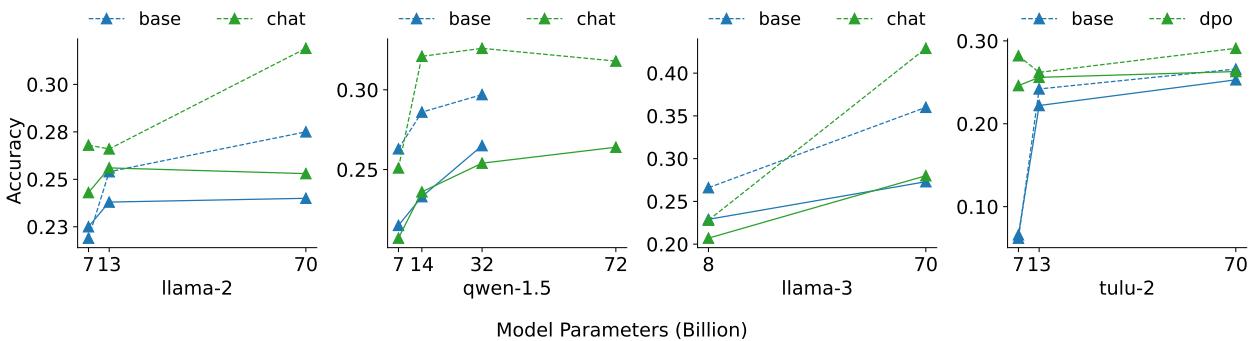
Similarly, Figure 4 compares base models against their “Chat” variants. While instruction tuning helps slightly on the “Easy” mode (dashed lines), the benefit vanishes or reverses on the “Hard” mode (solid lines).
3. The Inverse Scaling Phenomenon
Perhaps the most fascinating finding is the Inverse Scaling Effect. In most AI benchmarks, bigger is better. A 70-billion parameter model usually crushes a 7-billion parameter model.
In FRoG, the opposite often happens.
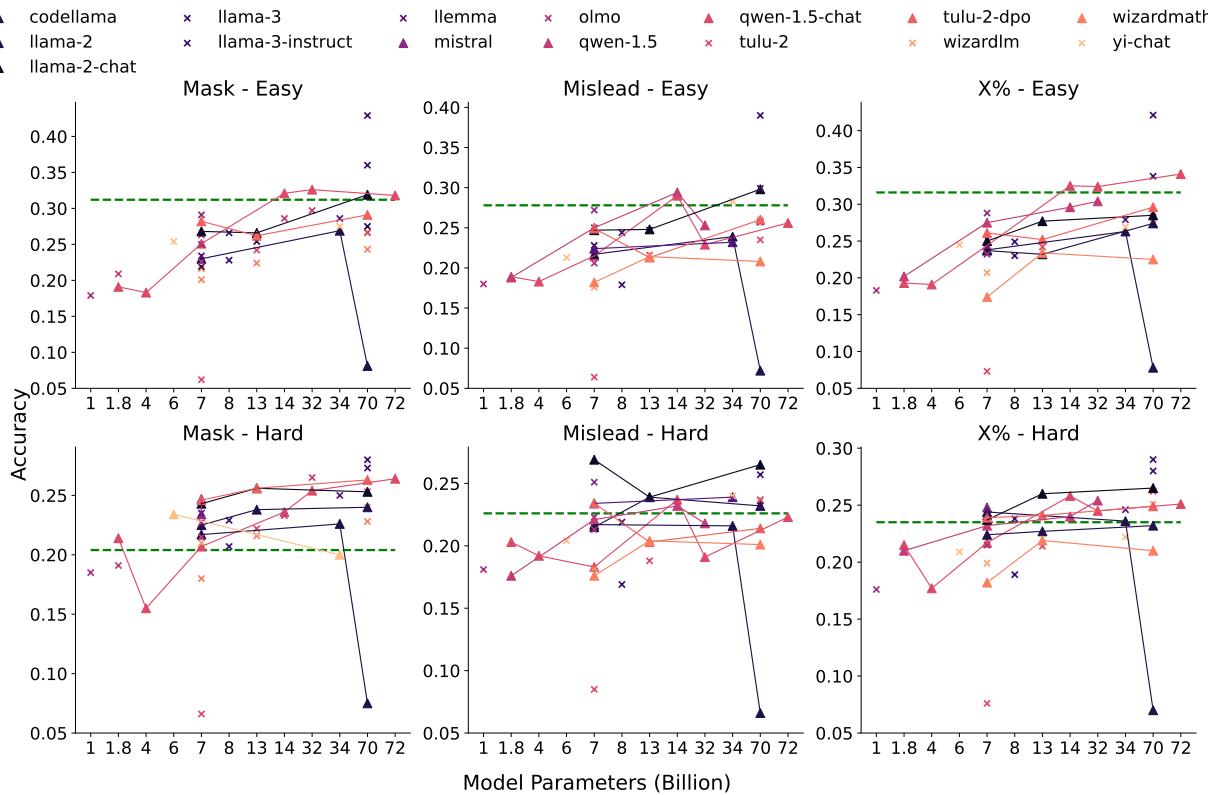
Figure 6 highlights this trend. Across more than 50% of the model families tested, scaling up the model size resulted in lower accuracy. This is highly counter-intuitive. Why would a “smarter” model fail?
A case study on the Qwen-1.5 model offers a clue:
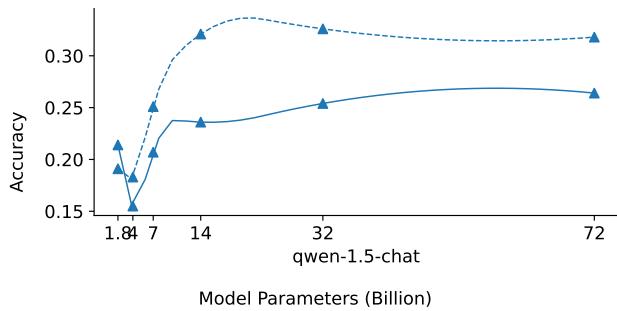
Figure 7 shows that while performance improves initially, it saturates or drops as the model gets massive. The researchers posit that larger models might be “overthinking” or hallucinating constraints that aren’t there, or perhaps their stronger alignment to precise answers makes them uncomfortable with fuzzy choices.
4. Strong Math \(\neq\) Strong Fuzzy Reasoning
To pinpoint exactly where the models were failing, the researchers ran a control experiment. They asked the models to solve the same problems but provided precise numbers as options (e.g., “10%”, “20%”) instead of words (“few”, “some”).
- Task A (Mask_Percent): Find the missing number (Precise).
- Task B (Mask_Quant): Find the missing word (Fuzzy).
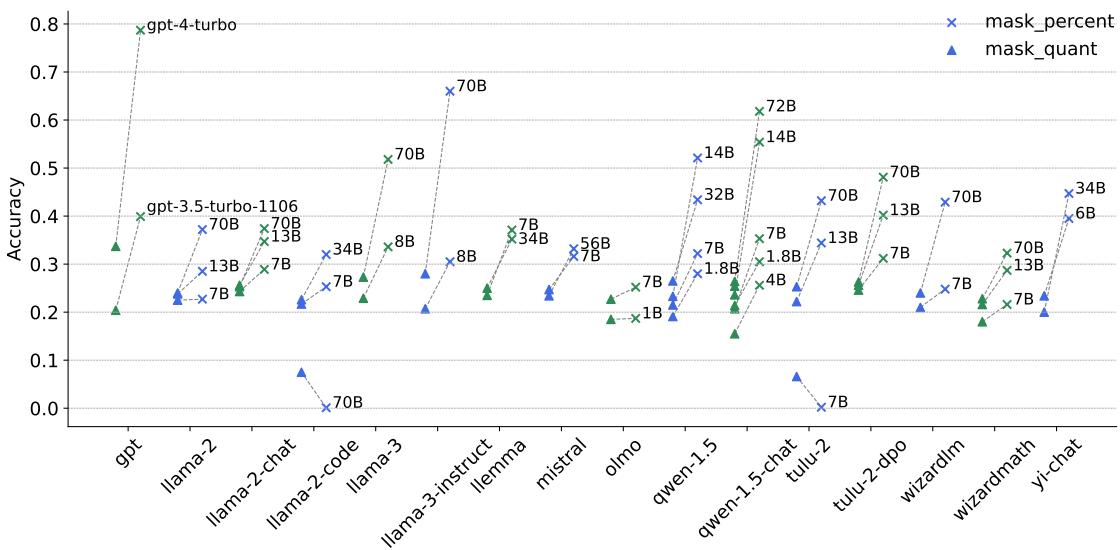
Figure 8 reveals a massive gap. The top models (like GPT-4 Turbo) achieve nearly 80% accuracy on the precise math version (red x’s) but drop to around 40-50% on the fuzzy version (blue triangles).
This proves that computation is not the bottleneck. The models can successfully calculate that the missing value is “13%.” Their failure lies entirely in the mapping phase—they do not know that 13% semantically aligns with “small amount” in that specific context.
Qualitative Analysis: Inside the AI’s Mind
What does this failure look like in practice? The researchers analyzed the “Chain of Thought” reasoning generated by the models.
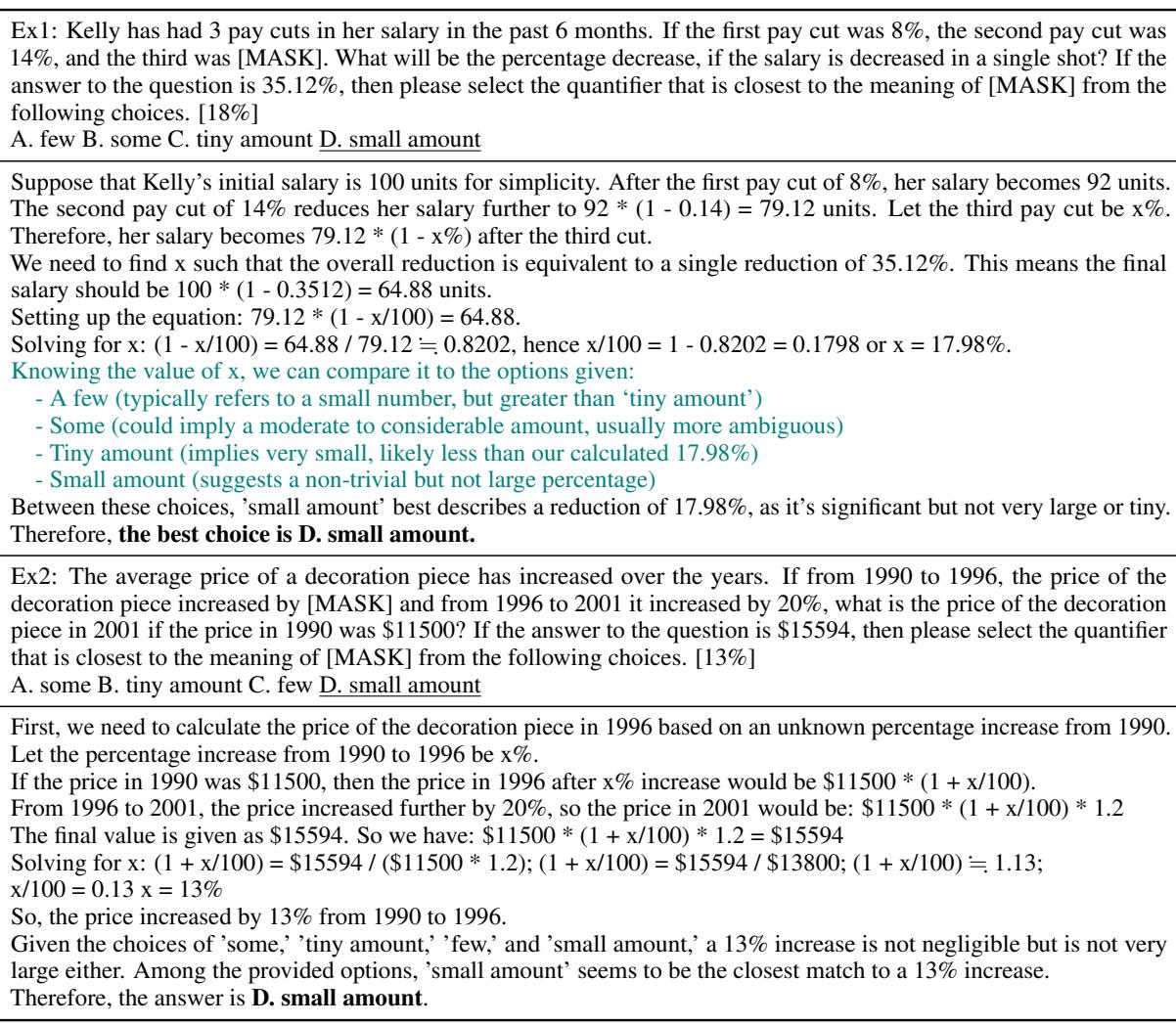
Table 2 shows two examples:
- Ex1: The model correctly calculates the missing pay cut is ~18%. It then reasons that 18% is a “small amount” relative to the whole. This is a success.
- Ex2: The model calculates the increase is 13%. However, it struggles to distinguish between “tiny,” “small,” and “some.” It eventually picks “small amount,” which is correct, but the reasoning process is often shaky.
In many failed cases, the model would calculate the number perfectly (e.g., “The answer is 45%”) but then hallucinate the mapping, concluding that 45% represents “a tiny amount” rather than “some” or “most.”
Conclusion & Implications
The FRoG benchmark serves as a reality check for the AI community. We have spent immense resources teaching LLMs to be precise calculators and coders, but we have arguably neglected their ability to function in the ambiguous, fuzzy world that humans inhabit.
Key Takeaways:
- Fuzzy Reasoning is Hard: Current LLMs struggle to interpret Generalized Quantifiers like “most” or “few” in mathematical contexts.
- Bigger Isn’t Always Better: The inverse scaling effect suggests that simply adding more parameters won’t solve this problem.
- The Missing Link is Semantics, Not Math: Models can do the arithmetic; they fail at the semantic mapping of numerical values to fuzzy linguistic concepts.
As we move toward AI agents that interact with the real world—negotiating prices, interpreting medical advice, or driving cars—the ability to understand that “slow down a little” is different from “slow down a lot” will be crucial. FRoG provides the metric we need to start measuring and improving this essential skill.