](https://deep-paper.org/en/paper/file-3086/images/cover.png)
Introduction: The Lazy Student Problem in AI
Imagine you are a teacher grading a multiple-choice history exam. You notice a student who gets nearly every answer correct. Impressive, right? But then you look closer. You realize that for every question where the answer is “C,” the question is slightly longer than the others. The student isn’t actually reading the history questions; they have just learned a shortcut: “Long question = Answer C.”
If you give that student a new test where the answers are randomized properly, they will fail miserably.
This is exactly the problem facing modern Natural Language Understanding (NLU) models like BERT and RoBERTa. These models are incredibly powerful, but they are also “lazy.” They often achieve high accuracy not by understanding language, but by exploiting dataset biases—spurious correlations or “shortcuts” hidden in the training data.
For example, in Natural Language Inference (NLU) tasks, where a model must decide if two sentences contradict each other, models often learn that the presence of the word “not” usually implies a contradiction. They stop analyzing the actual meaning and simply hunt for the word “not.” When they face a complex sentence where “not” is present but the sentences actually agree, the model fails.
Today, we are doing a deep dive into a research paper that proposes a clever solution to this problem. The framework is called FAIRFLOW. Instead of trying to force the model to be “unbiased” directly, the researchers teach the model a more human skill: the ability to be undecided.
Background: Explicit vs. Implicit Biases
To understand how FAIRFLOW works, we first need to understand the enemy: dataset bias. The researchers categorize these biases into two main types.
1. Explicit Biases
These are surface-level patterns that are easy for humans to spot.
- Lexical Overlap: If two sentences share many of the same words, a model might assume they mean the same thing (Entailment), even if they don’t.
- Negation Words: As mentioned, words like “no” or “never” act as triggers for specific labels.
- Sentence Length: Sometimes the length of a sentence correlates with a specific answer category.
2. Implicit Biases
These are much harder to detect. They are subtle, statistical correlations that humans might miss but deep learning models—which are essentially pattern recognition machines—pick up on instantly. These can be complex combinations of syntax, tone, and specific word embeddings that act as shortcuts to the right answer during training but fail in the real world.
The Shortcoming of Current Solutions
Previous attempts to fix this have often relied on “weak learners.” The idea is to train a small, simple model that only learns biases (since it’s too weak to learn the real task). Then, you use that weak model to tell the main model, “Hey, this example is easy to cheat on, don’t trust it.”
The problem? This approach assumes the weak model can find all the biases. It also usually focuses on just one view of the data. FAIRFLOW argues that we need a multi-view approach that tackles both explicit and implicit biases simultaneously.
Core Method: The Art of Undecided Learning
The core philosophy of FAIRFLOW is fascinatingly simple: If the input data is broken or biased, the model should not be confident in its prediction.
If I give you a sentence that is scrambled nonsense, or if I only show you half of a math problem, you shouldn’t guess the answer with 100% confidence. You should shrug and say, “I don’t know.” In probability terms, “I don’t know” looks like a uniform distribution—an equal probability assigned to every possible answer.
FAIRFLOW enforces this by generating “biased views” of the training data and forcing the model to output a uniform distribution for those views.
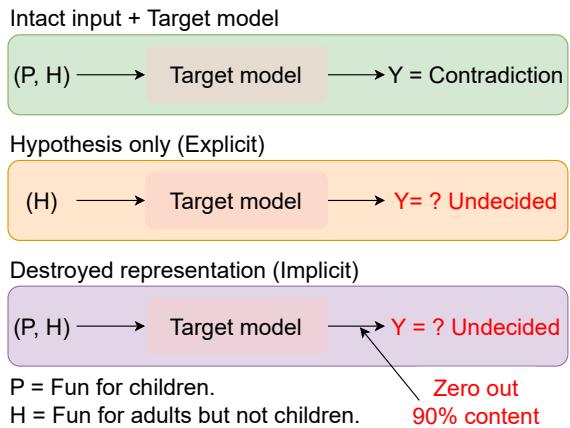
As shown in Figure 1, consider a standard NLI task where we have a Premise (“Fun for children”) and a Hypothesis (“Fun for adults but not children”).
- Intact Input: The model sees both. It should confidently predict “Contradiction.”
- Hypothesis Only (Explicit Bias): The model only sees “Fun for adults but not children.” Without the premise, it’s impossible to know if this is a contradiction. However, a biased model sees “not” and guesses “Contradiction.” FAIRFLOW forces the model to be Undecided.
- Destroyed Representation (Implicit Bias): The model sees a corrupted version of the hidden states. It should effectively be blind. FAIRFLOW forces the model to be Undecided.
The Architecture
The FAIRFLOW framework functions by taking an input batch of data and processing it through two parallel streams: the Intact Stream and the Perturbed Stream.
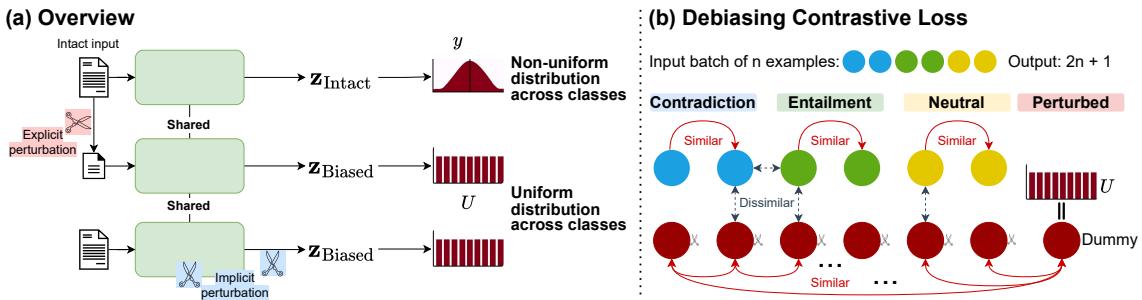
As illustrated in Figure 2, the architecture works as follows:
- Intact Input: The clean data goes through the encoder. The model tries to predict the correct label (\(Y\)).
- Perturbed Input: The researchers apply various “perturbation operators” to corrupt the data. This creates a “biased view.”
- Contrastive Learning: This is the magic step. The model is trained to push the Intact embeddings toward the correct label and pull the Biased/Perturbed embeddings toward a Uniform Distribution (U).
Let’s break down exactly how they break the data.
Perturbation Operators: Simulating Bias
The researchers introduce a suite of operations to simulate different types of bias. They don’t just guess what the biases are; they mechanically force the model to rely on bad data, and then punish it for doing so.
Explicit Perturbations (Data Level)
These operations mess with the raw text before it even hits the model.
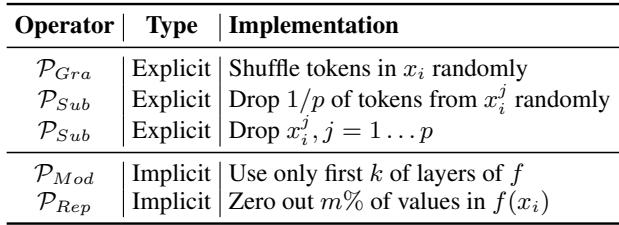
1. Ungrammatical Perturbation (\(\mathcal{P}_{Gra}\)): Models often ignore word order. To mitigate this, the authors randomly shuffle the words in the sentence. If the model still tries to make a confident prediction based on a “bag of words,” it gets penalized.

2. Sub-input Perturbation (\(\mathcal{P}_{Sub}\)): In tasks like NLI, you need both sentences (Premise and Hypothesis) to know the answer. This operator drops one of them. If the model tries to answer based on only the hypothesis (a common bias), it is corrected.

Implicit Perturbations (Representation Level)
These operations happen inside the neural network. They simulate the “unknown” shortcuts.
1. Model-based Perturbation (\(\mathcal{P}_{Mod}\)): This uses a “weak” version of the model by only using the first few layers (\(k\)) of the encoder. This mimics a model that only looks at shallow, surface-level features.

2. Representation-based Perturbation (\(\mathcal{P}_{Rep}\)): This is a more aggressive approach. It takes the encoded representation of the text and zeroes out a massive chunk of it (e.g., 90%). This creates a “feature-poor” view. If the model is still confident despite having 90% of its brain turned off, it’s relying on a shortcut.

Here is a summary of all the perturbation strategies used in the framework:
The Objective Function
How do we mathematically tell the model “Be confident on the good data, but be undecided on the bad data”? The authors use a modified Supervised Contrastive Loss.
In standard contrastive learning, you want similar images/text to be close together in embedding space and dissimilar ones to be far apart. Here, the definition of “similar” changes based on the view.
For the Biased/Perturbed views, the target is a “dummy” example that represents a perfect Uniform Distribution. The loss function pulls the perturbed representations closer to this uniform dummy and pushes them away from specific class labels.
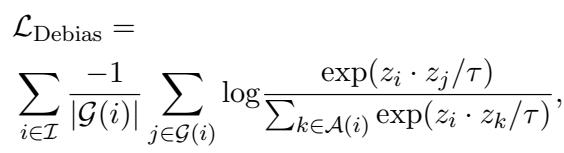
This equation essentially says: Calculate the similarity between our biased input (\(z_i\)) and the uniform distribution (\(z_j\)). Maximizing this similarity forces the model to be “undecided.”
Finally, the total training objective combines the standard Cross-Entropy loss (for getting the right answer on intact data) with this new Debiasing loss (\(\mathcal{L}_{Debias}\)), balanced by a weight parameter \(\lambda\).

Experiments and Results
The researchers tested FAIRFLOW on three major NLU datasets:
- MNLI: Multi-Genre Natural Language Inference.
- QQP: Quora Question Pairs (identifying duplicate questions).
- PGR: Phenotype-Gene Relation (a relation extraction task).
Crucially, they didn’t just test on the normal test sets (In-Domain or ID). They used Stress Tests and Out-Of-Distribution (OOD) sets.
- Stress Tests: Data specifically designed to trick models (e.g., sentences with heavy negation or high lexical overlap).
- OOD: Completely different datasets (like HANS or PAWS) that the model has never seen, which expose whether the model learned the task or just the dataset.
Main Results
The results were highly impressive. In many debiasing papers, there is a “trade-off”: you reduce bias, but your accuracy on the normal data drops. FAIRFLOW manages to improve robustness without sacrificing standard performance.
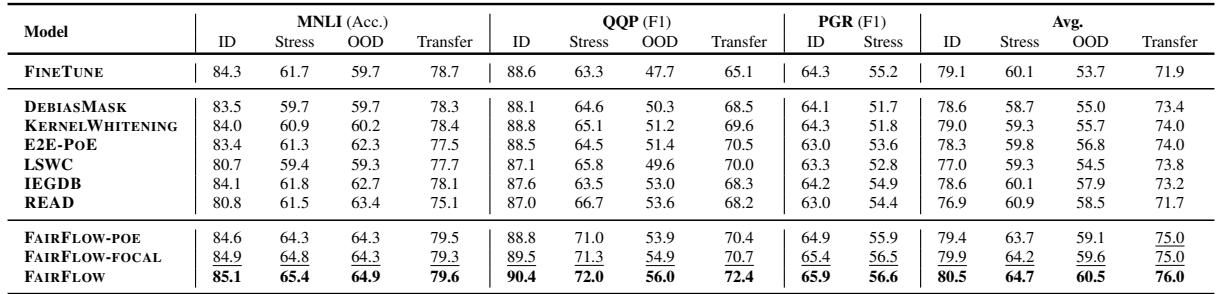
Looking at Table 2, we can draw several key conclusions:
- Stress Test Dominance: Look at the “Stress” columns. FAIRFLOW (in its various configurations like POE or FOCAL) consistently beats the baselines. On QQP, it jumps from roughly 63-66% (baselines) to over 71%.
- OOD Generalization: The “OOD” performance (Out-Of-Distribution) also sees significant gains. This confirms the model isn’t just memorizing; it’s learning features that transfer to new environments.
- No “In-Domain” Tax: Check the “ID” column. The accuracy remains competitive with, and often better than, the standard “Fine-tune” baseline. This is a major achievement, as methods like
READorIEGDBoften see a slight dip here.
Does the Choice of Model Matter?
One might wonder if this only works for BERT. The authors extended their evaluation to other architectures, including GPT-2.
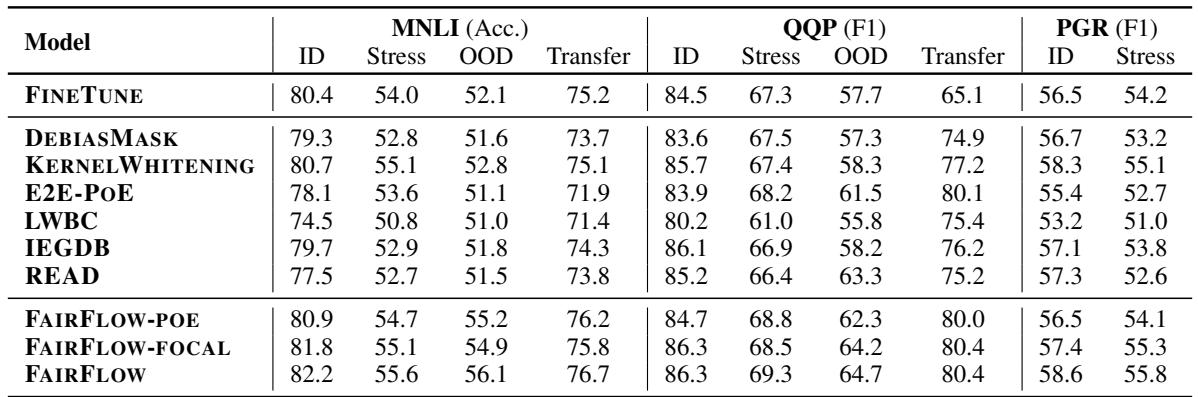
As seen in Table 7, the trend holds for GPT-2. FAIRFLOW consistently outperforms the Fine-Tuned baseline and other debiasing methods like DebiasMask on Stress and OOD metrics. This suggests the “undecided learning” framework is architecture-agnostic—it’s a fundamental training principle, not a model-specific hack.
Which Perturbation Matters Most?
Is it the shuffling? The dropping of words? Or the neural network pruning? The authors performed an ablation study to find out.
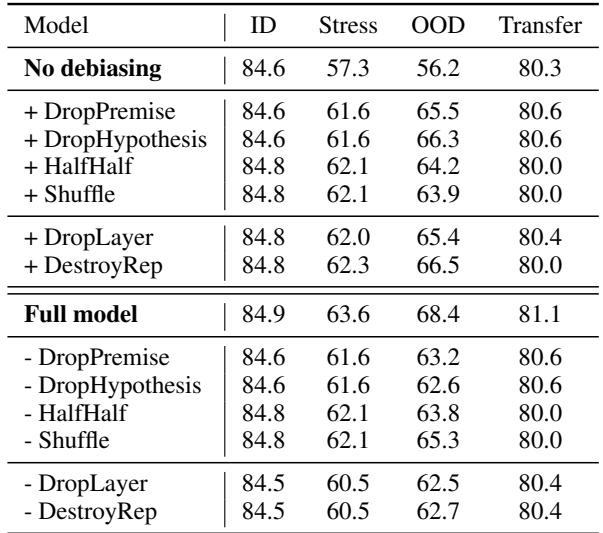
Table 3 shows what happens when you add or remove specific perturbations.
- Full Model performs best, suggesting that tackling both explicit and implicit biases is necessary.
- DestroyRep (implicit perturbation) seems to be the heavy lifter for Stress and OOD tests.
- DropPremise/Hypothesis (explicit perturbation) helps significantly with Transfer learning.
This reinforces the paper’s hypothesis: Biases are diverse. You can’t just fix one type (like negation) and expect the model to be robust. You need a multi-view approach.
Combining Perturbations
The researchers also visualized how different combinations of perturbations affect performance relative to standard fine-tuning.
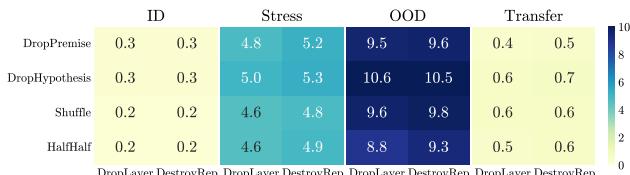
Figure 3 is a heatmap showing the relative accuracy increase. The darker blue areas represent higher gains. Notice how combining “Shuffle” (an explicit perturbation) with “DestroyRep” (an implicit perturbation) yields some of the strongest results on OOD data. This visualizes the synergy between addressing data-level shortcuts and model-level shortcuts simultaneously.
Efficiency
Finally, a practical question: Does this make training incredibly slow or heavy?
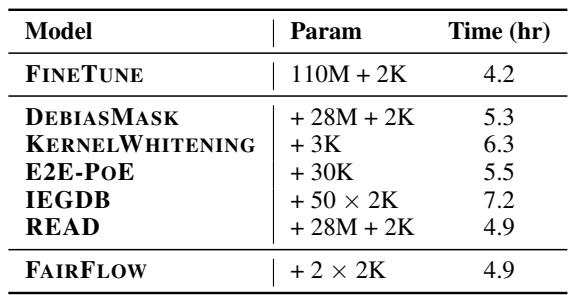
Table 4 compares the parameters and training time.
- Parameters: FAIRFLOW adds a negligible amount of parameters (+2 x 2K) compared to methods like
IEGDBorDebiasMaskwhich can add millions of parameters. - Time: The training time (4.9 hours) is comparable to standard fine-tuning (4.2 hours) and faster than most other debiasing methods. This is because FAIRFLOW doesn’t require training a separate “weak learner” model first; it generates the biased views on the fly during training.
Conclusion & Implications
The FAIRFLOW paper presents a compelling shift in how we think about training AI. Instead of just trying to teach the model “this is right” and “this is wrong,” FAIRFLOW teaches the model “this is insufficient information.”
By forcing the model to adopt a uniform, undecided distribution when looking at biased or corrupted data, we strip away the effectiveness of shortcuts. If the model can’t be confident when it sees a “shortcut” (like a negation word without context), it is forced to look deeper for the true signal in the intact data.
Key Takeaways
- Undecided is a Valid State: Uncertainty is a powerful teaching tool.
- Multi-View is Essential: Biases are explicit (words) and implicit (vectors). You must tackle both.
- Efficiency: You don’t need massive external models to debias; you can do it by perturbing your existing data.
As we move toward deploying Large Language Models (LLMs) in critical areas like healthcare and law, robustness is non-negotiable. We cannot have models that act like the “lazy student,” guessing answers based on sentence length or specific keywords. Frameworks like FAIRFLOW offer a scalable, efficient path toward models that actually read the question before answering.