](https://deep-paper.org/en/paper/file-3108/images/cover.png)
The integration of Artificial Intelligence into healthcare is no longer a futuristic concept; it is happening now. From diagnosing skin lesions to predicting patient outcomes, AI models are becoming powerful tools in the clinician’s arsenal. However, with great power comes the “black box” problem. Deep learning models, particularly in medical imaging, are notoriously opaque. We know what they decide, but we rarely know why.
To bridge this gap, the field of Explainable AI (XAI) has exploded in popularity. The logic is sound: if an AI can explain its reasoning, doctors can trust it when it’s right and—crucially—catch it when it’s wrong.
But what if the explanation itself is the problem?
In a fascinating paper titled “Fool Me Once? Contrasting Textual and Visual Explanations in a Clinical Decision-Support Setting,” researchers from the University of Oxford and partner institutions investigate a critical, often overlooked nuance in human-AI collaboration. They discovered that the modality of an explanation—whether it is a visual map or a sentence of text—drastically changes how humans interact with AI. Most alarmingly, they found that well-written textual explanations can be so persuasive that they trick medical professionals into accepting incorrect diagnoses.
In this deep dive, we will unpack their methodology, explore the dangerous allure of “eloquent” AI, and look at how combining visual and textual cues might be the key to safer clinical decision-support systems (CDSS).
Background: The Two Faces of Explainability
Before we analyze the study, we need to understand the two primary types of explanations currently vying for dominance in medical imaging.
1. Visual Explanations (Saliency Maps)
For years, the standard for interpreting computer vision models has been the Saliency Map (or heatmap). These maps highlight the specific regions of an image that the model deemed most important for its prediction.
- Pros: They are quick to process and directly overlay on the medical image.
- Cons: They are often ambiguous. A highlighted lung region could mean pneumonia, a nodule, or a broken rib. The “why” is left to the viewer’s interpretation.
2. Natural Language Explanations (NLEs)
With the rise of Large Language Models (LLMs) and Vision-Language Models (VLMs), AI can now generate fluent, human-like text justifying a diagnosis. For example: “Bibasilar opacities may represent atelectasis.”
- Pros: They are intuitive, human-readable, and mimic how doctors communicate with each other.
- Cons: As this study reveals, their very “human-ness” can lead to over-reliance.
The researchers set out to compare these two modalities not just on how much users liked them, but on how they affected accuracy in a high-stakes environment where the AI is not always perfect.
The Study Design: Simulating Imperfection
Most evaluations of XAI assume a binary world: the AI is either right or wrong. However, this paper introduces a more realistic, complex variable: Explanation Correctness (\(C_{\chi}\)).
In the real world, an AI might make the right diagnosis for the wrong reasons (right answer, wrong explanation), or it might hallucinate a convincing explanation for a wrong diagnosis. To test this, the authors designed a large-scale user study involving 85 healthcare practitioners (ranging from medical students to radiology residents).
The Protocol
The participants were tasked with reviewing chest X-rays. They were assisted by an AI that provided a diagnosis and, depending on the experimental condition, an explanation. The flow of the study was rigorous, ensuring participants were tested across different scenarios.
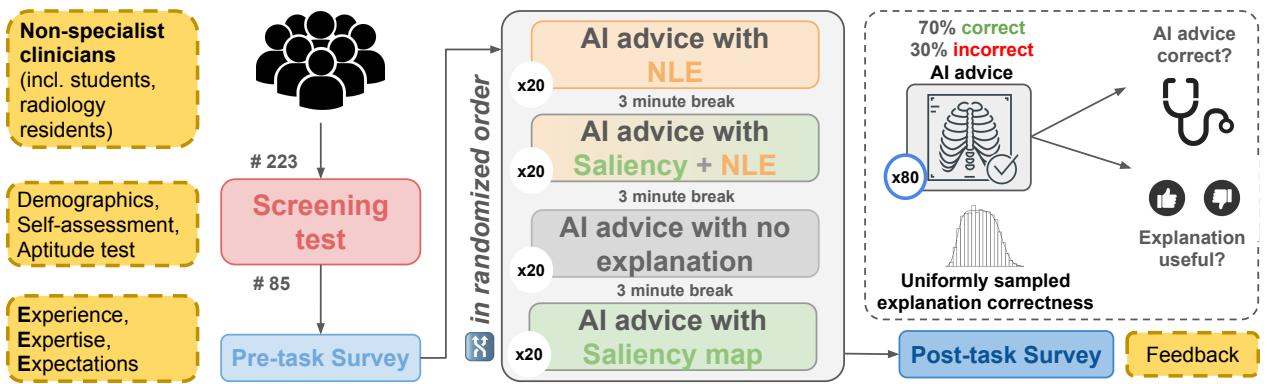
As shown in Figure 1, participants moved through four specific conditions:
- AI Advice + NLE (Text)
- AI Advice + Saliency Map (Visual)
- AI Advice + Combined (Both)
- AI Advice + No Explanation (Control)
The Twist: Insightful vs. Deceptive Explanations
The genius of this study lies in how the researchers categorized the AI’s behavior. They didn’t just use “Good AI” or “Bad AI.” They had expert radiologists annotate the correctness of the AI’s prediction (\(C_{AI}\)) and the correctness of the explanation (\(C_{\chi}\)) separately.
This created a four-quadrant framework for evaluating interactions:
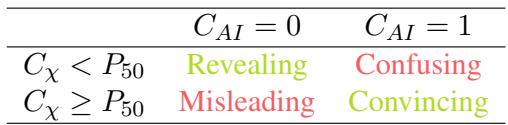
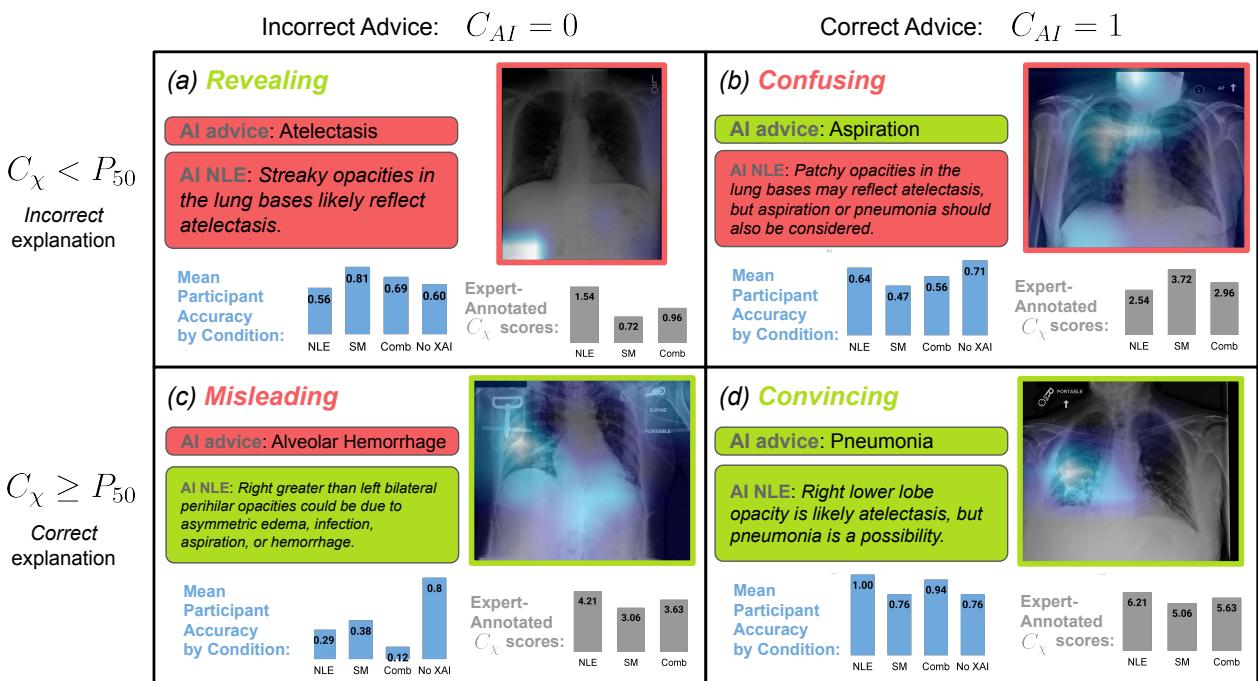
- Insightful: The AI is correct, and the explanation is high-quality.
- Confusing: The AI is correct, but the explanation makes no sense (low quality).
- Revealing: The AI is incorrect, and the explanation is poor (helping the human spot the error).
- Misleading: The AI is incorrect, but the explanation is highly plausible/correct-sounding (tricking the human).
Figure 2 below provides concrete examples of these categories. Pay attention to quadrant (c) Misleading. Here, the AI suggests “Alveolar Hemorrhage” (incorrect), but provides a highly-rated explanation. This is the “danger zone” for clinical AI.
Core Method: Modeling Human Decisions
To analyze the results, the researchers didn’t just look at raw averages. They employed a Generalized Linear Mixed-Effects Model (GLMM). This statistical approach allowed them to account for the variability between different participants (some are more experienced than others) and different images (some are harder to diagnose).
The model predicts the log-odds of a human making a correct decision based on several interacting factors.
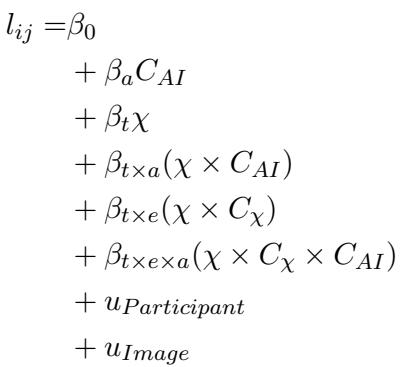
In this equation:
- \(l_{ij}\) is the human accuracy.
- \(C_{AI}\) is the AI’s correctness (0 or 1).
- \(\chi\) represents the explanation type (Text, Visual, Combined).
- \(C_{\chi}\) is the correctness of the explanation (a continuous score from the radiologists).
The interaction terms (like \(\chi \times C_{AI}\)) are crucial. They allow the researchers to ask: “Does the effect of a text explanation change depending on whether the AI is lying?”
Results: The Paradox of Preference vs. Performance
The results of the study uncovered a stark disconnect between what users think is helpful and what actually is helpful.
1. The Preference Illusion
When asked, the clinicians overwhelmingly preferred the textual Natural Language Explanations (NLEs). They rated NLEs higher on trust, transparency, and understandability compared to saliency maps.
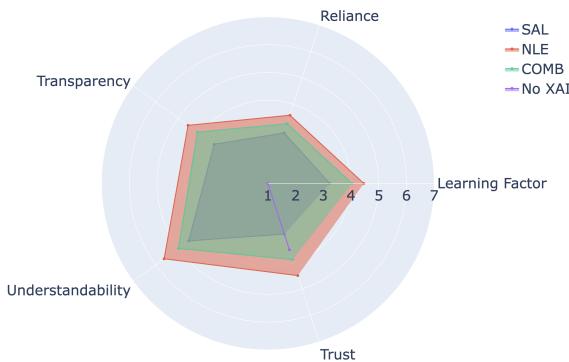
As Figure 4 shows, the orange line (NLE) dominates the purple line (Saliency Maps/SAL) across every subjective metric. Clinicians felt that text was more transparent and trustworthy.
2. The Trap of Textual Explanations
However, when the researchers looked at actual diagnostic accuracy, the story changed dramatically.
When the AI gave incorrect advice, NLEs significantly harmed human performance compared to visual explanations. This phenomenon is known as over-reliance. Because the text sounded plausible and authoritative (even when wrong), clinicians were less likely to question the AI’s judgment.
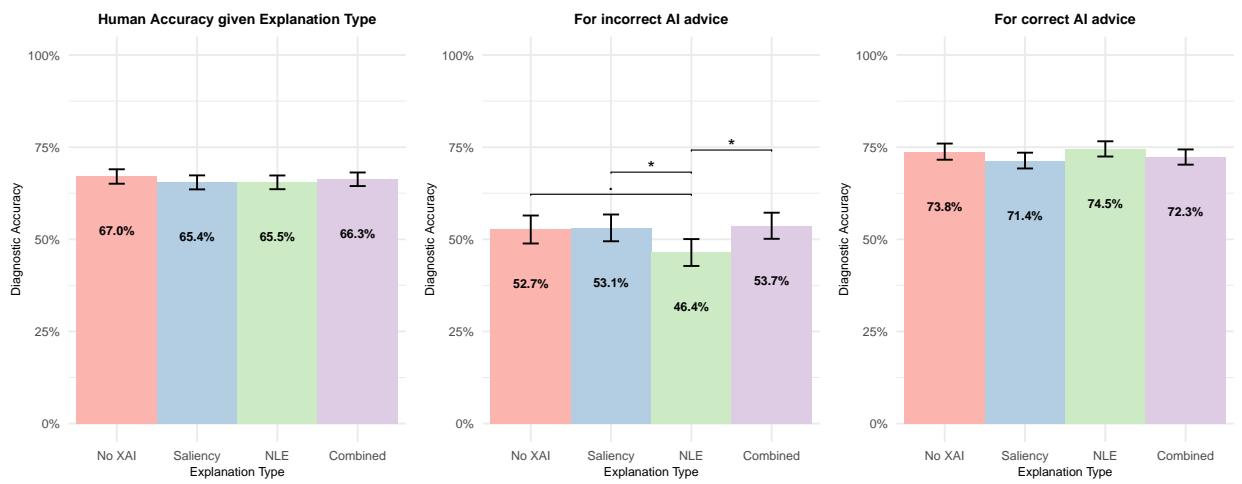
Look at the middle chart in Figure 6 (“For incorrect advice”). The green bar (NLE) is significantly lower than the others. This means that when the AI made a mistake, showing the doctor a text explanation made them more likely to agree with the mistake than if they had seen a saliency map or even no explanation at all.
3. Visuals Help Spot Errors
Conversely, Saliency Maps acted as a “sanity check.” Even though users rated them poorly in the survey, the data showed that low-quality saliency maps helped users identify when the AI was wrong.
If an AI predicts “Pneumonia” but the saliency map highlights the shoulder bone or the stomach, a doctor immediately knows something is wrong. This is a “Revealing” explanation. Text, however, can smooth over these errors with hallucinated medical jargon, making the error harder to spot.
4. The Power of Combination
The study found that the “Combined” modality (showing both text and visual maps) offered the best of both worlds, particularly when the explanations were “Insightful” (correct AI, correct explanation).
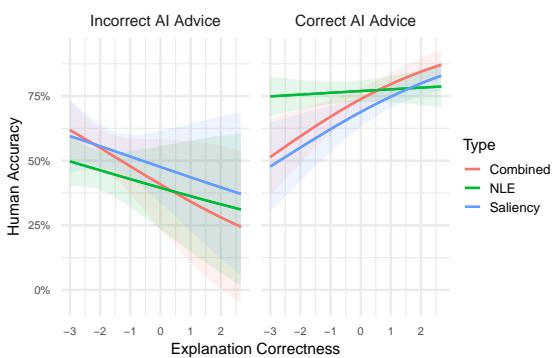
Figure 3 illustrates this interaction beautifully.
- Right Panel (Correct AI): As the explanation quality improves (moving right on the x-axis), human accuracy skyrockets. The Red line (Combined) consistently outperforms the others.
- Left Panel (Incorrect AI): As explanation quality drops (moving left), accuracy actually improves for the visual and combined models. Why? Because the explanations look “bad,” alerting the human to the error. However, note how the Green line (NLE) struggles to provide that same safety net.
The Impact of “Convincing” vs. “Deceptive”
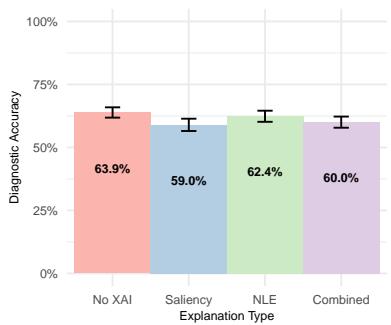
The researchers further broke down the results into the specific quadrants we discussed earlier. The bar charts in Figure 7 (specifically the bottom row) highlight the differences in human accuracy across these specific scenarios.
- Insightful Explanations (Top Left): When everything works as intended, Combined explanations (Red bar) yield the highest accuracy (\(76.5\%\)).
- Misleading Explanations (Top Right): This is the scenario where the AI is wrong, but the explanation looks “good.” Notice how low the accuracy drops across the board (around \(40-50\%\)). This proves that high-quality explanations for wrong predictions are a significant safety hazard.
Exploratory Insights: Speed and Confidence
Beyond accuracy, the study looked at how these explanations affected the workflow.
Decision Speed: Unsurprisingly, reading text takes time. The decision speed for NLEs and Combined explanations was significantly slower than for Saliency Maps or No Explanation.
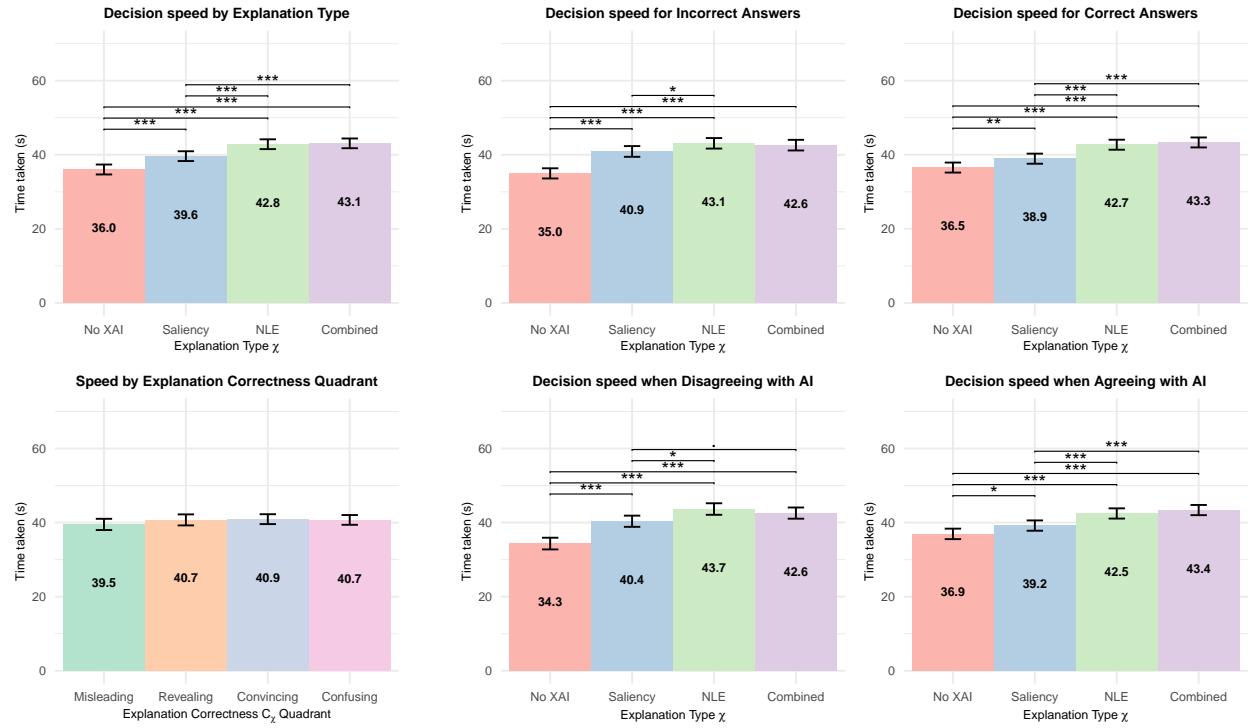
As shown in Figure 11 (Top Left), using Combined explanations added about 7 seconds per case compared to no explanation. While this might seem negligible, in a high-volume clinical setting, these seconds add up. However, given the safety implications, this might be a necessary trade-off.
Perceived Usefulness: The researchers also tracked “Perceived Usefulness” on a case-by-case basis. Interestingly, users rated NLEs as highly useful even when the AI was wrong, confirming the confirmation bias and over-reliance issues.
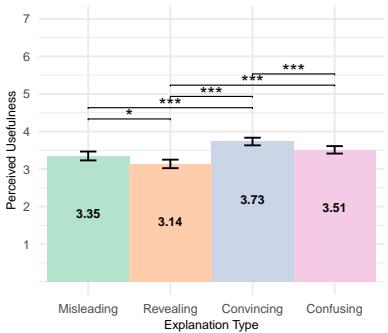
Figure 8 (Top Middle) shows that for incorrect answers, users still rated NLEs (Orange bar) as significantly more useful than Saliency maps. This subjective “feeling” of usefulness is dangerous when it doesn’t correlate with objective accuracy.
Conclusion: Trust, but Verify
This research paper provides a sobering reality check for the deployment of Generative AI in medicine. The authors effectively demonstrate that user preference is not a proxy for clinical safety.
Here are the key takeaways for students and practitioners of AI:
- Eloquence \(\neq\) Truth: Large Language Models are persuasive. In a clinical setting, their ability to generate plausible-sounding justifications can override a doctor’s judgment, leading to errors.
- Visuals are “Honest”: Saliency maps, while sometimes confusing, are harder to fake. A nonsensical heatmap is an immediate red flag, whereas a hallucinated text explanation can fly under the radar.
- Combination is Key: The best performance was achieved by combining modalities. The text provides context and ease of use, while the visual map serves as a grounding mechanism to verify the text’s claims.
- Evaluations Must Be Realistic: Testing AI on perfect data is not enough. To understand the real-world impact of CDSS, we must evaluate how humans react when the AI is wrong and when explanations are deceptive.
As we move forward, the design of medical AI interfaces must account for human psychology. We cannot simply maximize for “trust.” Instead, we must design systems that encourage appropriate reliance—trusting the AI when it’s right, but providing the necessary cues to doubt it when it’s wrong.