](https://deep-paper.org/en/paper/file-3130/images/cover.png)
Imagine you are trying to teach a computer to find specific moments in a video—like a “tennis swing” or a “penalty kick”—but you aren’t allowed to show the computer any video examples of those specific actions during training. You can only describe them with words.
This is the challenge of Zero-Shot Temporal Action Localization (TAL). It is one of the hardest problems in computer vision today. Traditional deep learning models crave massive datasets of labeled videos. If you want a model to recognize “skydiving,” you typically need to show it thousands of clips of people jumping out of planes. But gathering and annotating these video datasets is expensive, time-consuming, and impossible to scale for every possible human action.
So, how do we build models that can recognize actions they’ve never seen before?
The answer lies in bridging the gap between vision and language. If a model understands the concept of an action via text, it should theoretically be able to find it in a video. However, text descriptions are often too abstract, leading to confusion.
Enter GRIZAL (Generative Prior-guided Zero-Shot Temporal Action Localization). This new architecture, proposed by researchers from Yellow.ai, Northwestern University, and IIT Roorkee, takes a fascinating approach: if the model hasn’t seen the data, why not hallucinate it?
GRIZAL leverages the power of Large Language Models (like GPT-4) and Text-to-Image models (like DALL-E) to generate synthetic training examples on the fly. By “imagining” what an action looks like and how it is described, GRIZAL builds a robust internal representation that allows it to outperform state-of-the-art methods in finding actions in untrimmed videos.
In this deep dive, we will explore how GRIZAL works, the architecture behind its “generative priors,” and why adding a little imagination to AI makes it significantly more accurate.
The Problem: When Descriptions Aren’t Enough
To understand why GRIZAL is necessary, we first need to look at the limitations of current Zero-Shot TAL methods.
Most modern approaches rely on pre-trained Vision-Language models like CLIP. These models map images and text into a shared feature space. Theoretically, the vector for a video frame of a “dog barking” should be very close to the vector for the text string “a dog barking.”
However, relies purely on static text-to-video matching has two major pitfalls:
- Over-complete Representation: The model might associate a visual feature with too many different actions because the representation is too broad. For example, a “person running” appears in soccer, basketball, and track. If the model doesn’t understand the nuance, it might flag a basketball game as a track meet.
- Under-complete Representation: The model lacks context. A single sentence like “playing accordion” might not capture the hand movements, the posture, or the instrument’s appearance from different angles.
Furthermore, video is not just a stack of images; it is about time and motion. Standard CLIP models are trained on static images, meaning they often miss the temporal dynamics—the “flow”—of an action.
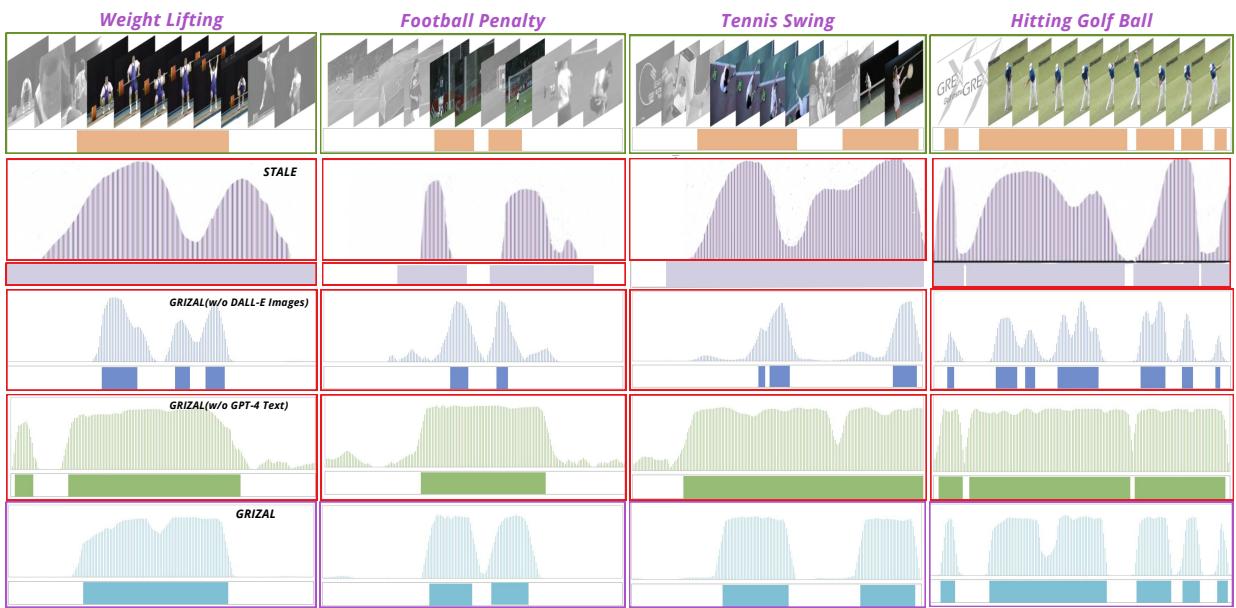
As seen in Figure 1 above, baseline methods like STALE (top row) often struggle with these issues. The heatmaps represent where the model thinks the action is happening. You can see that STALE produces scattered, inaccurate activations. It struggles to pinpoint exactly when the “Weight Lifting” or “Tennis Swing” starts and ends.
GRIZAL (bottom row), however, produces a tight, accurate heatmap that aligns almost perfectly with the ground truth (the green bars). How does it achieve this precision? By fixing the lack of data with Generative AI.
The Core Concept: Generative Priors
The hypothesis behind GRIZAL is simple yet powerful: Diversity leads to generalization.
If you only tell the model “look for a man skiing,” it has a very narrow linguistic hook. But if you use GPT-4 to generate detailed descriptions (“skier in a crouch position,” “snow spraying from skis,” “poles planted in snow”) and use DALL-E to generate photorealistic images of skiing, you provide the model with a rich, multi-modal “prior” knowledge base.
This acts as a form of synthetic data augmentation. Even if the model has never seen a real video of skiing during training, it has “imagined” it vividly through these generative models.
Let’s break down the architecture to see how this is implemented.
Inside the GRIZAL Architecture
GRIZAL is not just a single network; it is a complex system composed of three distinct blocks that work in harmony.
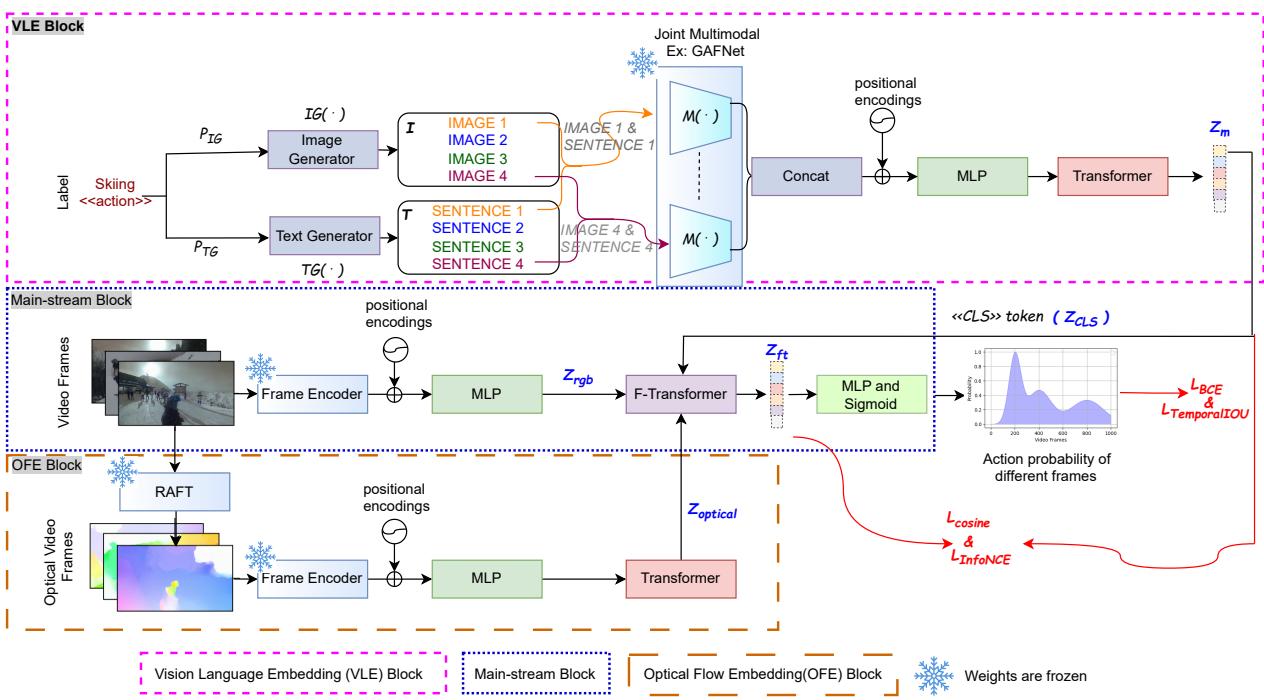
As illustrated in Figure 2, the architecture is divided into:
- Vision-Language Embedding (VLE) Block: Handles the generative “imagination.”
- Optical Flow Embedding (OFE) Block: Handles the motion and temporal dynamics.
- Mainstream Block: The central processor that fuses everything to make the final prediction.
1. The Vision-Language Embedding (VLE) Block
This is the brain of the operation where the “Zero-Shot” magic happens.
When the system needs to find an action label (AL), such as “playing guitar,” it doesn’t just look up that string.
- Text Generation: It feeds the label to a Text Generator (GPT-4). GPT-4 produces multiple diverse sentences describing the action in different contexts.
- Image Generation: It feeds the label to an Image Generator (DALL-E). DALL-E creates varied visual depictions of the action.
These generated assets act as “external augmentations.” They are then passed through a Joint Multimodal Model (specifically GAFFNet in this paper). This model processes the generated images and text pairs to create a dense, context-aware embedding (\(Z_{CLS}\)).
This embedding \(Z_{CLS}\) effectively encapsulates the “concept” of the action. Because it was built from diverse synthetic data, it is much more robust than a simple word embedding. It understands that “playing guitar” involves fingers on a fretboard, a strumming motion, and a specific object shape, even without seeing a real video.
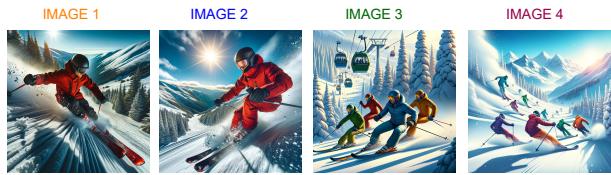
Figure S.6 shows this process in action. You can see how a simple prompt generates varied sentences describing skiing techniques (snow ploughing, parallel turns) and diverse images (close-ups, wide shots, groups). This richness prevents the “under-complete” representation issue mentioned earlier.
2. The Optical Flow Embedding (OFE) Block
Recognizing an action in a static image is one thing; recognizing it in a video requires understanding motion. A static image of a person holding a golf club is not a “golf swing.” The swing is the motion.
To capture this, GRIZAL uses Optical Flow. The researchers employ the RAFT algorithm to calculate optical flow frames from the video. These flow frames represent the direction and speed of pixel movement.
These flow frames are encoded into feature vectors (\(Z_{optical}\)). This stream of data gives the model a sense of “what is moving and how fast,” which is critical for defining the start and end boundaries of an action.
3. The Mainstream Block and F-Transformer
The Mainstream Block is where the actual video frames (\(V_{rgb}\)) are processed. But standard processing isn’t enough. The model needs to combine the RGB visual data with the Motion data (OFE) and the Conceptual data (VLE).
To achieve this fusion, the authors introduce a novel component called the F-Transformer (Fourier Transformer).
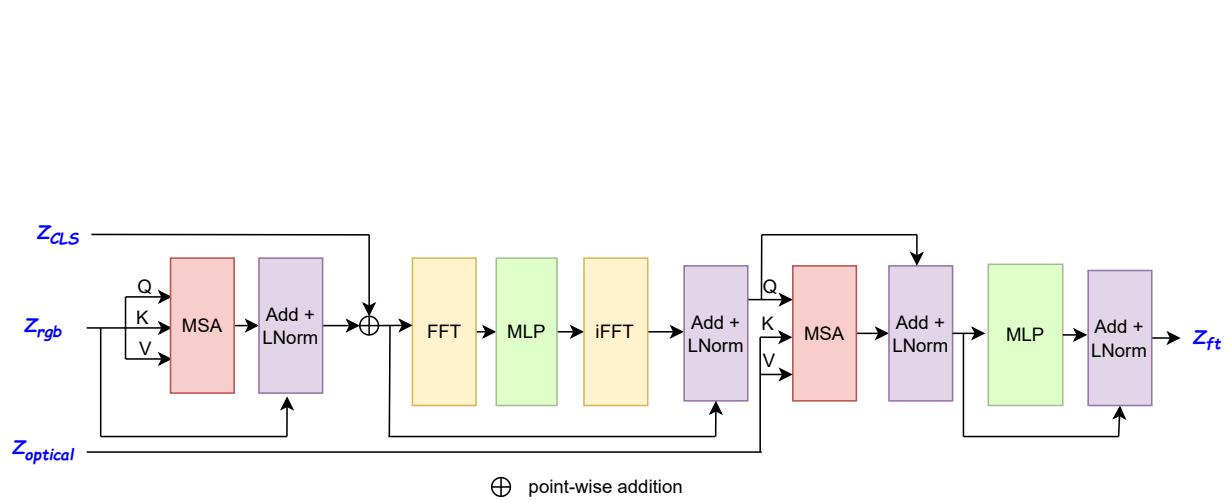
Standard Transformers use self-attention mechanisms to relate different parts of a sequence to each other. The F-Transformer (shown in Figure S.5) takes this a step further by operating in the Frequency Domain.
Here is the step-by-step fusion process:
- Spatial Mixing: The RGB video features (\(Z_{rgb}\)) are combined with the Conceptual embeddings (\(Z_{CLS}\)) using Multi-Head Self-Attention. This tells the video encoder what to look for based on the text description.
- Frequency Domain Processing: The model applies a Fast Fourier Transform (FFT) to the features. Why? In signal processing, FFT breaks a signal down into its constituent frequencies. In video analysis, this helps the model capture global temporal patterns—long-term dependencies that might be missed by looking at frame-by-frame changes.
- Inverse FFT: An MLP processes these frequency features, and an inverse FFT brings them back to the spatial domain.
- Motion Injection: Finally, the Optical Flow features (\(Z_{optical}\)) are injected via Cross-Attention. The video features query the motion features to understand the dynamics of the scene.
This sophisticated blending ensures that GRIZAL isn’t just matching keywords to pixels; it is aligning high-level concepts with low-level motion and visual patterns.
Learning Objectives: How GRIZAL Learns
GRIZAL is trained using a combination of Supervised and Self-Supervised losses. This dual approach helps it avoid the biases that come from relying on just one type of learning.
- Supervised Loss: The model uses standard Binary Cross Entropy (BCE) to classify frames and Temporal IoU (Intersection over Union) loss to ensure the predicted start/end times match the ground truth.
- Self-Supervised Loss: To make the model robust to unseen data, it uses Cosine Similarity and InfoNCE loss. These losses force the model to align the embeddings of the video frames with the embeddings of the generated text/images. Even without explicit labels, the model learns that the “video of a dog” and the “generated image of a dog” should live in the same mathematical neighborhood.
Experiments and Results
Does adding synthetic imagination actually help? The researchers tested GRIZAL on three major benchmarks: ActivityNet-v1.3, THUMOS14, and Charades-STA. They tested in “Open-set” scenarios (where the test actions are completely different from training actions) and “Closed-set” scenarios.
Quantitative Dominance
The results were overwhelmingly positive.
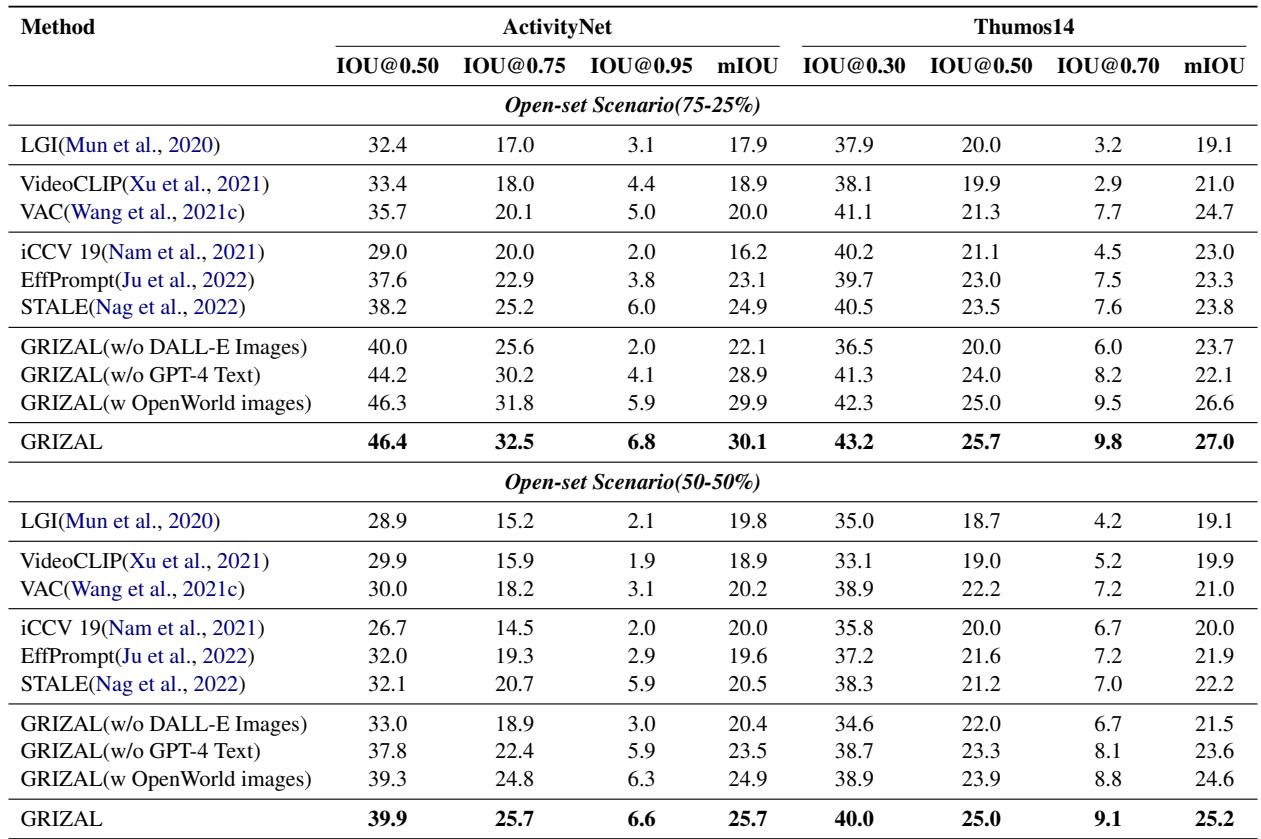
In the Open-set scenario (Table 1), which is the true test of Zero-Shot learning, GRIZAL outperformed all competitors.
- On ActivityNet, GRIZAL achieved an mIoU (mean Intersection over Union) of 30.1, significantly higher than the previous best, STALE (24.9).
- The “GRIZAL w/o DALL-E” and “w/o GPT-4” rows are particularly telling. Removing the generative images dropped performance by over 8 percentage points. This empirically proves that the synthetic images are doing the heavy lifting in helping the model generalize.
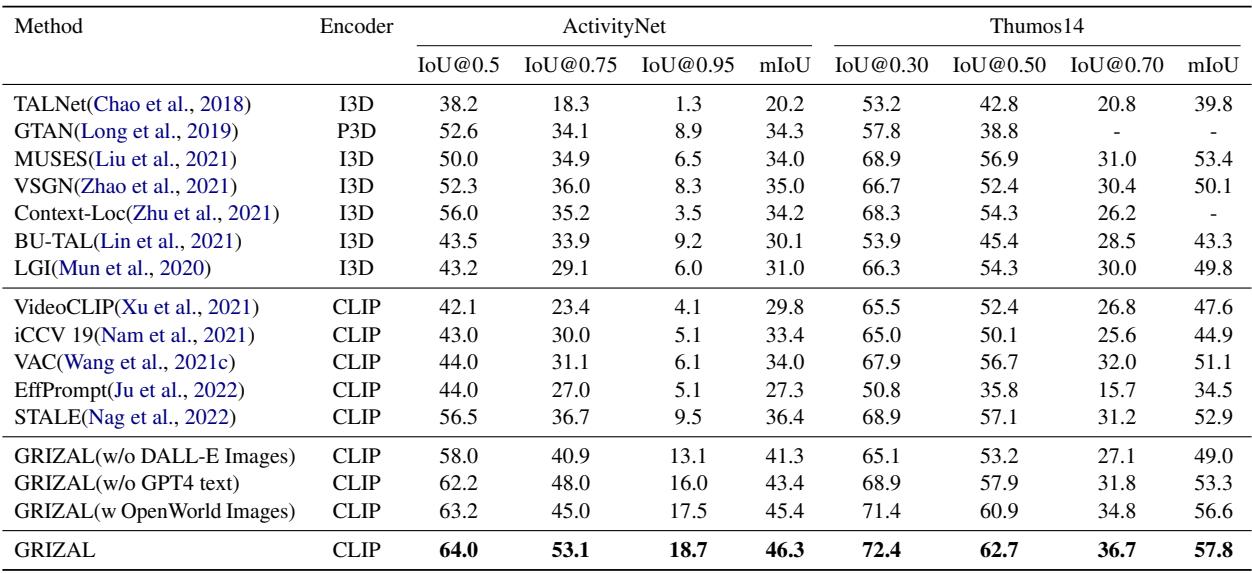
In the Closed-set scenario (Table 2), GRIZAL continues to shine. Even against fully supervised methods that have seen the actions before, GRIZAL’s rich representations allow it to localize actions more precisely. It beats the closest CLIP-based competitor by a wide margin (almost 10% mIoU improvement on ActivityNet).
Visualizing the “Brain” of the Model
Numbers are great, but visualizing what the model “sees” provides deeper insight. The researchers used Grad-CAM (Gradient-weighted Class Activation Mapping) to visualize which parts of the video frame the model focuses on when given a prompt.
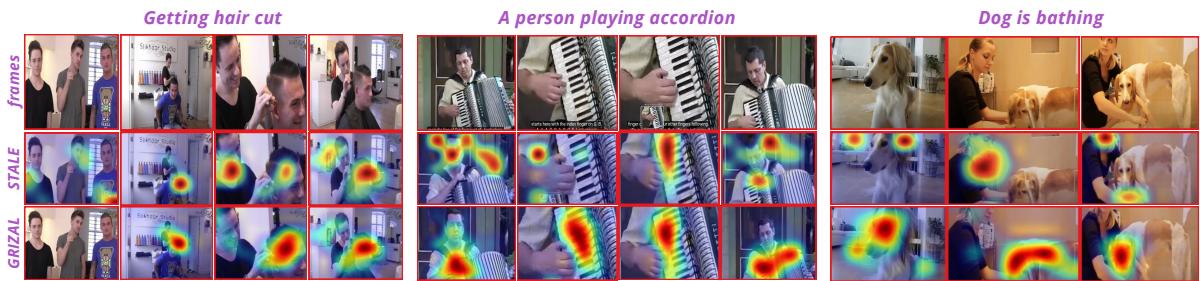
In Figure 3, look at the column for “Dog is bathing.”
- The baseline model (STALE) focuses heavily on the human’s arm (likely because humans are common in the dataset).
- GRIZAL, however, focuses squarely on the dog’s head and body.
Because GRIZAL was trained with diverse generated images of dogs bathing, it has a stronger semantic understanding of “dog” distinct from “person washing,” allowing it to ignore background clutter and focus on the subject.
The Power of Diversity
To further prove that the generative priors create better feature spaces, the authors plotted the feature embeddings using t-SNE, a technique for visualizing high-dimensional data in 2D.

Figure 4 compares the embedding spaces.
- In methods like VideoCLIP and VAC, the dots (representing different actions) are mashed together in a messy blob. This makes it hard for a classifier to draw a line between “running” and “jogging.”
- In the GRIZAL plot (far left), the clusters are distinct and well-separated. The diversity of the synthetic training data has forced the model to learn sharper, more discriminative boundaries between concepts.
Precision in Boundaries
Finally, let’s look at the actual output timelines. The goal of TAL is to say exactly when an action starts and ends.
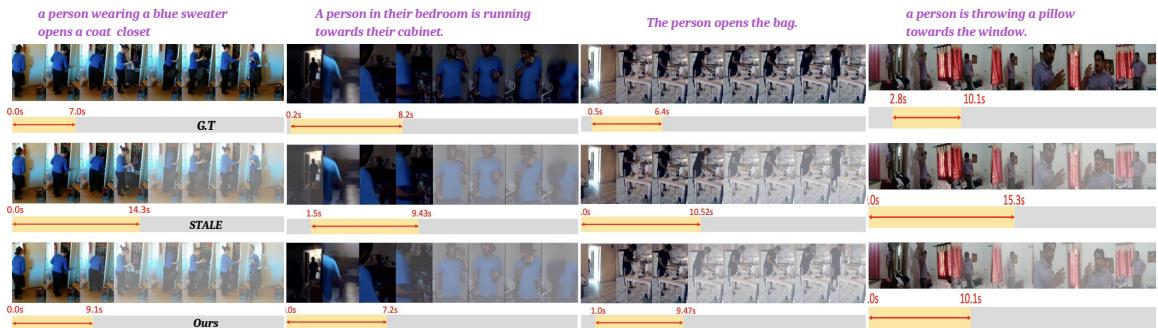
In Figure S.7, we see a direct comparison of predicted time intervals.
- Panel 1 (“opens a coat closet”): The STALE model (middle bar) predicts the action continues long after it has finished (0.0s to 14.3s). GRIZAL (bottom bar) stops the action at 9.1s, much closer to the Ground Truth (7.0s).
- Panel 4 (“throwing a pillow”): GRIZAL matches the end time of the ground truth (10.1s) perfectly, whereas STALE overestimates it significantly.
This precision comes from the Optical Flow integration. By sensing when the motion stops, GRIZAL knows the action is over, whereas a text-only model might still see the “pillow” and think the action is ongoing.
Why This Matters
GRIZAL represents a significant shift in how we approach machine learning with limited data. Instead of simply hunting for more labeled datasets, it suggests that we can use the generative capabilities of modern AI to teach other AI models.
By using GPT-4 and DALL-E to “hallucinate” training data, GRIZAL achieves:
- Robustness: It handles unknown classes better than any previous method.
- Context: It understands the nuance of actions through detailed descriptions.
- Precision: It combines this conceptual understanding with pixel-perfect motion tracking via Optical Flow.
Limitations and the Future
The authors note that GRIZAL’s performance is currently tied to the quality of the generative models (GPT-4/DALL-E). If those models have biases (e.g., only showing men playing soccer), GRIZAL will inherit them. Future work aims to explore “bias-free” generation and potentially fine-tuning smaller, open-source generative models to reduce reliance on paid APIs.
Additionally, the team plans to incorporate Audio in the future. Sound is a massive indicator of action—the crack of a bat, the sound of a splash, or a whistle blowing could provide even stronger cues for localization.
For students and researchers in Computer Vision, GRIZAL is a masterclass in Multimodal Fusion. It teaches us that the best way to solve a visual problem might just be to ask a language model for help.