](https://deep-paper.org/en/paper/file-3132/images/cover.png)
Introduction
In the era of big data, Electronic Health Records (EHRs) represent a treasure trove of information. They hold the keys to training AI models that can predict diseases, recommend treatments, and optimize hospital operations. However, this data is locked behind a massive ethical and legal gate: patient privacy. Regulations like HIPAA in the United States mandate that Protected Health Information (PHI)—names, dates, IDs, and locations—must be rigorously removed before data can be used for secondary research.
This process is known as de-identification (de-ID). While it sounds straightforward, automating de-identification is notoriously difficult. A model trained to recognize patient names in one hospital’s records often fails miserably when applied to another hospital’s data due to differences in formatting, medical jargon, and annotation standards. This “generalization gap” is a major hurdle in medical AI.
Furthermore, training these models requires massive datasets of annotated medical records, which are themselves hard to acquire because… well, they contain private information. It is a catch-22: we need sensitive data to train models to remove sensitive data.
In this post, we will explore a recent research paper that proposes a clever solution to this deadlock. The researchers introduce a framework utilizing GPT-4 for data augmentation. Their approach generates high-quality, synthetic clinical data to train robust de-identification models, all while ensuring that no actual patient privacy is compromised during the process.
The Problem: Why De-ID Models Fail to Generalize
To understand the solution, we must first understand the severity of the problem. In Natural Language Processing (NLP), de-identification is treated as a Named Entity Recognition (NER) task. The AI reads a sequence of text and tags specific words as “Patient Name,” “Hospital,” “Date,” etc.
State-of-the-art models, such as those based on BERT (specifically BioBERT or ClinicalBERT), can achieve impressive accuracy (F1 scores above 0.97) when tested on the same dataset they were trained on. However, medical data is not uniform. One dataset might write dates as “Nov 16th,” while another uses “11/16/2023.” One might capitalize “DOCTOR SMITH,” while another uses “Dr. Smith.”
When a model trained on one dataset (e.g., the famous i2b2 2006 corpus) is tested on a different one (e.g., i2b2 2014), performance collapses.
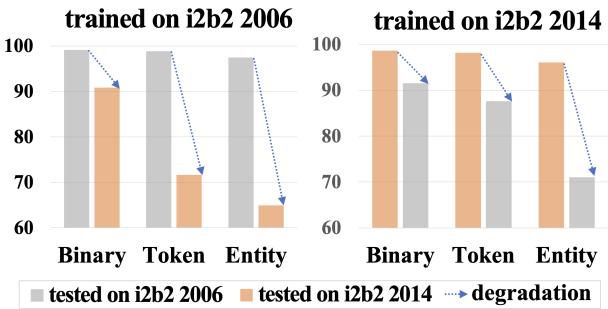
As shown in Figure 1, the degradation is stark. The gray bars represent performance when the model is tested on data from the same year it was trained on—scores are high. The orange bars represent cross-dataset testing—training on 2006 data and testing on 2014 (left chart), or vice versa (right chart).
Notice the dramatic drop in Entity-level F1 (the rightmost grouping in each chart). Entity-level F1 measures whether the model correctly identified the exact start and end of the sensitive information. When trained on the 2006 dataset and tested on the 2014 dataset, accuracy plummets from nearly 96% to around 63%. In a clinical setting, missing 37% of private information is unacceptable.
This failure stems from data scarcity and contextual variance. There simply isn’t enough diverse, public medical data to train a model that handles every possible writing style.
The Solution: Privacy-Safe Data Augmentation
The researchers propose using Large Language Models (LLMs) like GPT-4 to generate synthetic training data. By creating thousands of new, artificial clinical notes, they can teach the de-ID model a wider variety of contexts and formats.
However, using LLMs in healthcare introduces a new risk: Privacy Leakage. You cannot simply upload real patient records to the GPT-4 API and ask it to “rewrite this.” Doing so would violate HIPAA regulations by transmitting PHI to a third-party server.
The Augmentation Pipeline
The core innovation of this paper is a pipeline that allows for GPT-4 augmentation without ever exposing real patient data to the model. The process involves a technique called PHI-scrubbing.
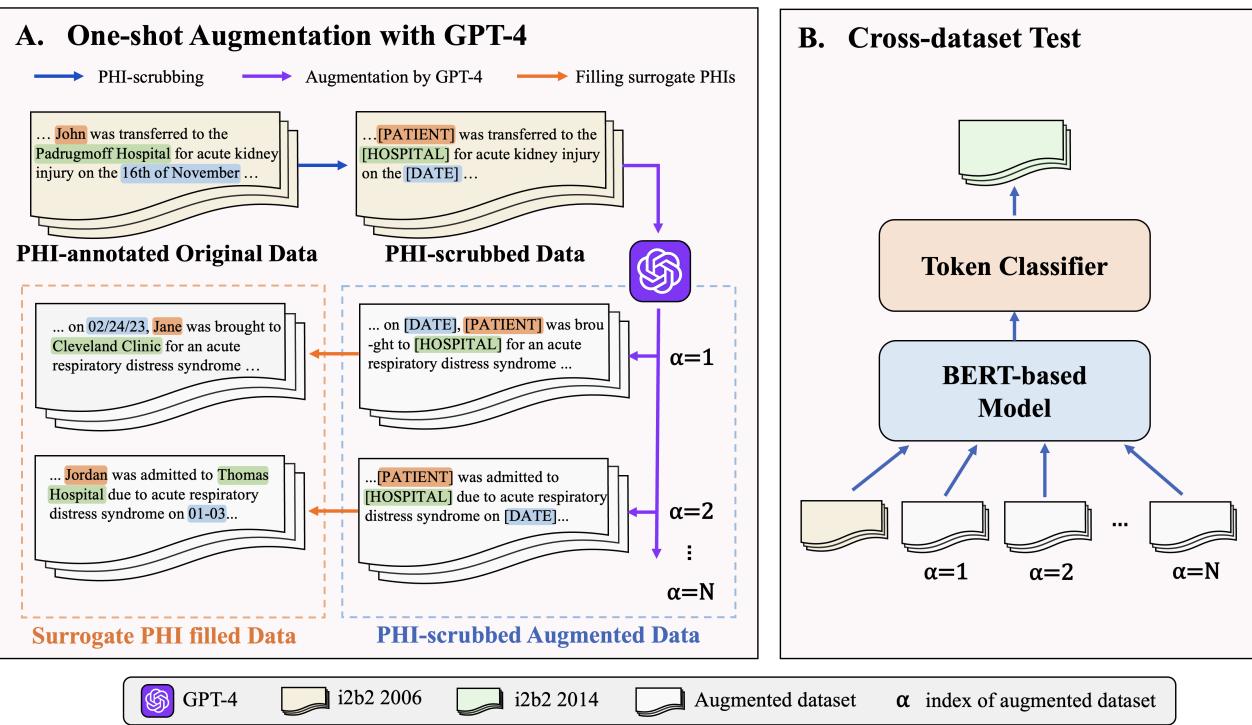
Figure 2 (Panel A) illustrates this “One-shot Augmentation” workflow. Let’s break down the steps:
- PHI-Scrubbing (The Privacy Shield): Before the data leaves the secure local server, a script identifies real PHI (e.g., “John Doe”, “General Hospital”) and replaces it with generic placeholders (e.g.,
[PATIENT],[HOSPITAL]). - Prompting GPT-4: The system sends this scrubbed text to GPT-4 as a template. It asks GPT-4 to generate a new synthetic clinical note that follows the format of the provided sample but uses different medical contexts and sentence structures. The prompt explicitly instructs GPT-4 to keep the placeholders.
- Generation: GPT-4 returns a new, synthetic clinical note containing placeholders like
[PATIENT]and[DATE]. - Surrogate Refilling: Back on the local server, the system fills these placeholders with fake, surrogate data (e.g., random names from a public list, random dates).
The result is a brand new, fully annotated training example that looks like a real medical record but contains no real patient info and was generated without leaking secrets to OpenAI.
Prompt Engineering: One-Shot vs. Zero-Shot
The researchers explored two methods of prompting the LLM: One-shot and Zero-shot.
One-Shot Prompting
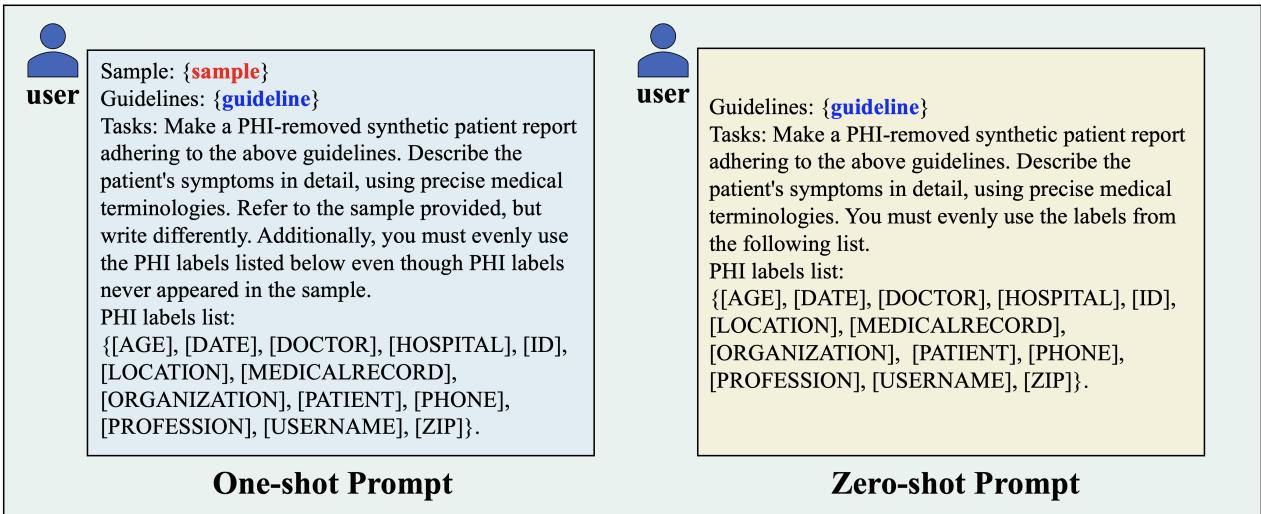
As seen on the left side of Figure 4, the One-shot prompt provides GPT-4 with a single example of a PHI-scrubbed note. The instruction is essentially: “Here is an example of a medical note with placeholders. Write a new, different note that follows this style.”
This method helps the LLM understand the specific structure and tone of medical records (e.g., “Discharge Summary,” “History of Present Illness”). It is ideal when you have a small existing dataset and want to multiply it.
Zero-Shot Prompting
The Zero-shot prompt (right side of Figure 4) provides no examples. It simply gives the model a list of guidelines and a task description: “Make a PHI-removed synthetic patient report… use precise medical terminologies… evenly use the labels from the following list.”
This approach is fascinating because it simulates a scenario where a hospital has zero training data available. It relies entirely on GPT-4’s internal knowledge of what a medical record should look like.
Experiments and Results
To validate this method, the authors conducted rigorous experiments using the i2b2 2006 and i2b2 2014 datasets. These are standard benchmarks in the field, but as noted in the introduction, they have very different annotation standards.
The goal was to see if mixing synthetic data with real data (or using synthetic data alone) could fix the generalization gap.
Improvement in One-Shot Augmentation
The researchers combined the original training data with increasing amounts of synthetic data (denoted by \(\alpha\), where \(\alpha=5\) means adding 5 synthetic versions for every original note).
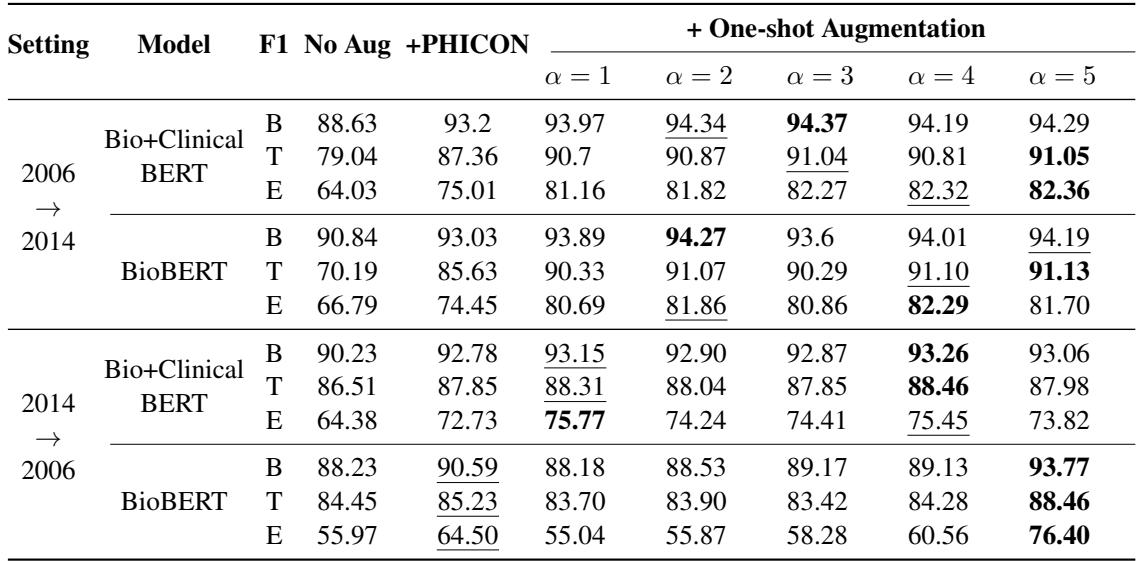
Table 2 presents the results of the cross-dataset tests. The key comparison is between the “No Aug” baseline and the “+ One-shot Augmentation” columns.
- Significant Gains: When training on 2006 and testing on 2014 (“2006 → 2014”), the Entity-level F1 (E) for the Bio+Clinical BERT model jumped from 64.03% (No Aug) to 82.36% (\(\alpha=5\)). This is a massive improvement of over 18 percentage points.
- Beating Rule-Based Methods: The table also compares the method against PHICON, a previous rule-based augmentation technique. The GPT-4 method consistently outperforms PHICON, particularly in the strict Entity-level metric. This suggests that the linguistic diversity provided by GPT-4 is superior to simple synonym replacement.
Analyzing Performance by Category
It is also helpful to look at where the model improved. Did it get better at finding names? Dates? Hospitals?
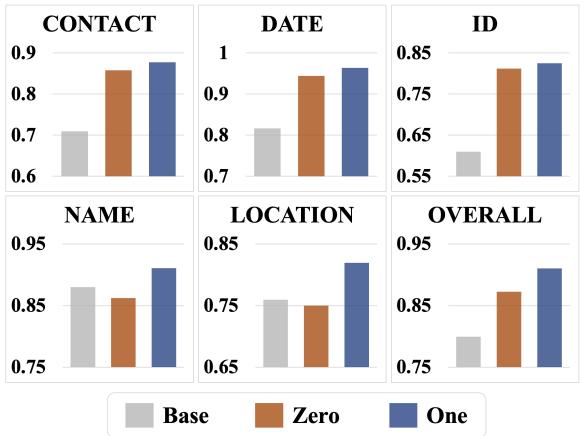
Figure 3 breaks down the F1 scores by PHI category.
- Base (Gray): Model trained only on the original dataset.
- One (Blue): Model trained with One-shot augmentation.
- Zero (Orange): Model trained only on Zero-shot synthetic data.
The Blue bars (One-shot) are consistently the highest across almost all categories. Notably, in the ID and Contact categories, the augmented models show drastic improvements over the baseline. This is likely because the synthetic data introduced a wider variety of ID formats and phone number styles than existed in the small original dataset.
The Power of Zero-Shot (Data from Nothing)
Perhaps the most surprising finding comes from the Zero-shot experiments. In this setup, the models were trained exclusively on synthetic data generated by GPT-4, without seeing a single real medical record.
 (Correction: While Table 3 is discussed here, the visual reference provided in the deck is labeled Table 3 in the text, but the image deck contains Table 1, Table 2, Table 4, and Appendix tables. We will proceed by describing the findings based on the text logic, referring to the Zero-shot column in Figure 3 which is available.)
Referencing the “Zero” (Orange) bars in Figure 3 again, we see that models trained purely on synthetic data often outperformed the “Base” models trained on real (but out-of-domain) data. For example, in the ID category, the Zero-shot model significantly beats the Base model.
This implies that if a hospital has absolutely no annotated data to start with, they could generate a purely synthetic dataset using GPT-4 and train a model that performs respectably well—sometimes better than using an old, mismatched dataset from another institution.
The Gap Remains
While the improvements are substantial, the problem is not entirely solved.
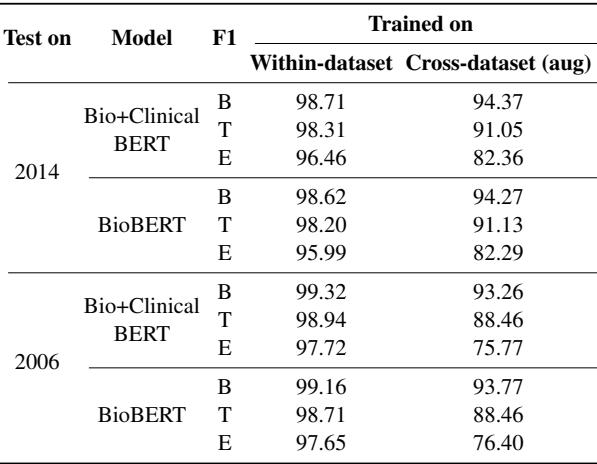
Table 4 compares the augmented cross-dataset performance against “Within-dataset” performance (training and testing on the same data source). Even with the best augmentation, the cross-dataset score (e.g., 82.36% Entity F1) is still lower than the within-dataset score (96.46%).
This indicates that while synthetic data bridges the gap, it doesn’t close it completely. There are still nuances in local data distributions that general synthetic data cannot perfectly mimic.
Conclusion and Implications
This research addresses a critical bottleneck in medical AI. We need de-identification systems to unlock the value of medical records, but we lack the shared data to build them.
The paper demonstrates that Generative AI can act as a privacy-safe bridge. By using the “Scrub-and-Prompt” method:
- Privacy is Preserved: Real patient data never touches the LLM API.
- Data is Diverse: GPT-4 generates varied sentence structures and medical contexts that rule-based methods cannot match.
- Performance is Boosted: Models generalize significantly better to new hospitals and datasets.
The success of the Zero-shot approach is particularly promising for smaller institutions or under-resourced languages where annotated medical datasets simply do not exist. Instead of spending months manually annotating records, researchers might soon be able to “prompt” a dataset into existence, bootstrapping their privacy tools and accelerating the pace of medical research.