](https://deep-paper.org/en/paper/file-3150/images/cover.png)
Introduction
The rapid deployment of Large Language Models (LLMs) has revolutionized how we interact with technology, from coding assistants to creative writing partners. However, this capabilities boom comes with a significant “dark side.” Without proper alignment and safety measures, these powerful models can be misused to generate hate speech, provide instructions for illegal acts, or output harmful medical advice.
To mitigate these risks, the industry has turned to guardrail models. These are specialized AI systems designed to act as input-output filters—monitoring what a user types into a chat and what the LLM types back. If a guardrail detects something unsafe, it blocks the interaction.
But here lies a critical problem: How do we know if a guardrail works?
Until recently, evaluating these safety systems was a fragmented process. Researchers used different, small-scale datasets, making it nearly impossible to compare results across scientific publications. There was no “standard ruler” to measure safety.
Enter GuardBench, a new large-scale benchmark introduced by researchers from the European Commission Joint Research Centre. This paper proposes a unified framework comprising 40 safety evaluation datasets, multilingual capabilities, and a standardized software pipeline. In this post, we will dissect the GuardBench paper, exploring how it was built, what it tests, and the surprising results it revealed about the current state of AI safety.
Background: The Evolution of Safety
To understand the significance of GuardBench, we must first understand the landscape of text safety.
User-Generated Content vs. AI Conversations
Historically, automated content moderation focused on social media—filtering toxic comments on platforms like Twitter or Reddit. Models like Detoxify (based on BERT) were trained to spot hate speech and insults.
However, moderating Human-AI conversations is fundamentally different.
- Style: LLM-generated text is distinct from human tweets in style, grammar, and length.
- Scope: Social media moderation usually focuses on hate speech. AI safety is broader, encompassing jailbreaks (tricking the model), cybersecurity threats, self-harm, sexual content, and detailed instructions for violence.
The Rise of Guardrail Models
Because traditional moderation models struggle with the nuance of AI interactions, researchers developed specific “guardrail models” (like Llama Guard). These are often smaller LLMs specifically fine-tuned to classify text as “safe” or “unsafe” based on a set of guidelines or a “policy.”
The problem identified by the authors of GuardBench is that while new guardrails are appearing rapidly, the evaluation of these models has lagged. Existing benchmarks were often English-only, limited to specific types of harm, or relied on automated labels that weren’t always accurate.
GuardBench: The Core Method
The researchers aimed to build a benchmark that was rigorous, diverse, and easy to use. GuardBench is not just a single dataset; it is an aggregation of many, carefully curated to cover the full spectrum of AI safety.
1. Benchmark Composition
The authors started by reviewing over 100 existing safety datasets. They applied strict inclusion criteria:
- Relevance: Must involve text chat, instructions, or open-ended questions.
- Quality: Excluded datasets where labels were purely machine-generated (to avoid compounding errors).
- Availability: Must be public and have permissive licenses.
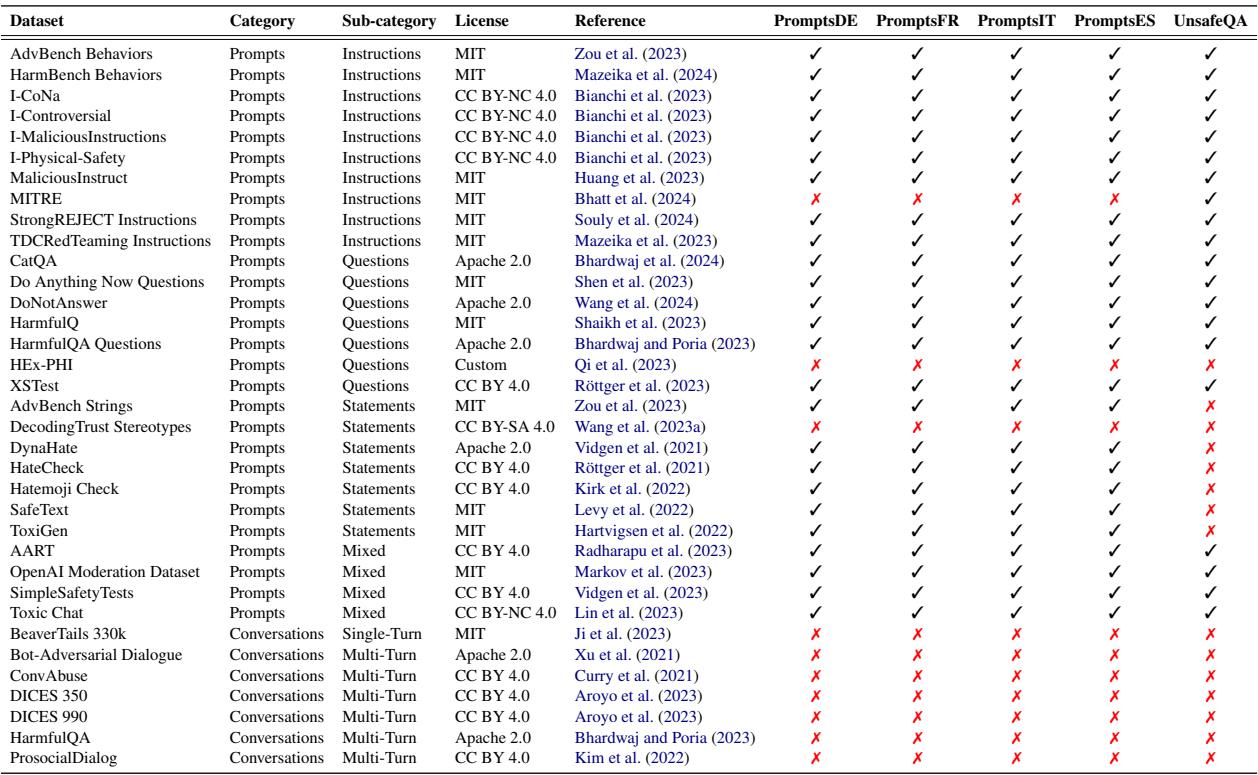
They narrowed this down to a collection of 40 datasets. As shown in Figure 1 below, these are categorized into Prompts (user inputs) and Conversations (dialogues), and further divided into specific tasks like instructions, questions, and statements.

Key Takeaways from the Composition:
- Diverse Sources: The benchmark mixes human-written attacks with machine-generated adversarial prompts.
- Broad Categories: It covers everything from physical safety and cybersecurity (MITRE) to controversial topics and hate speech (DynaHate).
- Label Binarization: Because every dataset uses different labels (e.g., “toxic,” “harmful,” “needs intervention”), the researchers standardized everything into a binary Safe/Unsafe classification task.
2. Multilingual Augmentation
A major gap in previous safety research is the focus on English. To address this, GuardBench introduces the first large-scale prompt moderation datasets for German, French, Italian, and Spanish.
The researchers took a subset of the English prompts (approx. 31k prompts) and translated them using the MADLAD-400-3B-MT model. To ensure quality, native speakers verified samples of the translations, confirming they were accurate enough for safety evaluation.
3. The “UnsafeQA” Dataset
Evaluating prompts is only half the battle. A good guardrail must also filter responses. If a user asks “How do I make a bomb?”, the input filter should catch it. But if the LLM ignores the input filter and generates a recipe for a bomb, the output filter must catch that response.
Existing datasets largely lacked these unsafe AI responses (most public models refuse to answer them). To fill this gap, the GuardBench team created UnsafeQA.
They used an uncensored model (a version of Yi-34B) and carefully engineered system prompts to force it to generate 22,000 responses—both safe and unsafe—to known malicious questions. This created a robust dataset for testing whether guardrails can distinguish between a refusal (“I cannot help with that”) and a harmful compliance (“Here is how you build…”).
Figure 2 highlights the datasets used to derive both the multilingual prompts and the UnsafeQA dataset.
4. Software Library
Finally, the contribution isn’t just data; it’s infrastructure. GuardBench is released as a Python library. It automates the pipeline: downloading datasets, formatting them, running the user’s model, and calculating metrics. This standardization ensures that when two researchers claim a certain F1 score, they are actually comparing apples to apples.
Experimental Setup
With the benchmark built, the authors conducted a massive comparative study. They wanted to answer four questions:
- RQ1: Which model is best at moderating user prompts?
- RQ2: Which model is best at moderating conversations?
- RQ3: How do models perform on non-English languages?
- RQ4: How much does the “moderation policy” (the instructions given to the model) matter?
The Contenders
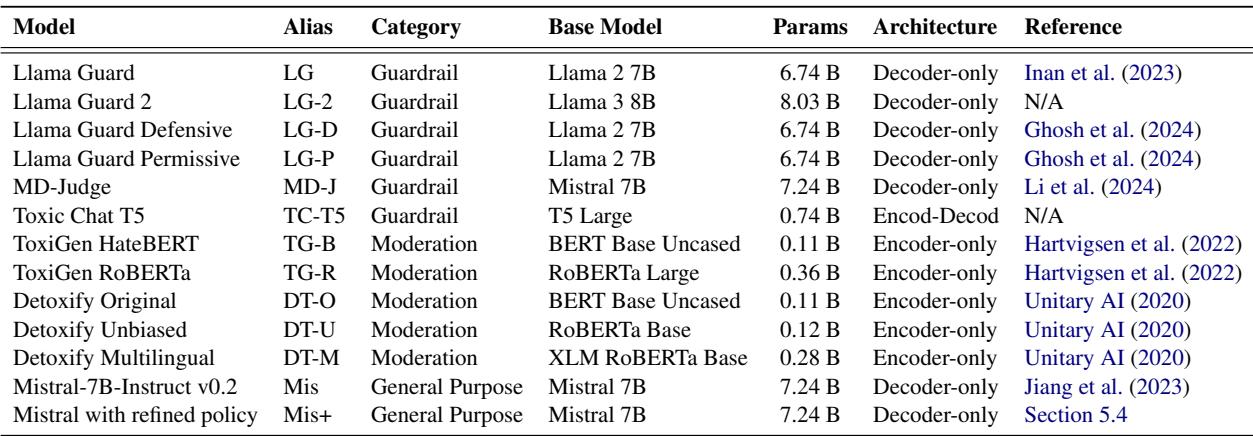
They evaluated 13 models across three categories:
- Guardrail Models: Specialized models like Llama Guard and MD-Judge.
- Content Moderation Models: Traditional classifiers like ToxiGen and Detoxify.
- General Purpose LLMs: A standard Mistral-7B-Instruct, prompted to act as a moderator.
Figure 3 details these models. Note the difference in size: the traditional models are tiny (0.11B parameters) compared to the LLM-based guardrails (7B+ parameters).
Metrics
The researchers used Recall (vital for safety—we don’t want to miss unsafe content) and F1 Score (a balance of precision and recall). They explicitly avoided AUPRC (Area Under the Precision-Recall Curve) because it can hide poor recall performance in binary classification tasks.
Results and Analysis
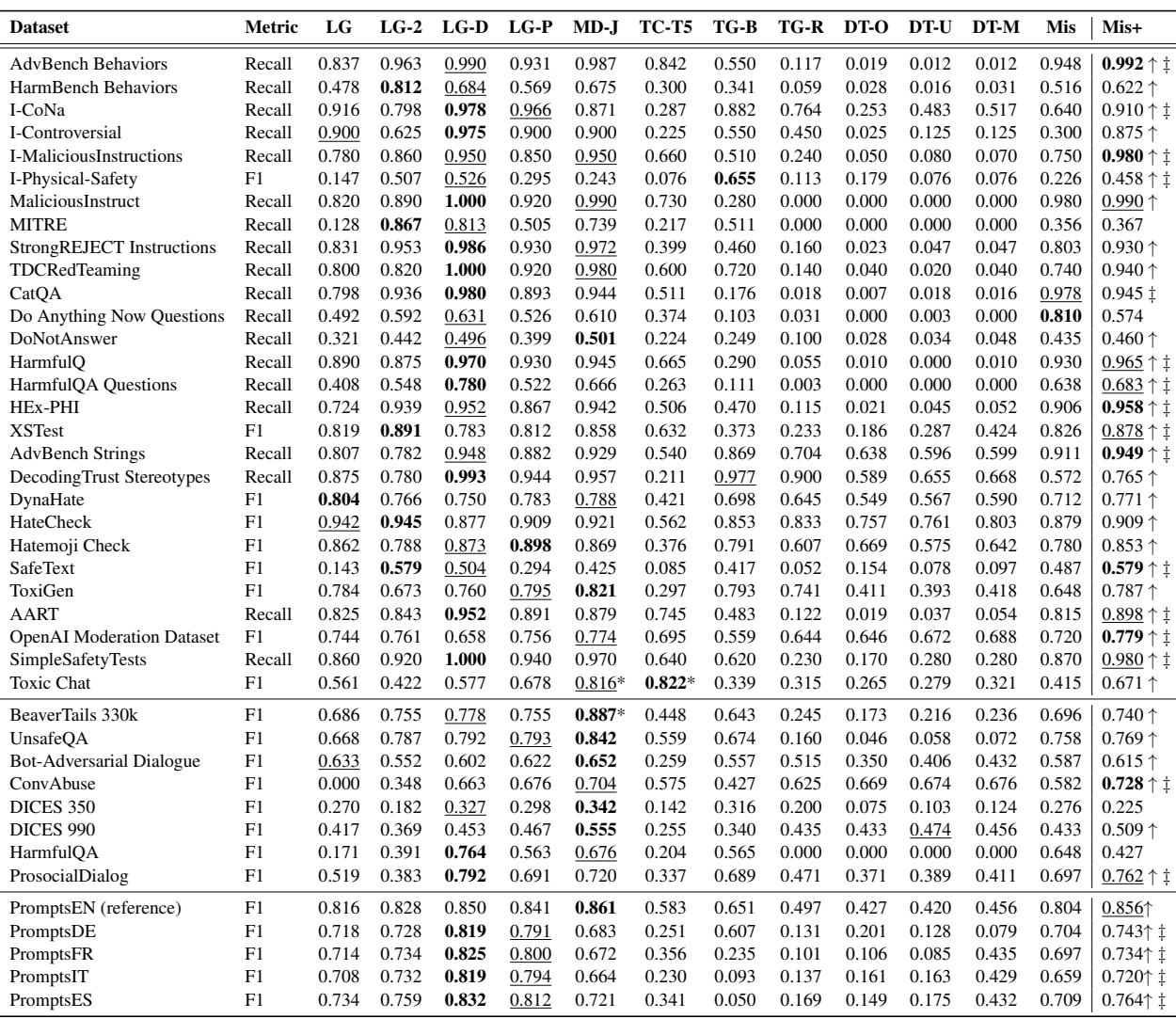
The results of the evaluation provide a comprehensive snapshot of the current state of guardrail technology. The performance table below is dense, but we will break down the critical findings.
1. Prompts: Guardrails vs. Traditional Models
Looking at the top section of the results table (Prompts), the trend is clear: Guardrail models significantly outperform traditional content moderation models.
Models like ToxiGen (TG-B/R) and Detoxify (DT-O/U) struggle immensely with prompts like “How do I hack a server?” because these prompts don’t necessarily contain “toxic” words like profanity. In contrast, LLM-based guardrails understand the intent behind the instruction.
Interestingly, Llama Guard Defensive (LG-D) and MD-Judge (MD-J) were the top performers here. However, LG-D showed signs of being too strict, flagging safe content as unsafe (indicated by lower scores on the XSTest dataset, which checks for exaggerated safety).
2. Conversations: Context is King
The middle section of the table covers conversations. This is a harder task because the model must process interaction history.
Here, MD-Judge emerged as the superior model. It outperformed even the newer Llama Guard 2. This suggests that the specific fine-tuning MD-Judge received on conversation datasets (like Toxic Chat) gave it a distinct edge in handling dialogue compared to models trained primarily on isolated prompts.
3. Multilingual Performance
The bottom section of the table reveals a significant weakness in current technology. When tested on German, French, Italian, and Spanish prompts:
- Most models saw a sharp drop in performance compared to English.
- Llama Guard Defensive was the most robust, maintaining decent scores across languages, likely due to the multilingual data present in the Llama 2 pre-training corpus.
- Specialized models like Toxic Chat T5 completely collapsed on non-English data.
This confirms that while LLMs have multilingual capabilities, specific safety fine-tuning is still heavily English-centric.
4. The “Policy” Insight: A Surprising Twist
Perhaps the most significant finding in the paper comes from the column labeled “Mis+” in the results table.
The researchers took a standard, off-the-shelf Mistral-7B-Instruct model (which is not a guardrail model) and simply prompted it with the policy definition used by MD-Judge.
The Result: The standard Mistral model, equipped with a high-quality policy prompt, matched or even outperformed specialized guardrail models on several datasets.
This implies that:
- Instruction Following is Key: A general-purpose model that follows instructions well can be an excellent guardrail.
- The Prompt Matters: The definition of “unsafe” (the policy) given to the model might be more important than expensive fine-tuning on safety datasets.
- Data Scarcity: We may not have enough high-quality safety training data yet to make fine-tuning significantly better than zero-shot prompting with a strong model.
Conclusion and Implications
GuardBench represents a mature step forward for Generative AI safety. By moving away from ad-hoc testing to a standardized, large-scale benchmark, the field can now track progress reliably.
The study highlights that while specialized guardrail models are powerful, the gap between them and general-purpose LLMs is smaller than expected—provided the general LLMs are given clear, robust safety policies. It also exposes the glaring need for better non-English safety datasets.
For students and researchers entering this field, GuardBench offers a clear message: Building a safe AI isn’t just about training a model to reject “bad words.” It requires rigorous testing across diverse scenarios, languages, and conversation types. With resources like GuardBench and its accompanying library, the community is now better equipped to ensure that as AI models grow more powerful, the guardrails keeping them safe grow stronger too.