](https://deep-paper.org/en/paper/file-3179/images/cover.png)
Introduction
Imagine you are building a system to analyze social media debates. You want to separate people who love pineapple on pizza from those who consider it a culinary crime. You feed two sentences into a standard state-of-the-art AI model:
- “I love pineapple on pizza.”
- “I hate pineapple on pizza.”
To a human, these are opposites. To a standard Sentence Transformer model, they are nearly identical. Why? Because they are both about the topic of “pineapple on pizza.”
This is the “Stance-Awareness Gap.” While modern Natural Language Processing (NLP) models are incredibly good at detecting topic similarity, they are often terrible at distinguishing stance—the actual opinion or viewpoint being expressed.
This limitation is a massive headache for social computing, political analysis, and opinion mining. If you are trying to track polarization on abortion rights or gun control, a model that groups “Pro” and “Anti” arguments together simply because they share keywords is useless.
In this deep dive, we are exploring a fascinating paper titled “I love pineapple on pizza != I hate pineapple on pizza: Stance-Aware Sentence Transformers for Opinion Mining.” The researchers propose a novel way to fine-tune Sentence Transformers to recognize that “I love it” and “I hate it” should be miles apart in vector space, all while keeping the model computationally efficient.
The Core Problem: Topic vs. Stance
To understand the solution, we first need to understand the mechanics of the problem.
The Shortcoming of Sentence Transformers
Sentence Transformers (SBERT) have revolutionized NLP by converting text into “embeddings”—numerical vectors that represent meaning. If two sentences have similar meanings, their vectors are close together in mathematical space.
However, standard pre-trained models are trained primarily to detect semantic overlap. The sentences “The weather is good” and “The weather is NOT good” share almost all the same words and context. Topically, they are twins. Stance-wise, they are enemies.
As the researchers note, this leads to a situation where:
“Using the default sentence transformers would group both pro- and anti-abortion tweets together since they are merely similar topic-wise.”
The Computational Cost of Alternatives
You might ask, “Why not just use a classifier?” We could train a model specifically to look at two sentences and predict “Agree” or “Disagree.”
The problem is scale.
Let’s say you have 1,000 tweets and you want to see how they relate to each other.
- Classification Approach (Cross-Encoders): You have to feed every pair of sentences into the model. That is a complexity of \(\binom{n}{2}\). For 1,000 sentences, that is roughly 499,500 comparisons. On a standard GPU, that could take 4.5 hours.
- Sentence Transformer Approach (Bi-Encoders): You pass each sentence through the model once to get a vector. That’s 1,000 passes. Then, you just calculate the distance between vectors (which is instant). Total time? About 4.5 minutes.
The researchers summarize this trade-off clearly: we need the speed of Sentence Transformers, but the intelligence of a classifier. We need Stance-Aware Sentence Transformers.
Methodology: Teaching AI to Argue
The researchers developed a comprehensive pipeline to solve this. They didn’t just tweak a model; they created a new training strategy involving debate trees, triplet networks, and careful data filtering.
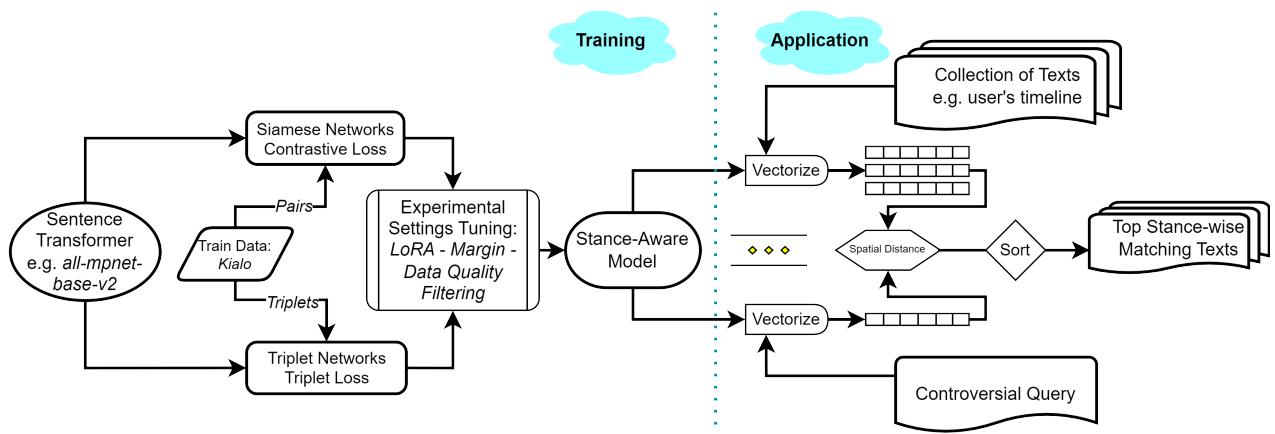
As shown in Figure 1, the process is split into two phases: Training (teaching the model) and Application (using the model). Let’s break down the training phase.
1. The Data: Mining the “Kialo” Debate Platform
To teach a model about stances, you need data that explicitly links arguments. The authors used Kialo, a collaborative debate platform.
In Kialo, discussions are structured as trees. You have a main thesis (e.g., “Ukraine should surrender”), and users post “Pros” (green) and “Cons” (red). Those arguments can then have their own Pros and Cons.
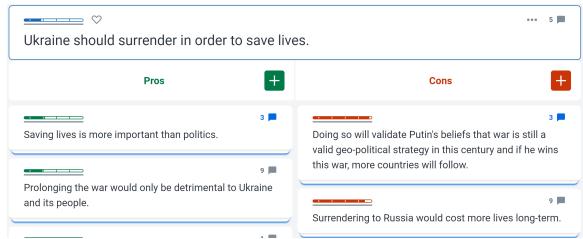
Figure 2 shows what this looks like. This structure is a goldmine because it provides labeled relationships automatically. The researchers extracted over 440,034 arguments from 5,631 discussions.
From these debate trees, they generated two types of training data:
- Pairs: Two statements and a label (Agree/Oppose).
- Triplets: An “Anchor” statement, a “Positive” (agreeing) statement, and a “Negative” (opposing) statement.

Table 6 illustrates how pairs are formed. Notice that they don’t just pair a parent with a child. They also pair “siblings.” If two arguments both support the same parent, they are considered to be agreeing with each other.

Table 7 shows a triplet. This is crucial for the specific neural network architecture they used, which relies on comparing relative distances.
2. The Architecture: Siamese and Triplet Networks
The researchers didn’t build a new model from scratch. They fine-tuned a popular existing model, all-mpnet-base-v2. They employed two distinct network structures to teach it stance awareness.
Siamese Networks (The Pair Approach)
A Siamese network consists of two identical versions of the model (twins). You feed Sentence A into one and Sentence B into the other. The model tries to bring their vectors closer if they agree and push them apart if they disagree.
To do this mathematically, they used Contrastive Loss:

Here is the breakdown of this equation:
- \(y_i\): The label (1 for similar/agree, 0 for dissimilar/oppose).
- \(D\): The distance between the embeddings.
- The Logic: If they agree (\(y=1\)), minimize the distance. If they disagree (\(y=0\)), maximize the distance—but only up to a certain point, defined by the
margin.
Triplet Networks (The Context Approach)
Siamese networks look at pairs in isolation. Triplet networks look at relationships. They take three inputs: an Anchor (A), a Positive (P), and a Negative (N).
The goal is simple: The distance between the Anchor and the Positive should be smaller than the distance between the Anchor and the Negative.
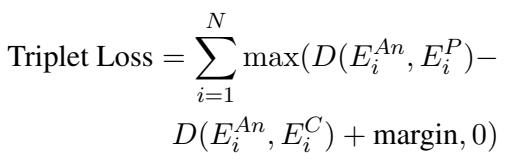
As seen in the equation above, the model is penalized if the “Pro” argument isn’t closer to the Anchor than the “Con” argument by at least a specific margin.
The Hybrid Model
The researchers found that the best approach wasn’t choosing one or the other. They created a Hybrid method: fine-tuning with the Triplet network for half the epochs (to learn context) and the Siamese network for the other half (to enforce direct separation).
3. Fine-Tuning Strategies
Training these models is tricky. The researchers implemented two clever strategies to ensure high quality and efficiency.
Data Quality Filtering
Human debates are messy. Sometimes, a “Con” argument is just someone saying “I disagree” without explaining why. If you train a model to think “I disagree” is the semantic opposite of “Abortion is murder,” you confuse the model.
The authors introduced a filtering step. They calculated the cosine similarity of training pairs using the original model. If a pair was too dissimilar topically (or too vague), they threw it out. They found that keeping only the top 50% of pairs yielded better results than using all the data.
LoRA (Low-Rank Adaptation) to Prevent “Catastrophic Forgetting”
This is a critical concept in modern AI. When you fine-tune a model on a new task (detecting stance), it often “forgets” its original job (detecting general semantic similarity). This is called Catastrophic Forgetting.
To prevent this, the researchers used LoRA. Instead of updating all the millions of parameters in the model, LoRA freezes the pre-trained weights and only trains tiny “adapter” layers.
- Benefit 1: It’s much faster and requires less memory.
- Benefit 2: It retains the model’s original knowledge about the English language, ensuring it remains a good topic detector while becoming a stance detector.
Experiments & Results
So, did it work? The researchers put their Stance-Aware model to the test against the original all-mpnet-base-v2 and other baselines.
1. Validation on Kialo (In-Domain)
First, they checked if the model could distinguish opposing arguments within the Kialo dataset.
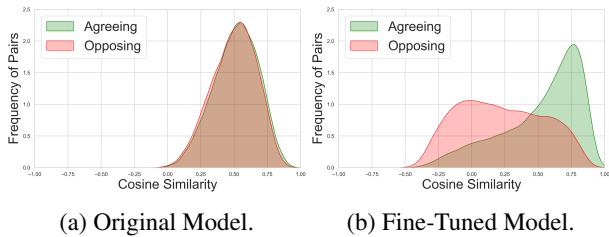
Figure 3 tells the whole story.
- Graph (a) - Original Model: Look at the Red (Opposing) and Green (Agreeing) curves. They overlap almost completely. The original model sees agreeing and opposing arguments as roughly the same level of similarity.
- Graph (b) - Fine-Tuned Model: The curves have separated. The Green curve has shifted right (higher similarity for agreeing), and the Red curve has shifted left (lower similarity for opposing).
To quantify this separation, they used a metric called KL Divergence. A higher score means better separation.
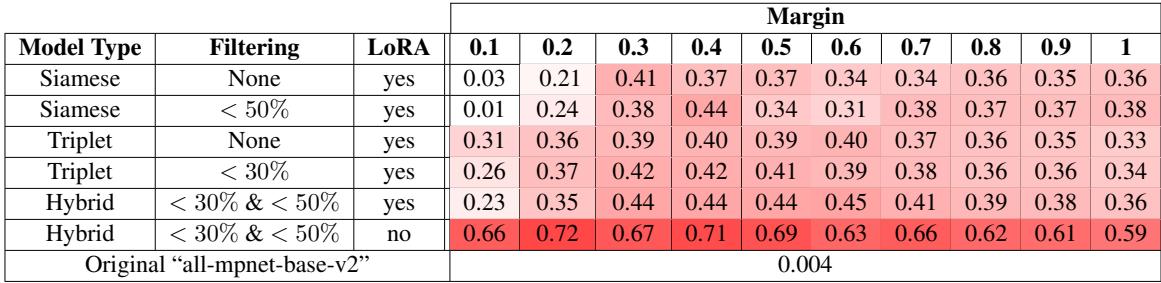
Table 2 shows that while the original model had a KL Divergence of practically zero (0.004), the fine-tuned Hybrid model achieved 0.44. This is a massive improvement in distinguishing ability.
2. Preventing Brain Drain (STS-B)
The researchers also needed to ensure they didn’t break the model’s general abilities. They tested it on the STS-B dataset, a standard benchmark for general sentence similarity (unrelated to stances).
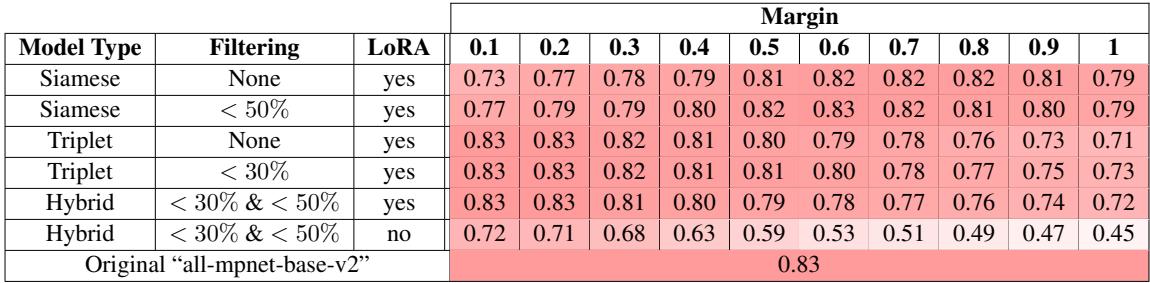
Table 3 highlights the magic of LoRA.
- The Original Model scores 0.83.
- The LoRA fine-tuned models also score around 0.80 - 0.83.
- The Fully Fine-Tuned model (without LoRA) drops significantly to 0.63 or lower.
This proves that using LoRA allows the model to learn stances without undergoing catastrophic forgetting.
3. Out-of-Distribution Testing (SemEval-2014)
It is easy to perform well on the data you trained on. But how does the model handle a completely new dataset? The researchers tested it on SemEval-2014, a dataset for detecting contradictions.

Figure 6 shows the distribution of similarities for Entailment (Green), Contradiction (Red), and Neutral (Blue).
- Plot (b) - LoRA Fine-Tuned: We see a healthy separation. The Red curve (Contradictions) is pushed to the left, distinct from the Green (Entailment).
- Plot (c) - Fully Fine-Tuned: While the separation is wide, the Neutral (Blue) curve is pushed too far right, confusing neutral statements with agreements. Again, LoRA strikes the best balance.
4. Even Giant Models Fail at This
You might wonder, “Why not just use a massive, modern LLM embedding model?” The authors anticipated this. They tested NV-Embed-v1, a massive 29GB model (compared to their tiny 420MB model).
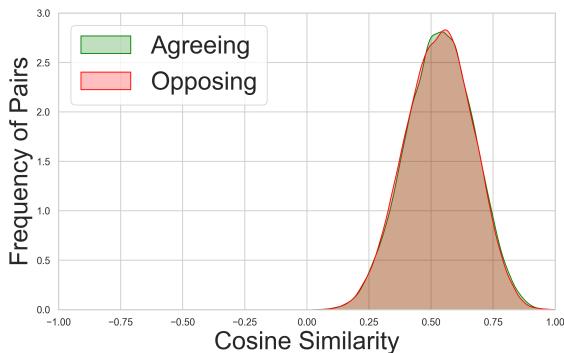
Figure 5 shows that even the giant model fails to separate the curves. Size isn’t everything; specific training objectives matter.
Real-World Application: Opinion Mining on Twitter
The ultimate goal of this research is to apply it to the messy real world. To demonstrate this, the authors analyzed the timelines of US Congresspeople.
They created two queries:
- “Abortion is healthcare” (Pro-choice stance)
- “Abortion is murder” (Pro-life stance)
They then searched for tweets similar to these queries using both the Original and the Fine-Tuned models. The goal was to see if the “Abortion is healthcare” query would actually retrieve tweets from Democrats, and “Abortion is murder” from Republicans.

Table 4 shows the results. The “Alignment Precision” measures how often the retrieved tweets matched the expected political party.
- For the Democrat query, accuracy jumped from 76% (Original) to 91% (Fine-Tuned).
- For the Republican query, accuracy jumped from 67% (Original) to 80% (Fine-Tuned).
But the numbers only tell half the story. Let’s look at the actual text retrieved.
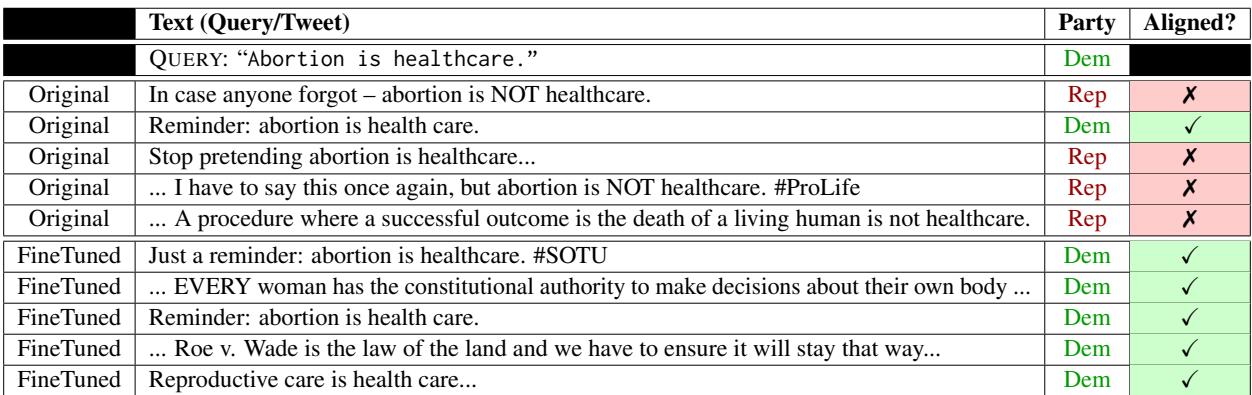
Table 5 is revealing.
- Original Model Results: When queried with “Abortion is healthcare,” the original model returned tweets like “abortion is NOT healthcare.” Why? Because they share almost all the same words.
- Fine-Tuned Model Results: It correctly returned tweets agreeing with the sentiment, such as “Reproductive care is health care” and “Roe v. Wade is the law of the land.”
This confirms that the Fine-Tuned model isn’t just matching keywords; it is understanding the argument.
Conclusion & Implications
This paper tackles a subtle but critical flaw in modern AI: the confusion between “topic” and “stance.” By creatively using debate data from Kialo and applying a Hybrid training strategy with LoRA, the researchers created a model that is both Stance-Aware and Computationally Efficient.
Key Takeaways:
- Standard Embeddings are Stance-Blind: They group opposing views together because they look topically similar.
- Efficiency Matters: We can’t afford to use heavy classifiers for millions of social media posts. We need vector-based solutions.
- Hybrid Architecture Works: Combining Siamese (pairs) and Triplet (context) networks yields the best results.
- LoRA is Essential: It allows models to learn new tricks (stance detection) without forgetting old ones (English semantics).
This work paves the way for much more sophisticated social listening tools. Instead of just knowing what people are talking about, automated systems can now accurately map how they feel about it—whether they are debating pizza toppings or political policy.