](https://deep-paper.org/en/paper/file-3191/images/cover.png)
Knowledge Graphs (KGs) are the silent engines powering much of the modern web. From Google’s Knowledge Vault to Wikidata, these massive networks store facts in the form of triples: (Head Entity, Relation, Tail Entity). For example, (Leonardo da Vinci, painted, Mona Lisa).
However, KGs have a fundamental problem: they are never finished. Even the largest repositories suffer from incompleteness. This has given rise to the field of Knowledge Graph Completion (KGC)—the task of predicting missing links.
In recent years, researchers have started using Pre-trained Language Models (PLMs) like BERT to solve this problem. These text-based models are excellent at understanding the semantics of entity names, but they often have a blind spot: they treat facts in isolation. They look at a triple, but they ignore the complex web of connections—the structure—surrounding it.
Today, we are diving into a research paper that bridges this gap: StructKGC. This framework introduces “Structure-Aware Supervised Contrastive Learning,” a method that forces language models to look beyond the immediate triple and understand the broader topology of the graph, from neighbors to multi-hop paths.
The Problem: Tunnel Vision in Text-Based KGC
To understand why StructKGC is necessary, we first need to look at how modern KGC works.
Traditionally, KGC relied on embedding-based methods (like TransE or RotatE). These treated entities as vectors in geometric space. They were fast and structure-sensitive but completely ignored the text. They didn’t know that “Steve Jobs” and “Apple” were semantically related words; they just saw ID numbers.
Then came text-based methods (like KG-BERT and SimKGC). These models use PLMs to encode the text descriptions of entities. The current state-of-the-art approach uses Contrastive Learning.
The Limits of Standard Contrastive Learning
In a standard setup (like SimKGC), the model is trained using a “dual-tower” architecture. One tower encodes the query \((h, r)\), and the other encodes the target tail entity \(t\). The goal is simple: maximize the similarity between the query and the correct tail, while pushing away random “negative” entities.
The mathematical formulation usually looks like this, known as the InfoNCE loss:
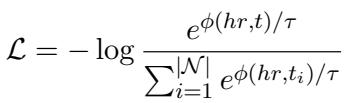
Here, the model contrasts the positive pair against a batch of negatives. While effective, this approach has “tunnel vision.” It assumes a single positive tail entity for a query.
But real knowledge graphs are messy.
- One-to-Many Relations: A query like (Ronaldo, Teammate, ?) has many valid answers.
- Structural Context: Entities are defined by their neighbors.
- Logical Paths: Often, the relationship between two entities is defined by a multi-hop path, not just a direct link.
Let’s look at a concrete example provided by the researchers.
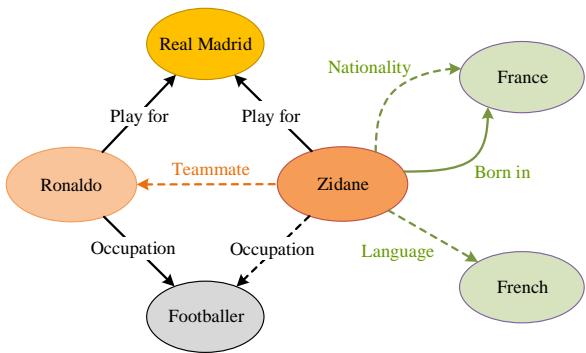
In Figure 1, consider predicting the profession of Zidane. If the model only looks at the text “Zidane,” it might struggle. However, the graph structure shows that Zidane shares a specific context with Ronaldo: they both played for Real Madrid. Since Ronaldo is a footballer, the structural similarity suggests Zidane is likely one too. Furthermore, the path Play_for \(\rightarrow\) Play_for (inverse) acts logically like a “Teammate” relation.
Standard text-based models ignore these rich structural clues. They treat the training data as a bag of independent triples, missing the forest for the trees.
The Solution: StructKGC
The researchers propose StructKGC, a framework designed to inject structural awareness into the fine-tuning of PLMs.
The core idea is to expand the definition of a “positive sample.” Instead of just matching a query \((h, r)\) to a single tail entity \(t\), StructKGC maximizes the mutual information between an anchor and its structural context.
The framework introduces a generalized Supervised Contrastive Learning loss. Unlike standard contrastive loss which handles one positive, this formula supports multiple positives (denoted as set \(P(q)\)):

This equation essentially says: “Pull the representation of the query closer to all structurally relevant items (positives), not just the single ground-truth tail.”
To operationalize this, StructKGC introduces four specific auxiliary tasks, each targeting a different “level” of graph structure.
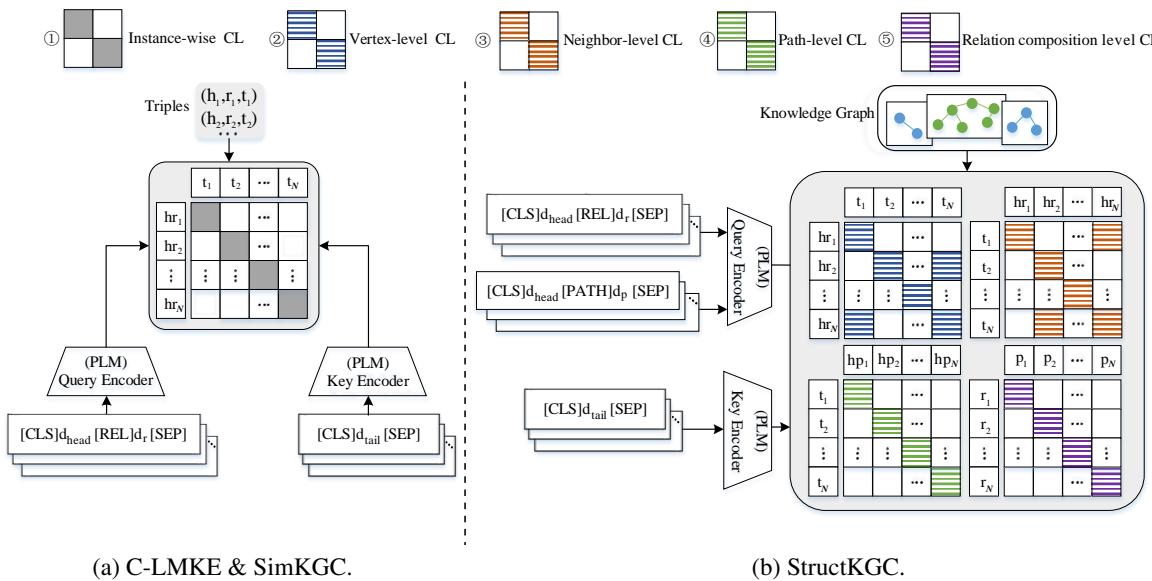
As shown in Figure 3, while standard models (left) focus on Instance-wise CL, StructKGC (right) adds four colored layers of structural tasks. Let’s break them down.
1. Vertex-Level Contrastive Learning (VC)
In many KGs, a relationship is rarely unique. A movie has many actors; a country has many cities. This is the One-to-Many problem.
If we ask (USA, Contains, ?), “New York,” “Los Angeles,” and “Chicago” are all correct answers. In standard training, if the current batch samples “New York” as the target, the model might inadvertently be taught to push “Los Angeles” away as a negative.
Vertex-level CL fixes this. It defines the positive set \(P_v(h, r)\) as all entities connected to the head-relation pair in the graph.

By aligning the query with all valid answers simultaneously, the model learns a representation space where all valid cities cluster around the “USA-Contains” query vector.
2. Neighbor-Level Contrastive Learning (NC)
“You are the average of the five people you spend the most time with.” This quote applies to KG entities too. The semantics of an entity are largely defined by its incoming and outgoing connections.
Neighbor-level CL focuses on the target entity \(t\). It posits that the representation of \(t\) should be similar to the representations of its neighbors.

Here, the positive set \(P_n(t)\) consists of tuples \((v_i, e_j)\)—the neighbors connected to \(t\). This task forces the PLM to encode the text of an entity in a way that is semantically consistent with its surrounding graph neighborhood.
3. Path-Level Contrastive Learning (PC)
Direct links are great, but reasoning often requires hops. If \(A\) is the father of \(B\), and \(B\) is the father of \(C\), then \(A\) is the grandfather of \(C\). This is a 2-hop path.
Path-level CL tries to capture these long-range dependencies. It constructs a positive set \(P_p(h, t)\) containing valid paths between the head and tail.
However, not all paths are created equal. Some are noise. The researchers use a reliability score \(R(p|h, r)\) (based on resource flow algorithms) to weight the importance of a path.

This equation pulls the representation of the tail entity \(t\) closer to the representation of the path originating from \(h\). It effectively teaches the model: “If you see this sequence of relations starting from \(h\), you should end up at \(t\).”
4. Relation Composition Level CL (RC)
While Path-level CL focuses on the entities, Relation Composition focuses on the logic of the relations themselves. It aims to learn that a composition of relations (e.g., born_in + city_of) is semantically equivalent to a direct relation (e.g., nationality).

This task aligns the embedding of the direct relation \(r\) with the embedding of the path sequence. This allows the model to perform implicit logical reasoning, inferring direct facts from multi-hop chains.
Visualizing the Structures
To visualize what these different “positives” look like, consider Figure 2:

- (a) Triple-based: The standard method. Only the direct tail is positive.
- (b) Vertex-based: All valid tails (green nodes) are positives.
- (c) Neighbor-based: The nodes surrounding the tail are positives.
- (d) Path-based: The sequence of nodes connecting head to tail is positive.
The Combined Objective
StructKGC doesn’t train these in isolation. It combines them into a joint training objective. The model tries to satisfy all these structural constraints simultaneously alongside the standard ranking task.

The weights \(w_1\) through \(w_4\) are hyperparameters, allowing the model to adapt to different datasets where paths or neighbors might be more or less important.
Experiments and Results
The researchers tested StructKGC on two standard benchmarks: FB15k-237 (a subset of Freebase) and WN18RR (a subset of WordNet).

Main Results
The results were compared against both embedding-based methods (like RotatE) and text-based methods (like SimKGC).

Key Takeaways from the Data:
- State-of-the-Art: StructKGC achieves the highest Mean Reciprocal Rank (MRR) on both datasets (38.3% on FB15k-237 and 69.6% on WN18RR).
- Beating SimKGC: It outperforms its direct predecessor, SimKGC, by a solid margin (up to 4.4% improvement). This proves that adding structural tasks to a contrastive PLM yields better representations than text alone.
Low-Resource Scenarios
One of the most compelling arguments for using KGs is that they can help when data is scarce. The researchers simulated a “low-resource” setting by removing massive chunks of the training data (using only 10% to 50% of available triples).
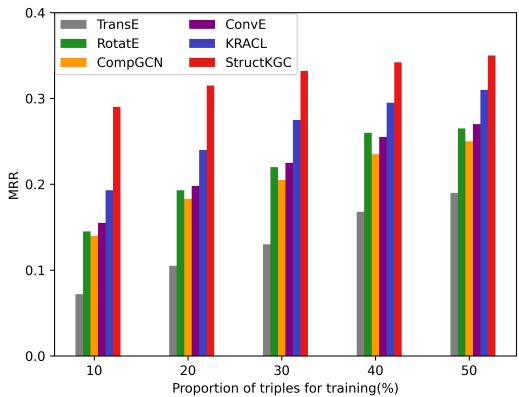
As seen in Figure 4, StructKGC (the green bar) consistently dominates across all data percentages. When training data is limited, the model cannot rely solely on memorizing frequent triples. It must rely on structure and logic (neighbors and paths) to generalize. StructKGC’s ability to leverage these structural cues makes it extremely data-efficient.
Handling Complex Relations (1-to-Many)
The paper breaks down performance by relation category. The hardest category is usually 1-to-Many (1-to-M), where a head is connected to multiple tails.
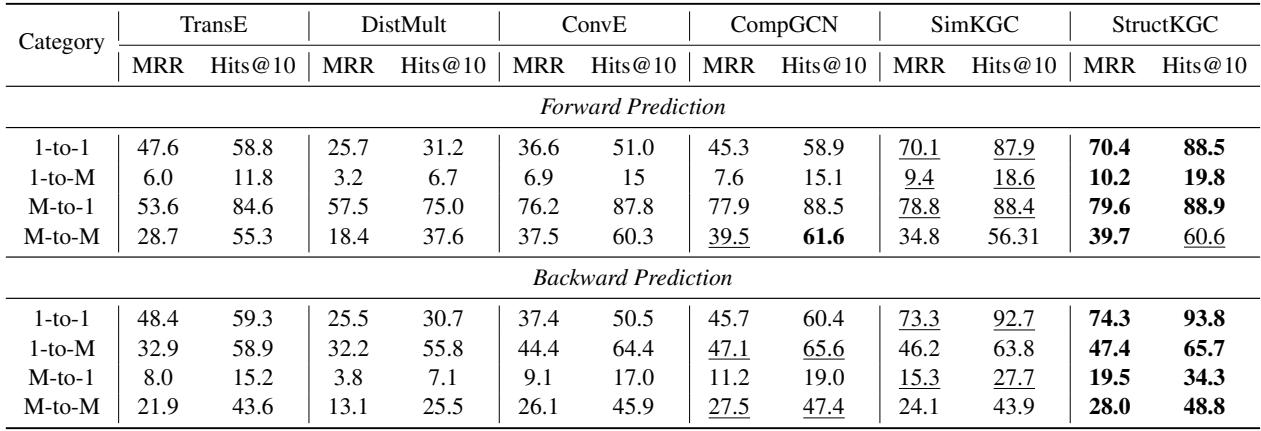
Looking at the 1-to-M rows in Table 4, StructKGC shows clear improvements over SimKGC. This validates the design of the Vertex-level CL task, which was explicitly built to handle multiple valid positives.
Component Analysis (Ablation Study)
Did all four tasks help? The researchers removed them one by one to find out.
- VC (Vertex) provides a consistent boost.
- NC (Neighbor) adds further improvement.
- PC + RC (Path & Relation) provide the largest jump on FB15k-237 (an 8.8% MRR increase!). Interestingly, paths helped less on WN18RR, likely because WordNet has fewer relational paths and more hierarchical sparsity compared to Freebase.
Trade-offs: Is it Worth the Time?
There is no free lunch in machine learning. Encoding paths and neighbors means processing more text tokens, which naturally requires more computation.

Figure 6 reveals the cost:
- Training Time (Left): StructKGC takes longer to train than SimKGC (about 1.2x).
- Inference Time (Right): Crucially, inference time remains identical to SimKGC.
This is a very favorable trade-off. The complex structural learning happens offline during training. Once the model is trained, it encodes the query and retrieves the answer just as fast as the simpler models, but with much higher accuracy.
Conclusion and Future Implications
StructKGC represents a logical evolution in Knowledge Graph Completion. We started with geometry (embeddings), moved to semantics (BERT), and are now effectively fusing the two by teaching language models to “read” the structure of a graph.
By introducing Vertex, Neighbor, Path, and Relation composition tasks, the authors have created a model that doesn’t just memorize facts—it understands context.
Key Takeaways:
- Context is King: A triple \((h, r, t)\) does not exist in a vacuum. Its meaning is defined by the graph topology.
- Multi-Tasking Works: Forcing a PLM to solve auxiliary structural tasks improves its performance on the main link prediction task.
- Efficiency: The structural overhead is paid only during training, leaving inference fast and scalable.
As Knowledge Graphs continue to grow and power AI applications—from search engines to recommendation systems—methods like StructKGC will be essential for filling in the blanks and making these systems more robust and intelligent.