](https://deep-paper.org/en/paper/file-3200/images/cover.png)
If you have ever spent hours tweaking a prompt for a Large Language Model (LLM)—changing a word here, adding a constraint there, trying to get the model to “think” correctly—you have experienced the bottleneck of prompt engineering.
We know that LLMs are capable of incredible reasoning, but their performance is often highly sensitive to the instructions they receive. While techniques like “Chain-of-Thought” (CoT) prompting significantly improve performance, they usually require humans to manually write out detailed reasoning steps. This is time-consuming and requires expertise.
What if the model could write its own instructions and reasoning examples?
In this post, we are diving into a fascinating paper titled “INDUCT-LEARN: Short Phrase Prompting with Instruction Induction.” The researchers propose a framework that allows an LLM to look at a handful of raw input-output examples and a short phrase (like a task name), and automatically generate detailed, high-quality instructions and reasoning chains.
The result? A method that often outperforms human-written instructions and state-of-the-art prompt optimization methods, all while being cost-effective.
The Problem: The High Cost of Good Prompts
To get the best out of an LLM, you generally need two things:
- Clear Instructions: Telling the model exactly how to solve the problem.
- Demonstrations: Showing the model examples (Few-Shot Prompting), ideally with step-by-step reasoning (CoT).
Existing methods to automate this process usually rely on massive datasets to “train” a prompt optimizer or require an extensive iterative process that burns through API credits. For the average student or developer who just has a small dataset (say, 10 examples of a specific problem) and a tight budget, these high-resource methods are impractical.
This is where INDUCT-LEARN steps in. It operates on a “low-resource” assumption: you only have a few raw examples (input-output pairs) and a simple label for the task.
The Solution: The INDUCT-LEARN Framework
The core idea is to mimic human inductive learning. When a smart student sees a set of solved math problems, they don’t just memorize the answers. They induce the underlying rules (formulas) and then practice applying those rules to ensure they understand the logic.
INDUCT-LEARN formalizes this into two distinct stages:
- INDUCT Stage: The model looks at examples to generate “Pseudo Instructions” (the rules).
- LEARN Stage: The model uses those instructions to rewrite the examples with reasoning steps (the practice).
Let’s look at a high-level comparison of how this differs from standard prompting.
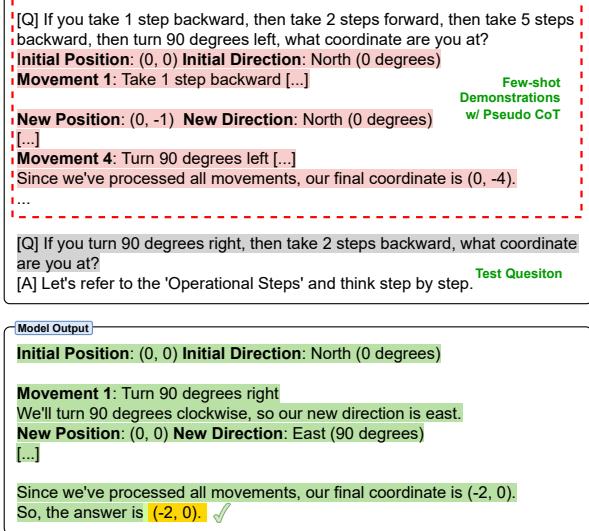
As shown in Figure 1, standard prompting (left) often fails on complex tasks (like 2D movement tracking) because it lacks explicit guidance. INDUCT-LEARN (right) provides a structured prompt with specific operational steps and reasoning, leading to the correct answer.
Stage 1: The INDUCT Stage
The goal of this stage is Instruction Induction. We want the LLM to act as an expert analyst. We give it a set of demonstrations (\(D\)) and a very short phrase (\(I\)) describing the task (e.g., “Boolean Expressions” or “Movie Recommendation”).
The input dataset \(D\) consists of simple pairs:

The framework uses a Meta Prompt (\(P_{\phi}\)) to tell the LLM: “You are an expert analyst. Look at these examples and the task name. Deduce the rules, input format, and step-by-step operations required to solve this.”
Mathematically, the generation of the pseudo-instructions (\(P_{\text{INDUCT}}\)) looks like this:

The result (\(P_{\text{INDUCT}}\)) is a structured text containing:
- Task Content: What is the goal?
- Input/Output Format: How should the data look?
- Operational Steps: A step-by-step algorithm to solve the problem.
Stage 2: The LEARN Stage
Now that the model has “induced” the rules, it needs to verify them and generate high-quality Chain-of-Thought (CoT) examples.
In this stage, the model takes the original inputs (\(x_i\)) and tries to solve them using the newly generated instructions (\(P_{\text{INDUCT}}\)). It generates a predicted answer (\(\hat{y}_i\)) and, crucially, a reasoning path or “Chain-of-Thought” (\(c_i\)).

Here is the clever part: The model might get some of these wrong. The framework compares the model’s generated answer (\(\hat{y}_i\)) with the actual ground truth (\(y_i\)). It filters the data and keeps only the examples where the model arrived at the correct answer.
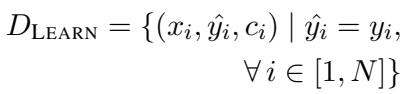
The surviving examples form a new dataset, \(D_{\text{LEARN}}\). These are powerful because they are not just input-output pairs anymore; they now include the reasoning steps (\(c_i\)) that successfully led to the correct answer based on the induced instructions.
We then take the top \(k\) examples from this verified set to create the learning component of our final prompt:

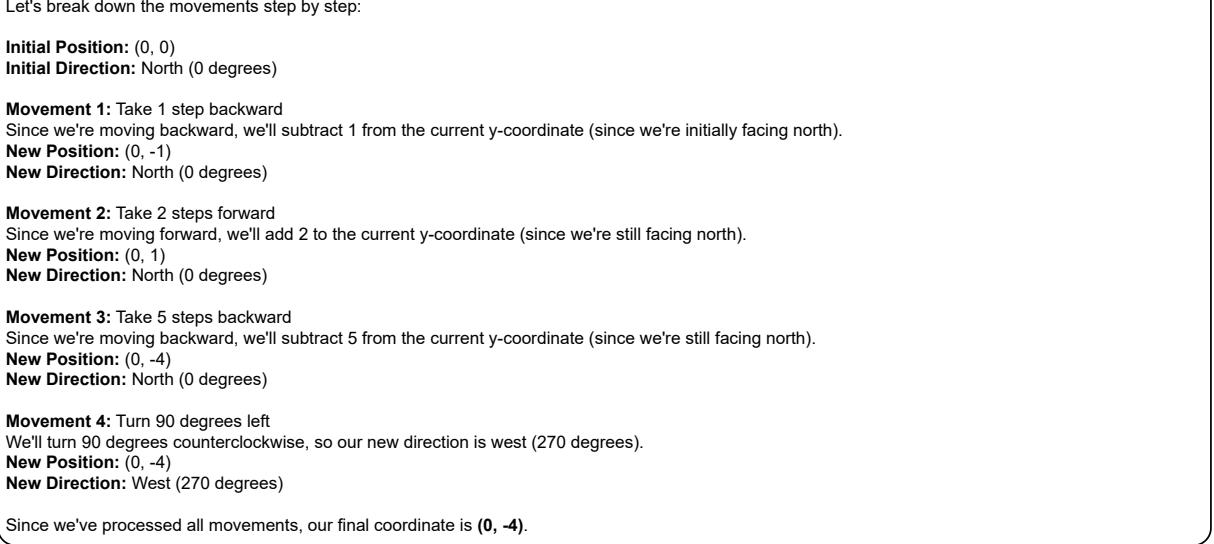
An example of what this “LEARN” output looks like can be seen below. Notice how the model breaks down the “2D movement” task into logical steps based on the operational rules it generated earlier.
Putting It Together: The Inference Stage
When the user wants to solve a new problem (\(x'\)), the framework combines the induced instructions and the learned CoT demonstrations into one powerful prompt.

The final inference is simply passing the new input to the LLM, guided by this comprehensive, self-generated prompt:

Experimental Setup
To validate this approach, the authors used two difficult datasets:
- BBH-Induct: A modified version of the BIG-Bench Hard dataset where all explicit instructions were stripped away, leaving only input-output pairs.
- Evals-Induct: Derived from OpenAI Evals, focusing on tasks that even GPT-4 struggles with.
They tested across various models, including Llama 3, Mistral, Mixtral, and the Gemini series.
Does it actually work?
The results were impressive. Let’s look at the zero-shot performance (just using the induced instructions without the CoT examples yet).
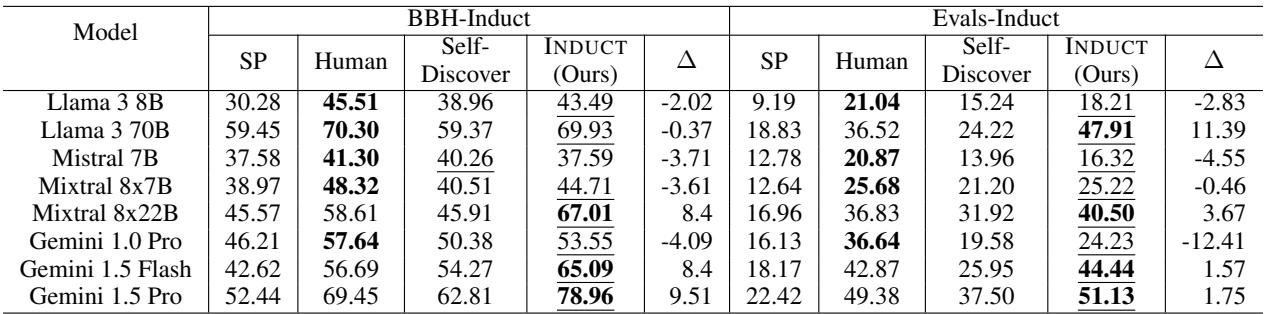
Table 1 shows that the induced instructions (\(P_{\text{INDUCT}}\)) significantly outperform the “Short Phrase” baseline. More importantly, look at the comparison with Human instructions. For the most powerful models (like Llama 3 70B and Gemini 1.5 Pro), the self-generated instructions actually outperform the instructions written by human experts.
This supports the hypothesis that larger models have stronger inductive reasoning capabilities—they are better at “figuring out the rules” on their own.
The Impact of the LEARN Stage
When the researchers added the second stage (the self-generated CoT examples), performance jumped again.
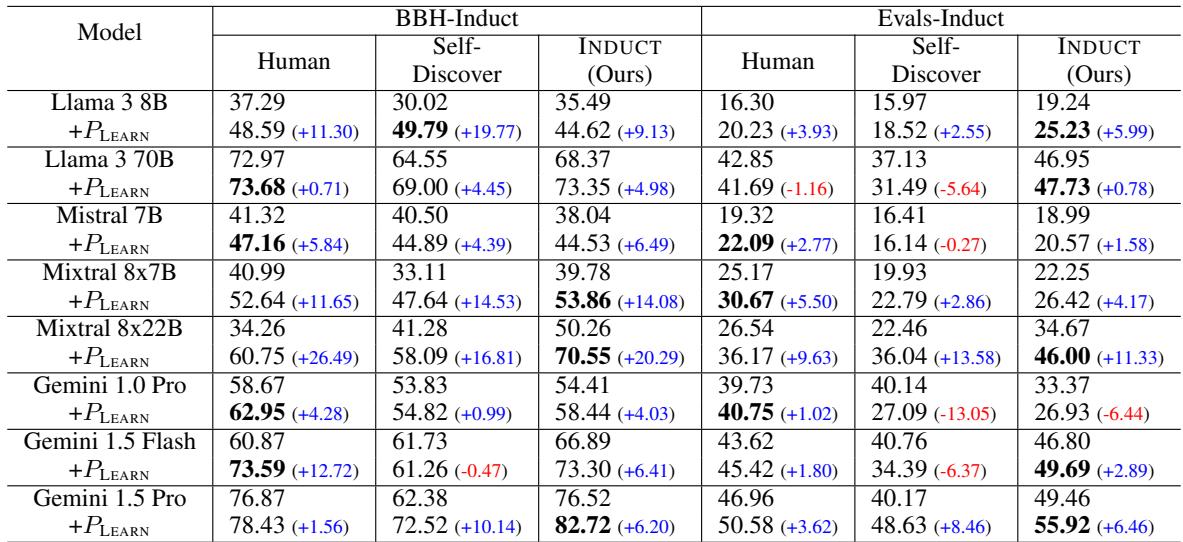
As seen in Table 2, adding \(P_{\text{LEARN}}\) (the pseudo-CoT) consistently improves accuracy. In many cases, the full INDUCT-LEARN framework beats Self-Discover, a competing state-of-the-art method from Google DeepMind.
Cross-Model Adaptability
One of the most exciting findings in this paper is Cross-Model Adaptability. Can a “smart” model (like Gemini 1.5 Pro) write instructions that help a “weaker” model (like Llama 3 8B) perform better?
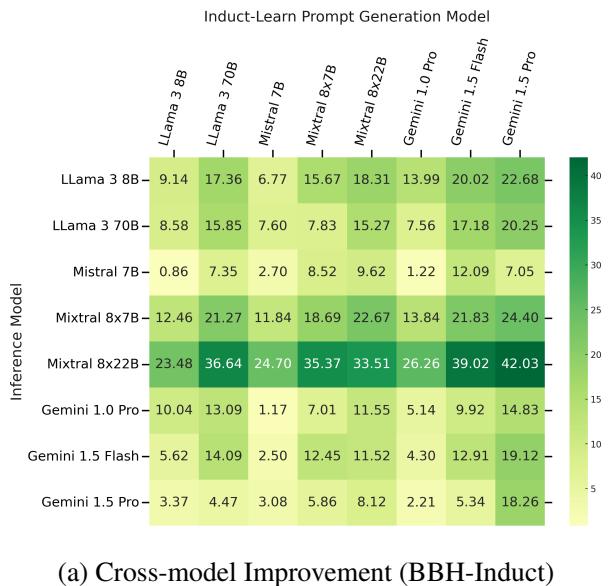
Figure 2 visualizes this transferability. The y-axis represents the model doing the inference, and the x-axis represents the model that generated the prompt.
- Dark Green indicates a massive performance boost.
- Notice that prompts generated by powerful models (right side of the x-axis) improve the performance of almost all inference models.
This suggests a cost-effective strategy: use a large, expensive model once to generate the INDUCT-LEARN prompt, and then use that prompt to run inference on a smaller, cheaper model.
Cost Analysis
Speaking of cost, automated prompt engineering often gets a bad reputation for being token-heavy. Does INDUCT-LEARN break the bank?
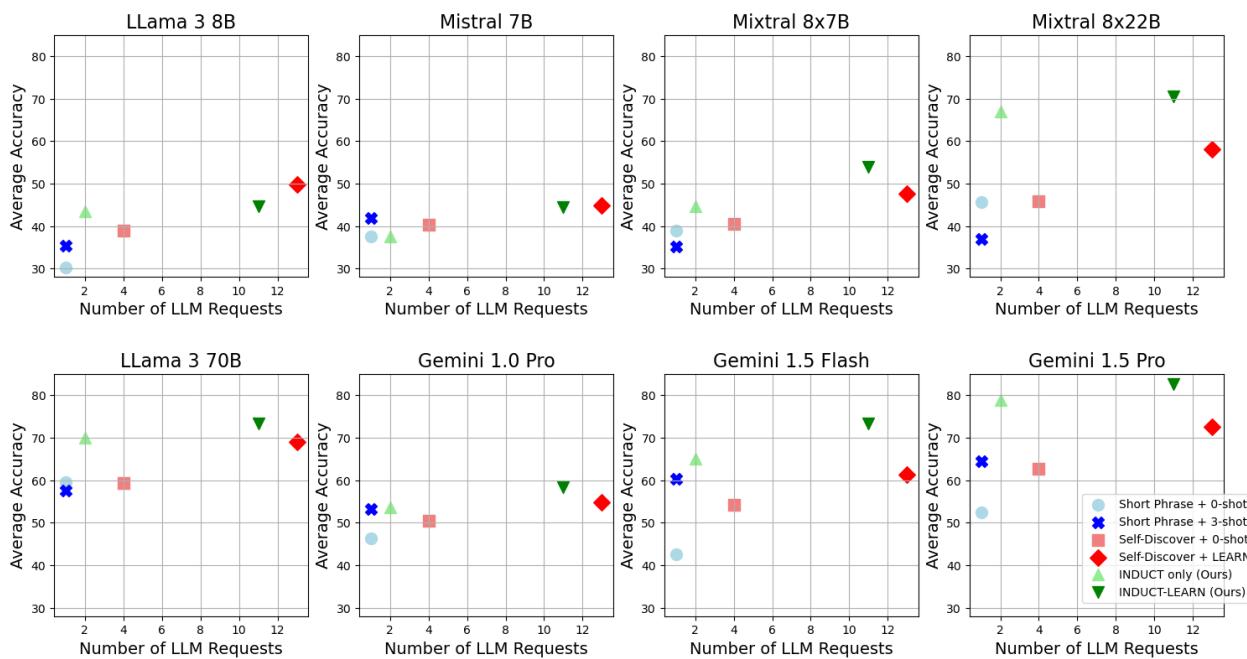
Figure 4 plots Average Accuracy (y-axis) against the Number of LLM Requests (x-axis).
- Self-Discover (Pink/Red): Requires many requests to navigate its reasoning structure search.
- INDUCT-LEARN (Dark Green Triangle): Achieves comparable or superior accuracy with significantly fewer requests (often just 2 requests: one for induction, one for learning).
The efficiency here is remarkable. You are getting SOTA performance without an iterative loop that burns thousands of tokens per task.
Why does this matter?
The INDUCT-LEARN framework highlights a shift in how we interact with LLMs. We are moving away from “prompt engineering” (humans guessing what the model wants) toward “instruction induction” (models telling us how they should be prompted).
Key Takeaways:
- Inductive Reasoning is Powerful: Large models are excellent at looking at raw data and extracting the underlying rules.
- Self-Correction Works: The LEARN stage acts as a filter. By forcing the model to generate reasoning and discarding the failures, we curate a high-quality “textbook” for the model to use during inference.
- Model Hierarchy: You can use your strongest model as a “Teacher” to generate prompts for your “Student” models, optimizing both performance and deployment costs.
For students and researchers, this paper offers a practical framework. If you have a unique dataset but lack the time to craft perfect prompts, INDUCT-LEARN suggests you might not have to—you just need to let the model teach itself.