](https://deep-paper.org/en/paper/file-3211/images/cover.png)
Introduction
In the digital age, misinformation is a hydra. Cut off one head by flagging a post or banning a user, and two more appear in its place. We are witnessing a proliferation of false information that is not only annoying but potentially life-threatening, particularly in contexts like public health or crisis management.
The current standard for dealing with this—content moderation—is largely reactive. Platforms wait for a report, check the content, and remove it. While this might stop the immediate spread, it does little to address the root cause: the perception of the person sharing the misinformation. If a user believes a falsehood and is simply silenced, their belief often hardens. They retreat to echo chambers, convinced of a conspiracy to silence the “truth.”
To truly combat misinformation, we need scalable solutions that do more than delete content; we need solutions that persuade. We need systems capable of engaging in dialogue, broadening perspectives, and encouraging behavior change.
This blog post dives deep into a fascinating research paper, “Integrating Argumentation and Hate-Speech-based Techniques for Counteracting Misinformation,” which proposes a novel Artificial Intelligence framework. The researchers suggest that simply stating facts isn’t enough. Instead, they built a system that learns from hate speech counter-measures—which are rich in rhetorical strategies—and applies those persuasive techniques to misinformation.
By treating conversations as “argument graphs” and using Large Language Models (LLMs) to plan strategic responses, this new method aims to generate counter-responses that are not just factual, but also engaging, natural, and polite.
Background: The Limitations of Current Approaches
Before understanding the solution, we must understand the nuances of the problem. Research shows that counter-misinformation responses on social media generally fall into two categories:
- Expert Responses: These come from verified health organizations or fact-checkers. They are highly factual, polite, and informative. However, they suffer from being “template-like.” They often lack the human touch, making them less engaging and less likely to spark a genuine conversation.
- Non-Expert Responses: These are replies from everyday users. They are diverse, natural, and engaging. Unfortunately, they are frequently rude, hostile, or cite unverified evidence. This hostility often backfires, causing the misinformed user to double down on their beliefs.
The researchers identified a “sweet spot”: a system that combines the naturalness and variety of non-expert responses with the informativeness and politeness of expert responses.
The Connection to Hate Speech
Why look at hate speech to solve misinformation? Interestingly, the two often coexist. Misinformation can fuel hate speech, and hate speech often relies on false narratives.
More importantly, the field of Natural Language Processing (NLP) has a much more mature taxonomy for countering hate speech than it does for countering misinformation. There are established definitions for strategies like “pointing out hypocrisy,” “humor,” or “warning of consequences.” The authors hypothesized that these rich rhetorical strategies could be adapted to debunk fake news effectively.
The Core Method: A Pipeline for Persuasion
The researchers proposed a sophisticated pipeline that doesn’t just “guess” the next word in a sentence. Instead, it “plans” an argument. The architecture involves data augmentation, strategy classification, and a graph-based generation process.

As shown in Figure 1, the architecture consists of two main parallel processes that feed into the final response generator:
- Strategy Annotation (Left Branch): Training models to recognize rhetorical strategies.
- Argument Parsing (Middle/Bottom Branch): Converting text into structured argument graphs.
- Response Generation (Right Branch): A fine-tuned LLM that uses the strategies and graphs to create a reply.
Let’s break these down step-by-step.
Step 1: Adapting Hate Speech Strategies
To teach an AI how to argue effectively, you first need to define the “moves” it can make. The researchers utilized a taxonomy of strategies originally defined for countering hate speech.
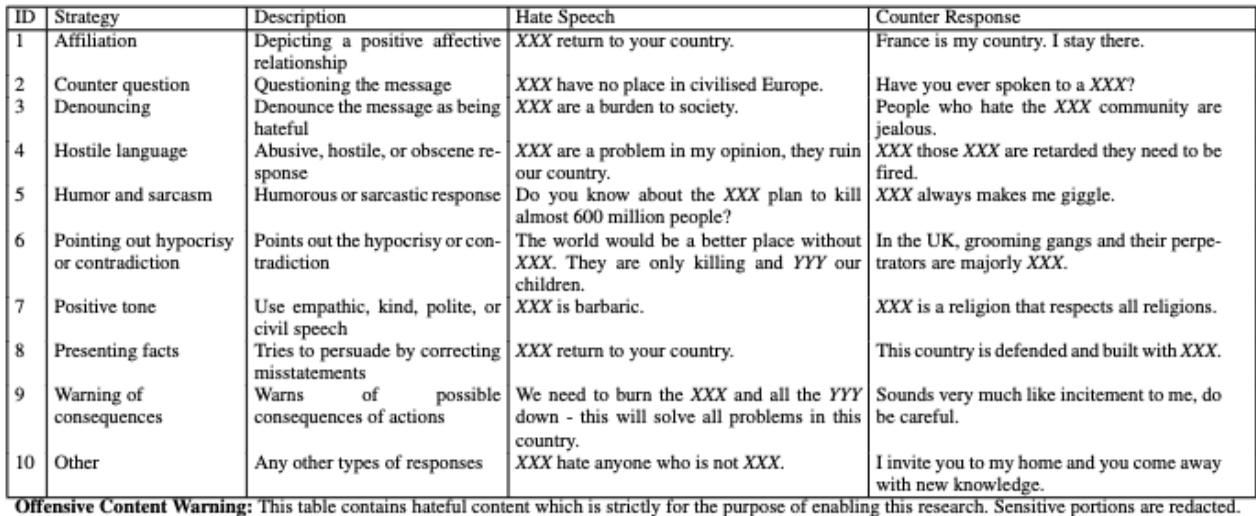
As Figure 8 illustrates, there are diverse ways to respond to a toxic or false statement. You can use Humor and sarcasm, Point out hypocrisy, ask a Counter question, or simply rely on Presenting facts.
The “Backfilling” Challenge
One major hurdle was the lack of training data. While there are datasets of hate speech responses (like “TSNH”), they often contain only the response without the original hate comment. It is hard to train a model to understand a reply if it doesn’t know what it is replying to.
To solve this, the researchers used a technique called backfilling. They used an LLM (Orca) to hallucinate (synthetically generate) the likely hate speech that would prompt a specific response. By pairing real responses with these synthetic prompts, they created a robust dataset to train a classifier. This classifier (an ensemble of Roberta and Llama-2) could then look at any dialogue and label the rhetorical strategy being used.
Step 2: Analyzing Misinformation Strategies
With their new classifier in hand, the researchers analyzed existing datasets to see how experts and non-experts currently behave. The results were revealing.
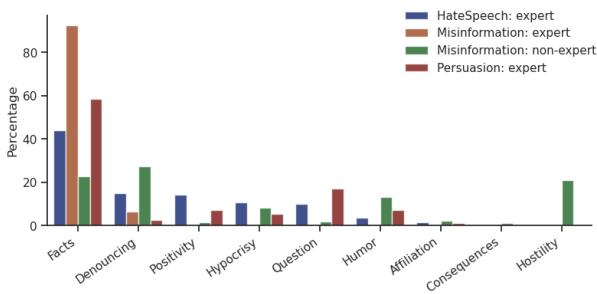
Figure 2 highlights the behavioral gap:
- Experts (Brown/Blue bars): They rely heavily on “Facts.” In misinformation contexts (the brown bar), experts use facts in nearly 90% of cases. While accurate, this is often dry.
- Non-Experts (Green bar): They are far more likely to use “Denouncing” and “Hostile language” (the only group with a visible presence in the hostility category).
- Persuasion Experts (Red-brown bar): Interestingly, in general persuasive dialogues, effective debaters use “Denouncing” and “Counter questions” more often than just dry facts.
This analysis confirmed that to make an AI persuasive, it needs to move beyond just “Presenting facts” and incorporate more engaging strategies like questioning or pointing out contradictions, without descending into the hostility of non-experts.
Step 3: Dialogue as an Argument Graph
A conversation is not just a string of sentences; it is a structure of logic. To capture this, the researchers represented dialogues as Argument Graphs.
In this framework:
- Nodes are argument components (Claims and Premises).
- Edges represent relationships (Support or Attack).
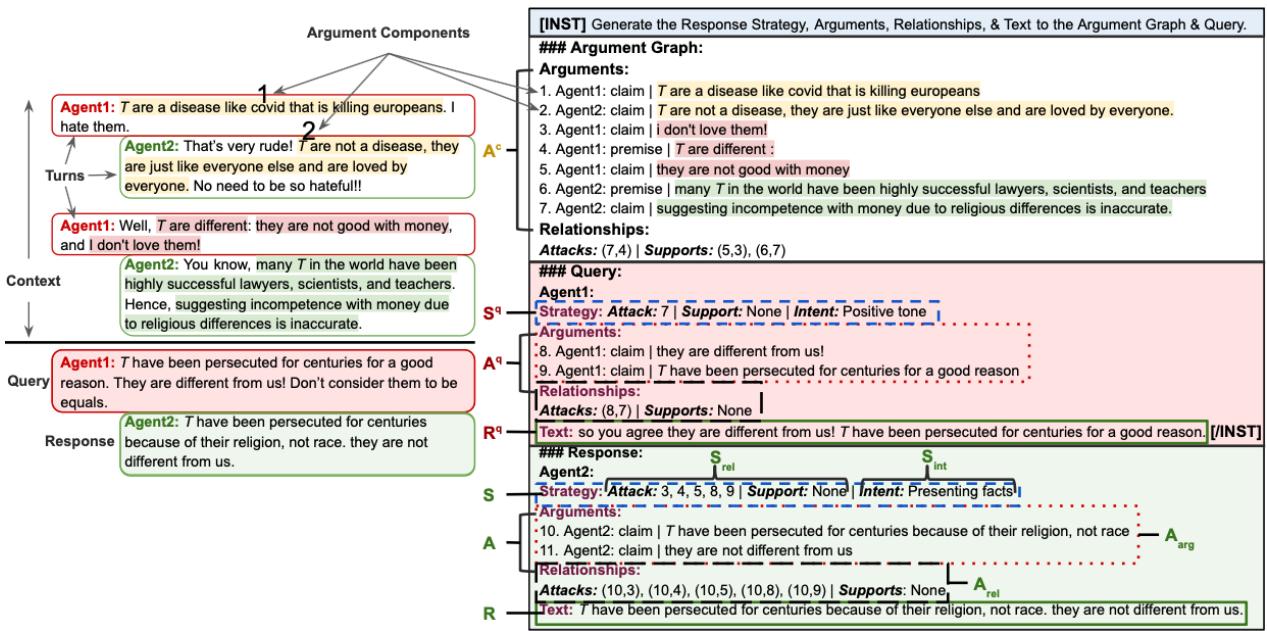
Figure 3 demonstrates this transformation. On the left, we see a standard chat log. On the right, this is converted into structured data. The system identifies that “Agent 1” is making a claim about a specific group (redacted for sensitivity) and “Agent 2” is attacking that claim with a premise.
By parsing dialogue into this graph structure, the AI can “see” the logical flow. It knows exactly which point to refute and which point to support.
Step 4: The 2-Step Response Generator
The heart of the proposed solution is a generative model (based on Mistral-7B) that operates in two distinct phases: Planning and Realization.
Phase 1: Planning
Before writing a single word of the response, the model decides what it wants to do. It generates a plan containing:
- Logic (\(S_{rel}\)): Which nodes in the argument graph should be attacked? Which should be supported?
- Strategy (\(S_{int}\)): What is the “intent” or tone? (e.g., “Positive tone,” “Counter question,” “Presenting facts”).
Phase 2: Realization
Conditioned on the argument graph and the plan from Phase 1, the model then generates the actual text.
This separation is crucial. It gives the system controllability. If you want the AI to be more inquisitive, you can force the strategy to “Counter question.” If you want it to be firm, you can set it to “Pointing out hypocrisy.”
Experiments and Results
The researchers evaluated their “dual” model (the 2-step planner/generator) against several baselines, including standard text-generation models and responses written by humans.
Does the Model Plan Like a Human?
One of the first questions was whether the AI’s “planning” phase resembled how humans think.
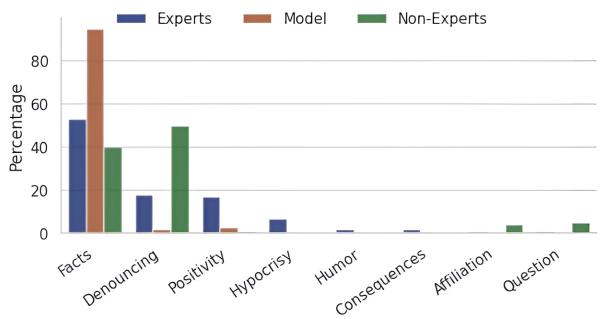
Figure 5 shows the distribution of strategies (Intents) chosen by the Model compared to Experts and Non-Experts.
- The Model (Brown) closely aligns with Experts (Blue) in its heavy use of “Facts,” ensuring accuracy.
- However, unlike the chaotic Non-Experts (Green), the model avoids hostility entirely.
When looking at where the model focuses its attention in a conversation, we see further sophistication.
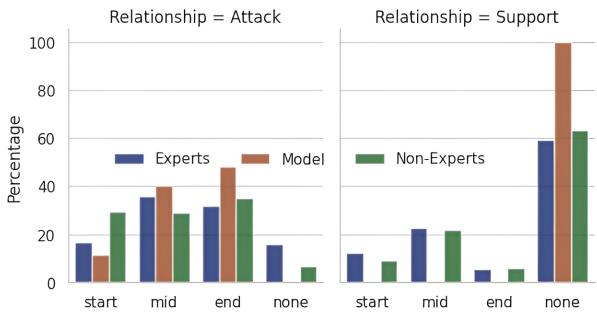
Note: Referencing the charts in the top half of the image above.
The charts show that the Model (Orange) prefers to attack arguments that appear at the end or middle of a conversation (the most recent points), which is a logical way to keep a debate focused. It rarely “supports” the opponent’s arguments, which makes sense when the goal is to correct misinformation.
Assessing Quality: Engagement and Naturalness
The ultimate test is how these responses are perceived by humans. The researchers conducted a study where human evaluators ranked responses from different sources:
- Control: A simple “This is fake news” statement.
- Zero-shot: A standard ChatGPT-like response without the special architecture.
- Wild: Real responses from social media users.
- Curated: Responses from experts.
- Generated: The proposed “Dual+Amp” model.
The evaluators judged the responses on three criteria: Engagingness (likelihood of a reply), Naturalness, and Factualness.
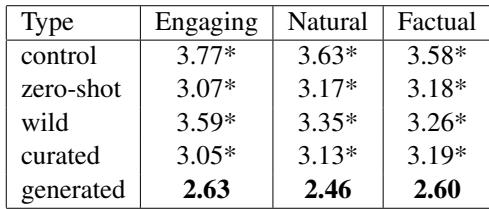
Table 3 presents the results (lower scores are better). The proposed Generated model achieved the best rankings across the board:
- Most Engaging (2.63): Significantly better than experts (3.05) and far better than simple control statements (3.77).
- Most Natural (2.46): It sounded more human than the “template-like” expert responses.
- Most Factual (2.60): It maintained the high accuracy of the experts.
Technical Performance
In addition to human rankings, the model was evaluated using automated metrics like BLEU and ROUGE, which measure how closely the generated text matches high-quality reference text.

Table 2 confirms the superiority of the 2-step approach. The “Dual+Amp” variant (which includes additional argument mining training) achieved the highest scores. Interestingly, the table also shows that the model is very good at executing its own plan—if it plans to “Support” a node, the resulting text almost always contains a supportive argument (Score of 92.6 in the “Generated vs Re-Parsed” column).
Conclusion and Implications
The fight against misinformation has long been a game of “whack-a-mole.” By moving away from simple content moderation and toward computational persuasion, this research offers a glimpse into a more sustainable future.
The key takeaways from this work are:
- Strategy Transfer: We can successfully adapt the rich rhetorical strategies of counter-hate speech to the domain of misinformation.
- Planning Matters: An AI that explicitly plans its argument (identifying what to attack and what tone to take) produces superior content compared to one that just predicts the next word.
- The Hybrid Approach: The most effective counter-misinformation isn’t just a dry fact-check; it’s a fact-check wrapped in an engaging, natural, and polite conversational wrapper.
While the system has limitations—it relies on the quality of the argument parser and has currently only been tested on specific topics like COVID-19—it represents a significant step forward. Future iterations could see these “persuasive agents” deployed to help factual information compete in the marketplace of ideas, not by silencing dissent, but by winning the argument.