](https://deep-paper.org/en/paper/file-3212/images/cover.png)
Introduction
In the world of Natural Language Processing (NLP), sentiment analysis has become a solved problem. Determining whether a movie review is positive or negative is something even basic models can handle with high accuracy. However, human experience is rarely just “positive” or “negative.” It is a kaleidoscope of joy, grief, anticipation, remorse, and awe.
Detecting these fine-grained emotions in text remains a massive hurdle. For example, while models like RoBERTa can crush sentiment analysis benchmarks, their accuracy often plummets when asked to classify specific emotions in tweets or social media posts. Why? Because emotions are subjective, complex, and often overlapping.
How do we bridge this gap? A fascinating new research paper, “Integrating Plutchik’s Theory with Mixture of Experts for Enhancing Emotion Classification,” proposes a novel solution that combines classic psychological theory with cutting-edge deep learning architecture. The researchers argue that to make AI better at recognizing emotions, we shouldn’t just feed it more data; we should change how it understands emotion labels and how its architecture processes them.
In this post, we will deconstruct their approach, which integrates Plutchik’s Wheel of Emotions—a famous psychological model—with a Mixture of Experts (MoE) neural network architecture. By the end, you’ll understand how decomposing complex human feelings into “primary colors” and assigning them to specialized neural “experts” can significantly boost AI performance.
Background: The Psychology of Emotion
To understand the engineering contribution of this paper, we first need to step back into the mid-20th century and look at the work of psychologist Robert Plutchik.
The Problem with Labels
In most machine learning datasets, emotions are treated as distinct, unrelated buckets. A sentence is labeled “Angry” or “Sad.” But is “Annoyance” a completely different emotion from “Rage,” or are they just different intensities of the same feeling? Is “Love” a standalone emotion, or is it a compound feeling made of other ingredients?
Standard “Normal Labeling” in AI ignores these relationships. This leads to confusion in the model, especially when dealing with complex emotions that don’t fit neatly into a single box.
Plutchik’s Solution: The Wheel and The Dyads
Robert Plutchik proposed that emotions are analogous to colors. Just as you can mix primary colors (Red, Blue, Yellow) to make secondary colors (Purple, Green, Orange), you can mix primary emotions to create complex ones.
Plutchik identified eight basic emotions, arranged in opposite pairs:
- Joy vs. Sadness
- Anger vs. Fear
- Trust vs. Disgust
- Surprise vs. Anticipation
He visualized this in his famous Wheel of Emotions.
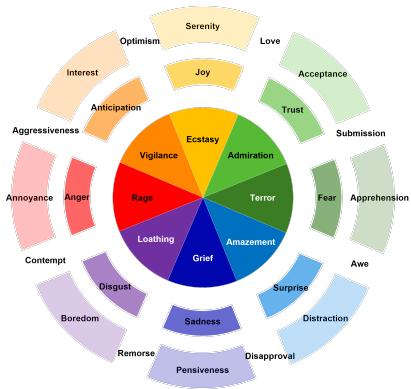
As shown in Figure 2, the cone-shaped diagram illustrates not just the emotions, but their intensity. Rage is a more intense version of Anger, which is more intense than Annoyance.
But the theory goes deeper. Plutchik proposed that “complex” emotions are actually combinations (dyads) of these basic eight. This is visualized in the Diagram of Emotion Dyads.
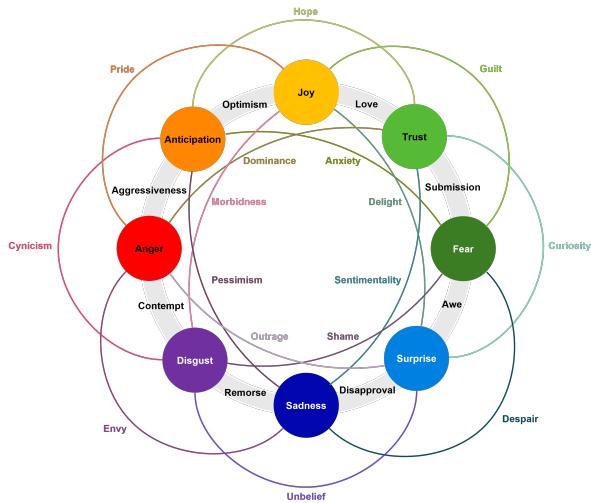
Look closely at Figure 1. It shows that:
- Love is actually a mixture of Joy and Trust.
- Optimism is a mixture of Anticipation and Joy.
- Remorse is a mixture of Disgust and Sadness.
The researchers of this paper hypothesized that if they forced the AI to learn these “recipes” rather than just memorizing arbitrary labels, the model would become more robust and accurate.
The Core Method
The authors’ methodology rests on two pillars: a new labeling strategy based on Plutchik’s theory, and a specialized model architecture called Mixture of Experts (MoE).
1. Plutchik Labeling: Decomposing Emotion
The first step was to refactor existing datasets. The researchers took standard emotion datasets (like SemEval-2018 and GoEmotions) and applied a transformation they call Plutchik Labeling.
Instead of training the model to predict a label like “Love” directly, they decomposed “Love” into its constituent basic emotions: “Joy” and “Trust.” If a data point was labeled “Pessimism,” it was relabeled as “Anticipation” and “Sadness.”
This effectively creates a multi-label classification task where the model only needs to learn the eight basic emotions to understand the entire spectrum of human experience.
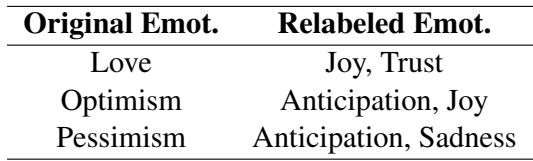
As seen in Table 1, this simplifies the target for the AI. It doesn’t need to learn the abstract concept of “Optimism” from scratch; it just needs to recognize that the text contains elements of both looking forward (Anticipation) and happiness (Joy).
2. Mixture of Experts (MoE): Specialized Neural Networks
Changing the labels is smart, but does a standard neural network have the capacity to handle these overlapping, nuanced definitions? To ensure success, the authors utilized a Mixture of Experts (MoE) architecture.
What is MoE?
In a standard Large Language Model (LLM) like Llama-2 or Mistral, every piece of data passes through the same “dense” layers. Every neuron works on every problem.
In a Mixture of Experts model, the Feed-Forward Network (FFN) layers—which hold much of the model’s knowledge—are split into multiple smaller networks, called Experts. When a token (a word or piece of a word) comes in, a Router (or Gating Network) decides which Expert is best suited to handle it.
Think of it like a hospital. You don’t see every doctor for every problem. You go to a triage nurse (the Router), who sends you to a cardiologist or a neurologist (the Experts) depending on your symptoms.
The Implementation
The researchers modified the architecture of Llama-2 (7B) and Mistral (7B) models. Specifically, they replaced the FFN in the final transformer block with an MoE layer containing 8 experts.
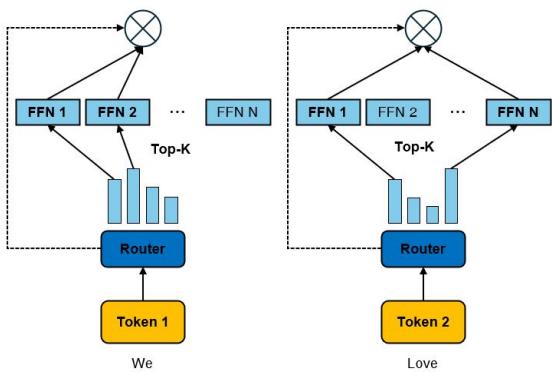
Figure 3 illustrates this process:
- Input: A token enters the layer (e.g., the word “Love”).
- Router: The router analyzes the token and assigns scores to the available Experts (FFN 1 through FFN N).
- Top-k Selection: The system selects the top \(k\) experts with the highest scores. The authors experimented with different \(k\) values (1 to 4) to see how many experts were needed to capture complex emotions.
- Fusion: The outputs of the selected experts are combined to form the final representation.
The hypothesis was that specific experts would naturally specialize in specific emotions. Expert 1 might become the “Anger” specialist, while Expert 2 handles “Joy.”
Experiments and Results
To test this theory, the researchers compared their Plutchik-MoE approach against baseline models using “Normal Labeling” (standard categories). They used two major datasets:
- SemEval-2018: Tweets labeled with 11 emotions.
- GoEmotions: Reddit comments labeled with 27 emotions.
Did Plutchik Labeling Improve Performance?
The results showed that integrating Plutchik’s theory generally improved the stability and accuracy of the models, measured by the F1-score (a metric combining precision and recall).
Let’s look at the performance across different \(k\) values (the number of active experts).
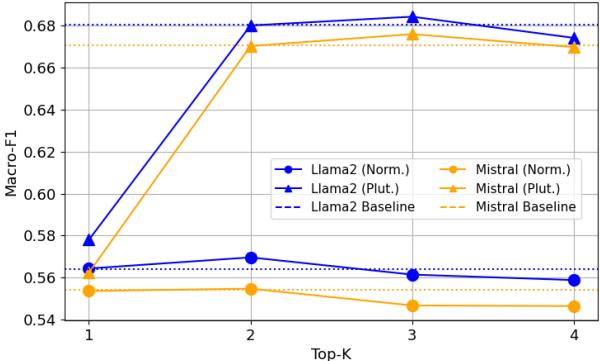
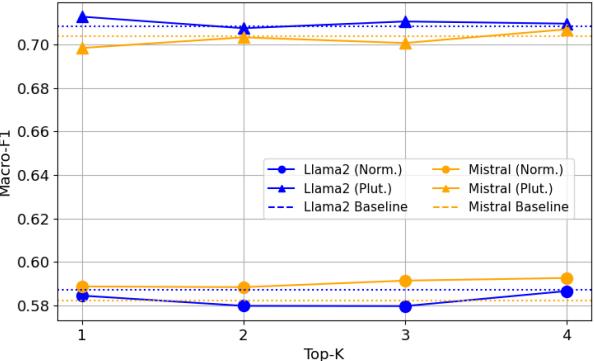
The graphs above (from Figure 4) reveal several key insights:
- Plutchik Superiority: In almost every configuration, the models using Plutchik Labeling (the lines marked “Plut.”) outperformed the Normal Labeling (“Norm.”) and the baselines.
- The Importance of \(k\):
- For SemEval-2018 (Left graph), setting \(k=2\) (using 2 experts) often yielded the best results. This aligns with Plutchik’s theory that many complex emotions are “dyads”—combinations of two basic emotions.
- For GoEmotions (Right graph), the performance was robust, though the optimal \(k\) varied slightly.
- Stability: Plutchik labeling helped mitigate the effects of label imbalance (where some emotions are rare in the dataset), providing a more consistent learning curve.
Rescuing “Underperforming” Emotions
One of the most significant findings was the improvement in classifying emotions that models typically struggle with. In standard training, emotions like “Anticipation” or “Trust” often have low detection rates because they are subtle and context-dependent.
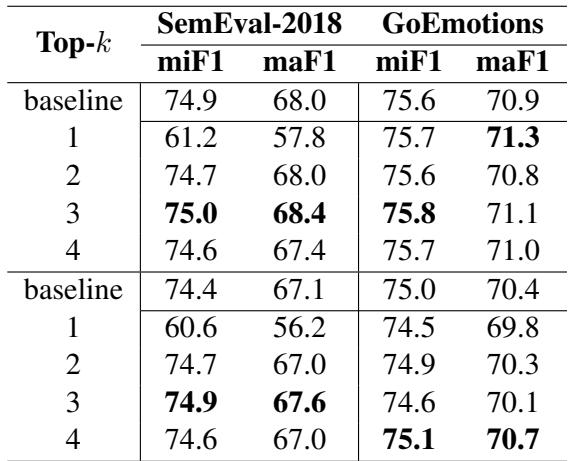
Table 9 highlights a dramatic improvement in SemEval-2018:
- Anticipation (ANT): The Llama2 model’s score jumped from 24.0 (Normal) to 66.8 (Plutchik).
- Trust (TRU): Improved from 12.8 to 57.8.
Why such a massive leap? Under Normal Labeling, “Pessimism” is a separate label. Under Plutchik Labeling, “Pessimism” contributes training data to both “Anticipation” and “Sadness.” This effectively performs data augmentation, giving the model more examples of “Anticipation” to learn from, thus refining its understanding of that basic emotion.
Handling Complex Emotions
The method also shined when classifying complex emotions. By teaching the model that “Love = Joy + Trust,” the MoE model could leverage its strong understanding of Joy and Trust to identify Love, even if “Love” examples were distinct.
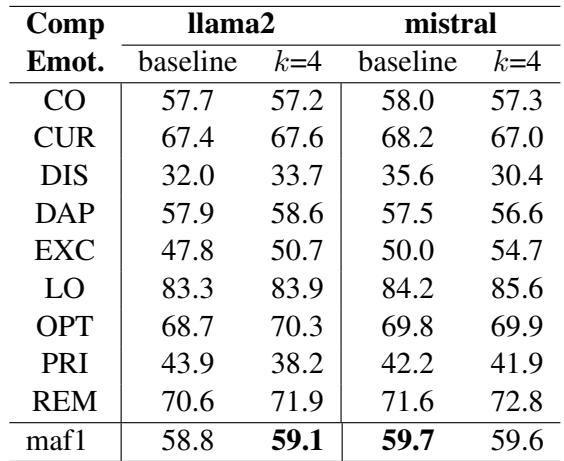
In Table 12 (GoEmotions results), we see high performance for complex states like Love (LO), achieving F1 scores around 85.6 with the Mistral model. This confirms that the model successfully learned to synthesize basic emotional cues to recognize complex sentiment.
Did the “Experts” Actually Specialize?
Perhaps the most fascinating part of the paper is the analysis of what the experts learned. Did specific experts actually take ownership of specific emotions?
To visualize this, the authors tracked which experts were selected for which emotion labels and plotted the correlations.
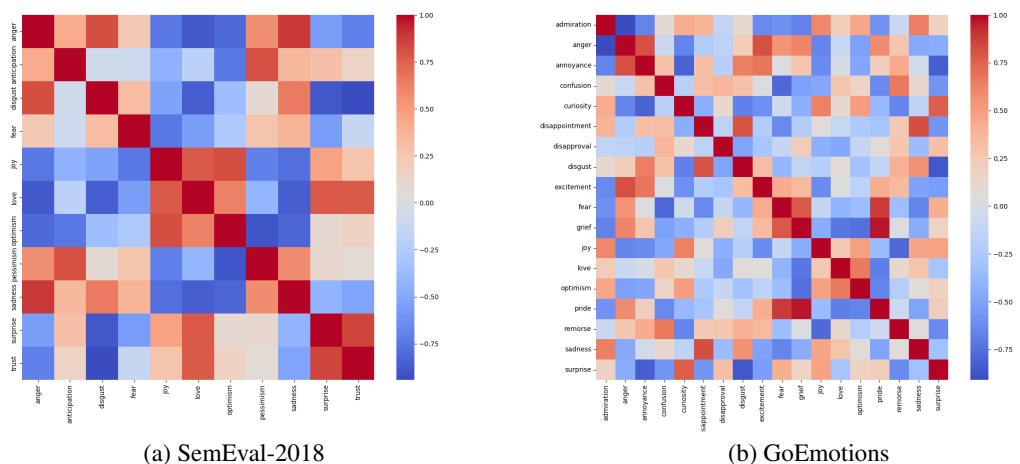
Figure 5 displays these correlation heatmaps (Red = Positive correlation, Blue = Negative).
- The Positive Cluster: Notice the strong red blocks connecting Joy, Love, and Optimism. This means the Router was sending these inputs to the same group of experts. The model independently discovered that these emotions are related.
- The Negative Cluster: Similarly, Anger, Disgust, and Sadness formed a correlated cluster.
- Opposites Repel: Notice the deep blue (negative correlation) between Anger and Admiration, or Joy and Sadness. The model learned to send these opposing emotions to completely different experts.
This behavior emerged naturally from the training; it wasn’t hard-coded. The MoE architecture, combined with Plutchik’s logic, allowed the AI to develop an internal representation of emotion that mirrors human psychological theory.
Conclusion and Implications
This research by Lim and Cheong provides a compelling argument for “Informed AI.” Rather than treating deep learning models as black boxes that just need more data, they showed that injecting domain knowledge—in this case, psychological theory—can drastically improve performance.
By integrating Plutchik’s Wheel with Mixture of Experts, the researchers achieved:
- Better Accuracy: Significant gains in F1 scores over baseline models.
- Better Generalization: Massive improvements in detecting subtle, “underperforming” emotions like Anticipation and Trust.
- Interpretability: An architecture where we can actually see experts specializing in positive or negative emotional clusters.
Why does this matter?
As we move toward AI agents that interact with humans in customer service, therapy, or education, recognizing “Sentiment: Positive” is no longer enough. An AI tutor needs to distinguish between a student who is Confused (Surprise + Anticipation) versus one who is Bored (Disgust + Sadness).
This paper offers a blueprint for building that level of emotional intelligence. It suggests that the future of Empathetic AI lies not just in larger models, but in models that are structurally designed to understand the complex, mixed-up recipe of human feeling.