](https://deep-paper.org/en/paper/file-3215/images/cover.png)
Large Language Models (LLMs) like GPT-4 or LLaMA are often described as modern-day encyclopedias. They store vast amounts of information about the world, from historical dates to scientific constants. But there is a fundamental flaw in this analogy: unlike a digital encyclopedia that can be updated with a few keystrokes, an LLM is frozen in time.
What happens when the Prime Minister changes? What if the model learned incorrect information during training? Or worse, what if it memorized private user data that needs to be scrubbed?
The traditional solution is retraining or fine-tuning the model, but this is computationally expensive and slow. It’s like rebuilding an entire library just to correct a typo in one book. This has given rise to the field of Knowledge Editing—techniques designed to surgically alter specific facts inside a model without retraining it.
However, current methods are often blunt instruments. They either “paste” new info over old info loosely (leading to instability) or aggressively rewrite neural weights (leading to damage in unrelated areas).
In this deep dive, we will explore a new approach proposed by researchers from University College London: Tailored Knowledge Editing (TailoredKE). This method uses model interpretability—peeking inside the “brain” of the transformer—to perform precise, dynamic edits that stick.
The Problem: Why Editing LLMs is Hard
To understand why TailoredKE is necessary, we first need to understand how LLMs store knowledge and why existing editing methods struggle.
Research suggests that Feed-Forward Networks (MLPs) within Transformer models act as Key-Value memories.
- The Key is the subject (e.g., “iPod”).
- The Value is the attribute or knowledge associated with it (e.g., “Apple”, “Device”, “Music”).
When you ask an LLM “Who created the iPod?”, the model’s internal layers recall these attributes to generate the answer.
The Instability of In-Context Learning
One way to “edit” a model without touching its weights is In-Context Learning (ICL). This involves providing the correct information in the prompt, like: “Imagine that iPod is a product released by Microsoft. Who released the iPod?”
While simple, this method is superficial. The researchers analyzed the internal probabilities of tokens when using ICL and found that the model doesn’t truly “forget” the old knowledge; it just suppresses it momentarily.
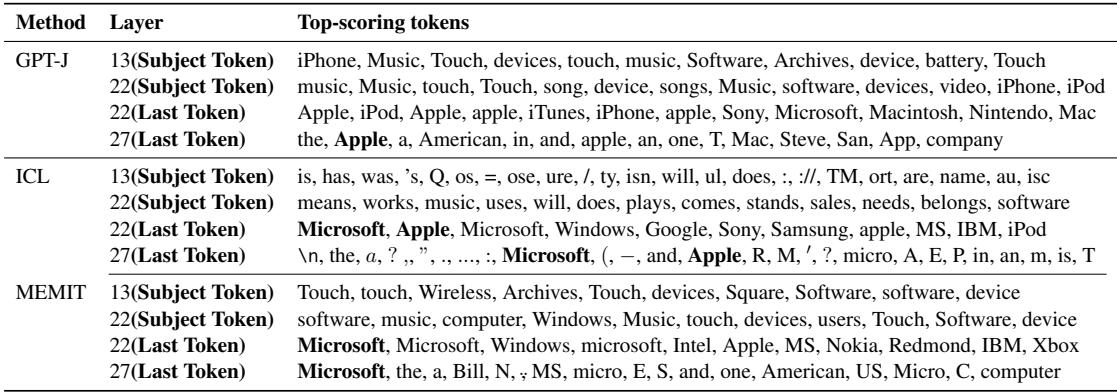
As shown in Table 1 above, the researchers tracked the “Top-scoring tokens” inside GPT-J layers when trying to change the creator of the iPod from Apple to Microsoft.
- Top Row (Original Model): The model confidently associates “iPod” with “Apple” and “Steve”.
- Middle Row (ICL): Even after being told to imagine Microsoft created it, the model’s internal probability distribution is messy. “Apple” still appears alongside “Microsoft.” The edit is unstable.
The sledgehammer: Parameter Editing and Over-Editing
The alternative to prompts is Parameter Editing (methods like ROME or MEMIT). These techniques mathematically compute update to the model’s weight matrices to hard-code the new fact.
While effective, these methods suffer from Over-Editing. Because valid concepts often share similar internal representations (e.g., “iPod”, “iPhone”, and “iPad” are all mathematically similar in the embedding space), aggressively editing the parameters for “iPod” can accidentally corrupt the facts about “iPhone.”
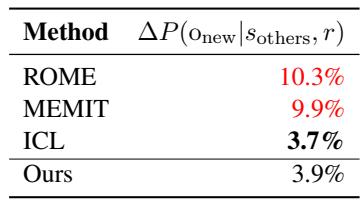
Table 2 highlights this issue. When editing a specific fact, methods like ROME and MEMIT caused a ~10% probability shift in unrelated but similar objects (\(s_{others}\)). This means fixing one bug might introduce five new ones.
The Solution: Tailored Knowledge Editing (TailoredKE)
The core insight of the TailoredKE paper is that not all knowledge is stored in the same place, and not all knowledge should be learned from a single sentence.
Previous methods tended to edit a fixed set of layers (e.g., always editing layers 13-17) regardless of the content. TailoredKE argues that knowledge retrieval is dynamic. The concept of “iPod as a music player” might live in a shallow layer, while “iPod as an Apple product” might live deeper.
The proposed method, TailoredKE, introduces a three-step process to solve this:
- Multi-Form Knowledge: Rephrasing the new fact to create a robust memory.
- Dynamic Editing Window: Using interpretability to find exactly where the edit needs to happen.
- Targeted Injection: Updating the weights only in those specific layers.
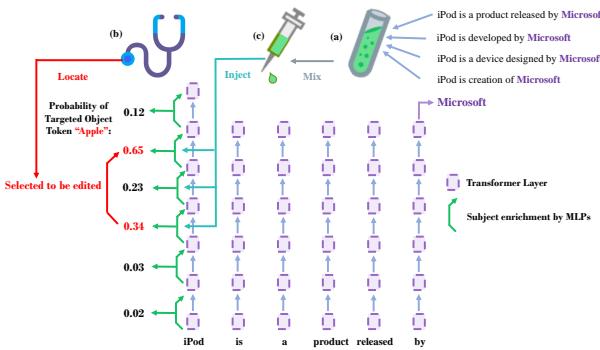
Let’s break down these steps in detail.
Step 1: Diverse Knowledge Forms (The “Rephrase” Strategy)
Human beings don’t learn complex concepts by memorizing a single sentence. We learn by seeing a concept used in various contexts. TailoredKE mimics this.
Instead of just feeding the model the update target “The Space Needle is located in Palace,” the system automatically generates multiple variations of this fact.
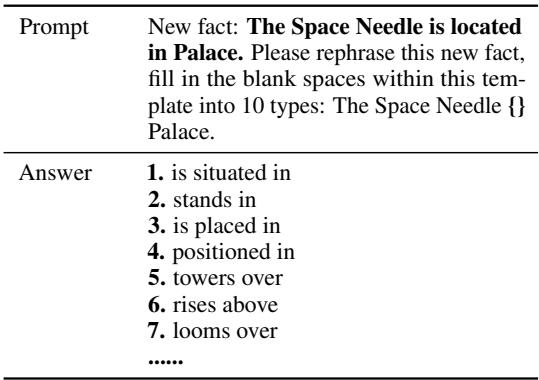
As seen in Table 3, the system prompts the LLM itself to rephrase the new knowledge. It creates variations like “is situated in,” “stands in,” or “towers over.”
The goal is to calculate a shared weight update that satisfies all these variations simultaneously. The researchers optimize the following objective function:
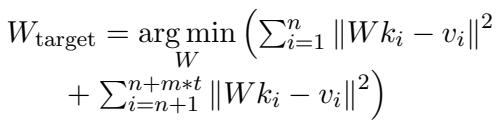
Here, the algorithm searches for a weight matrix \(W_{target}\) that minimizes the error for the preserved original knowledge (the first sum) and the new, rephrased knowledge (the second sum). This prevents the model from just rote-memorizing a specific sequence of words and encourages it to learn the underlying semantic fact.
Step 2: Precision Selection (The “Dynamic Window”)
This is the most innovative part of the paper. Standard editing methods (like MEMIT) apply edits to a fixed range of layers for every single sample. But the information flow inside a Transformer is not static.
To make edits precise, TailoredKE traces the Subject Enrichment Process.
In a Transformer, the representation of a token \(X\) at layer \(l+1\) is the sum of the previous state, the MLP output, and the Attention output:
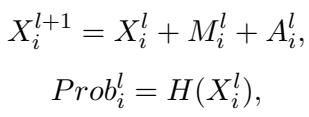
The researchers focus on the MLP output (\(M_i^l\)), as this is where factual knowledge is believed to be retrieved.

By projecting the output of these MLP layers onto the vocabulary space, the researchers can see exactly when the model “realizes” a fact.
- At Layer 5, the model might just know “iPod” is a noun.
- At Layer 10, it might know “iPod” is electronic.
- At Layer 20, it might heavily recall “Apple.”
TailoredKE dynamically selects an Editing Window for each specific sample. It looks for the layers where the probability of the original object (e.g., “Apple”) spikes.

It calculates probabilities (\(Probs\)) across all layers:

The algorithm selects the layers (\(i\) and \(j\)) with the highest probabilities for the relevant attribute and defines that range as the “window” to edit. By only touching the layers that are actively recalling the specific attribute we want to change, the method drastically reduces the “over-editing” collateral damage on other concepts.
Experimental Results
The researchers tested TailoredKE against state-of-the-art baselines like ROME, MEMIT, and MEND using two popular models: GPT-J (6B) and LLaMA-2 (7B).
They evaluated the method using several key metrics:
- Efficacy: Did the model successfully learn the new fact?
- Generalization: Can the model answer questions about the new fact when phrased differently?
- Specificity: Did the edit leave unrelated knowledge (like specific details about the iPhone) alone?
Performance on CounterFact Dataset
Table 4 presents the main comparison.
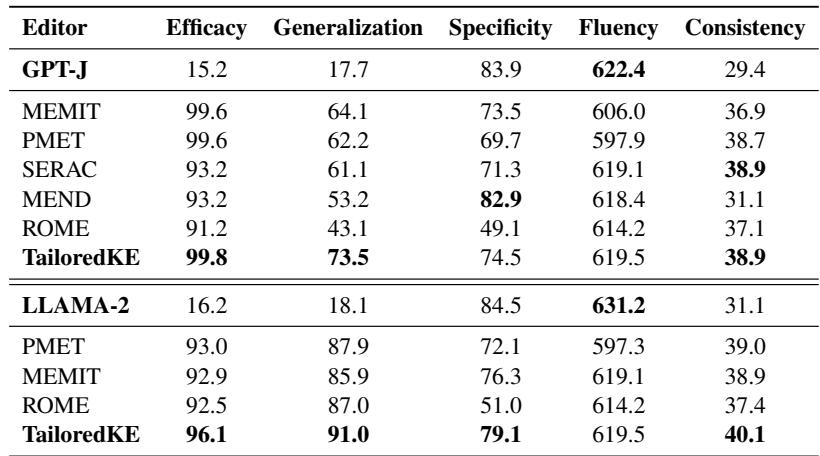
The results are striking:
- Generalization: TailoredKE significantly outperforms ROME and MEMIT. On GPT-J, it achieves 73.5% generalization compared to MEMIT’s 64.1%. On LLaMA-2, it reaches 91.0%. This confirms that the “rephrasing” strategy helps the model truly understand the new fact, rather than just memorizing a sentence.
- Specificity: TailoredKE maintains high specificity (74.5% on GPT-J), meaning it is much less likely to break unrelated knowledge than aggressive methods like ROME (which drops to 49.1%).
Stability Over Mass Edits
One of the biggest challenges in Knowledge Editing is Mass Editing. Editing one fact is easy; editing 10,000 facts without destroying the model is hard.
The researchers ran a stress test, performing up to 10,000 sequential edits.
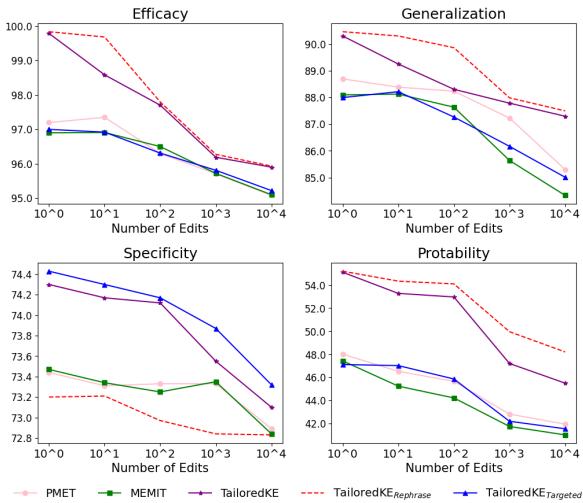
Figure 2 visualizes this durability.
- Efficacy (Top Left): Most methods crash after 100-1,000 edits. TailoredKE (purple line) and its variants maintain higher efficacy longer.
- Specificity (Bottom Left): This is the most dramatic win. As the number of edits increases, TailoredKE remains highly specific, whereas other methods cause the model to bleed knowledge, modifying things it shouldn’t.
The Power of Portability
Finally, the team introduced a metric called Portability. This measures reasoning capabilities. If we edit the model to believe “The Space Needle is located in Paris,” does the model effectively reason that “The Space Needle is in France”?
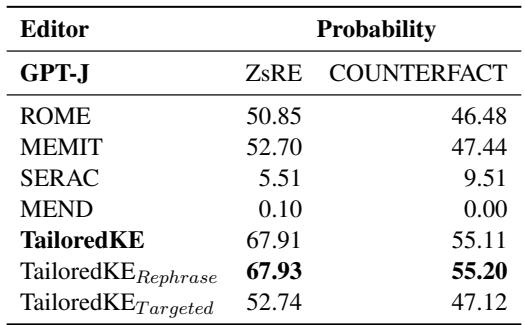
Table 6 shows that TailoredKE dominates in portability (67.91 vs MEMIT’s 52.70 on ZsRE).
The ablation study in this table (comparing TailoredKE_Rephrase vs TailoredKE_Targeted) reveals an interesting dynamic:
- The Rephrase strategy is the primary driver of Portability and Generalization.
- The Targeted Layer strategy is the primary driver of Specificity (preventing over-editing).
Together, they make a complete system.
Conclusion and Implications
The “Interpretability-based Tailored Knowledge Editing” paper presents a mature step forward for maintaining Large Language Models. By moving away from “one-size-fits-all” editing layers and rote memorization, the authors have created a method that respects the internal mechanics of the Transformer.
Key Takeaways:
- Don’t just overwrite; teach. Using diverse rephrased sentences creates a robust, multi-dimensional memory trace for the new fact.
- Location matters. Knowledge isn’t stored uniformly. Using interpretability to find where a specific fact lives allows for surgical edits that protect the rest of the model.
- Stability is key. As we move toward LLMs that need daily updates (e.g., news bots, personalized assistants), methods that can handle thousands of edits without degradation are essential.
While challenges remain—such as handling completely new entities the model has never seen—TailoredKE offers a promising blueprint for the dynamic, updatable Knowledge Bases of the future. Instead of retraining a massive model for every correction, we can now simply perform a tailored, surgical operation.