](https://deep-paper.org/en/paper/file-3242/images/cover.png)
If you have ever played with a Large Language Model (LLM) like ChatGPT or Claude, you know that the magic doesn’t just lie in the model’s ability to predict the next word. It lies in the model’s ability to follow your instructions, answer your questions, and act as a helpful assistant. This capability is achieved through a process called Supervised Fine-Tuning (SFT).
But here is the catch: SFT requires massive datasets of high-quality conversations—specifically pairs of (instruction, response). Curating these datasets by hand is incredibly expensive and slow. To solve this, researchers have turned to using LLMs to generate their own training data, a technique known as bootstrapping.
However, existing bootstrapping methods have a major flaw. They often rely on random sampling to generate new ideas, which can lead to generic, repetitive, or low-quality data.
In this post, we will deep dive into KNN-INSTRUCT, a novel approach presented by researchers from the University of Science and Technology of China. This method moves away from random luck and uses K-Nearest Neighbor (KNN) deduction to systematically build high-quality, diverse instruction datasets. We will explore how it works, why it outperforms existing methods, and the impressive results it achieves on 7B-parameter models.
The Bottleneck of Alignment
Before understanding the solution, we need to understand the problem. Pre-trained LLMs (like the base version of LLaMA or Qwen) have read the internet, but they don’t necessarily know how to chat. To align them with human intent, we need SFT.
There are generally three ways to get SFT data:
- Human Annotation: Experts write questions and answers. High quality, but very expensive and unscalable.
- User Simulation: One AI plays the user, another plays the assistant.
- Bootstrapping (Self-Instruction): This is where KNN-INSTRUCT fits in.
The Problem with Current Bootstrapping
The most famous bootstrapping method is SELF-INSTRUCT. It works by taking a small “seed” set of human-written instructions (e.g., 175 examples). It then randomly picks a few examples, shows them to a powerful model (like GPT-3.5), and says, “Here are some examples of tasks. Please come up with a new task.”
The researchers of KNN-INSTRUCT identified a critical weakness in this “random sampling” strategy. When you feed an LLM three random, unrelated examples—say, one about cooking, one about quantum physics, and one about poetry—and ask it to generate a new task, the model often gets confused or defaults to very generic topics like climate change or healthy eating. The resulting data lacks depth and specificity.
Enter KNN-INSTRUCT
The core hypothesis of this paper is simple but profound: Related instructions make for better demonstrations.
Instead of showing the model random examples, what if we showed it examples that are semantically related? If we want the model to generate a complex coding challenge, we should show it existing coding challenges. This is the foundation of KNN-INSTRUCT.
The Architecture
The KNN-INSTRUCT framework is an iterative loop that grows a dataset from a seed pool. Let’s break down the workflow visually.
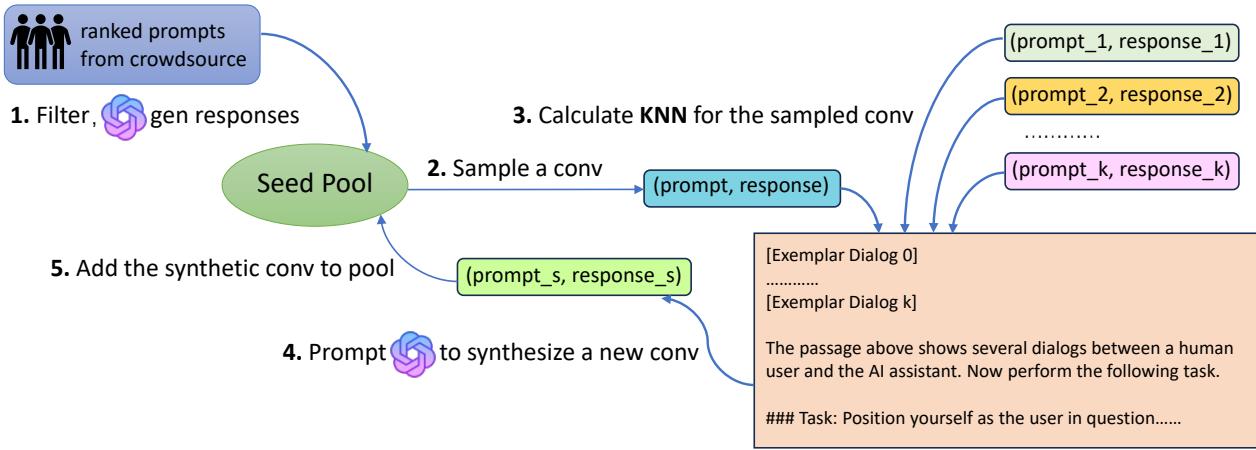
As shown in Figure 1, the process consists of five distinct steps:
- Seed Pool Initialization: We start with a high-quality set of instructions.
- Sampling: We pick a single “core” instruction from the pool.
- KNN Search: Instead of picking random partners, the system searches the existing pool for the \(K\) instructions that are most similar (nearest neighbors) to the core instruction.
- Synthesis: These similar instructions are used as a prompt (a few-shot demonstration) to ask ChatGPT to generate a new instruction and response.
- Update: The newly created conversation is added back to the pool, and the cycle repeats.
This approach ensures that the “context” provided to the teacher model is coherent, encouraging it to produce nuanced, specific, and high-quality new data.
Key Innovation 1: KNN Deduction
The heart of this method is the K-Nearest Neighbor (KNN) Deduction. To implement this, the researchers use text embeddings.
For every instruction in the dataset, they calculate a vector representation (using a model called SimCSE). This turns text into numbers where similar ideas are close together in mathematical space. When the system selects an instruction, it calculates the cosine similarity to find the closest neighbors.
By setting \(K=2\) (using 2 neighbors + the core instruction = 3 examples), the prompt sent to ChatGPT looks like this:
- Example 1: A question about Italian vs. Norwegian coffee culture.
- Example 2: A question about Italian dishes in Norway.
- Example 3: A question about coffee brewing methods.
- Task: “Create a new instruction based on these.”
Because the examples are coherent, the model is inspired to create a semantically related but novel instruction—perhaps about Japanese vs. English tea culture—rather than a generic, unrelated task.
Key Innovation 2: A Better Seed
Bootstrapping is a compounding process. If your starting seeds are bad, your final dataset will be bad. The original SELF-INSTRUCT used only 175 seeds. KNN-INSTRUCT scales this up significantly.
The researchers utilized the “10k-prompts-ranked” dataset, which contains instructions scored by quality. However, they didn’t just use all of them. They analyzed the quality distribution carefully.
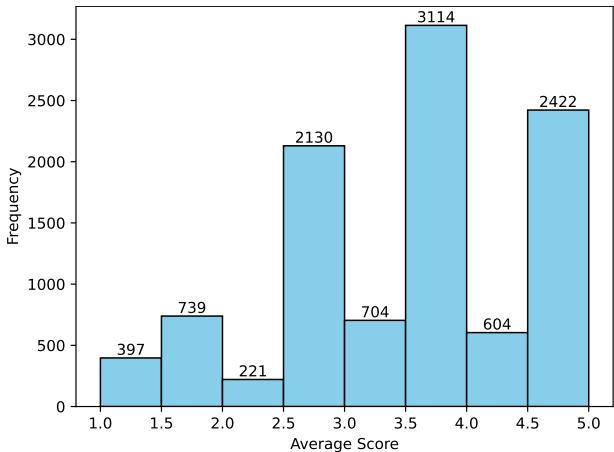
As seen in Figure 2, the quality varies. To ensure the highest standard, they filtered for instructions with a score strictly above 4.0. This resulted in 3,026 high-quality seed instructions, which they named Seeds-3k. This provides a much more diverse and robust foundation than previous methods.
Key Innovation 3: Efficiency and Cost
One practical improvement in KNN-INSTRUCT is how it handles filtering. Previous methods (like SELF-INSTRUCT) would generate a new instruction and then run a heavy “ROUGE-L” overlap check to ensure it wasn’t too similar to existing data. This often resulted in throwing away 60% of the generated data—a huge waste of money.
KNN-INSTRUCT abandons this aggressive filtering. Instead, they rely on a specifically designed prompt that explicitly tells the model to be “Original” and “Standalone.”
The result is a highly economical process. The researchers estimated the cost of generating their 12,000-sample dataset (KNN-INST-12K) using GPT-4o-mini prices:

The total cost to synthesize the dataset is approximately $1.02. This extremely low barrier to entry makes this method accessible to students and researchers with limited budgets.
Experiments and Results
To prove that this method works, the authors compared KNN-INSTRUCT against several famous baselines: Alpaca, ShareGPT, UltraChat, and Evol-Instruct.
They focused on two major benchmarks:
- AlpacaEval: Using GPT-4 to judge win rates against a baseline model.
- MT-Bench: A rigorous benchmark of multi-turn questions graded by GPT-4.
Preliminary Results (GPT-3.5 Teacher)
In the first round of experiments, they used GPT-3.5 as the “teacher” (the model writing the instructions) and trained standard 7B models (LLaMA-2 and Qwen).
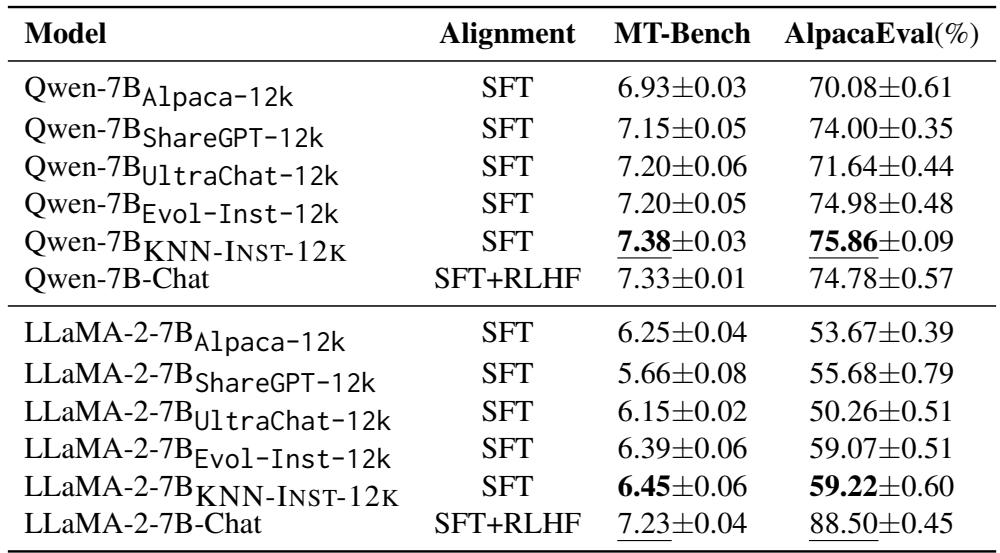
Table 1 shows the results. The rows highlight different datasets applied to the same base models.
- Qwen-7B + KNN-INSTRUCT achieved an MT-Bench score of 7.38, beating the official Qwen-7B-Chat model (7.33).
- LLaMA-2-7B + KNN-INSTRUCT scored 6.45, significantly outperforming the Alpaca-12k baseline (6.25).
The data shows that for the exact same dataset size (12k samples), the quality provided by KNN deduction yields a smarter model.
Why is the data better?
The researchers didn’t just look at the scores; they analyzed the linguistic features of the generated data.
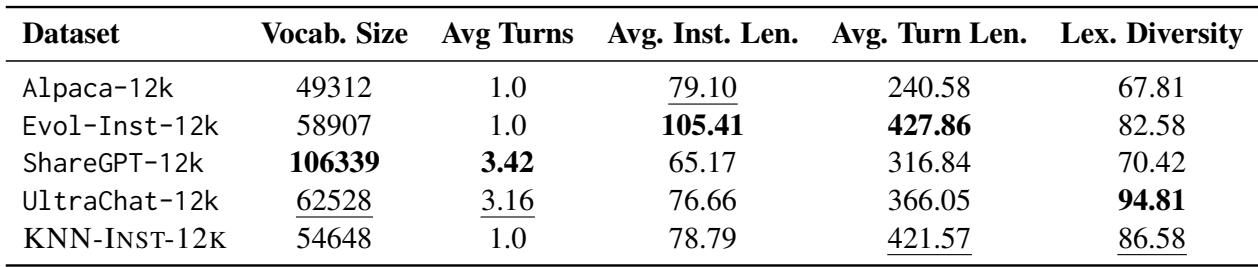
Table 2 provides a statistical breakdown. While ShareGPT has the largest vocabulary (likely due to noise and multilingual content), KNN-INST-12K maintains a very high Average Turn Length (421.57 tokens) and high Lexical Diversity. This suggests the model is generating complex, detailed instructions rather than short, simple queries.
The Heavy Hitter: Qwen2-7B Experiment
The preliminary results were promising, but the researchers wanted to see how far they could push the performance. They upgraded their teacher model to GPT-4-Turbo to generate a refined dataset called KNN-INST-12K*.
They fine-tuned the powerful Qwen2-7B model on this data. The results were stunning.
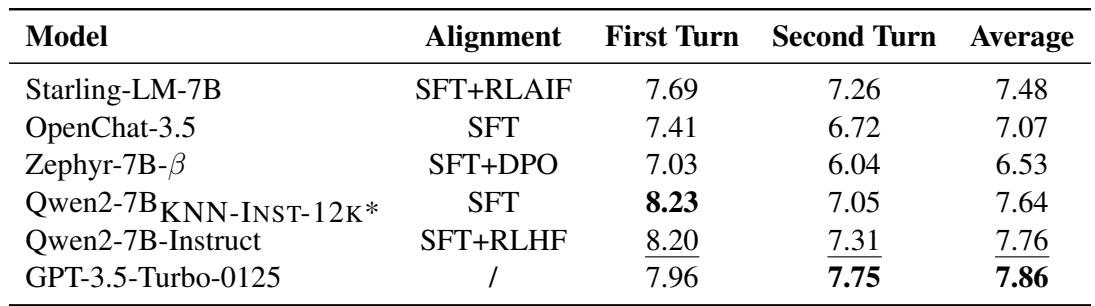
Table 3 displays the leaderboard. The model Qwen2-7B-KNN-INST-12K* achieved an MT-Bench score of 7.64.
This score is significant because:
- It outperforms Starling-LM-7B (7.48), OpenChat-3.5 (7.07), and Zephyr-7B-beta (6.53).
- In the First Turn of conversation, it actually beats GPT-3.5-Turbo-0125 (8.23 vs 7.96).
This confirms that with high-quality, KNN-deduced synthetic data, a small 7B model can punch well above its weight class, rivaling proprietary models in single-turn interactions.
Ablation Studies: What Actually Matters?
In research, it is crucial to verify why a method works. Was it the KNN? Was it the seed data? Or was it just luck? The authors conducted extensive ablation studies to isolate these variables.
Does ‘K’ Matter?
Is finding neighbors actually helpful, or would any random samples do? The researchers varied \(K\) (the number of neighbors) and measured performance.
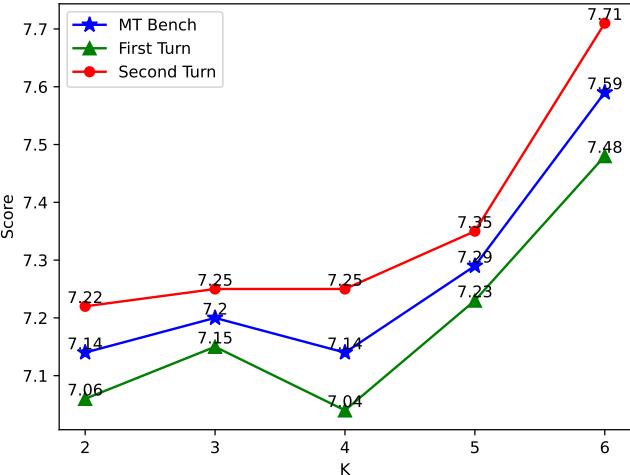
Figure 3 shows a clear trend. As \(K\) increases from 2 to 6, the model performance (Blue Star line) generally trends upward. This validates the core premise: providing more relevant context helps the teacher model synthesize better training data.
Random vs. KNN
To be absolutely sure, they ran a direct comparison: KNN-INSTRUCT vs. RAND-INSTRUCT (using random sampling like the original SELF-INSTRUCT).
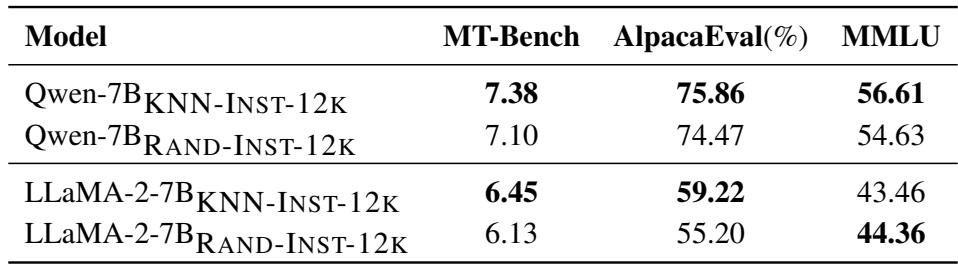
Table 4 puts this debate to rest. Across almost all metrics and models, the KNN approach wins. For example, on AlpacaEval with Qwen-7B, KNN scored 75.86% while Random scored 74.47%. It is a consistent improvement derived solely from how the data is sampled.
The Importance of Seeds
How much credit does the “Seeds-3k” dataset deserve? The researchers swapped out their seeds for the original “Manual-175” (from SELF-INSTRUCT) and a filtered “ShareGPT” set.
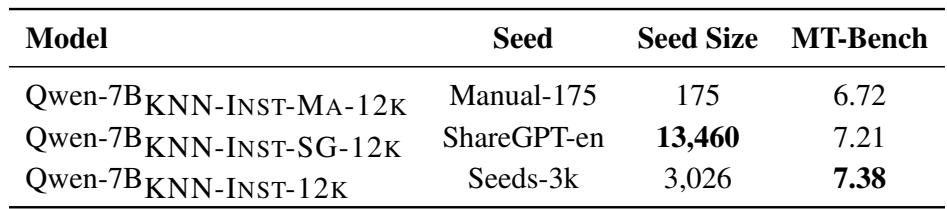
Table 5 highlights that seed quality is massive. Using the small “Manual-175” set dropped the MT-Bench score from 7.38 down to 6.72. This proves that while KNN deduction is powerful, it needs a diverse, high-quality starting pool to work effectively.
Scalability: Is More Better?
Finally, the researchers asked: “If 12k samples are good, are 36k samples three times better?”
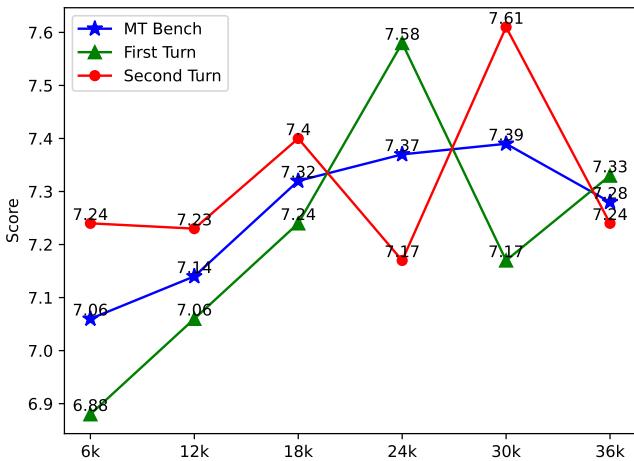
Figure 4 reveals an interesting phenomenon often seen in LLM fine-tuning: diminishing returns. The performance peaks around 30k samples (score 7.39) and actually dips slightly at 36k. This suggests that for a specific teacher model and seed set, there is an optimal dataset size. Simply flooding the model with more synthetic data does not guarantee better results indefinitely.
The Similarity Filter
One concern with KNN is that the neighbors might be too similar, causing the model to just copy the input rather than create something new. The researchers analyzed the similarity distribution of the neighbors.
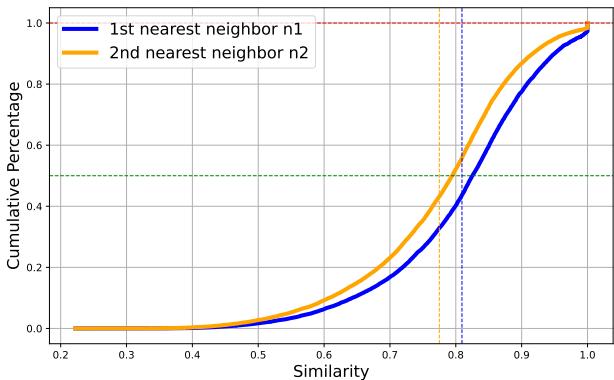
Figure 5 shows that the first nearest neighbor (\(n1\)) is often very similar (similarity > 0.8). To combat redundancy, they introduced a Similarity Filter (Table 6 in the paper, visualized conceptually here): if the neighbors are too close (similarity > 0.7), the system skips them or forces variation. This filter boosted the MT-Bench score from 7.14 to 7.42, proving that diversity within the neighborhood is vital.
Conclusion and Implications
KNN-INSTRUCT offers a compelling lesson for students and researchers in AI: Data quality and construction strategy matter as much as, if not more than, the model architecture.
By moving from random sampling to semantic deduction (KNN), the authors created a pipeline that generates cleaner, more diverse, and more instruction-heavy data. They achieved this with minimal cost ($1.02 for a dataset!) and beat top-tier open-source models on the leaderboards.
Key Takeaways:
- Context is King: Prompting a teacher model with semantically related examples yields better synthetic data than random examples.
- Seeds Matter: A larger, quality-filtered seed dataset is essential for bootstrapping.
- Efficiency: You don’t need complex filtering pipelines if your prompt engineering ensures originality.
- Small Models are Capable: With the right SFT data, 7B models can outperform much larger or older proprietary models.
While the current method focuses on single-turn conversations, the potential to expand this to multi-turn dialogues represents an exciting frontier. For now, KNN-INSTRUCT stands as a robust framework for anyone looking to align their own LLMs efficiently and effectively.