](https://deep-paper.org/en/paper/file-3260/images/cover.png)
Introduction
Imagine you are a librarian tasked with organizing a massive pile of books into genres. Most books are easy: the ones with spaceships go into Science Fiction, and the ones with dragons go into Fantasy. But what do you do with a book about a dragon flying a spaceship? Or a book with a torn cover and a vague title?
In the world of data science, this is the problem of Text Clustering. It is a fundamental task where we group similar documents together without having any prior labels. While it sounds simple, it is notoriously difficult to get right. Traditional mathematical methods often choke on “edge points”—the ambiguous data points or outliers that don’t fit neatly into a circle. On the other hand, modern Large Language Models (LLMs) like GPT-4 are brilliant at understanding these nuances, but using them to read every single document in a massive dataset is prohibitively expensive and slow.
Is there a middle ground? Can we combine the speed of traditional algorithms with the brainpower of LLMs?
This is exactly what a fascinating new research paper, “LLMEdgeRefine: Enhancing Text Clustering with LLM-Based Boundary Point Refinement,” sets out to achieve. The researchers propose a novel, two-stage framework that identifies the tricky “edge points” and uses LLMs surgically—only where they are needed most—to refine the clusters. The result is a method that is not only highly accurate but also cost-efficient.
In this deep dive, we will unpack how LLMEdgeRefine works, the mathematics behind it, and why it represents a significant leap forward for unsupervised learning.
Background: The Clustering Conundrum
To appreciate the elegance of LLMEdgeRefine, we first need to understand the limitations of the tools we currently have.
The Problem with K-Means
The most common clustering algorithm is K-Means. It works by selecting “centroids” (center points) for clusters and assigning every data point to the nearest centroid. It then recalculates the average position of the points to move the centroid, repeating this until the clusters stabilize.
While fast, K-Means has a major weakness: Outliers. Because K-Means relies on calculating the mean (average) position, a single data point that is far away from the group can drag the centroid toward it, much like a heavy person sitting on the far end of a seesaw. This distorts the cluster boundaries and leads to misclassification of the normal data points.
The Problem with LLMs
Enter Large Language Models. Recent approaches like ClusterLLM or IDAS try to solve clustering by asking an LLM to read the text and decide how it relates to others. While LLMs understand context beautifully (they know that “Apple” can be a fruit or a tech company based on the sentence), these methods have their own flaws:
- Cost: Asking an LLM to compare thousands of documents requires a massive number of API calls.
- Context Window: You cannot simply feed a million documents into a prompt at once.
- Over-reliance: They often ignore the geometric structure of the data that traditional algorithms capture so well.
The researchers behind LLMEdgeRefine realized that the best approach is a hybrid one: let the math handle the easy stuff, and let the LLM handle the edge cases.
Core Method: The LLMEdgeRefine Framework
The proposed framework operates in a continuous loop of refinement. It doesn’t just cluster once; it iteratively improves the boundaries of the clusters. The method is divided into two distinct stages: Super-Point Enhanced Clustering (SPEC) and LLM-Assisted Cluster Refinement (LACR).
Let’s break these down step-by-step.
Step 1: Initialization
Before the refinement begins, the system needs a starting point. The researchers use the standard K-Means algorithm to create an initial set of clusters. The goal here isn’t perfection; it’s to get a rough “sketch” of the data structure.
Mathematically, this tries to minimize the distance between data points (\(x_i\)) and their assigned cluster centroids (\(\mu\)).
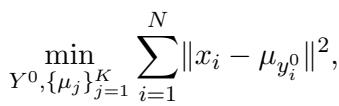
Here, \(Y^0\) is the initial assignment of clusters. However, as discussed, this initial state is likely distorted by outliers.
Step 2: Super-Point Enhanced Clustering (SPEC)
This is where the paper introduces a clever geometric trick. The goal of this stage is to fix the damage caused by outliers during the initialization.
The researchers introduce the concept of a Super-Point. In many clustering definitions, a “super-point” usually refers to a centroid or a representative core. However, in this paper, the definition is quite specific and strategic.
The Logic: If outliers are dragging the centroid away from the true center, we need to reduce their influence. The SPEC algorithm identifies the “farthest” points in a cluster (the top \(\alpha\%\) of points farthest from the center). It aggregates these distant points into a single “super-point.”
By treating a group of outliers as a single entity (a super-point), their statistical weight is reduced during the recalculation. The remaining data points are treated as “singletons.”

As shown in Figure 1, the process iterates through a loop. The split function separates the data into super-points and singletons. Then, a different algorithm—Agglomerative Clustering—is used to re-group these points.
Agglomerative clustering works by merging points from the bottom up, which is generally more robust than K-Means but computationally heavier. By using super-points, the researchers simplify the input for the agglomerative step, making it efficient.
The re-clustering equation looks like this:

This stage effectively “tightens” the clusters, pulling the centroids back to where they belong by neutralizing the gravitational pull of the outliers.
Step 3: LLM-Assisted Cluster Refinement (LACR)
After the SPEC stage, we have geometrically solid clusters. However, text data is messy. Two sentences might be mathematically close in vector space (using embeddings) but semantically different.
For example, “I hate this movie” and “I hate this sandwich” are structurally identical, but one belongs in a “Media Review” cluster and the other in “Food Review.”
This is where the LLM comes in. But instead of showing the LLM every data point, the researchers only focus on the Boundary Points—the points that are on the edge of the cluster, far from the high-confidence center.
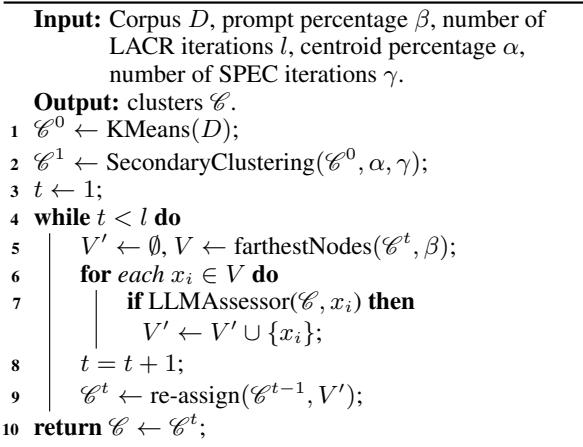
The LACR Process (Figure 2):
- Identify Edge Points: The system selects the farthest \(\beta\%\) of points from the centroid. These are the “uncertain” candidates.
- Prompting: For each of these edge points, the system generates a prompt for the LLM. The prompt contains:
- The text of the doubtful data point.
- Descriptions of the nearest candidate clusters.
- A few “demonstrations” (examples) to help the LLM understand the task (In-Context Learning).
- Decision: The LLM acts as a judge. It determines if the point belongs in its current cluster or if it fits better elsewhere.
If the LLM decides a point is misclassified, the algorithm reassigns it based on the LLM’s insight. The reassignment logic is defined as:

If the outcome is “removal,” the point is moved to the next nearest cluster centroid. This process repeats for several iterations (\(l\)), slowly polishing the edges of the clusters until they are semantically coherent.
Experiments & Results
The researchers didn’t just propose a theory; they rigorously tested it against 8 diverse datasets, ranging from intent classification (like banking queries) to emotion detection.
The Competitors: They compared LLMEdgeRefine against:
- Instructor: A standard embedding model.
- ClusterLLM: A state-of-the-art method that uses LLMs for clustering.
- IDAS: Another LLM-based intent discovery method.
Effectiveness Analysis
The results were overwhelmingly positive. As seen in Table 2 below, LLMEdgeRefine (the second row from the bottom) consistently scores the highest or second-highest across almost all datasets for both Accuracy (ACC) and Normalized Mutual Information (NMI).

Key Takeaways from the Data:
- Massive Improvement: On the CLINC(I) dataset, accuracy jumped from around 83% (ClusterLLM) to over 86%. On the difficult MTOP(I) dataset, it leaped from 35% to 46%.
- The Power of Components: The ablation study (bottom rows of Table 2) is particularly revealing. When they removed the LACR (LLM refinement) or SPEC (Super-point) modules, performance dropped significantly. This proves that both the geometric cleanup (SPEC) and the semantic cleanup (LACR) are necessary for success.
Sensitivity and Tuning
One might wonder: “Is this method fragile? Do I need to tune the parameters perfectly to get these results?”
The authors conducted sensitivity tests to see how changing the parameters affected the outcome.
Parameter \(\alpha\) (Super-Point Size): The \(\alpha\) parameter controls what percentage of “farthest points” are grouped into super-points.
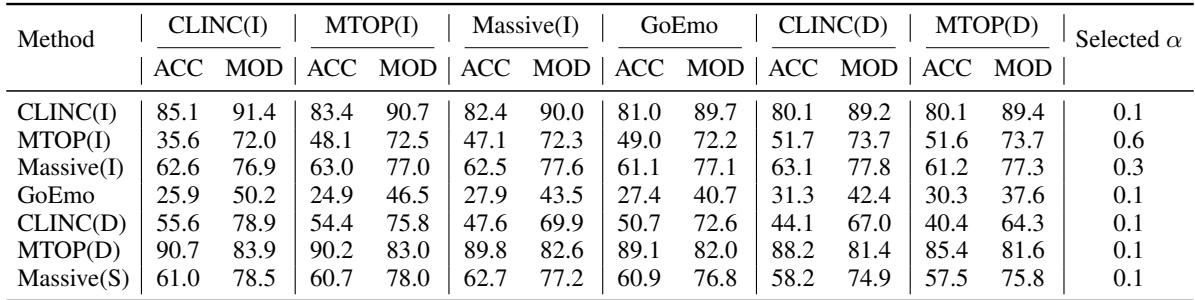
As shown in Table 4, the method is relatively stable, though optimal values vary by dataset. For many datasets (like CLINC and GoEmo), a smaller \(\alpha\) (0.1) works best, implying that only the very extreme outliers need to be mitigated.
Parameter \(\gamma\) (Iterations): They also tested how many times the SPEC loop needs to run.
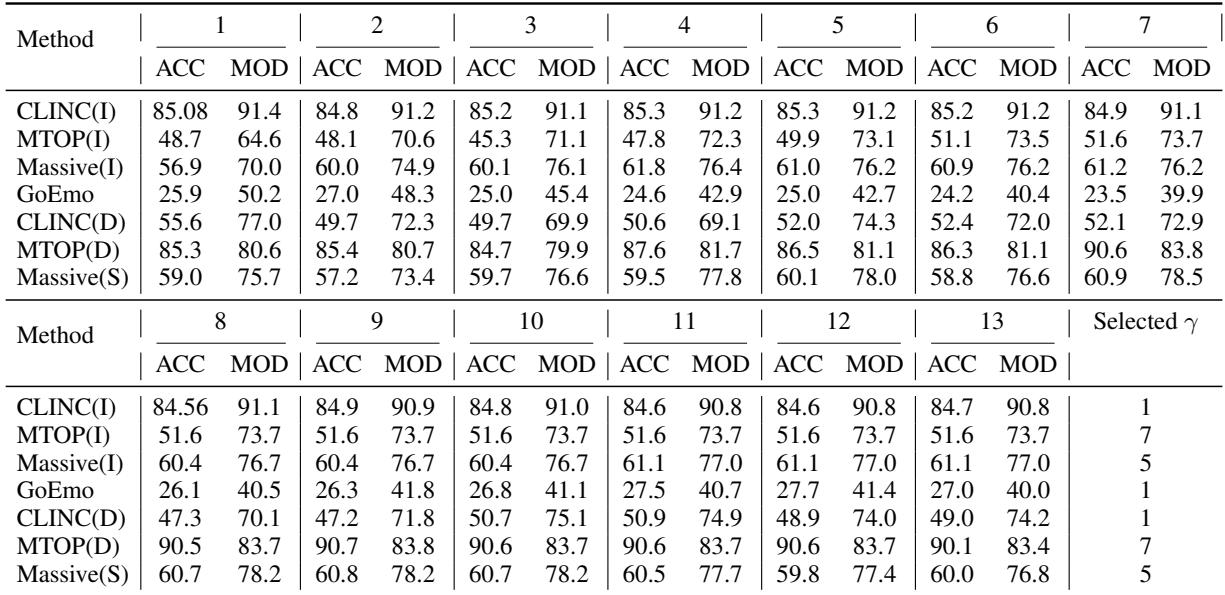
Table 5 shows that for most datasets, the performance stabilizes quickly. For example, on CLINC(I), the accuracy peaks around iteration 1 and stays flat. This is good news for efficiency—you don’t need to run the algorithm for hundreds of cycles to get good results.
Efficiency: The Cost Factor
Perhaps the most practical victory of LLMEdgeRefine is its efficiency.
- ClusterLLM requires a fixed, large number of prompts regardless of dataset difficulty.
- IDAS scales poorly, needing prompts proportional to the total dataset size.
- LLMEdgeRefine only queries the edge points (\(\beta\)). If \(\beta\) is set to 10%, you are saving 90% of the LLM costs compared to a full-scan approach.
The authors note that their method uses significantly fewer tokens, making it a viable solution for real-world applications where budget is a constraint.
Conclusion & Implications
The LLMEdgeRefine paper teaches us a valuable lesson about the current state of Artificial Intelligence: Hybrid systems are often better than monolithic ones.
By relying solely on traditional math (K-Means), we lose semantic depth. By relying solely on LLMs, we lose computational efficiency and geometric structure. LLMEdgeRefine bridges this gap by using math to structure the core of the data and using LLMs to refine the fuzzy boundaries.
Why this matters for you:
- For Students: It’s a perfect example of how to critique and improve existing algorithms. The authors identified specific weaknesses in K-Means (outliers) and LLMs (cost) and engineered a solution that targets exactly those weaknesses.
- For Practitioners: If you are building a topic modeling system or a customer support ticket classifier, this approach offers a way to get high-quality clusters without breaking the bank on OpenAI or Anthropic API credits.
As LLMs continue to evolve, we will likely see more of these “Edge Refinement” strategies—where AI is used not as a bulldozer, but as a scalpel, applied precisely where human-like judgment is needed most.