](https://deep-paper.org/en/paper/file-3268/images/cover.png)
Introduction
In the rapidly evolving world of Large Language Models (LLMs), the race for “context window” supremacy has been fierce. We’ve gone from models that could barely hold a conversation history to behemoths like GPT-4 and Claude 2, which boast context windows of 128k and 200k tokens respectively. Ideally, this means you should be able to feed a model an entire novel, a legal repository, or a massive technical manual, and ask it any question.
But there is a catch.
Just because a model can ingest 100,000 tokens doesn’t mean it understands them all equally. Researchers have identified a phenomenon known as “lost in the middle”—where models tend to forget information buried in the center of a long prompt. Furthermore, scaling context windows via massive hardware or complex attention mechanisms is computationally expensive and often degrades performance on shorter tasks.
What if the solution isn’t a bigger brain, but better teamwork?
In this post, we are diving deep into LONGAGENT, a fascinating research paper that proposes a multi-agent collaboration method. Instead of forcing one model to read everything, LONGAGENT splits the work among a team of agents. The results are startling: a smaller, open-source LLaMA-2 7B model using this architecture outperforms GPT-4 on sophisticated long-document tasks.
The Problem with Long Contexts
Before we unpack the solution, let’s establish why long-document Question Answering (QA) is so hard.
Currently, there are two main ways to handle long texts:
- Context Extension: Modifying the model’s architecture (like Positional Interpolation) so it accepts longer inputs. The downside? It requires massive training resources, and the model’s accuracy often plummets as the text gets longer.
- Retrieval-Augmented Generation (RAG): Using a search engine to find relevant chunks of text and feeding only those to the LLM. The downside? Retrievers are often “coarse.” They might miss subtle clues or fail to connect dots scattered across a document (multi-hop reasoning).
The researchers behind LONGAGENT recognized that current “long-context” models struggle with resource constraints and hallucinations. They needed a system that combined the precision of reading the whole text with the efficiency of dividing the workload.
The Core Method: A Divide-and-Conquer Strategy
LONGAGENT is inspired by how humans handle massive tasks. If you had to find specific legal precedents in a 1,000-page archive in one hour, you wouldn’t read it page by page. You would assemble a team, assign each person a chapter, and appoint a leader to coordinate the findings.
That is exactly how LONGAGENT works. It employs a Leader-Member architecture.
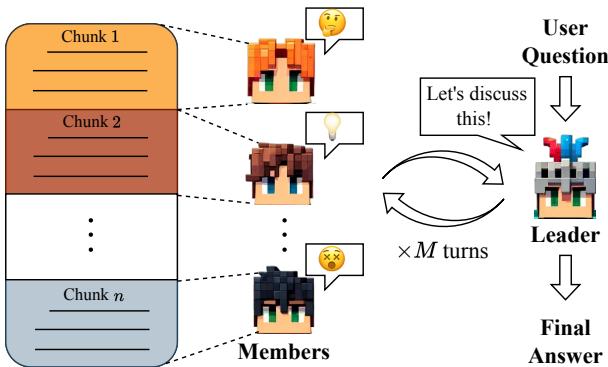
As shown in Figure 1, the process begins by segmenting the massive input text (up to 128k tokens) into smaller chunks (e.g., 1k-2k tokens). Each chunk is assigned to a “Member” agent. The “Leader” agent sits at the top, managing the workflow.
The Collaborative Workflow
The collaboration isn’t just a simple map-reduce function; it’s an iterative dialogue. Let’s break down the three distinct steps of this process, visualized below.
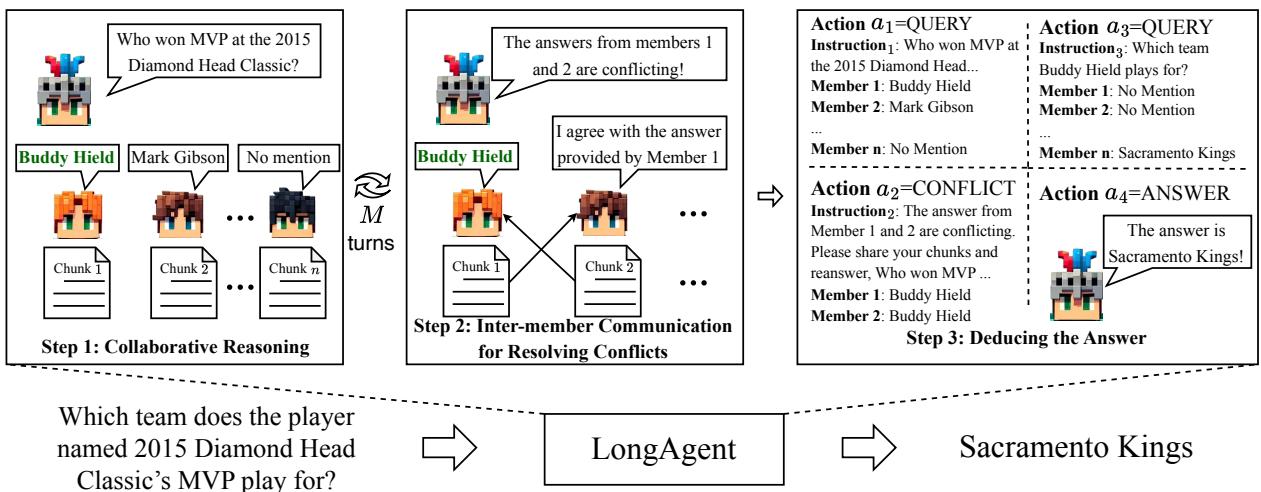
Step 1: Collaborative Reasoning
The process starts when a user asks a question. The Leader agent does not read the text chunks. Instead, it “thinks” about the question and issues instructions to the Members.
If the user asks a complex question like “Which team does the player named 2015 Diamond Head Classic’s MVP play for?”, the Leader realizes this is a multi-hop problem. It cannot be answered in one go.
- Round 1: The Leader asks the members: “Who won the MVP at the 2015 Diamond Head Classic?”
- Member Response: The members read their assigned chunks. Some say “No mention.” One member might find the answer: “Buddy Hield.”
- Round 2: Armed with this new clue, the Leader issues a new instruction: “Which team does Buddy Hield play for?”
This creates a dynamic interaction history. The Leader decides the next action based on previous findings, using the following probabilistic decision-making process:

Here, \(a_i\) represents the Leader’s action (Query, Resolve Conflict, or Answer) based on the history \(S_{i-1}\) and the initial question \(q\).
Step 2: Resolving Conflicts (The “Secret Sauce”)
Here is where LONGAGENT shines. A major issue with splitting text among agents is hallucination. If you ask an LLM a question about a text chunk, and the answer isn’t there, the model often feels pressured to invent one rather than admitting “I don’t know.”
In Step 1 of Figure 2, you might notice a conflict. Member 1 says the MVP is “Buddy Hield,” but Member 2 hallucinates and says it’s “Mark Gibson.”
How does the Leader know who to trust?
The researchers developed an Inter-Member Communication mechanism. The Leader detects a conflict and instructs the disagreeing members to share their text chunks with each other.
The intuition is simple:
- If a member does not have the answer, they are prone to hallucinating.
- If a member does have the answer, they are usually correct.
- If you show the “hallucinating” member the chunk containing the real answer, they will almost always correct themselves.
This logic is formalized in the following equation:

This equation states that the “Truth” is found when member \(m_j\) (who has the correct chunk \(c_j\)) shares it with member \(m_i\) (who has the irrelevant chunk \(c_i\)). When combined (\(c_j \oplus c_i\)), both agents will converge on the correct answer.
Step 3: Deducing the Answer
Once conflicts are resolved and the Leader has gathered all necessary clues (e.g., MVP is Buddy Hield -> Buddy Hield plays for Sacramento Kings), the Leader executes the ANSWER action. It synthesizes the findings into a final response for the user.
Building the Agents
How are these agents actually constructed? The authors used LLaMA-2 7B as the base model.
- The Leader: Fine-tuned on 1,000 trajectories generated by GPT-4. It learns how to decompose questions and manage the team.
- The Members: Fine-tuned on a standard QA dataset (SQuAD). Crucially, they were trained to output “No Mention” if their text chunk didn’t contain the answer, which helps reduce (but not eliminate) noise.
Interestingly, the authors also showed that this framework works without fine-tuning by using prompt engineering on models like GPT-3.5, turning a 16k context model into one that handles 128k tokens effectively.
Experimental Setup: Needle-in-a-Haystack PLUS
To prove LONGAGENT works, standard benchmarks weren’t enough. The community often uses the “Needle-in-a-Haystack” test: inserting a random fact (the needle) into a long document (the haystack) and asking the model to find it.
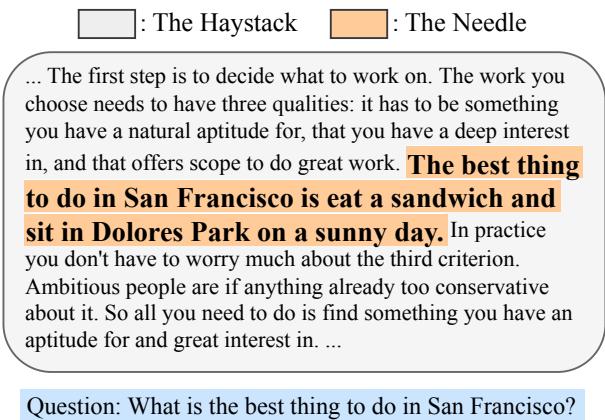
However, the authors identified flaws in this test. It’s too simple (single-hop) and prone to data leakage (models might know the answer from pre-training).
They introduced Needle-in-a-Haystack PLUS, which upgrades the challenge in two ways:
Multi-Needle (Multi-Hop) Tasks: The model must find Needle 1 to know what to look for in Needle 2.
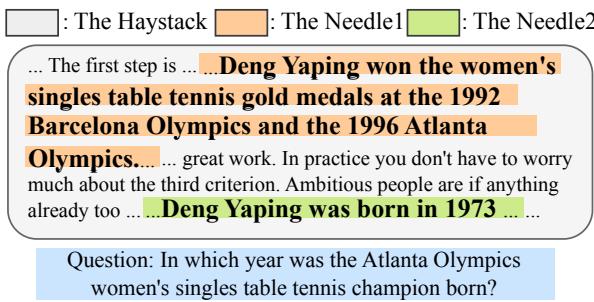
Fake Needles: They alter real-world facts (e.g., changing an Olympic year) to ensure the model is actually reading the text and not relying on internal memory.
Results and Discussion
The results of the experiments are impressive, particularly given that the backbone model is a relatively small LLaMA-2 7B.
1. Beating the Giants on Accuracy
In the Single-Needle test, LONGAGENT dominates.
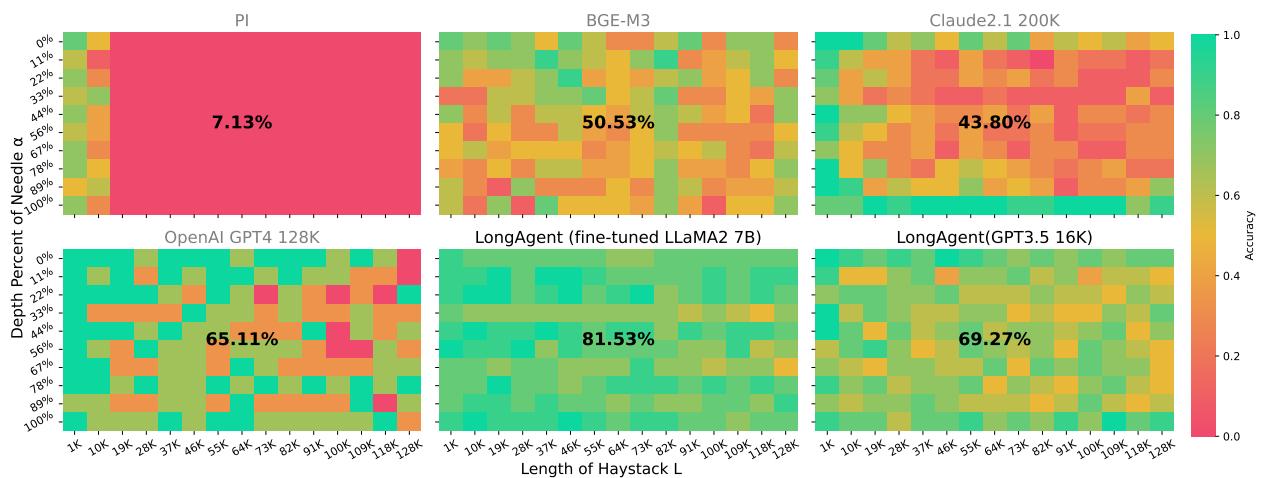
Look at the heatmaps in Figure 5.
- GPT-4 (128k context): Shows significant degradation (orange/red areas) as the document length increases and depending on where the needle is located.
- LONGAGENT (LLaMA-2 7B): It is almost entirely green (high accuracy) across the board, up to 128k tokens. It achieved an average accuracy of 81.53%, compared to GPT-4’s 65.11%.
In the harder Multi-Needle test, the gap narrows but LONGAGENT still holds the lead.
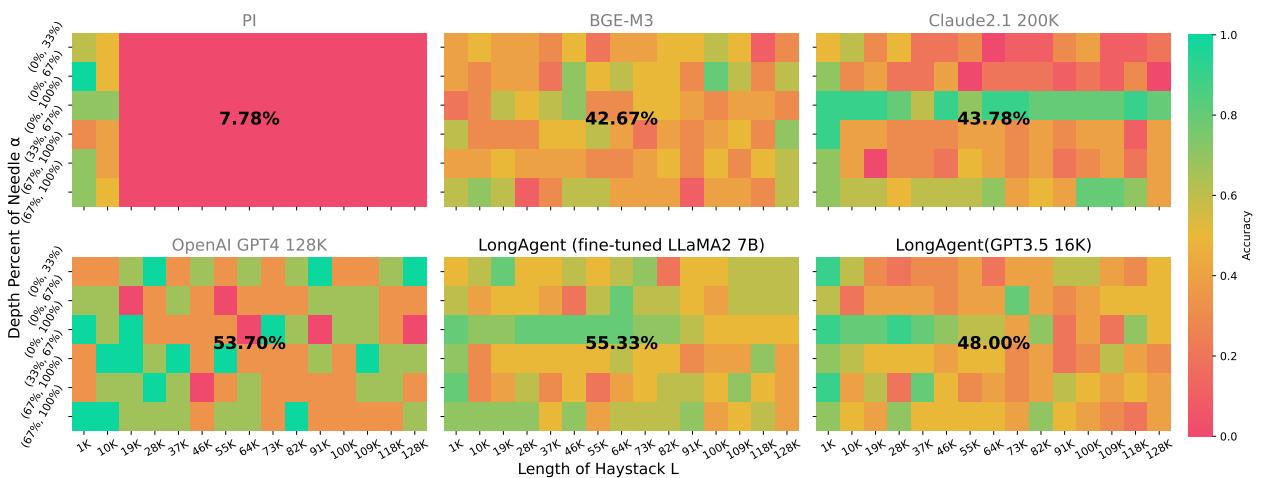
As seen in Figure 6, standard retrieval methods (BGE-M3) and even long-context models like Claude 2.1 struggle significantly with multi-hop reasoning over long distances. LONGAGENT maintains robust performance.
2. Comparing with RAG
A common critique is “Why not just use RAG?” The paper compares LONGAGENT against RAG systems (using top-k retrieval).
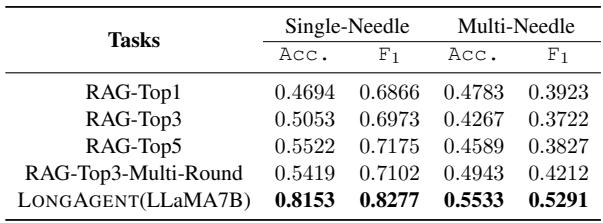
Table 2 shows that RAG struggles with precision. Even when retrieving the top-5 chunks, RAG misses the context required for deep understanding, scoring significantly lower than LONGAGENT (0.55 vs 0.81 in accuracy). RAG is efficient for finding a document in a library, but LONGAGENT is better for reading the book.
3. General Benchmarks
The team also tested on standard benchmarks like LongBench and InfiniteBench.
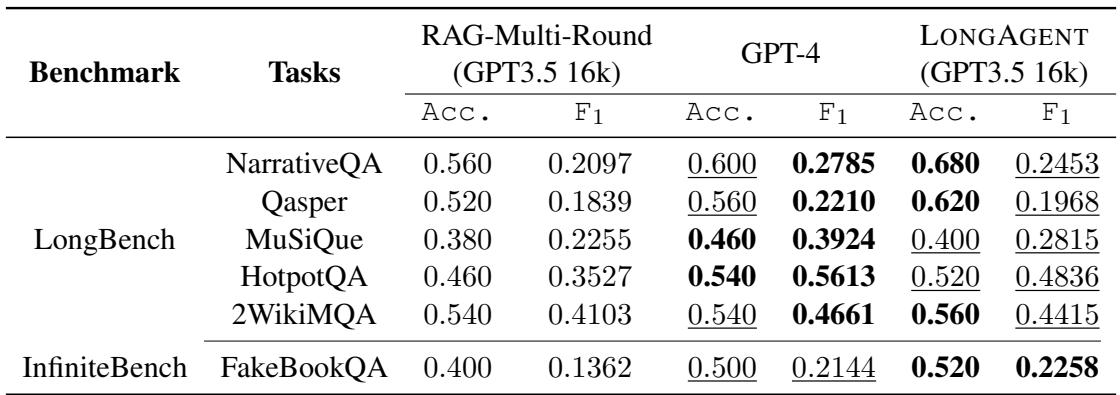
Remarkably, Table 1 shows that GPT-3.5 (16k context), when driven by the LONGAGENT framework, matches or exceeds the performance of GPT-4 on several tasks. This democratizes long-context understanding, making it accessible to smaller, cheaper models.
4. Hallucination and Training Data
The researchers performed an ablation study to understand why members hallucinate.
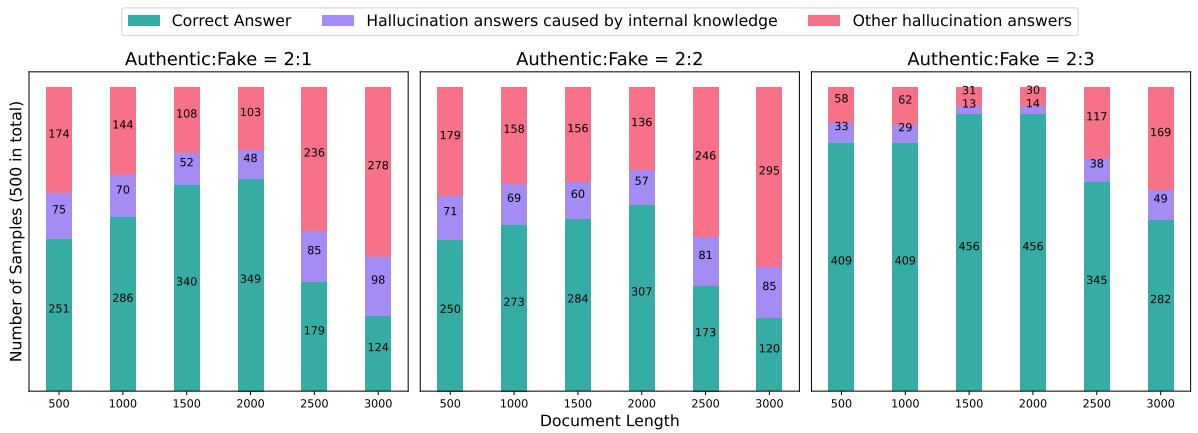
Figure 7 reveals that the ratio of “Authentic” (answer present) to “Fake” (answer absent) data during training is crucial. Increasing the amount of “Fake” data helps the model learn to say “No Mention” more often. However, as the chunk length approaches the model’s pre-training limit (4k), hallucinations start to creep back in.
5. The Power of Communication
Does the “Inter-Member Communication” (conflict resolution) actually work?
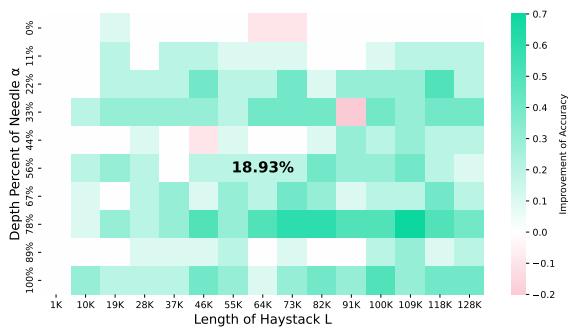
Yes. Figure 8 visualizes the accuracy gain specifically attributed to the communication step. The sea of green indicates that allowing agents to swap chunks and double-check each other improved accuracy by an average of nearly 19%.
6. Efficiency
Finally, cost and speed matter. Processing 128k tokens with full attention (standard LLM behavior) has quadratic complexity—it gets exponentially slower and more memory-hungry as text grows.

Because LONGAGENT chunks the text, its complexity is linear (\(\mathcal{O}(N)\)). Figure 9 shows that while full attention methods spike in latency, LONGAGENT’s time cost grows gradually and predictably.
Conclusion
LONGAGENT represents a shift in how we think about processing massive datasets. Instead of trying to cram more tokens into a single model’s “working memory,” this approach suggests that architecture matters more than raw size.
By organizing a team of smaller agents—guided by a leader and capable of error-checking each other—we can achieve results that surpass the most powerful proprietary models available today.
Key Takeaways:
- Divide and Conquer: Breaking long texts into chunks allows 4k-context models to process 128k-token documents.
- Teamwork Reduces Errors: The inter-member communication mechanism effectively neutralizes hallucinations.
- Smarter, Not Harder: A fine-tuned 7B model can beat GPT-4 on specific long-context tasks using this framework.
For students and researchers, LONGAGENT opens up exciting avenues. It suggests that the future of AI isn’t just about building larger Transformers, but about designing smarter multi-agent systems that can reason, collaborate, and double-check their own work.