](https://deep-paper.org/en/paper/file-3270/images/cover.png)
Imagine trying to explain a complex scientific concept to a 5-year-old, then to a 10-year-old, and finally to a high schooler. You would change your vocabulary, sentence structure, and tone for each “target” audience. This is the essence of Target-level Sentence Simplification.
While humans do this naturally, teaching machines to generate text at specific complexity levels (like “Grade 3” vs. “Grade 8”) is notoriously difficult. The primary bottleneck isn’t the model architecture; it’s the data. We simply don’t have enough high-quality parallel datasets—pairs of complex sentences aligned with their simplified versions across multiple grade levels.
In this post, we dive into a fascinating paper by Xinying Qiu and Jingshen Zhang: “Label Confidence Weighted Learning for Target-level Sentence Simplification.” They propose a clever solution that allows models to learn from “noisy,” imperfect data by mathematically weighing how confident we are in that data.
The Problem: Data Scarcity and The Noise Trap
To train a deep learning model for text simplification, you ideally need a massive dataset like:
- Input: “The orchestration of the event was meticulous.”
- Label: Level 4 (Complex)
- Target: “The event was planned very carefully.”
The gold standard for this is the Newsela-auto dataset, which contains news articles rewritten at different grade levels. However, as shown in the statistics below, this dataset is relatively small and imbalanced.

With only a few thousand examples per level, training a robust Transformer model is difficult. Researchers often turn to Data Augmentation—specifically, using large “paraphrase datasets” (sentences that mean the same thing but look different).
Here is the catch: Paraphrase datasets are unlabeled. We don’t know the complexity level of the sentences. If we use a separate classifier to guess the levels (pseudo-labeling), those guesses will inevitably contain errors. If a neural network trains on these wrong labels (“noise”), it creates a “garbage in, garbage out” loop, leading to poor generalization.
The Solution: Label Confidence Weighted Learning (LCWL)
Qiu and Zhang introduce Label Confidence Weighted Learning (LCWL). Instead of blindly trusting the pseudo-labels generated for the paraphrase data, LCWL calculates a “confidence score” for each label. If the system is unsure about a label, the model pays less attention to that specific example during training.
The Architecture Overview
The approach combines a BERT-based classifier with a BART-based generator. The entire workflow operates in a loop of classifying unlabeled data, calculating confidence, and then training the generator.

As illustrated in Figure 1 above, the process breaks down into three distinct phases:
- Train a Multi-level Classifier: Use the small, labeled Newsela data to train a model that can predict reading levels.
- Label the Paraphrase Dataset: Take a massive, unlabeled dataset (ParaNMT) and use the classifier to assign levels to millions of sentences.
- Train with Confidence: Train the simplification model (Encoder-Decoder) using these new pairs, but weight the loss function based on how “sure” the classifier was.
Let’s break down the technical components.
Step 1: The BERT Classifier
First, the authors need a way to guess the complexity of a sentence. They fine-tune a BERT model. For any input sentence \(x_i\), BERT extracts the hidden representation of the [CLS] token (\(h_b\)).
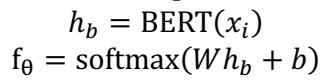
The model outputs a probability distribution over the complexity levels \(K\). While this classifier is trained on the small Newsela dataset, it achieves reasonable accuracy, making it a useful tool for labeling the larger external dataset.
Step 2: Confidence Estimation
This is the core innovation of the paper. When the classifier predicts a level for a paraphrase sentence, we don’t just take the label; we look at two factors:
- Precision (\(p_k\)): How accurate is the classifier generally for this specific level \(k\)? (Calculated from the validation set).
- Confidence Score (\(s\)): How high was the softmax probability for this specific sentence?
For a sentence pair (source and target), the authors calculate a confidence weight (\(c\)) that combines these factors. If the classifier predicts a label with low probability, or if it predicts a level that it historically struggles to identify correctly, the confidence score drops.
Step 3: The Weighted Loss Function
Standard training uses Cross-Entropy Loss, which treats every training example as equally important. LCWL modifies this by introducing the confidence weights \(c^s\) (source) and \(c^t\) (target) into the loss equation.

In this equation:
- \(\mathcal{L}(\phi)\) is the total loss.
- \(c_j^s\) and \(c_j^t\) are the confidence scores for the source and target sentences.
- The term \(\log p(\dots)\) is the standard probability of generating the correct sentence.
The intuition: If the data point is likely mislabeled (low \(c\)), the product \(c_j^s \cdot c_j^t\) becomes small, effectively “muting” the loss. The model learns less from this noisy example, preventing it from overfitting to errors.
Step 4: The BART Generator
Finally, the generation model itself is based on BART (Bidirectional and Auto-Regressive Transformers). It takes the complex sentence and a special token indicating the desired target level (e.g., <SIMP_3>) as input.
The encoder processes the input \(x\):

The decoder generates the simplified output \(y\), conditioned on the encoded input and the target level \(l\):

Experimental Results
The researchers compared LCWL against several state-of-the-art baselines, including MUSS (a strong unsupervised method), FUDGE (controlled generation), and even GPT-3.5-Turbo. They evaluated the models using a suite of metrics like SARI (simplification quality), FKGL (readability), and LENS (a learnable evaluation metric).
Unsupervised Performance
In the “unsupervised” setting (where the model is trained only on the pseudo-labeled paraphrase data, not the labeled Newsela data), LCWL demonstrated superior performance. It consistently ranked highest in preserving meaning while successfully lowering the linguistic complexity.
Supervised Performance (The “Best of Both Worlds”)
The most impressive results came when the researchers combined methods. They took the LCWL model pre-trained on the noisy data and fine-tuned (FT) it on the labeled Newsela dataset. They also combined it with Symmetric Cross Entropy (SCE), another technique for handling noisy labels.
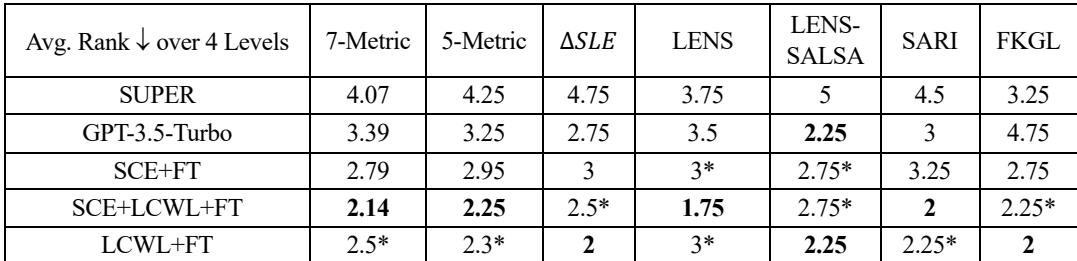
The table below summarizes the rankings of the supervised methods:
Key Takeaways from the Data:
- LCWL+FT (Fine-Tuning) and SCE+LCWL+FT consistently achieved the best (lowest) average ranks across metrics like LENS and SARI.
- GPT-3.5-Turbo, while capable, generally lagged behind the specialized LCWL models in target-level control.
- The combination of LCWL and Fine-Tuning creates a robust pipeline: LCWL exploits the massive scale of noisy data without getting confused by errors, and Fine-Tuning polishes the output using the small, high-quality gold data.
Case Studies: Qualitative Analysis
Numbers are great, but how does the text actually look? The paper provides case studies showing that LCWL excels at two specific human-like simplification strategies:
- Sentence Splitting: When faced with a long, convoluted sentence, LCWL tends to break it into two shorter, digestible sentences.
- Original: “The scientists studied 22 very different species… using video recordings to determine patterns.”
- LCWL Output: “The scientists studied 22 very different species. They used video recordings to determine patterns.”
- Contextual Explanation: In some cases, the model adds slight elaborations to clarify difficult terms, a strategy often used by human editors for lower reading levels.
Conclusion and Implications
The paper “Label Confidence Weighted Learning for Target-level Sentence Simplification” addresses a critical gap in Natural Language Processing. It provides a blueprint for how to use the vast ocean of unlabeled data available on the internet without being drowned out by the noise inherent in automated labeling.
By mathematically discounting “uncertain” data points during training, LCWL allows the model to learn robust patterns of simplification. This approach is not just a win for text simplification; it has broader implications for any domain where labeled data is scarce but noisy data is abundant.
For students and researchers, this paper serves as a perfect example of Weak Supervision: leveraging imperfect signals to build powerful models that outperform those trained on perfect, but tiny, datasets.