](https://deep-paper.org/en/paper/file-3272/images/cover.png)
Imagine you are looking for instructions on how to bake a specific type of pastry. You type your query into a search engine. Somewhere out there, the perfect recipe exists, written by a master baker. However, that baker wrote the recipe in Italian, and you searched in English.
Ideally, a modern semantic search engine should find that document. After all, “flour” means “farina,” and the semantic intent of baking is the same regardless of the language used to describe it. If we have a translation tool, the language of the document shouldn’t matter—only the meaning should.
This is the goal of Language-Invariant Dense Retrieval: creating a search system where the representation of a text captures its essential meaning, completely stripping away the “language identity” (whether it is English, Chinese, or Arabic).
However, current state-of-the-art multilingual models struggle with this. Even though they are trained on over 100 languages, they still stubbornly “remember” which language a text is in. This creates a barrier, segregating information by language rather than organizing it by meaning.
In this post, we will dive deep into a research paper titled “Language Concept Erasure for Language-invariant Dense Retrieval.” The authors introduce a framework called LANCER. It uses a clever mathematical technique called “linear concept erasure” to force AI models to “forget” language identity during training, resulting in a truly universal retrieval system.
The Problem: Language Bias in Multilingual Models
To understand LANCER, we first need to understand the architecture of modern search engines, specifically Dense Retrieval.
How Dense Retrieval Works
In the past, search engines matched keywords (lexical search). If you searched for “car,” it looked for the word “car.” Today, we use dense retrieval.
- The Encoder: A neural network (like BERT) reads the query and converts it into a fixed-size list of numbers called a vector (or embedding).
- The Document: The search engine does the same for every document in its database.
- The Match: To see if a document matches a query, we compare their vectors. If the vectors point in the same direction in the mathematical space, they are semantically similar.
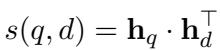
Mathematically, the relevance score \(s(q, d)\) between a query \(q\) and a document \(d\) is calculated using the dot product of their vectors (\(\mathbf{h}_q\) and \(\mathbf{h}_d\)):
The Invisible Wall
Multilingual models like mBERT or mContriever are designed to map sentences from different languages into this shared vector space. The theory is that the vector for “Hello” (English) should look almost identical to the vector for “Bonjour” (French).
But in practice, this doesn’t happen perfectly. These models suffer from Language Bias. They tend to cluster vectors based on language rather than meaning. All English documents hang out in one corner of the vector space, and all French documents in another.
This segregation hurts performance, especially in “zero-shot” scenarios—where we train a model using only English data (because it’s cheap and abundant) but expect it to work on Swahili or Thai.
The researchers demonstrated this degradation in performance clearly. In the graph below, they tested standard models (mDPR, mContriever, LaBSE) on a dataset called LAReQA. Look at what happens to the performance (nDCG@10) as the number of languages involved increases:
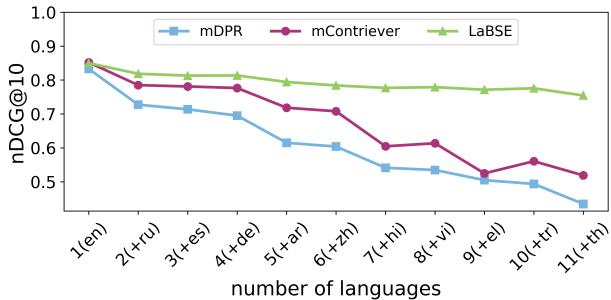
As soon as the task moves beyond just English (1(en)), performance plummets. The models are confused by the linguistic variety.
Proving the Bias
You might ask: “Are we sure the model is actually looking at the language?”
To prove this, the authors performed a Language Identification experiment. They took the vectors produced by these retrieval models and trained a simple classifier (Logistic Regression) to guess the language of the text based only on the vector.
If the vectors were truly “language-invariant” (only encoding meaning), the classifier shouldn’t be able to tell if the text was German or Japanese.
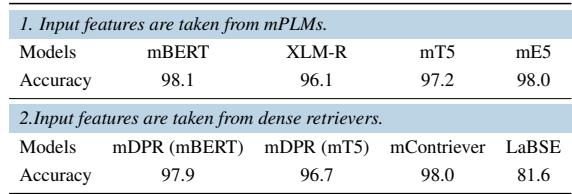
As Table 1 shows, the classifier achieved 96% to 98% accuracy. This is definitive proof. The vectors are practically shouting, “I AM A SPANISH SENTENCE.” This language signal acts as noise, distracting the retrieval mechanism from the actual semantic meaning.
The Solution: LANCER
The researchers propose LANCER (Language Concept Erasure for Language-invariant Dense Retrieval). The core idea is intuitive but mathematically rigorous:
If we want the model to focus only on meaning, we must penalize it whenever it encodes language identity.
This is done through Multi-Task Learning. The model is trained to do two things simultaneously:
- Retrieval Task: Find relevant documents (learn semantics).
- Concept Erasure Task: Ensure no linear classifier can guess the language of the document (forget language).
The Architecture
The beauty of LANCER lies in how it combines these conflicting goals into a single training pipeline.

As shown in Figure 2, the “Backbone Encoder” (the brain of the operation) feeds into two different loss functions. Let’s break down the mathematics of each branch.
1. The Retrieval Objective (Ranking Loss)
The first part of the training is standard for dense retrieval. The model is given a query (\(q\)), a positive document (\(d^+\)) that answers the query, and a set of negative documents (\(d^-\)) that do not.
The goal is to maximize the similarity score for the positive pair while minimizing it for the negative pairs. This is calculated using the Negative Log-Likelihood Loss (often called InfoNCE or contrastive loss):

This equation pulls the query and the correct document closer together in vector space while pushing away the incorrect ones. Crucially, the authors only use English data for this step. This mimics the real-world scarcity of high-quality multilingual training data.
2. The Erasure Objective (Correlation Loss)
This is the novel contribution of the paper. This branch takes Multilingual Data—simple passages from various languages (with no relevance labels needed).
The goal is Linear Guardedness. A representation is “guarded” against a concept (like language) if you cannot train a linear model to predict that concept from the representation.
Mathematically, this is equivalent to ensuring there is zero correlation between the output vectors and the language labels.
First, the model computes the Cross-Covariance Matrix (\(\Sigma_{XZ}\)) between the dense vectors (\(\mathbf{X}\)) and the language labels (\(\mathbf{Z}\)):

If the covariance is high, it means specific dimensions in the vector are acting as “flags” for specific languages (e.g., dimension 54 might be high whenever the text is German).
To make the optimization stable, they normalize this into a correlation matrix and then define the Concept Erasure Loss (\(\mathcal{L}_C\)) as the mean absolute value of these correlations:
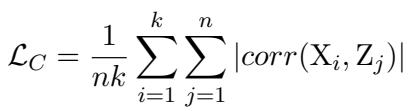
By minimizing this loss, the model is forced to scramble the language signals. It effectively scrubs the “German-ness” or “Chinese-ness” from the vector, leaving only the semantic content.
3. The Combined Objective
Finally, the model optimizes both losses together. It tries to be a good retriever and a language-agnostic encoder at the same time.
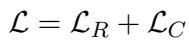
This creates a competitive dynamic. The retrieval loss tries to organize vectors by meaning. The erasure loss tries to prevent them from organizing by language. The equilibrium point is a Language-Invariant Dense Retriever.
Analyzing the Training Process
Does this actually work? Can we see the model “forgetting” language in real-time?
The researchers monitored the training process by periodically trying to train a classifier to guess the language from the vectors. If LANCER is working, this classifier should fail miserably.
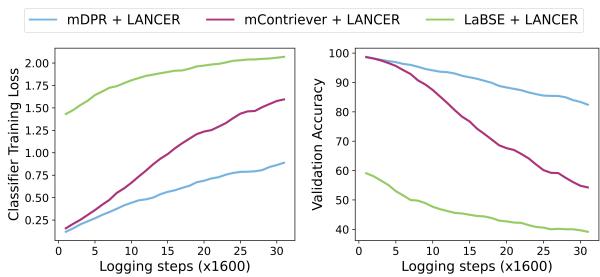
Figure 4 tells a fascinating story.
- Left Graph (Training Loss of the Classifier): As the LANCER model trains (logging steps on the x-axis), the loss of the adversary classifier shoots up (specifically for mContriever and LaBSE). This means the classifier is struggling to find patterns.
- Right Graph (Validation Accuracy): This is the smoking gun. At step 0, accuracy is near 100% (the classifier can easily guess the language). As training progresses, accuracy drops significantly (down to 40% for LaBSE).
The model is successfully hiding the language identity from the classifier.
Visualizing the Vector Space
Numbers are great, but seeing the vector space is even better. The authors used t-SNE, a technique for visualizing high-dimensional data in 2D, to show how the embeddings change.
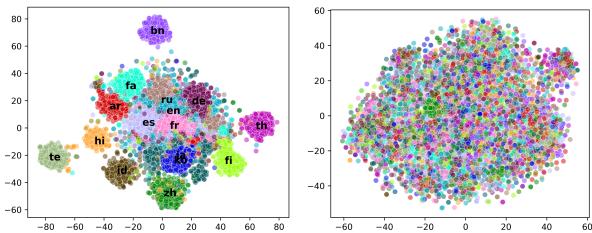
- Left (Standard mDPR): Notice the distinct islands. Each color represents a language. The blue dots (English) are far away from the orange dots. This is bad for cross-lingual retrieval because the model thinks “Apple” (in English) is fundamentally different from “Manzana” (in Spanish).
- Right (mDPR + LANCER): The islands have merged into a single, colorful continent. The languages are intermingled. In this space, an English sentence and its Thai translation are much more likely to be neighbors. This is the definition of Language Invariance.
Experimental Results
The theoretical justification is strong, but does it improve search results? The authors tested LANCER on a variety of difficult datasets.
Multilingual Retrieval (CLEF & LAReQA)
In this task, the query and documents can be in many different languages.
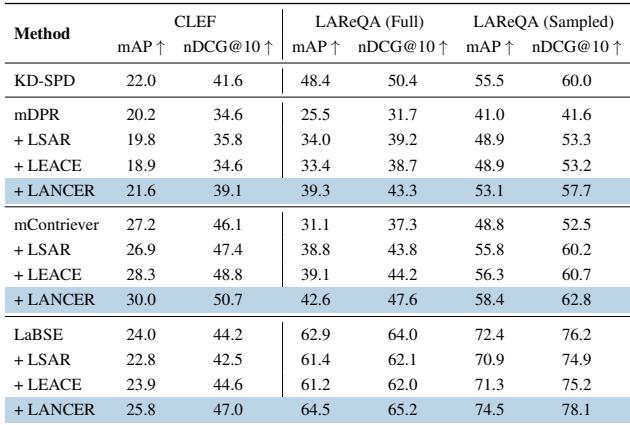
Table 2 shows the Mean Average Precision (mAP) and nDCG scores.
- The Baseline: Look at the standard
mContrieverrow. - The Competitors:
LSARandLEACEare “post-hoc” methods (trying to remove language bias after training). - LANCER: The rows highlighted in blue show LANCER’s performance. It consistently outperforms the baseline and the competitors. For example, on LAReQA (Full),
mContriever + LANCERachieves a score of 47.6, a massive jump from the baseline of 37.3.
Robustness Against Language Variety
Recall the first graph in this post, where adding more languages caused performance to crash? Let’s see how LANCER handles that same stress test.
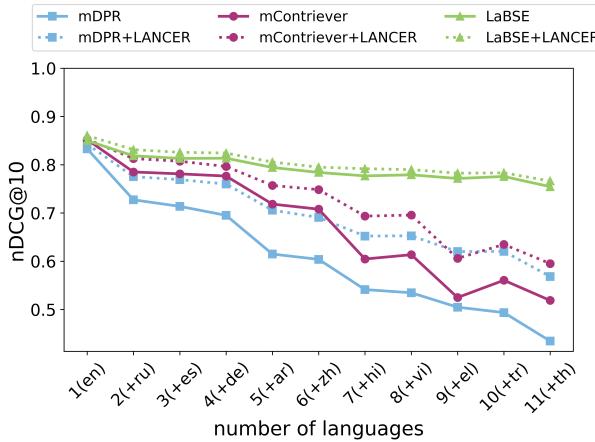
In Figure 3, the solid lines represent the baselines, and the dashed lines represent the models trained with LANCER. Notice how the dashed lines stay much flatter? As you add more languages (moving right on the x-axis), LANCER maintains its performance significantly better than the standard models. It has become resilient to linguistic diversity.
Cross-Lingual Retrieval (XOR-Retrieve)
This is the “Universal Translator” scenario: searching in one language (e.g., Japanese) to find documents in another (e.g., English).
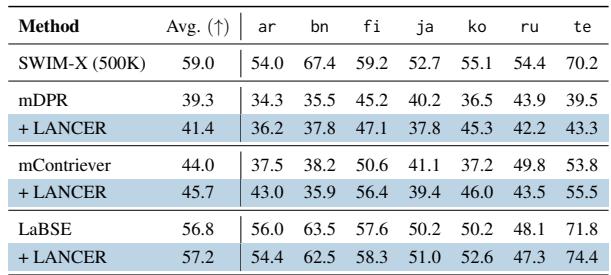
In Table 3, we look at Recall@5kt (did the correct document appear in the top 5,000 results?).
- mContriever achieves 44.0 average.
- mContriever + LANCER improves this to 45.7.
While the gains on LaBSE are smaller (because LaBSE is already very heavily pre-trained on parallel data), the improvement on unsupervised models like mContriever is distinct.
Note: The table also compares against SWIM-X, a method that uses Large Language Models (LLMs) to generate synthetic training data. While SWIM-X performs well, it requires expensive data generation. LANCER achieves competitive results using only the data we already have.
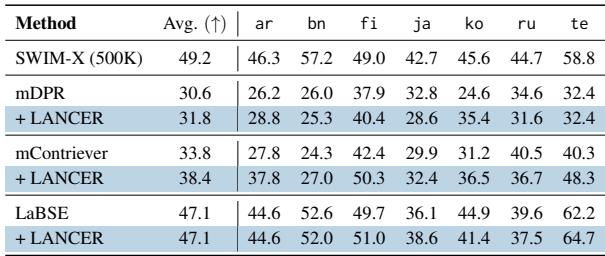
(The paper also provides Recall@2kt results for further verification, shown below).
Monolingual Retrieval (MIRACL)
Finally, what about searching in a specific language, like Swahili or Bengali, when the model was only fine-tuned on English? This is the Zero-Shot Monolingual test.
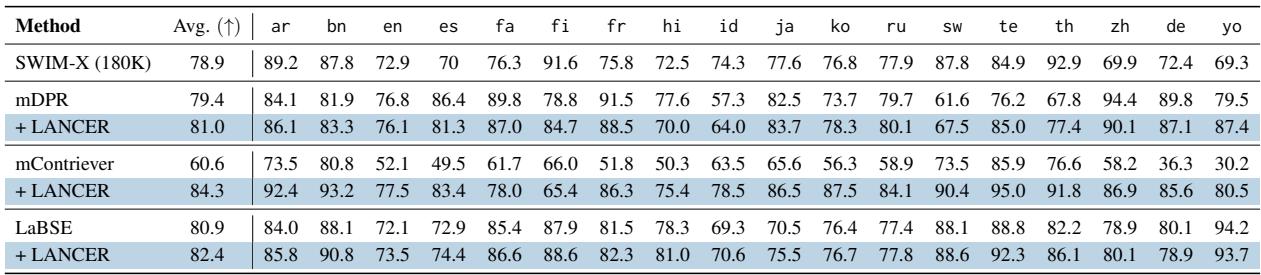
Table 6 (Recall@100) and the text of the paper highlight massive gains here.
- On mContriever, LANCER improves nDCG@10 by 32.5% over the baseline.
- It even beats the LLM-based SWIM-X method on average.
This is a critical finding. It suggests that if you want to build a search engine for low-resource languages (where training data is scarce), you might not need to generate millions of synthetic examples. Instead, you can just train on English and use LANCER to force the model to generalize.
Conclusion and Implications
The “Tower of Babel” problem in AI is that models tend to overfit to the surface forms of language—the specific words and grammar—rather than the underlying intent.
The LANCER framework offers a sleek, mathematical solution to this problem. By treating “Language Identity” as a concept to be erased, it forces the neural network to dig deeper and find the semantic “soul” of the text.
Key Takeaways:
- Language Bias is Real: Standard multilingual models segregate data by language, hurting retrieval performance.
- Concept Erasure Works: We can mathematically penalize models for remembering language identity during training.
- Zero-Shot Success: LANCER allows models trained only on English to perform exceptionally well on languages like Swahili, Thai, and Bengali without needing parallel training data.
This approach opens exciting doors. If we can erase “Language” as a concept, what else can we erase? Could we use similar techniques to erase gender bias, political stance, or writing style from embeddings, creating truly neutral and universal representations? LANCER provides a blueprint for how we might get there.