](https://deep-paper.org/en/paper/file-3277/images/cover.png)
Imagine you have just released a new software library or a specialized database API. You want developers to be able to use it effortlessly, perhaps by simply typing natural language commands like “find all users who signed up yesterday” rather than writing complex SQL queries or function calls.
To build a tool that translates English into your specific code, you typically face a massive hurdle: data. Training a model to understand a specific API usually requires thousands of pairs of natural language commands and their corresponding code snippets. Creating this dataset is expensive, time-consuming, and tedious.
But what if you could build a highly accurate translation system using only one labeled example?
This is the promise of ICIP (In-Context Inverse Programming), a novel method introduced in the paper “Language-to-Code Translation with a Single Labeled Example” by researchers from UT Austin and Microsoft. This technique leverages the power of Large Language Models (LLMs) to bootstrap their own training data from unlabeled code, effectively teaching themselves how to use a new tool.
In this deep dive, we will explore how ICIP works, the mathematics behind its “cycle consistency,” and why it performs nearly as well as fully supervised systems with a fraction of the human effort.
The Problem: The High Cost of Supervision
Large Language Models like GPT-4 or CodeLlama are already excellent at writing code. If you ask for a Python script to sort a list, they can do it instantly because they have seen millions of Python examples during pre-training.
However, the problem arises when we move to domain-specific languages (DSLs) or new APIs. If you create a custom internal tool for your company, the LLM has likely never seen it before. It doesn’t know the syntax, the function names, or the logic.
To teach the model, you normally use few-shot prompting: you provide the model with a list of examples (pairs of instructions and code) in the prompt context.
- Instruction: “Remove all red items.”
- Code:
inventory.filter(color='red').delete()
The more examples you provide, the better the model performs. But providing these examples requires a human expert to sit down and write them. The researchers ask a pivotal question: Can we automate this process using code that already exists?
Most software projects have plenty of unlabeled programs—unit tests, log files, or API documentation examples—that consist of code without English descriptions. ICIP is designed to unlock the value of this unlabeled data.
The Core Insight: Inverse Programming
The fundamental insight behind ICIP is simple but profound: It is easier to read code than to write it.
Even if an LLM doesn’t know how to generate code for a new API from scratch, it can often look at a snippet of that code and guess what it does. Code is generally designed to be human-readable, with meaningful variable names and logical structures.
ICIP flips the standard generation process on its head. Instead of mapping Language \(\rightarrow\) Code, it starts by mapping Code \(\rightarrow\) Language. It uses the LLM to generate synthetic descriptions for unlabeled code, filters out the bad guesses, and then uses the good pairs to teach the model how to perform the original task.
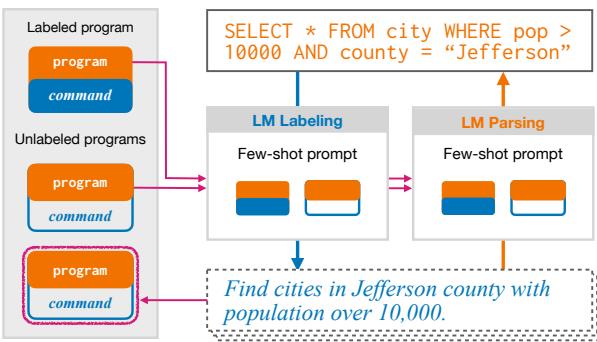
As shown in Figure 1, the process creates a loop. We start with a tiny set of labeled data (potentially just one example) and a large set of unlabeled code. We use the LLM to label the code, refine those labels, and then use the newly labeled data to prompt the parser.
The ICIP Methodology
Let’s break down the mechanics of In-Context Inverse Programming. The method is an iterative process that resembles the Expectation-Maximization (EM) algorithm used in statistics. It alternates between two main phases: Sampling and Filtering.
1. The Setup
We assume we have:
- A pre-trained Language Model (\(p_{\rm LM}\)).
- A very small set of labeled examples, \(D_{L\Pi}\). (This can be as small as 1 example).
- A larger set of unlabeled programs, \(D_{\Pi}\).
Our goal is to create a synthetic dataset \(\hat{D}_{L\Pi}\) of (command, program) pairs that we can use to prompt the LLM.
2. The Sampling Step (Guessing the Prompt)
For every unlabeled program \(\pi_i\) in our collection, we want to find a corresponding natural language command \(\ell\). We ask the LLM to look at the code and generate a list of candidate commands.
Mathematically, we are sampling from the probability distribution of natural language commands (\(\ell\)) given the program (\(\pi\)) and our existing examples:

In this equation:
- \(L'_i\) is the set of candidate natural language labels for program \(\pi_i\).
- The model looks at the existing labeled data (\(D_{L\Pi}\)) and any synthetic data we’ve already created (\(\hat{D}_{L\Pi}\)) to understand the style of commands desired.
Intuitively, the model is looking at a line of code like query.sort_by('date') and generating candidates like:
- “Sort the results by date.”
- “Order by time.”
- “Find dates.”
3. The Filtering Step (Cycle Consistency)
The sampling step is noisy. The LLM might hallucinate or misunderstand the code. To solve this, ICIP introduces a rigorous filtering mechanism based on cycle consistency (often called “round-tripping”).
The logic is: If the generated English command is correct, translating it back into code should result in the original program.
We create a temporary dataset of candidates (\(D'_{L\Pi}\)) and then filter them:

This step effectively acts as a quality control gate. We only keep the pairs where the natural language description is accurate enough to produce the correct code.
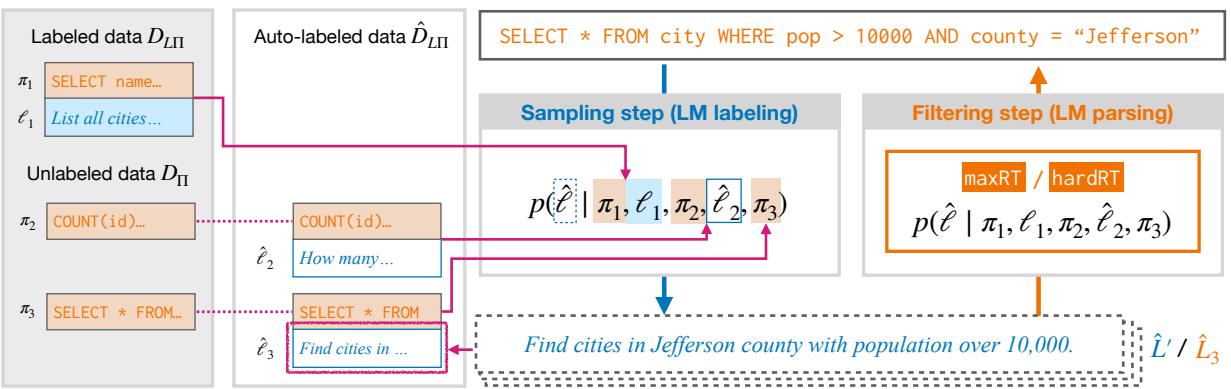
Figure 2 visualizes this flow. The “LM Labeling” box generates the description (e.g., “Find cities in Jefferson county…”). The “LM Parsing” box takes that description and tries to regenerate the SQL. If the output matches the original input SELECT * FROM city..., the pair is kept.
Two Types of Filters
The researchers propose two specific ways to implement this filter:
A. Hard Round Trip (HardRT) This is the stricter approach. A candidate command \(\hat{\ell}\) is accepted only if the LLM, when prompted with \(\hat{\ell}\), generates the exact original program \(\pi\) as its most likely output.

This ensures high precision but might reject valid commands if the model is slightly unsure.
B. Max Round Trip (MaxRT) This is a more flexible, probabilistic approach. Instead of demanding the model generate the code perfectly, we look at the probability scores. We select the command \(\hat{\ell}\) that assigns the highest probability to the original program \(\pi\), compared to all other candidate commands.

MaxRT ensures that for every unlabeled program, we pick the best available description, even if the model wouldn’t have generated the code perfectly on its own. This helps cover more diverse coding patterns.
4. Iteration
Once the filtering is done, we add the successful pairs to our “labeled” set. We then repeat the process! The newly labeled examples help the LLM understand the task better, which improves the labeling of the remaining unlabeled programs in the next round.
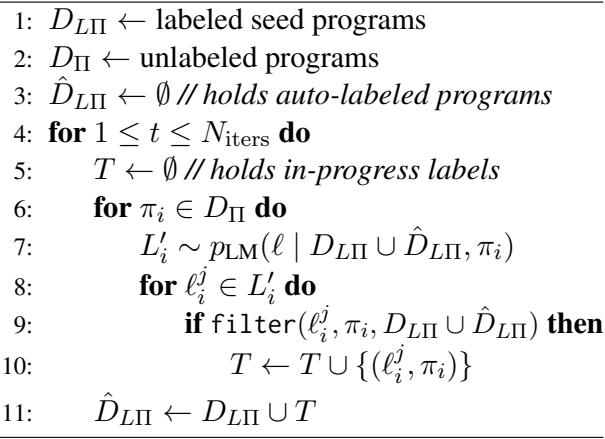
Algorithm 1 summarizes the loop: Sample candidates \(\rightarrow\) Filter them \(\rightarrow\) Update the dataset \(\rightarrow\) Repeat.
Experimental Setup
To prove that this works, the authors tested ICIP on two challenging semantic parsing benchmarks:
- Overnight: A dataset containing queries for various domains like calendars, basketball stats, and housing.
- Spider: A famous text-to-SQL dataset involving complex database queries.
They compared different setups:
- Few-shot (1+0): The baseline. The model is given 1 labeled example and 0 unlabeled ones.
- Few-shot (1+100): The model is given 1 labeled example, plus 100 unlabeled programs (just listed as “examples of code,” without translations).
- ICIP (1+100): The proposed method. 1 labeled seed, 100 unlabeled programs processed via the sampling/filtering loop.
- Fully Labeled (100+0): A supervised “oracle” where humans actually labeled all 100 examples.
They used robust metrics, specifically Execution Accuracy (does the code produce the right result when run?) and Exact Match (is the code identical to the ground truth?).
The Results: Doing More with Less
The results were striking. ICIP dramatically outperformed standard prompting techniques.
Table 1 (below) displays the performance across datasets.
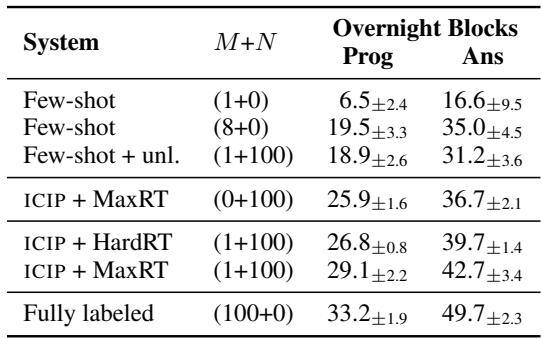
Look at the text-davinci-003 results on the left side of Table 1:
- Few-shot (1+0): 16.6% accuracy. (The model barely knows what to do).
- Few-shot (1+100): 31.2% accuracy. (Just showing unlabeled code helps a bit).
- ICIP + MaxRT (1+100): 42.7% accuracy.
Crucially, compare the ICIP (1+100) result (42.7%) with the Fully Labeled (100+0) result (49.7%). ICIP achieves roughly 85% of the performance of a fully supervised system, despite having only one human-labeled example versus 100.
This confirms that the synthetic labels generated by the model are high-quality enough to serve as training data.
The Power of Iteration
Does the iterative loop really matter? Yes. Figure 3 shows the accuracy climbing as the model performs more rounds of sampling and filtering.
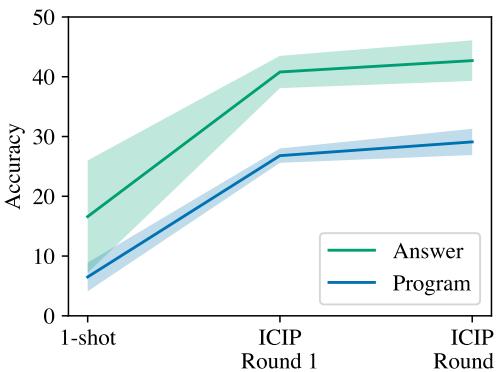
In the first round, the model makes decent guesses. By feeding those guesses back into the context, the model gains a better understanding of the syntax and style, allowing it to label the harder examples in Round 2.
Qualitative Analysis: What is the Model Writing?
One might worry that the model generates nonsense descriptions. However, looking at the actual output in Table 2, we see that ICIP generates accurate and natural commands.
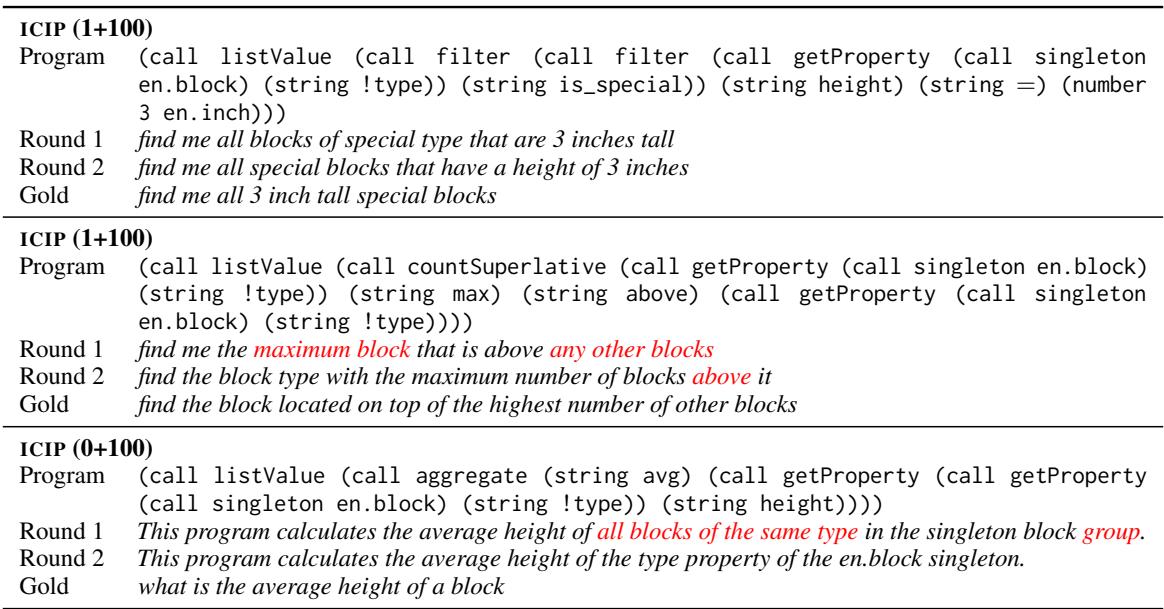
Notice the top row (ICIP 1+100). The Gold (human) label is “find me all 3 inch tall special blocks.” The ICIP generated label is “find me all special blocks that have a height of 3 inches.” While phrased differently, the semantics are identical. This linguistic diversity can actually be beneficial, as it exposes the model to different ways users might phrase a request.
Robustness: What if the Code looks Weird?
You might argue that LLMs are pre-trained on so much SQL and Python that they already know the syntax, so ICIP isn’t really “learning” anything new—it’s just remembering.
To test this, the researchers created a “torture test.” They took the standard programming language used in the dataset and applied transformations to make it unfamiliar. They removed braces, reversed arguments, or anonymized function names (e.g., turning filter() into p0()).
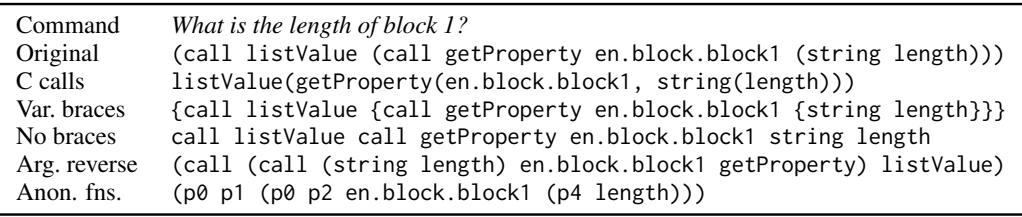
As seen in Table 3, the “Anon. fns.” version looks like gibberish to a human eye: (p0 p1 (p0 p2...)).
Remarkably, ICIP adapted well to these changes. Because it looks at the structure and context of the unlabeled code, it could still map natural language to these strange, obfuscated programs.
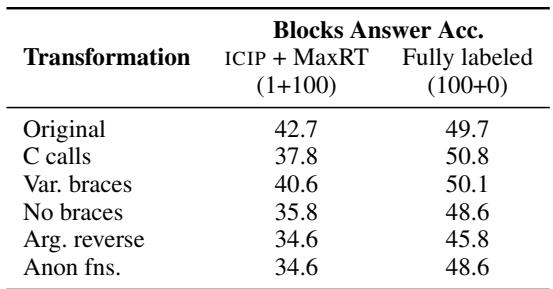
Table 4 shows that while performance drops (as expected) on the harder transformations, ICIP (1+100) continues to function effectively, maintaining a similar ratio of performance relative to the fully supervised oracle. This proves ICIP is genuinely learning the new syntax from the unlabeled examples.
Conclusion and Implications
The ICIP method represents a significant step forward in semi-supervised learning for code generation. It addresses the “cold start” problem that developers face when integrating LLMs with new, custom, or rapidly changing software libraries.
Here are the key takeaways:
- Unlabeled Data is Valuable: Don’t throw away your logs or test cases. Even without English descriptions, raw code contains the structural information an LLM needs to master a new domain.
- Generative Models are Discriminative: We often think of LLMs as writers, but ICIP shows they are also excellent readers. Their ability to “inverse program”—to explain what code does—is a powerful supervision signal.
- Consistency is Key: The success of ICIP relies on the “round-trip” check. Trusting the model blindly leads to errors; trusting only the outputs that are self-consistent leads to high-quality synthetic data.
For students and researchers, ICIP highlights a growing trend in AI: Self-Alignment. As models become more capable, we can rely less on expensive human labeling and more on clever algorithms that allow models to teach themselves, bootstrapping from a single seed of knowledge into full competence.