](https://deep-paper.org/en/paper/file-3280/images/cover.png)
Introduction
In the past year, headlines have been dominated by the impressive feats of Large Language Models (LLMs) in the medical field. We’ve seen reports of AI passing the United States Medical Licensing Examination (USMLE) with flying colors, performing on par with—or sometimes even better than—human experts on standardized tests. It is easy to look at these results and assume that we are on the brink of an AI revolution in daily clinical practice.
However, there is a distinct difference between passing a multiple-choice exam and navigating the messy, open-ended reality of treating patients. A standardized test provides a closed environment with pre-set options. A real hospital involves long, disorganized patient histories, open-ended decision-making, and the constant influx of new drugs and protocols.
This discrepancy is the focus of a fascinating research paper titled “Large Language Models Are Poor Clinical Decision-Makers: A Comprehensive Benchmark.” The researchers argue that while LLMs are excellent test-takers, their ability to function as clinical decision-makers is far less proven. To test this hypothesis, they constructed a massive new benchmark called ClinicBench.
In this post, we will tear down this paper to understand where current AI models succeed, where they fail dangerously, and how the type of data used to train them makes all the difference.
Background: The Illusion of Competence
To understand why this paper is necessary, we first need to look at the current landscape of Medical LLMs. Models like MedPaLM-2 and various iterations of GPT-4 have achieved accuracy scores exceeding 85-90% on medical QA datasets.
The problem, as identified by the authors, lies in evaluation limitations:
- Closed-Ended Questions: Most benchmarks rely on “Exam-style QA.” The model picks A, B, C, or D. This tests knowledge retrieval, not clinical reasoning.
- Short Contexts: Exam questions are concise summaries. Real patient Electronic Health Records (EHRs) are lengthy, containing thousands of words of notes, labs, and history.
- Static Knowledge: Models trained in 2022 don’t know about drugs released in 2024.
If we want to trust AI in a hospital, we need to evaluate it on tasks that mimic the actual work of a clinician.
Core Method: Introducing ClinicBench
The researchers developed ClinicBench, a comprehensive framework designed to stress-test LLMs across a much wider spectrum of clinical activities than ever before.
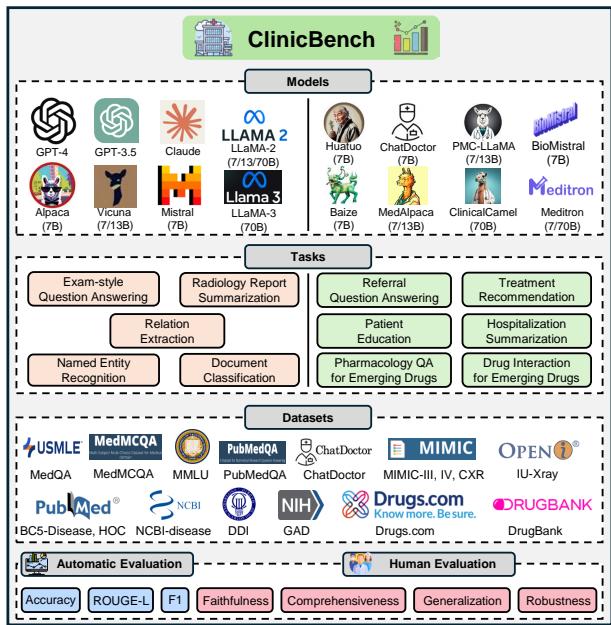
As shown in Figure 1, ClinicBench is not just a single test. It is a multi-dimensional arena comprising:
- 22 Different LLMs: Including commercial giants (GPT-4, Claude-2) and open-source medical models (BioMistral, MedAlpaca).
- 11 Tasks: Spanning reasoning, generation, and understanding.
- 17 Datasets: Including 6 brand-new datasets specifically created for this paper to simulate real-world complexity.
The Three Pillars of Clinical Capability
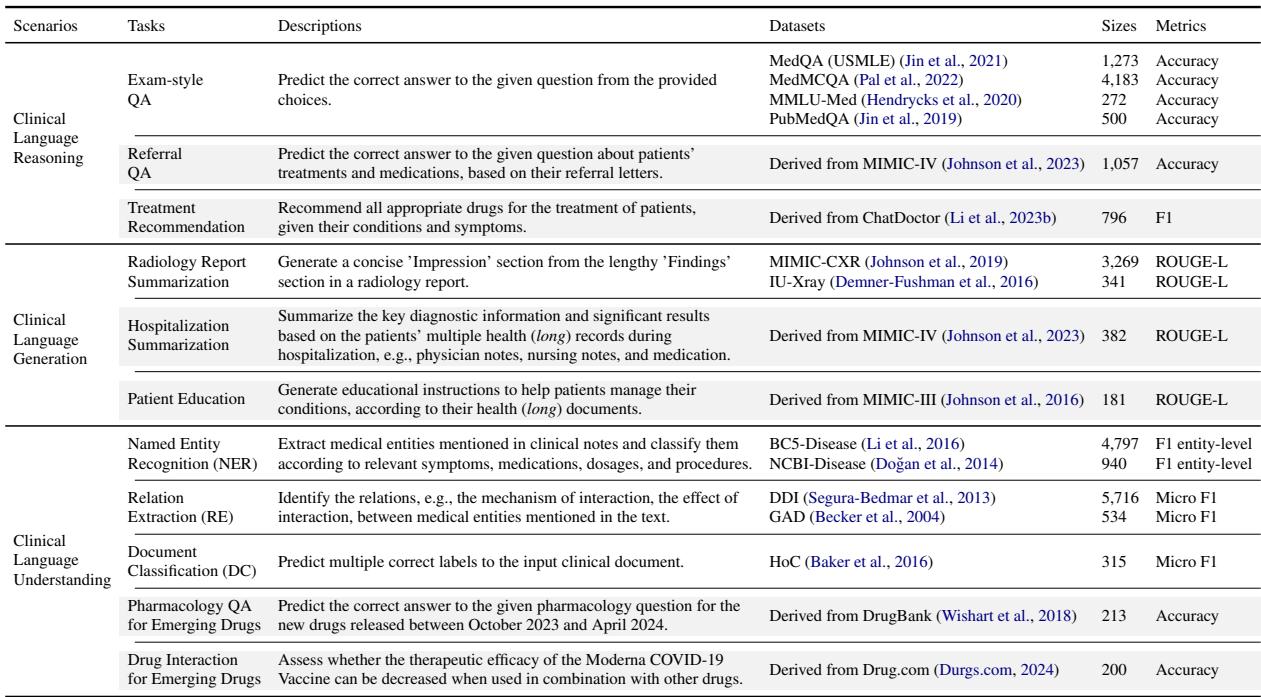
The benchmark divides clinical capability into three specific scenarios. Let’s look at the breakdown of tasks and datasets provided by the researchers.
1. Clinical Language Reasoning
This goes beyond simple QA. While it includes standard exams (like the USMLE), the authors added two critical new tasks:
- Referral QA: The model must read a referral letter (often messy and dense) and answer questions about the patient’s treatment history.
- Treatment Recommendation: This is an open-ended task. Instead of picking a drug from a list, the model must “recommend all appropriate drugs” based on symptoms. This mimics the blank page a doctor faces when writing a prescription.
2. Clinical Language Generation
Doctors spend up to 50% of their time documenting. Can AI help?
- Radiology Report Summarization: turning complex imaging findings into a concise “Impression.”
- Hospitalization Summarization: Summarizing a patient’s entire stay based on long documents (approx. 1,600+ words).
- Patient Education: Writing simple instructions for patients based on their complex medical charts.
3. Clinical Language Understanding
This involves extracting structured data from unstructured text.
- Named Entity Recognition (NER) & Relation Extraction: Finding specific diseases or drug interactions in text.
- Emerging Drug Analysis: A novel task testing the model on drugs released after its training data cutoff (late 2023 to early 2024). This tests the model’s ability to reason about new pharmacological data rather than just reciting memorized facts.
The Contestants: General vs. Medical LLMs
The study compares a wide variety of models. This is crucial because there is an ongoing debate in the AI community: Do we need specialized medical models, or is a really smart general model (like GPT-4) enough?
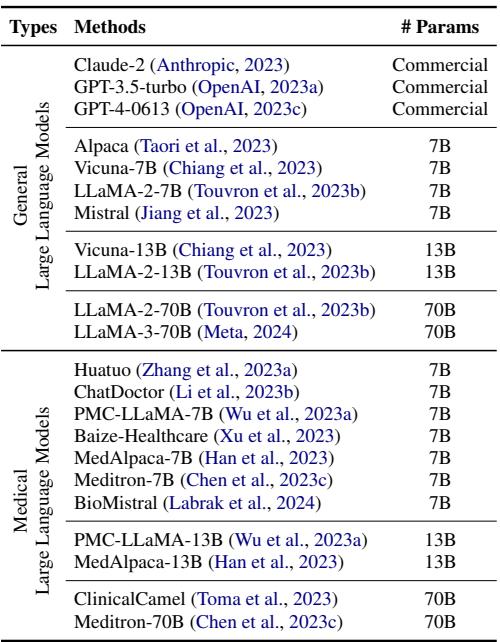
As listed in Table 2, the team tested General LLMs (like LLaMA-2, Mistral, GPT-4) against Medical LLMs (models that started as general models but were fine-tuned on medical data, such as ChatDoctor, MedAlpaca, and PMC-LLaMA).
Experiments & Results
The results of this comprehensive benchmark were revealing, and somewhat sobering.
1. Commercial Giants vs. Open Source
When it comes to raw performance across the board, the commercial closed-source models reigned supreme.
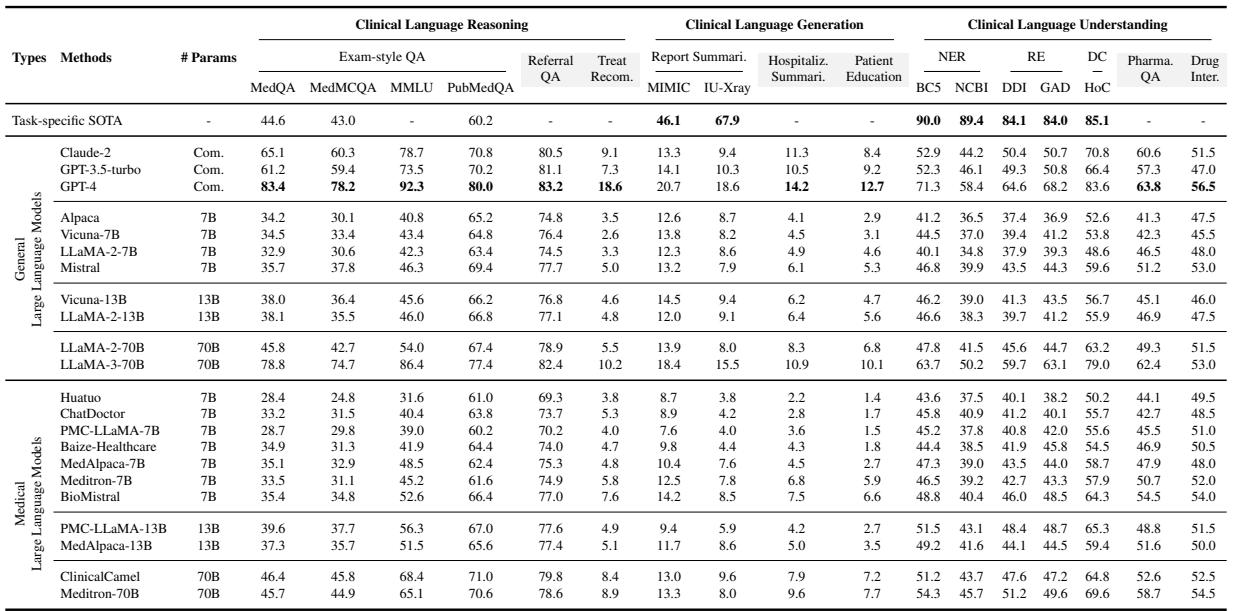
Looking at Table 3, observe the performance of GPT-4. It consistently achieves the highest scores across almost every category.
- Exam-Style QA: GPT-4 hits 83.4% on MedQA (USMLE), nearing human expert levels.
- The Reality Check: Look at the Treatment Recommendation column (Clinical Language Reasoning). While GPT-4 scores 18.6%, many open-source models score below 5%. This is a massive drop-off from the 80%+ scores seen in multiple-choice exams.
This table confirms the paper’s title: while models are great at exams (Reasoning), they struggle significantly with open-ended generation and understanding tasks compared to State-of-the-Art (SOTA) task-specific models.
2. The “Clinical Drop”
One of the most profound findings of this paper is visualized in the graph below. The researchers compared how models performed on standard machine learning tasks (like classification) versus the newly introduced complex clinical tasks.
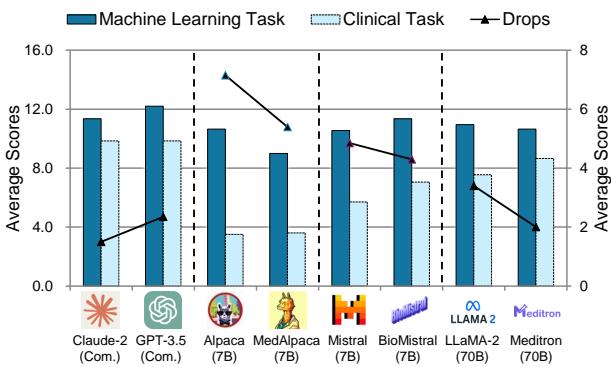
Figure 2 tells a clear story:
- The Blue Bars: The dark blue bars (Machine Learning Tasks) are consistently higher than the light blue bars (Clinical Tasks).
- The Black Line (The Drop): This line represents the performance degradation when moving to clinical tasks.
- Resilience: Interestingly, Medical LLMs (like Meditron) and huge commercial models (GPT-4) suffer a smaller drop than smaller general models. This suggests that domain-specific training helps models “survive” the complexity of real clinical data better, even if their raw scores aren’t perfect.
3. Does “Few-Shot” Learning Help?
“Few-shot” learning involves giving the model a few examples of the task (e.g., “Here are 3 example patient summaries, now write one for this new patient”) before asking it to perform.
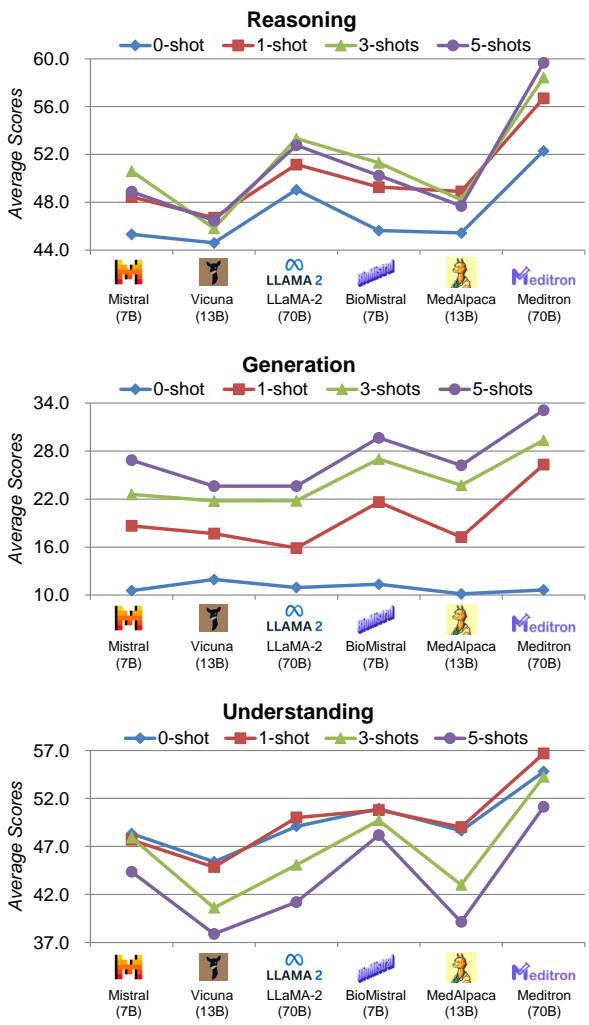
Figure 3 breaks this down by task type:
- Reasoning (Top Graph): Providing 1 or 3 examples helps significantly.
- Generation (Middle Graph): More examples are better. Giving the model 5 examples of good summaries helps it write much better summaries.
- Understanding (Bottom Graph): This is the surprise. Performance gets worse with more examples. The authors speculate that for tasks like Entity Extraction, providing examples from different medical contexts introduces “noise” that confuses the model rather than helping it.
4. Human Evaluation: The Clinical Usefulness
Automated metrics (like accuracy) don’t tell the whole story. A model might be “accurate” but rude, unsafe, or dangerously concise. The researchers recruited medical experts to evaluate the models on four criteria: Factuality, Completeness, Preference, and Safety.
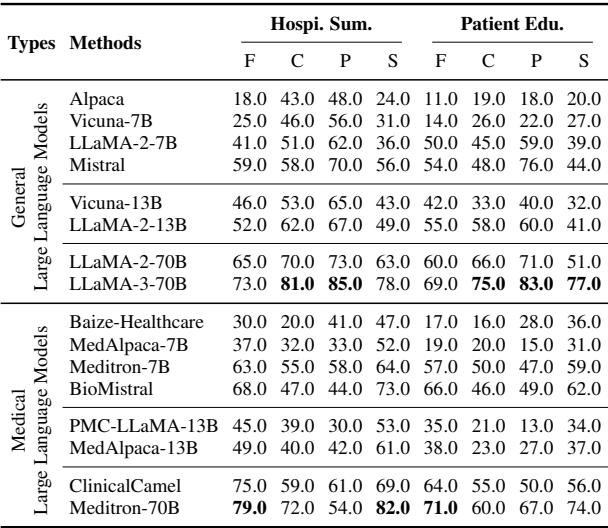
Table 4 reveals a fascinating trade-off between General and Medical LLMs:
- Safety & Factuality: Medical LLMs (like Meditron-70B) often outperform General LLMs here. They are less likely to hallucinate dangerous advice because they’ve been trained on medical literature.
- Preference & Completeness: General LLMs often win here. They write more fluently and adhere to user preferences better.
The Paradox: Sometimes, “Hallucination” in General LLMs resulted in more complete answers (by suggesting a broader range of diagnoses), which clinicians sometimes preferred for brainstorming, provided they verified the info. However, for Safety, Medical LLMs are superior.
Developing Better Medical LLMs: The Role of Data
If we want to fix these issues, we need to look at how these models are trained. The researchers conducted an ablation study to see what kind of Instruction Fine-Tuning (IFT) data works best.
They compared four data sources:
- Dialogues: Doctor-patient chats.
- QA: Exam questions.
- Articles: Medical textbooks/papers.
- NHS: A clinical-standard knowledge base (structured data about diseases and treatments).
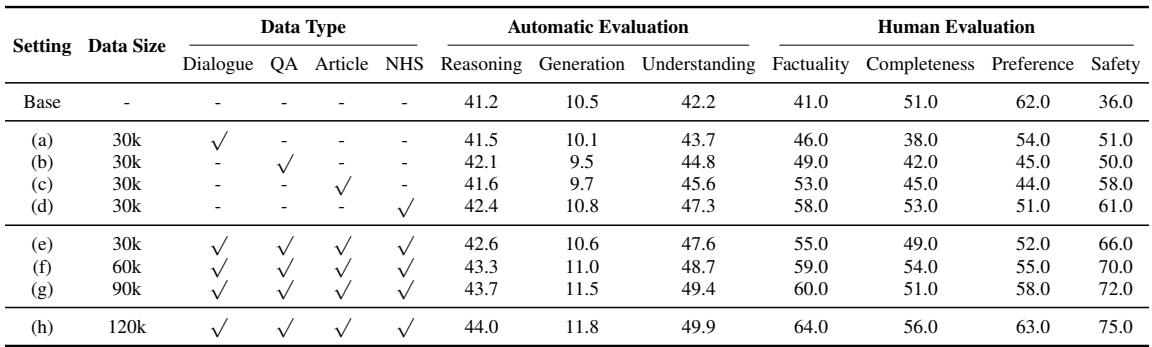
Table 5 shows the impact of these data sources.
- Row (d): Training on NHS (Knowledge Base) data yielded the highest Factuality (58.0) and Safety (61.0) scores among single data sources.
- Row (h): The best results came from combining all data types and increasing the dataset size to 120k samples.
This leads to a crucial insight: Diversity of data is as important as quantity. Reliance solely on dialogues (which is common for many chatbots) results in lower factuality. You need hard, clinical knowledge bases in the training mix.
A Qualitative Example
To make this concrete, let’s look at an actual output comparison.
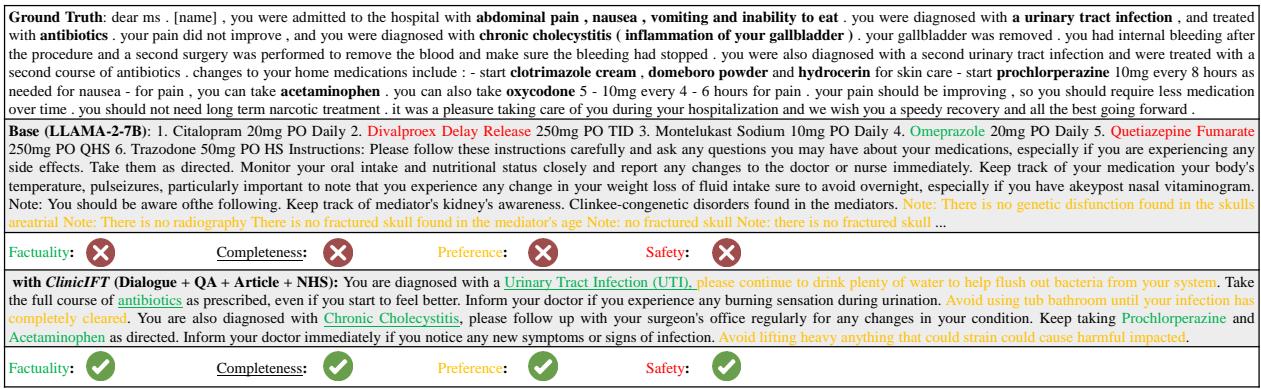
In Figure 4, we see a Patient Education task.
- Base Model (LLAMA-2-7B): It fails completely. It hallucinates (“There is no fractured skull” - irrelevant to the patient), repeats itself, and dangerously suggests anti-psychotic drugs (Quetiazepine) that the patient doesn’t need.
- With ClinicIFT (Fine-Tuned): The model correctly identifies the UTI and Cholecystitis, recommends appropriate meds (Acetaminophen), and gives clear, safe instructions.
This visualizes exactly why “out-of-the-box” LLMs are dangerous in clinical settings and why the specific fine-tuning recipe proposed by the authors (ClinicIFT) is necessary.
Conclusion & Implications
The paper “Large Language Models Are Poor Clinical Decision-Makers” serves as a vital reality check for the AI healthcare industry. By moving the goalposts from “passing exams” to “ClinicBench,” the authors have highlighted the significant gaps that still exist.
Key Takeaways:
- LLMs are not yet Doctors: They excel at reasoning when given options but falter when asked to generate open-ended treatment plans or handle long documents.
- The “Clinical Gap” is Real: Performance drops significantly when moving from academic ML tasks to realistic clinical workflows.
- Data Quality Matters: Building a safe Medical LLM requires fine-tuning on diverse, knowledge-grounded data (like the NHS database), not just scraping medical dialogues or papers.
For students and researchers, this paper opens up exciting avenues. The challenge is no longer just “can we get higher accuracy on MedQA?” The real challenge is “can we build models that handle the messiness of real-world data without hallucinating, while remaining safe?” The ClinicBench provides the roadmap to answer that question.