](https://deep-paper.org/en/paper/file-3283/images/cover.png)
Imagine you are looking at a photograph of a bustling city street. In the background, there is a bus. A friend asks you, “What is the name of the bus company?” To answer, your eyes immediately filter out the pedestrians, the buildings, the traffic lights, and the clouds. You focus entirely on the logo printed on the side of the bus.
For humans, this selective attention is instinctual. For Artificial Intelligence, specifically Visual Question Answering (VQA) systems, it is incredibly difficult. When presented with a complex image, traditional AI models often get “distracted” by the most prominent objects (like the pedestrians) rather than the specific detail required to answer the question (the logo).
In a recent paper titled “Large Language Models Know What is Key Visual Entity: An LLM-assisted Multimodal Retrieval for VQA,” researchers propose a novel solution called LLM-RA. By leveraging the reasoning capabilities of Large Language Models (LLMs), they teach the system to act like a detective—identifying exactly which “Key Visual Entities” matter before attempting to answer the question.
In this deep dive, we will explore how LLM-RA works, the architecture that powers it, and why it outperforms models that are significantly larger in size.
The Problem: The Noise in the Picture
Visual Question Answering (VQA) has evolved from identifying simple objects (“Is there a dog?”) to answering knowledge-intensive questions (“What architectural style is this building?”). To handle these complex queries, researchers developed Retrieval-Augmented VQA (RA-VQA).
In an RA-VQA system, the model doesn’t just guess the answer; it uses the image to search an external database (like Wikipedia or Google Search) for relevant documents. It then uses those documents to generate an answer.
However, a major issue persists: Visual Noise.
If an image contains a church, a cemetery, trees, and people, and the question asks about the church’s history, a standard retriever might get confused by the visual features of the cemetery or the people. It might retrieve documents about “graves” or “tourists” rather than the specific church.
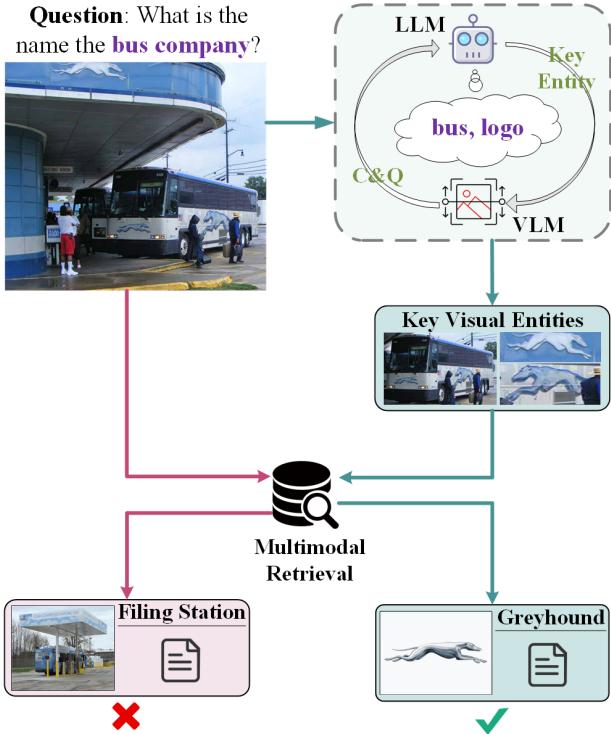
As shown in Figure 1, when asked about the bus company, a standard model might get distracted by the general scenery (like a filling station background) and retrieve incorrect information. The researchers realized that to fix this, the model needs to know what to look at before it starts searching.
The Solution: LLM-RA
The researchers propose LLM-RA (LLM-assisted Retrieval Augmentation). The core philosophy is simple: Reason first, look second.
Instead of feeding the entire image into a search engine blindly, LLM-RA uses a Large Language Model to analyze the question and the image’s description. The LLM deduces which specific objects (entities) are crucial for the answer. The system then “crops” or focuses on these entities to perform a much more targeted search.
The Architecture: A Two-Stage Process
The LLM-RA method operates in two distinct stages:
- Key Visual Entity Extraction: Identifying and locating the important objects.
- Multimodal Joint Retrieval: Encoding these specific objects to search the database effectively.
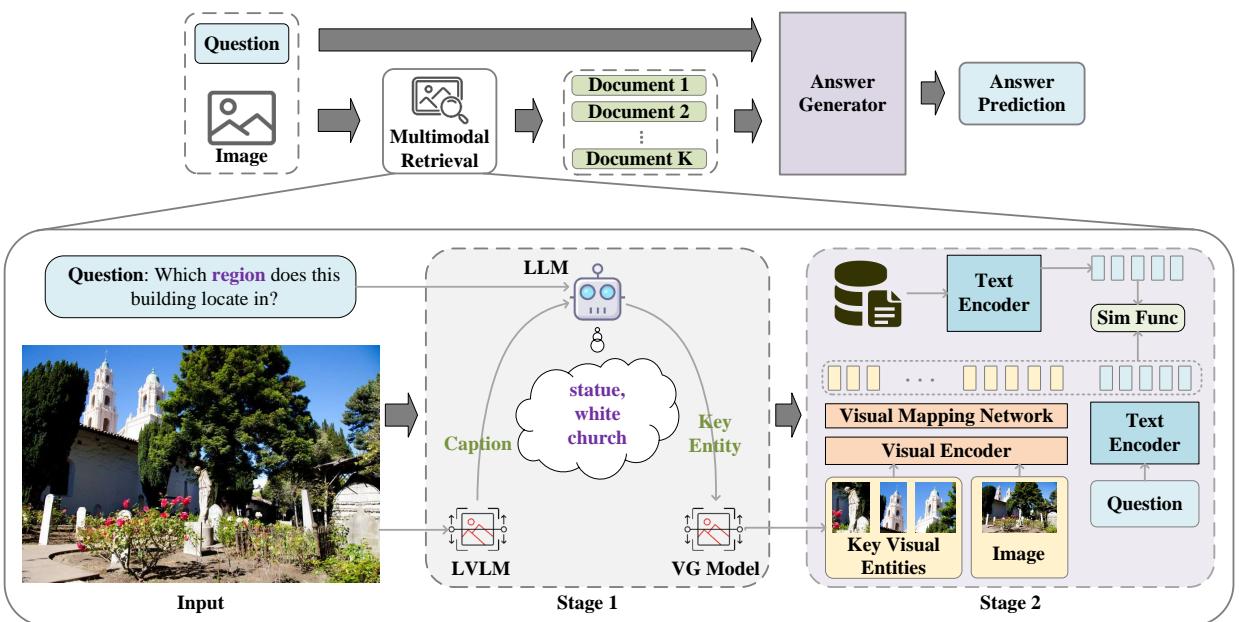
Let’s visualize the entire pipeline before breaking down the steps.
Stage 1: Key Visual Entity Extraction
This stage is where the “detective work” happens. It bridges the gap between the raw image and the reasoning required to answer the question.
1. General Captioning: First, the system uses a Visual Language Model (VLM) to generate a detailed text caption of the image. For example, “A sunlit churchyard features a white church with twin towers and a statue amid graves…”
2. LLM Reasoning: This is the critical innovation. The system feeds the caption and the question into a Large Language Model (like LLaMA or GPT). The LLM is prompted to output the specific entities that are relevant to the question.
- Input: Caption + Question (“Which region does this building locate in?”)
- LLM Output:
{"statue": "amid graves", "church": "white with twin towers"}
The LLM uses its internal logic to understand that to identify the region, one should look at landmarks like the church architecture or unique statues, ignoring generic trees or sky.
3. Visual Grounding: Now the system knows conceptually what to look for, but it needs to find those things visually in the pixels. It uses a Visual Grounding model (specifically Grounding-DINO). This model takes the text description of the entity (e.g., “The statue that is amid graves”) and draws a bounding box around it in the original image.
These bounding boxes are the Regions of Interest (ROIs). They represent the “Key Visual Entities.”
Stage 2: Multimodal Joint Retrieval
Now that the system has isolated the important visual clues, it needs to search the external database. In standard approaches, models often squash the entire image and question into a single mathematical vector. This causes Cross-Entity Interference—where the features of the “trees” blend with the features of the “church,” muddying the search query.
LLM-RA solves this by encoding the key entities independently.
The Mathematical Representation
The researchers construct a complex query vector (\(E_Q\)) that stacks different pieces of information together. The query includes:
- The text of the question (\(Q_s\)).
- The global view of the whole image (\(I\)).
- The specific cropped images of the Key Visual Entities (\(I_1, I_2, ...\)).
This is represented by the following equation:
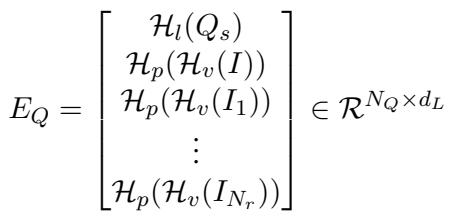
Here, \(\mathcal{H}_l\) is the text encoder, and \(\mathcal{H}_v\) is the visual encoder (like CLIP). By stacking them, the model preserves the distinct details of the key entities.
The documents in the database (\(D\)) are also encoded into vectors:

Joint Retrieval Similarity
To find the best document, the system calculates the similarity between the expanded query stack and the document. It doesn’t just look for a general match; it checks how well the document matches the question and the global image and the specific key entities.
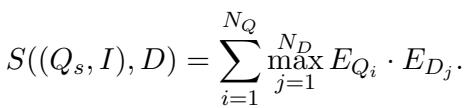
This summation ensures that a document is ranked highly only if it aligns well with the specific visual clues the LLM identified as important.
Why This Matters
By independently encoding the key entities (e.g., the specific logo on the bus), the retriever becomes sensitive to fine-grained details. It is no longer “drowned out” by the noise of the background scenery.
Experiments and Results
The researchers tested LLM-RA on two challenging “Knowledge-Intensive” benchmarks: OK-VQA (which requires external knowledge like Wikipedia) and Infoseek (which focuses on fine-grained entity recognition).
The results were impressive, particularly given the model’s size relative to its competitors.
Performance on Infoseek
The Infoseek dataset is notoriously difficult because it asks specific questions about specific entities (e.g., identifying a specific bird species or building).
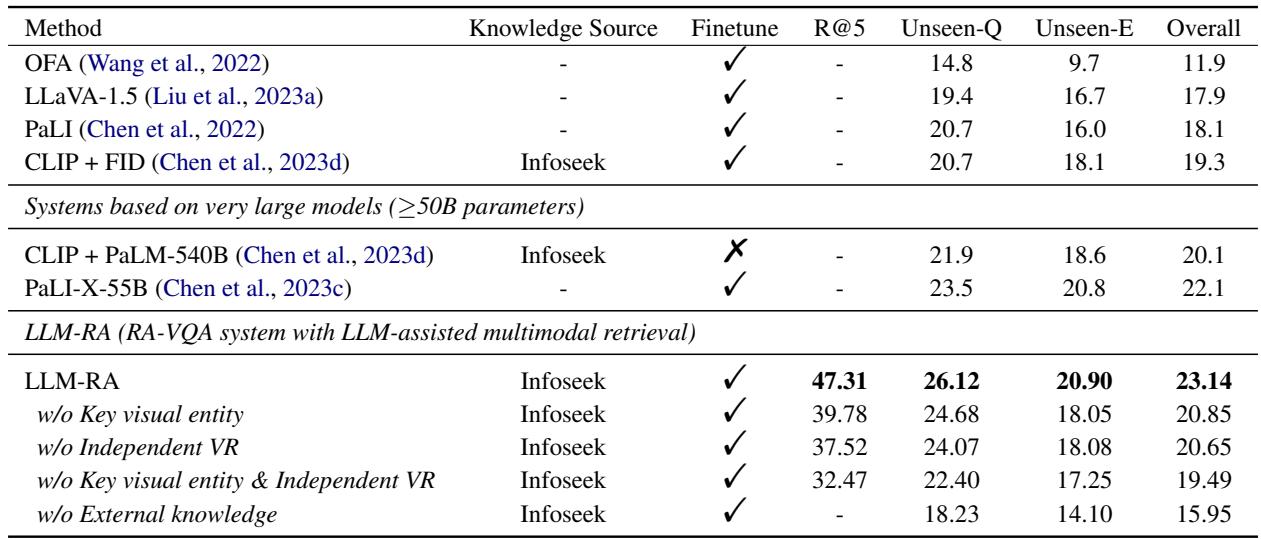
As shown in Table 2, LLM-RA achieved a score of 23.14, setting a new state-of-the-art. Crucially, it outperformed PaLI-X-55B (22.1), a model with nearly 10 times the parameters.
The “Unseen” columns are particularly telling. These represent questions or entities the model was not explicitly trained on. LLM-RA’s superior performance here proves that its method of reasoning about what to look for generalizes better than simply memorizing training data.
Ablation Study: Does the “Key Entity” Approach Work?
You might ask: “Is it the LLM reasoning that helps, or just the fact that we are cropping parts of the image?”
To answer this, the researchers compared their method against utilizing “All ROIs” (just detecting every object in the image using a standard object detector) versus their “Key ROIs” (only the objects the LLM said were important).
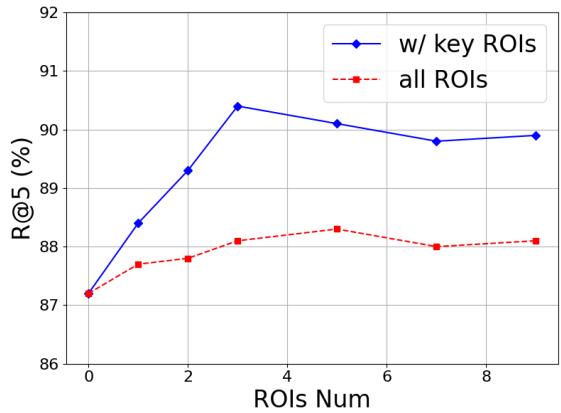
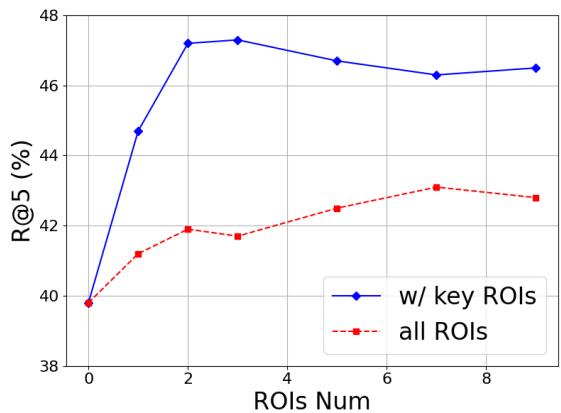
Figures 3 and 4 clearly show that “more” is not “better.”
- Red Line (All ROIs): Simply adding more object crops to the query often hurts performance or yields diminishing returns. It adds noise.
- Blue Line (Key ROIs): Selecting the top 3 entities identified by the LLM results in the highest accuracy. This confirms that the relevance of the visual information is more important than the quantity.
Handling Cluttered Images
The researchers also categorized images by how “cluttered” they were (the number of objects present).
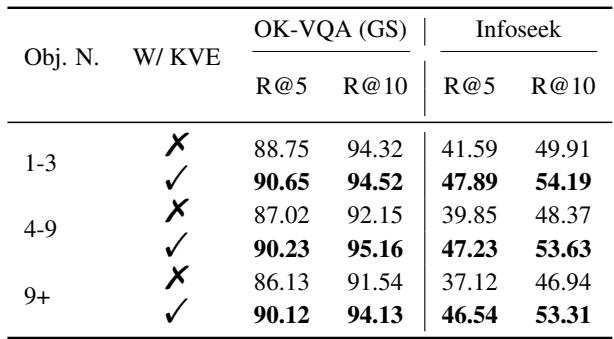
Table 3 highlights a fascinating trend. In images with few objects (1-3), the improvement is modest. However, in images with 9+ objects (highly cluttered scenes), the gap widens significantly. This proves the hypothesis: the more “visual noise” there is in an image, the more critical it is to have an LLM act as a filter to identify the key entities.
Case Studies: Seeing the Difference
Let’s look at some real-world examples from the study to see how LLM-RA corrects the mistakes of baseline models.
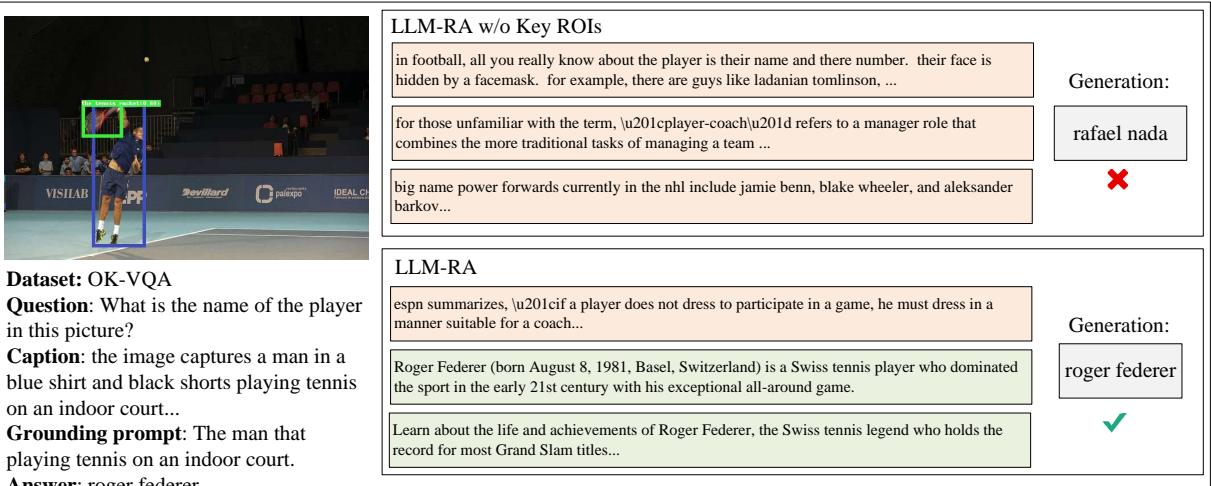
In the top example of Figure 5, the question asks “Where was this taken?”
- Without Key Entities: The model sees a street, cars, and buildings. It hallucinates a famous location (“Golden Gate”).
- With LLM-RA: The LLM identifies the “sign” as the key entity. The system crops the sign (“Welcome to Golden”), retrieves documents related to Golden, Colorado, and answers correctly.
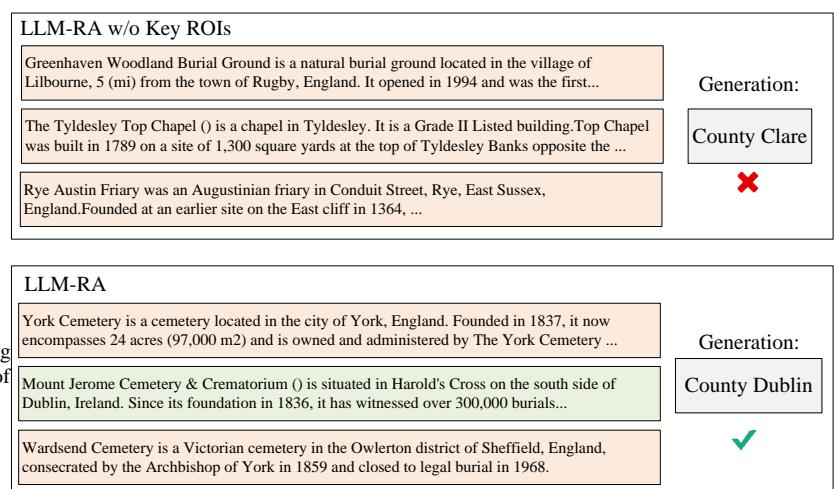
Similarly, in Figure 7, looking at the Stonehenge example:
- The question asks about the “historic county.”
- The baseline gets confused by the crowd or the grass and retrieves a random castle in Wales.
- LLM-RA isolates the “large stones,” recognizes them as Stonehenge, and retrieves the correct county (Wiltshire).
Conclusion: The Power of Guided Attention
The paper “Large Language Models Know What is Key Visual Entity” provides a compelling argument for the future of multimodal AI. It moves away from the trend of simply building larger and larger models. Instead, it demonstrates that smarter architectures—specifically those that mimic human-like attention—can achieve better results with fewer resources.
By using an LLM to reason about what matters in an image before trying to retrieve knowledge, LLM-RA solves two major problems:
- Redundancy: It ignores the “noise” (like the random pedestrians).
- Interference: By encoding entities independently, it ensures that the features of one object don’t confuse the features of another.
As AI continues to integrate into search engines and educational tools, techniques like LLM-RA will be essential for ensuring that when we ask a computer a question about a complex scene, it knows exactly where to look.