](https://deep-paper.org/en/paper/file-3305/images/cover.png)
Introduction
In the world of Natural Language Processing (NLP), we often view progress as a straight line: we move from Bag-of-Words to Word2Vec, and then to Transformers like BERT. The assumption is usually that the newer model renders the older technique obsolete. Why count words with TFIDF when BERT can understand deep contextual semantics?
However, when it comes to Short Text Clustering—grouping tweets, news headlines, or Q&A titles without labels—BERT has a blind spot. While it is excellent at understanding general language, it often misses the significance of rare, domain-specific keywords. Conversely, the “outdated” TFIDF method is excellent at spotting these keywords but fails to grasp context.
This blog post explores a fascinating research paper, “Leveraging BERT and TFIDF Features for Short Text Clustering via Alignment-Promoting Co-Training,” which proposes that the best path forward isn’t choosing one over the other, but forcing them to learn from each other.
The researchers introduce COTC (Co-Training Clustering), a framework that treats BERT and TFIDF as two distinct “views” of the data. By using a co-training strategy, the deep semantic understanding of BERT is aligned with the keyword-precision of TFIDF, resulting in clustering performance that significantly outperforms state-of-the-art methods.
The Problem: When Deep Learning Misses the Point
Short text clustering is notoriously difficult because there is very little signal to work with. A short sentence provides sparse context.
Standard approaches usually fall into two camps:
- TFIDF-based: These rely on word overlap. If two sentences share the word “Python,” they are grouped. This fails when sentences have different words but the same meaning (e.g., “coding” vs. “programming”).
- BERT-based: These encode sentences into dense vectors. This captures meaning well but can drown out specific, high-value keywords, especially in technical domains where the model wasn’t pre-trained heavily.
To visualize this limitation, look at the t-SNE plot below from the StackOverflow dataset.
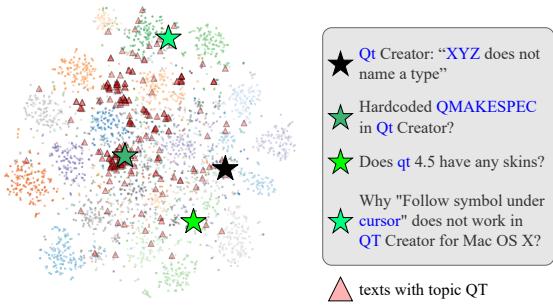
In Figure 1, notice the black star. It represents a question about “Qt Creator.” The three green stars are its nearest neighbors based on TFIDF—they are clearly relevant topics. However, in the BERT feature space, these points are scattered far apart. BERT fails to realize that the specific keyword “Qt” is the defining feature of this cluster. It prioritizes the general sentence structure over the crucial noun.
This observation is the foundation of the COTC framework: We need BERT’s brain, but we need TFIDF’s eyes for details.
The Solution: The COTC Framework
The authors propose a Co-Training Clustering (COTC) framework. Instead of simply concatenating BERT vectors and TFIDF vectors (which experiments show yields poor results), they build two separate training modules that communicate.
- The BERT Module: Learns dense representations using contrastive learning.
- The TFIDF Module: Learns from sparse data using a Variational Autoencoder (VAE).
The magic happens in the Alignment. The output of the TFIDF module guides the training of the BERT module, and vice versa.
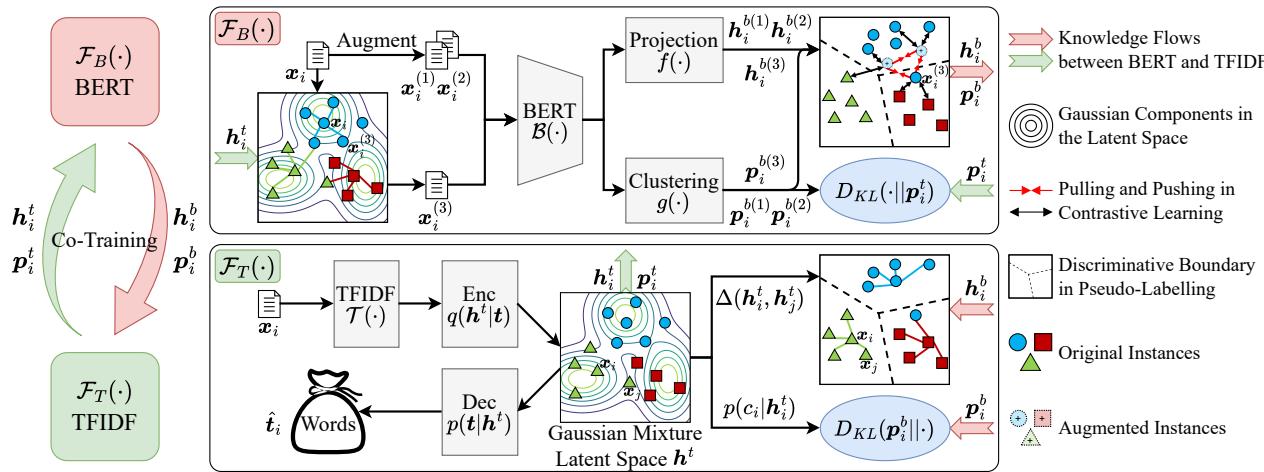
As shown in Figure 2, the architecture is bidirectional. Let’s break down how each module works and how they align.
1. The BERT Module (\(\mathcal{F}_B\))
The goal of this module is to fine-tune BERT to produce representations (\(h^b\)) and cluster assignments (\(p^b\)) that respect both semantic meaning and keyword similarity.
Contrastive Learning with a Twist
Standard contrastive learning creates two augmented versions of an image or text and forces the model to map them to the same point in space. COTC goes a step further. It uses the TFIDF signal to find “neighbors.”
If Text A and Text B are very similar in TFIDF space (meaning they share important keywords), the BERT module treats them as a “positive pair,” even if BERT initially thinks they are different.
The researchers construct a similarity graph using TFIDF representations. They then apply a contrastive loss function:
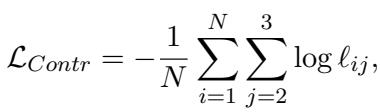
Here, the loss \(\mathcal{L}_{Contr}\) encourages the model to pull the representation of a text closer to its augmentations and its TFIDF-identified neighbors.
Clustering and Pseudo-Labeling
To perform the actual clustering, the BERT features are passed through a Multi-Layer Perceptron (MLP) to output a probability distribution over \(K\) clusters.

The model is trained using pseudo-labels. Instead of having human labels, the model generates its own “guess” labels (using a technique called Optimal Transport to ensure balanced clusters) and trains itself to predict them.
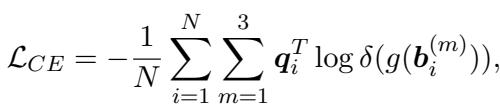
This allows the BERT model to refine its own boundaries iteratively.
2. The TFIDF Module (\(\mathcal{F}_T\))
While BERT uses contrastive learning, the TFIDF module uses a Variational Deep Embedding approach. Because TFIDF vectors are high-dimensional and sparse, the researchers use a Variational Autoencoder (VAE) to model the data generation process.
The generative process is defined as:
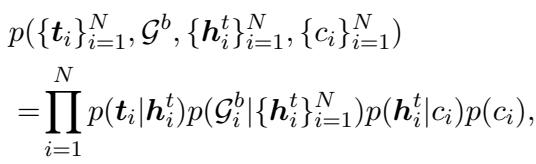
In simple terms, this equation says that a text’s TFIDF features (\(t_i\)) are generated by a latent variable (\(h_i^t\)), which in turn is generated by a specific cluster assignment (\(c_i\)).
The model tries to minimize the Evidence Lower Bound (ELBO), which is the standard loss function for VAEs:
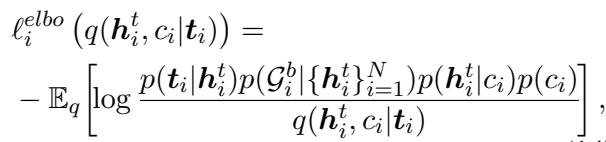
Crucially, the TFIDF module is not trained in isolation. It attempts to reconstruct a similarity graph derived from BERT representations. This is the reverse of the previous module: TFIDF is forced to respect relationships that BERT found significant.
3. Mutual Alignment (Co-Training)
The most critical contribution of this paper is the Alignment mechanism.
We have two probability distributions for every text sample:
- \(p_i^b\): The cluster probability predicted by BERT.
- \(p_i^t\): The cluster probability inferred from TFIDF.
Logic dictates that if the model is working correctly, these two should be identical. The researchers enforce this by minimizing the Kullback-Leibler (KL) Divergence between the two distributions.
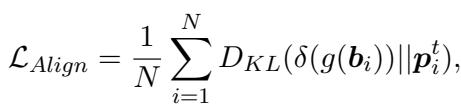
This alignment loss forces the two “views” to agree. If BERT thinks a text belongs to Cluster 1, but TFIDF thinks it belongs to Cluster 5, this loss will be high, forcing the networks to adjust their parameters until they converge on a consensus.
4. The Unified Training Objective
Finally, the researchers mathematically unify these separate losses into a single joint training objective. This allows gradients to flow efficiently across the entire framework.

In this equation:
- \(\mathcal{L}_{Contr}\): Ensures BERT representations are locally consistent.
- \(\mathcal{L}_{Cluster}\): Ensures BERT learns distinct clusters.
- \(\mathcal{L}'_{ELBO}\): Ensures TFIDF features are modeled correctly and aligned with BERT’s predictions.
This elegant unification means the BERT module essentially provides the “priors” for the TFIDF’s generative process, creating a tight feedback loop.
Experimental Results
The theory sounds solid, but does it work? The authors tested COTC on eight benchmark short-text datasets, including AgNews, SearchSnippets, and StackOverflow.
They compared their method against strong baselines:
- TFIDF-K-Means: Simple clustering on keyword features.
- BERT-K-Means: Simple clustering on BERT embeddings.
- SCCL & RSTC: State-of-the-art deep clustering methods that only use BERT.
- Concat Methods: Naively combining BERT and TFIDF vectors.
The results, presented in Table 1, are compelling.
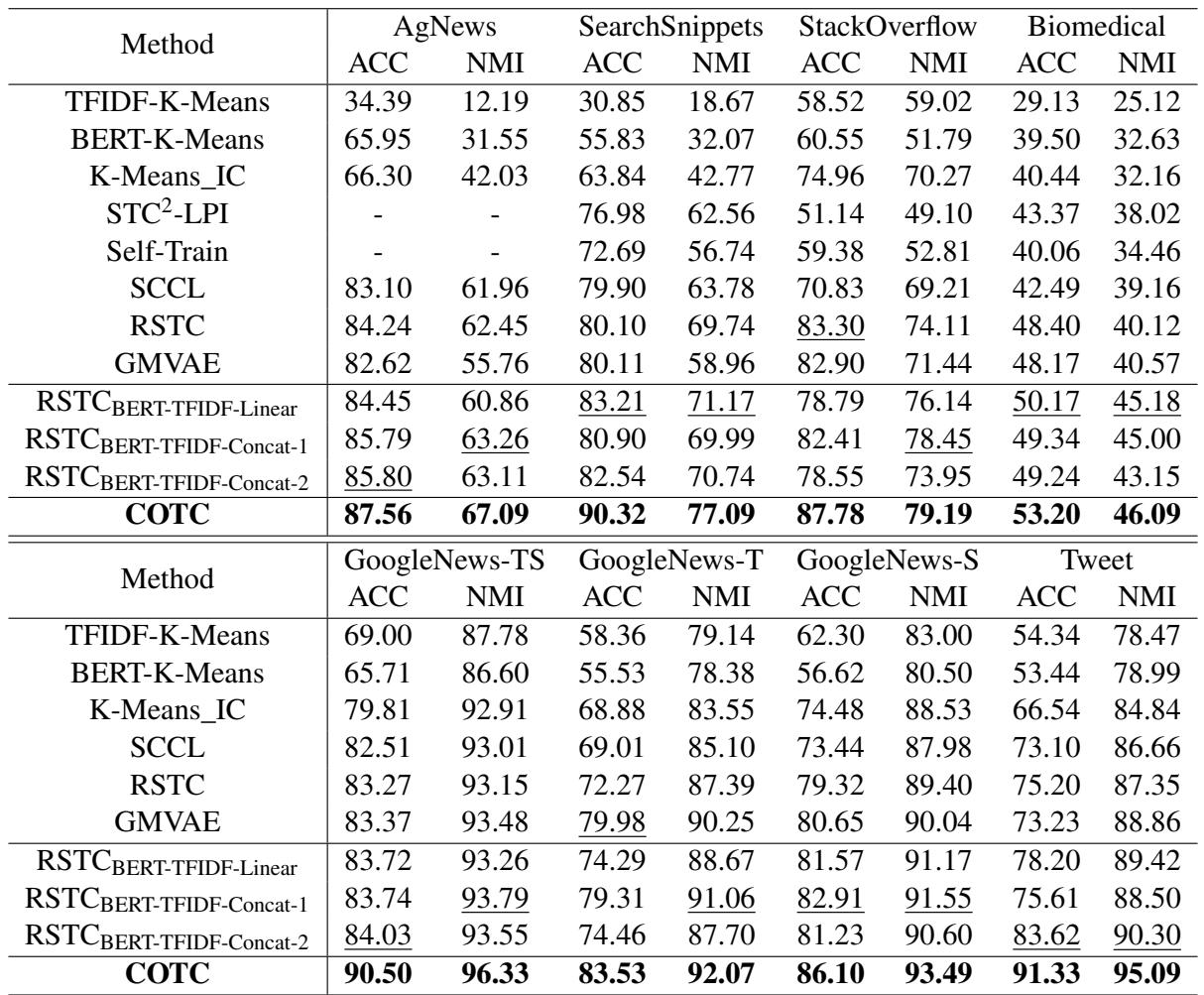
Key Takeaways from the Results:
- Dominance: COTC (the last row) achieves the best Accuracy (ACC) and Normalized Mutual Information (NMI) on almost every single dataset.
- Significant Margins: On the Biomedical dataset, COTC improves accuracy by nearly 5% over the previous best method (RSTC). On GoogleNews, the improvement is equally impressive.
- Naive Fusion Fails: Look at the rows for
RSTC_BERT-TFIDF-Concat. Simply sticking the two feature sets together often yields results worse than just using BERT alone. This proves that the co-training alignment strategy is necessary to effectively combine these modalities.
Visualizing the Improvement
To see what this looks like in practice, let’s examine the feature visualization on the StackOverflow dataset.
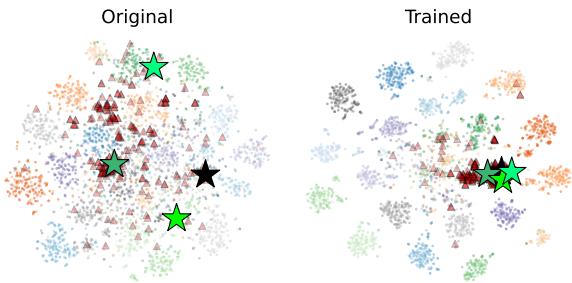
In Figure 7, the “Original” plot (Left) shows the initial data distribution. It is messy, with classes overlapping significantly. The “Trained” plot (Right) shows the output of the COTC framework. The clusters are clearly separated and distinct.
Furthermore, we can look at the keywords associated with these clusters to verify they make semantic sense.
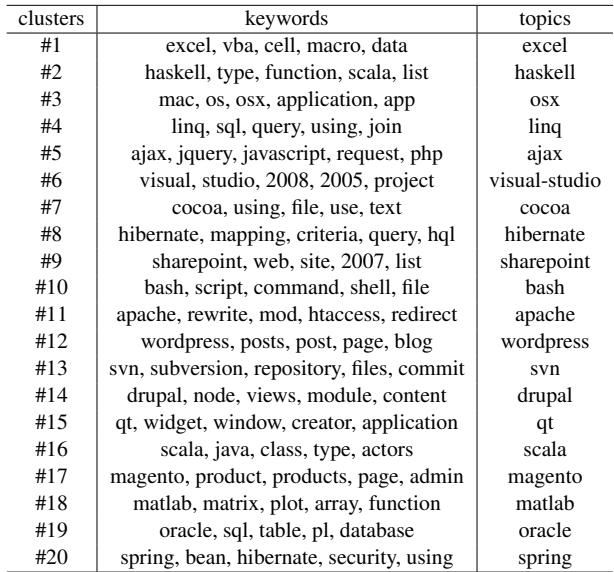
Table 8 confirms that the clusters are highly coherent. Cluster #1 is clearly about Excel/VBA, Cluster #15 is strictly about Qt development, and Cluster #19 groups Oracle/SQL database questions. The combination of BERT and TFIDF successfully grouped semantically related concepts while retaining the precision of technical keywords.
Sensitivity Analysis
One interesting aspect the researchers investigated was the sensitivity of the “neighbor” parameter (\(L\)). Recall that the BERT module uses TFIDF neighbors to guide its contrastive learning. How many neighbors should it look at?
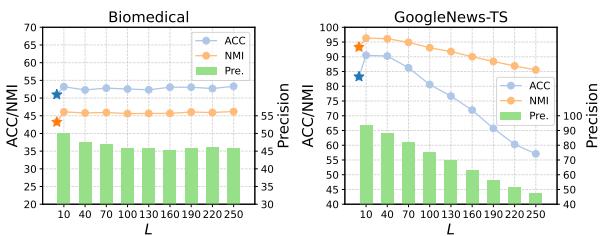
Figure 3 shows that the performance (ACC/NMI) is relatively stable, but generally peaks around \(L=10\). If \(L\) is too large (e.g., 250), the model starts pulling in irrelevant neighbors, introducing noise and lowering precision. This confirms that the keyword signal is most valuable when it is local and specific.
Conclusion and Implications
The paper “Leveraging BERT and TFIDF Features for Short Text Clustering via Alignment-Promoting Co-Training” provides a vital lesson for modern machine learning: Newer isn’t always sufficient.
While Pre-trained Language Models like BERT capture deep semantics, they are not omnipotent. They can struggle with the sparse, jargon-heavy nature of short text data. By revisiting TFIDF—a technique often discarded as “old school”—and integrating it through a sophisticated co-training framework, the researchers achieved state-of-the-art performance.
Key Takeaways for Students:
- Complementary Strengths: BERT provides the “context,” TFIDF provides the “anchor words.”
- Co-Training: Training two models to agree with each other is often more powerful than training one giant model or concatenating inputs.
- Alignment is Key: The success of multi-view learning relies on how you force the views to align (e.g., using KL Divergence).
This research opens the door for similar “hybrid” approaches in other fields, potentially combining deep learning with other traditional statistical features to solve complex data problems.