](https://deep-paper.org/en/paper/file-3349/images/cover.png)
Introduction
In the world of Information Retrieval (IR), we are constantly balancing a difficult trade-off: accuracy versus speed. We want our search engines to understand the nuance of human language like a massive Large Language Model (LLM), but we need them to return results in milliseconds like a simple keyword search.
Dense Passage Retrieval (DPR) has emerged as a powerful solution, using deep learning to represent queries and documents as vectors. However, the most accurate DPR models are often massive, computationally expensive, and slow to deploy. To solve this, researchers turn to Knowledge Distillation (KD)—a technique where a small, fast “student” model learns to mimic a large, slow “teacher” model.
But here is the problem: sometimes the gap between the teacher and the student is too wide. Imagine a Nobel Prize-winning physicist trying to teach quantum mechanics to a first-grader. The gap in understanding is so vast that the student gets lost.
In a recent paper titled “MTA4DPR: Multi-Teaching-Assistants Based Iterative Knowledge Distillation for Dense Passage Retrieval,” researchers propose a clever solution inspired by the university education system. Instead of relying solely on one professor, why not use Teaching Assistants (TAs)?
In this post, we will dive deep into MTA4DPR. We will explore how using multiple assistant models, fusing their knowledge, and iteratively training the student can create a compact model (66M parameters) that rivals the performance of massive 7B parameter models.
Background: The State of Dense Retrieval
Before understanding the solution, we need to understand the architecture of the models involved.
Dual-Encoders vs. Cross-Encoders
In dense retrieval, we generally categorize models into two types:
- Dual-Encoders: These are fast. They map the query (\(q\)) and the passage (\(p\)) into vectors independently. The relevance is calculated using a dot product. Because the document vectors can be pre-computed and indexed, retrieval is incredibly fast.

- Cross-Encoders: These are accurate but slow. They feed the query and passage together into the model (like BERT) to capture the deep interaction between every word in the query and every word in the passage.

Because Cross-Encoders are so much better at understanding context, we often use them as “Teachers” to train Dual-Encoder “Students.”
The Distillation Process
The goal of Knowledge Distillation in this context is to train the Dual-Encoder (Student) to predict the same relevance scores as the Cross-Encoder (Teacher).
We typically use a Contrastive Loss function, which encourages the model to pull positive passage vectors closer to the query vector and push negative passage vectors away.
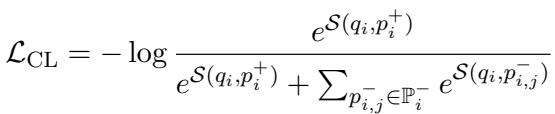
Simultaneously, we use KL Divergence to minimize the difference between the probability distributions of the Teacher and the Student. This forces the student to learn the “soft labels”—not just which document is right, but how right it is compared to others.
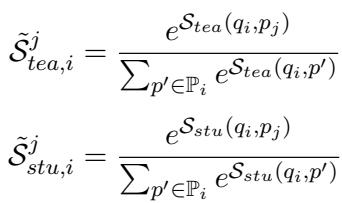

While this standard setup works, the researchers behind MTA4DPR argued that a single teacher isn’t enough, especially when the student is significantly smaller.
The Core Method: MTA4DPR
The core hypothesis of MTA4DPR is simple: incorporating assistants into knowledge distillation improves student performance. Furthermore, if we do this iteratively—where the student eventually becomes smart enough to help teach the next generation—we can narrow the performance gap even further.
Let’s break down the framework.
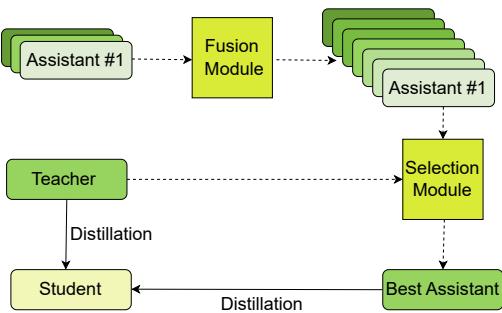
As shown in Figure 1, the framework consists of four main components:
- Data Preparation (with Difficulty Iteration)
- Fusion Module
- Selection Module
- Student Optimization
Let’s walk through each step of this iterative process.
1. Data Preparation and Curriculum Learning
At the beginning of each iteration, the system constructs a training dataset. This isn’t just a static list of queries and documents. The method uses “Curriculum Learning,” meaning the data gets harder as the student gets smarter.
The system uses the Teacher and all available Assistant models to retrieve the top-\(k\) passages for every query. It acts as a massive filter to find “Hard Negatives”—passages that look relevant but aren’t.
To combine the rankings from the Teacher and various Assistants, the authors use Reciprocal Rank Fusion (RRF). This creates a consolidated list of difficult passages for the student to learn from.
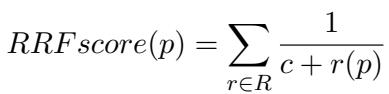
The Twist: In later iterations, the system specifically looks for queries that the previous student model got wrong. These “failure cases” are added back into the dataset, forcing the new student to focus on the hardest examples.
2. The Fusion Strategy
We have multiple assistants (e.g., other pre-trained dense retrievers). Just like in an ensemble method, combining the wisdom of the crowd often yields better results than listening to a single expert.
The Fusion Module generates new “Fused Assistants” by averaging the score distributions of the original assistants.
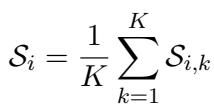
For example, if you have Assistant A and Assistant B, the module creates a new virtual Assistant C whose opinion is the average of A and B. This smooths out individual errors and provides a more robust signal for the student.
3. Assistant Selection
Now we have the Teacher (the ultimate truth), several original Assistants, and several Fused Assistants. We don’t want to use all of them at once for every single query, as that would be noisy and computationally overwhelming.
We need to pick the Best Assistant for the specific batch of data being trained. The paper proposes three strategies for this, but focuses on KL Divergence.
The Selection Module compares the score distribution of the Teacher against every Assistant. The Assistant that has the lowest KL divergence (i.e., is most similar) to the Teacher is selected as the best helper for that specific training step.
This is analogous to a professor assigning a TA who specializes in Algebra to help a student with Algebra homework, rather than assigning the Calculus TA.
4. Student Optimization
Finally, the student model is trained. The loss function is a combination of three things:
- Contrastive Loss (\(\mathcal{L}_{CL}\)): Learning to distinguish positives from negatives.
- Teacher Distillation (\(\mathcal{L}_{KL(tea, stu)}\)): Trying to mimic the Professor.
- Assistant Distillation (\(\mathcal{L}_{KL(ta, stu)}\)): Trying to mimic the selected Best Assistant.

The hyperparameters \(\alpha\), \(\beta\), and \(\gamma\) control the weight of each component. Interestingly, the assistant loss often receives a high weight, highlighting the importance of the intermediate guidance.
5. Iterative Evolution
This is where the magic happens. At the end of a training round (iteration), the student model is evaluated. If this new student performs better than the worst Assistant currently in the pool, the student replaces that Assistant.
In the next iteration:
- The pool of Assistants is stronger (because the new student joined).
- The data is harder (because we added the queries the student previously missed).
- The process repeats.
Experiments and Results
The researchers tested MTA4DPR on standard benchmarks: MS MARCO, TREC DL 2019/2020, and Natural Questions (NQ). They trained a compact 66M parameter model.
Main Results
The results were impressive. The 66M student model outperformed other models of the same size and remained competitive against models that were significantly larger.
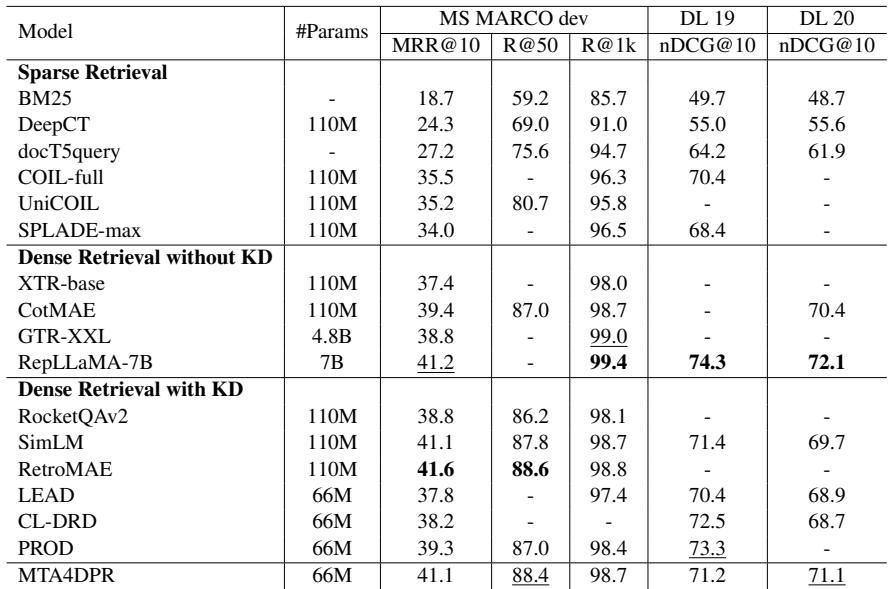
In Table 1, look at the MTA4DPR row at the bottom.
- On MS MARCO, it achieved an MRR@10 of 41.1.
- This matches SimLM (110M), a model nearly twice its size.
- It is incredibly close to RepLLaMA-7B, a massive Large Language Model based retriever, which scores 41.2.
This implies that with the right teaching strategy, a tiny model can punch way above its weight class.
The results on the Natural Questions (NQ) dataset tell a similar story:
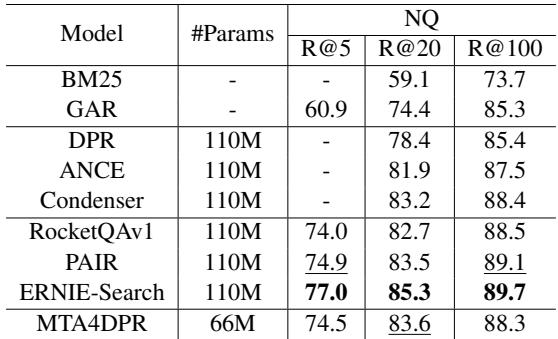
MTA4DPR achieves a Recall@20 of 83.6, outperforming standard DPR and closing the gap with larger distilled models like ERNIE-Search.
Ablation Study: Do we really need Assistants?
A common question in research is whether the complex parts of a method are actually necessary. The authors performed an ablation study to find out.
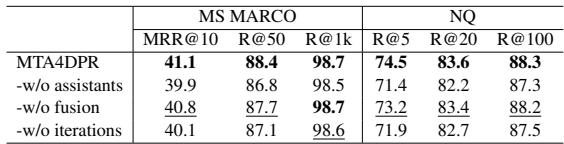
- w/o assistants: Removing assistants caused the biggest drop in performance (MRR dropped from 41.1 to 39.9). This proves the core hypothesis: the Teacher alone is not enough.
- w/o fusion: Removing the fusion strategy also hurt performance, showing that “ensemble” assistants provide better signals.
- w/o iterations: Training just once (without the iterative loop) resulted in lower scores, validating the curriculum learning approach.
Who is the “Best” Assistant?
The Selection Module picks the best assistant for each batch. The authors analyzed which assistants were actually chosen during training.
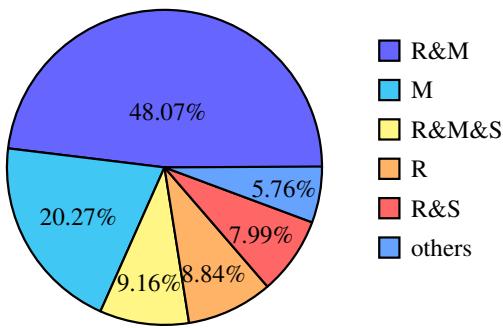
Figure 2 shows the breakdown. Interestingly, the single most selected assistant (at 48.07%) was “R&M”, which is a fused version of the RetroMAE and M2DPR models. This validates the Fusion Module—the “virtual” assistants created by combining models were often more helpful than the original models themselves.
Training Complexity vs. Inference Speed
One valid critique of this method is that the training process is complex. You need to run multiple assistants, calculate fusions, and iterate.

Table 8 shows that while data construction takes longer (12.9 hours vs 8.2 hours for traditional KD), the actual model training time is very similar.
However, the payoff is in Deployment. Because the resulting student model is small (66M params vs 110M or 7B), it is incredibly fast at inference time. You pay the cost once during training to get a model that is cheap and fast to run forever after.
Conclusion and Implications
MTA4DPR demonstrates that in Knowledge Distillation, the quality of instruction matters just as much as the quantity of data. By introducing “Teaching Assistants” to bridge the gap between a complex Teacher and a simple Student, the researchers achieved state-of-the-art results with a highly compact model.
Key Takeaways:
- The Gap is Real: Direct distillation from a massive teacher to a tiny student is suboptimal. Intermediate assistants help bridge the complexity gap.
- Collaboration Works: Fusing the knowledge of multiple assistants creates a better signal than any single assistant can provide.
- Iterative Growth: Allowing the student to “graduate” and become an assistant for the next iteration creates a positive feedback loop of improvement.
- Efficiency: It is possible to have LLM-level retrieval quality in a model that fits easily on a standard GPU.
This approach is not limited to Dense Passage Retrieval. The concept of “Multi-Teaching-Assistants” could potentially be applied to other areas of AI, such as text summarization, question answering, or even computer vision, wherever a large model needs to be compressed into a efficient, deployable one.