](https://deep-paper.org/en/paper/file-3363/images/cover.png)
In March 2024, Vladimir Putin won the Russian presidential election. If you read about this event in a state-backed Russian outlet, you likely encountered a narrative of “legitimacy,” “national unity,” and a “landslide victory.” If you read a Western outlet, the story was likely framed around “electoral fraud,” the “suppression of opponents,” and the ongoing war in Ukraine.
The core facts—that an election happened and Putin won—are the same. The difference lies in the media attitude, or how the outlet feels about the event.
For years, computer scientists have tried to build AI that can automatically detect this kind of bias. Traditional methods often rely on word choice (e.g., analyzing whether a text uses positive or negative adjectives). However, sophisticated propaganda and media framing are rarely that simple. They don’t just use “bad” words; they construct specific narratives by choosing which events to highlight, which to ignore, and how to link them together.
In this post, we are diving deep into a fascinating research paper, “Media Attitude Detection via Framing Analysis with Events and their Relations,” which proposes a novel way to detect media bias. Instead of just looking at keywords, this method analyzes the “skeleton” of the news story—the events, their descriptions, and the causal links between them.
The Problem: Why Word Choice Isn’t Enough
Imagine a journalist wants to frame a protest negatively. They don’t need to use the word “bad.” They simply need to focus on an event where a window was broken and imply that the protest caused the damage. Conversely, a supportive journalist might omit the broken window entirely and focus on the event of a peaceful speech.
This concept is known as Framing. As defined by Entman (1993), framing involves selecting certain aspects of a reality to make them more salient.
Previous computational approaches to framing have struggled with two main limitations:
- Shallow Analysis: They focus on “what is presented” (topics) rather than “how it is presented” (narrative structure).
- Missing Context: They often treat documents as “bags of words,” ignoring how events within the document relate to one another or how they relate to the same event in other documents.
The researchers behind this paper argue that to truly understand media attitude, we need to look at events and their relations.
The Solution: A Pipeline for Narrative Analysis
The researchers developed a comprehensive pipeline that transforms a raw news article into a structured representation of its narrative. This allows the model to “read” the story not just as a stream of text, but as a logical chain of events.
The architecture is visualized below. It’s a journey from raw text to a sophisticated “attitude map.”
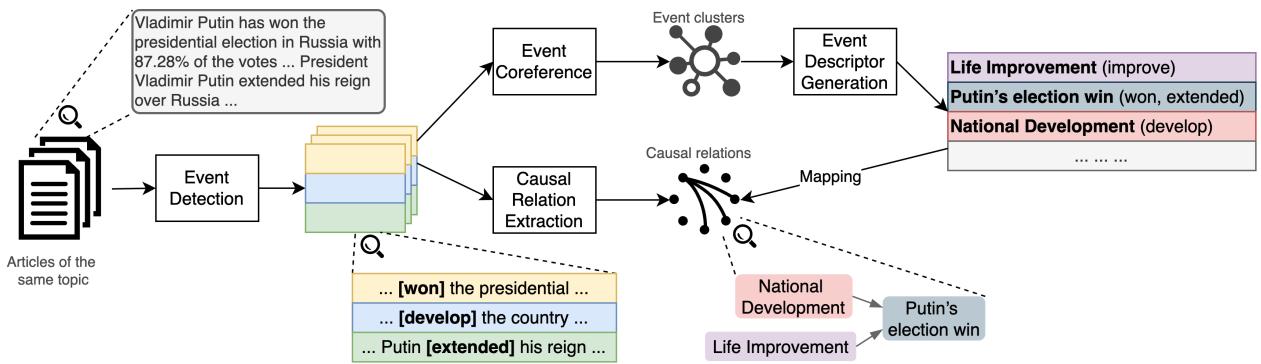
Let’s break down this pipeline into digestible steps.
Step 1: Event Detection
First, the system reads articles on a specific topic (like the Putin election). It scans the text to identify events—specific occurrences or actions. For example, in the sentence “Putin won the election,” the event trigger is “won.”
Step 2: Cross-Document Event Coreference (CDEC)
This is a fancy term for a simple concept: figuring out when different articles are talking about the same thing.
If Article A says “Putin’s victory” and Article B says “The election results,” they are referring to the same real-world event. The system clusters these mentions together. This is crucial because it allows the model to compare how different outlets describe the exact same event.
Step 3: Generating Framing Devices
Once the events are detected and clustered, the researchers extract three specific “Framing Devices.” These are the core features the AI uses to determine if an article is supportive, skeptical, or neutral.
The Core Method: Three Ways to Frame a Story
The heart of this paper is the conceptualization of these three devices. The researchers hypothesize that media attitude is encoded in Selection, Linguistics, and Causality.
Device 1: Selection and Omission (Event Clusters)
The most powerful tool a varied media outlet has is the ability to ignore things. If an article about an election omits all mentions of opposition protests, it creates a supportive frame by default.
To capture this, the model looks at the Event Coreference Clusters. It generates a neutral, abstract summary (a “descriptor”) for every event mentioned in the article.
The mathematical representation for an article \(d_i\) using this device looks like this:

Here, \(C(E)\) represents the abstract descriptor of an event cluster. By feeding the model a list of what events were included (and by extension, what was left out), the AI can judge the narrative scope.
Device 2: Linguistic Information (Event Mentions)
While Device 1 looks at what events are there, Device 2 looks at how they are described.
There is a massive difference between “The army neutralized a threat” and “The army killed a protestor.” Both refer to the same event cluster (Device 1), but the specific words (triggers and arguments) carry heavy emotional and political weight.
The encoding for this device preserves the specific textual triggers used in the article:

This vector captures the euphemisms (softening harsh events) or dysphemisms (making events sound worse) that are the hallmarks of biased writing.
Device 3: Cause and Effect (Causal Relations)
This is perhaps the most innovative part of the paper. Narratives are built on causality. A supportive article might imply:
- National Development \(\rightarrow\) Putin’s Win (Implying he won because he did a good job).
A skeptical article might imply:
- Suppression of Opponents \(\rightarrow\) Putin’s Win (Implying he won because he cheated).
The researchers extract these “Cause \(\rightarrow\) Effect” pairs to understand the logic the article is trying to sell to the reader.
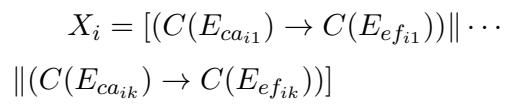
By combining these three devices, the model doesn’t just read the text; it understands the argument.
The Dataset: Real-World Contentious Topics
To test this, the researchers didn’t use synthetic data. They collected over 1,600 news articles covering three highly contentious international topics:
- Putin’s Election Win (March 2024)
- Israel’s Al-Shifa Hospital Raid (November 2023)
- Hong Kong Protests (July 2019)
The data includes sources from Western media (CNN, BBC), state-backed Russian media (Sputnik), Chinese media (Xinhua), and others, ensuring a wide spectrum of attitudes (Supportive, Skeptical, Neutral).
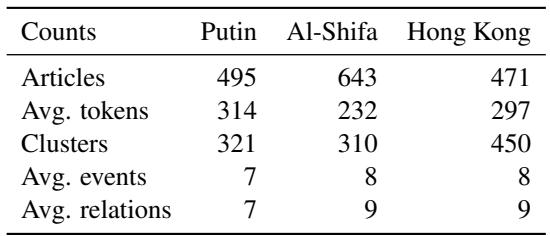
As you can see in the table above, the dataset is robust, with hundreds of articles per topic and thousands of extracted events and clusters.
Experiments and Results
The researchers tested their method using two types of AI models:
- Fine-tuned Small Models: Like RoBERTa (specialized for this task).
- Large Language Models (LLMs): Like GPT-4 and FlanT5 (using prompts).
They compared the “Baseline” (feeding the raw text of the article to the AI) against their “Framing Device” method (feeding the structured event/causal information).
1. Accuracy Performance
The results were compelling, particularly for Large Language Models.
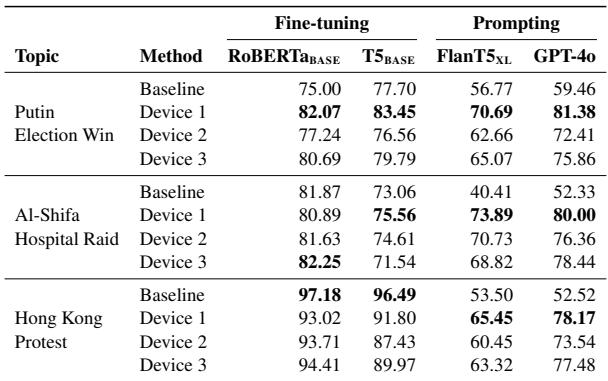
Key Takeaways from the Results:
- LLMs need structure: Look at the “Prompting” columns for FlanT5 and GPT-4o. When fed raw text (Baseline), they struggle (e.g., GPT-4o got 59.46% on Putin’s win). But when fed Device 1 (Event Clusters), performance jumped massively to 81.38%.
- Framing devices unlock reasoning: The structured input helps the LLM cut through the noise and focus on the narrative skeleton.
- Fine-tuned models are already good: RoBERTa performed well even on the baseline, likely because it learns to memorize specific keywords associated with bias. However, the framing devices still offered competitive performance.
2. Efficiency and Compression
One of the hidden benefits of this approach is efficiency. News articles are long. The framing devices compress the article down to its essential events and relations.
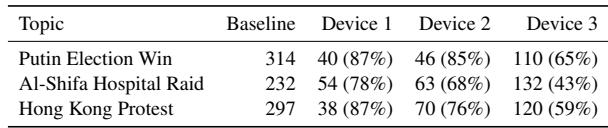
The table above shows that using framing devices reduces the input length by 43% to 87%. This means the AI processes the data much faster and at a lower cost, without losing the critical information needed to detect bias.
3. Explainability and Analysis
Why does this work better? The researchers performed a qualitative analysis to see how the models “think” when using these devices.
Table 5 below compares how GPT-4o interprets the same news story using different inputs.

- Baseline: The model reads the whole text about Navalny’s death but gets confused by the noise, labeling it “Neutral.”
- Device 1 (Selection): It sees “Navalny’s death” is selected as a key event. It infers skepticism.
- Device 3 (Causality): It sees the link “Navalny’s death \(\rightarrow\) Putin’s election win.” This explicitly suggests the election result is tainted by the death, leading to a “Skeptical” label.
The “Memorization” Test
A fascinating part of the analysis involved the Jensen–Shannon Divergence (JSD) score. In plain English, they measured how similar the training data was to the test data.
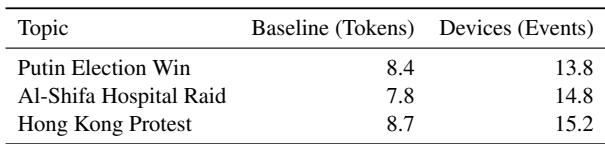
The JSD scores for “Tokens” (Baseline) are low, meaning the words used in the training and test sets are very similar. This suggests the fine-tuned models might just be memorizing keywords (pattern matching).
However, the JSD scores for “Events” are higher. This suggests that when the models use the Framing Devices, they aren’t just matching words; they have to actually reason about the events to make a prediction. This makes the Framing Device models more robust to new, unseen phrasing.
Limitations and Future Work
No method is perfect. The authors frankly discuss where their pipeline fails.

- Coreference Errors: Sometimes the system groups “Israel destroying facilities” and “Hamas destroying facilities” into a generic “Soldiers destroying facilities” cluster. This loss of detail can flip the perceived attitude.
- Missing Context: In the example above (Table 4), realizing that “seizing weapons” happened at a hospital is crucial for understanding the justification for the raid. If the extraction misses the location, the framing is lost.
- Sarcasm: The current pipeline struggles with sarcasm, which often relies on a mismatch between the literal event and the intended meaning.
Conclusion
This research marks a significant step forward in computational media analysis. By moving beyond “bag-of-words” approaches and treating news articles as structures of events and causes, we can build AI that understands narrative nuance much like a human does.
The implications are significant:
- For Researchers: It proves that injecting “structural knowledge” (events, causality) into LLMs drastically improves their zero-shot performance.
- For the Public: Tools built on this technology could one day help readers instantly identify the framing techniques used in the news they consume, promoting better media literacy.
In a world where the same election can be a “triumph” or a “sham” depending on where you click, understanding the frame is just as important as knowing the facts.