](https://deep-paper.org/en/paper/file-3369/images/cover.png)
Humans are emotionally complex creatures. We don’t just feel “happy” or “sad.” We feel ecstatic, content, devastated, terrified, or apprehensive. In the field of Natural Language Processing (NLP), distinguishing between these subtle nuances is known as Fine-grained Emotion Classification (FEC).
While standard sentiment analysis might be satisfied with labeling a sentence as “negative,” FEC aims to determine if that negativity stems from anger, fear, or sadness. This is incredibly difficult for machines because the difference often lies in the specific choice of vocabulary and the precise arrangement of words.
Today, we are diving deep into a research paper that proposes a novel solution to this problem: SEAN-GNN (SEmantic ANchor Graph Neural Network). This approach moves away from the traditional method of compressing a whole sentence into a single vector. Instead, it constructs a rich “anchor graph” that captures both the semantic content and the temporal structure of a sentence.
By the end of this post, you will understand how SEAN-GNN works, why “semantic anchors” are a powerful concept, and how this graph-based method outperforms massive Large Language Models (LLMs) on specific emotion tasks.
The Problem: The Compression Bottleneck
To understand why SEAN-GNN is necessary, we first need to look at how current state-of-the-art models handle text classification.
Typically, when we use a Pre-trained Language Model (PLM) like BERT or RoBERTa, we feed in a sentence and get back a sequence of “token embeddings” (vectors representing each word). To classify the sentence, most methods perform an aggregation step:
- Pooling: Taking the average or maximum of all token vectors.
- [CLS] Token: Using the special classification token derived from the model.
While efficient, these aggregation methods act as a compressor. They squash the complex, multi-dimensional information of a sentence into a single vector.
This compression leads to two major losses of information:
- Semantic Loss: A sentence expressing “terrified” might use words like “scream,” “horror,” and “intense.” A sentence expressing “afraid” might use “worry” or “nervous.” Averaging these vectors can wash out the high-order statistics that differentiate these fine-grained categories.
- Temporal Loss: The order of words matters. Consider these two sentences:
- “I feel extremely sad when I see animals abandoned.”
- “I feel sad when I see extremely pitiful animals abandoned.”
In the first, “extremely” modifies “sad,” intensifying the emotion. In the second, it modifies “pitiful.” A simple average pooling might treat these sentences identically because they contain the same bag of words.
SEAN-GNN addresses this by asking: What if, instead of compressing the sentence, we projected it onto a map of known emotional concepts?
The Solution: SEAN-GNN Architecture
The researchers propose a framework that introduces Semantic Anchors. Think of these anchors as fixed lighthouses in the sea of word embeddings. Each anchor represents a specific semantic concept (e.g., a cluster of words related to “joy” or “intensity”).
Instead of representing a sentence as a single vector, SEAN-GNN represents a sentence as a graph where:
- Nodes correspond to these Semantic Anchors.
- Node Attributes represent how much the sentence talks about that anchor (Semantics).
- Edge Weights represent the temporal relationship between anchors in the sentence (Time/Position).
Here is the high-level architecture of the model:
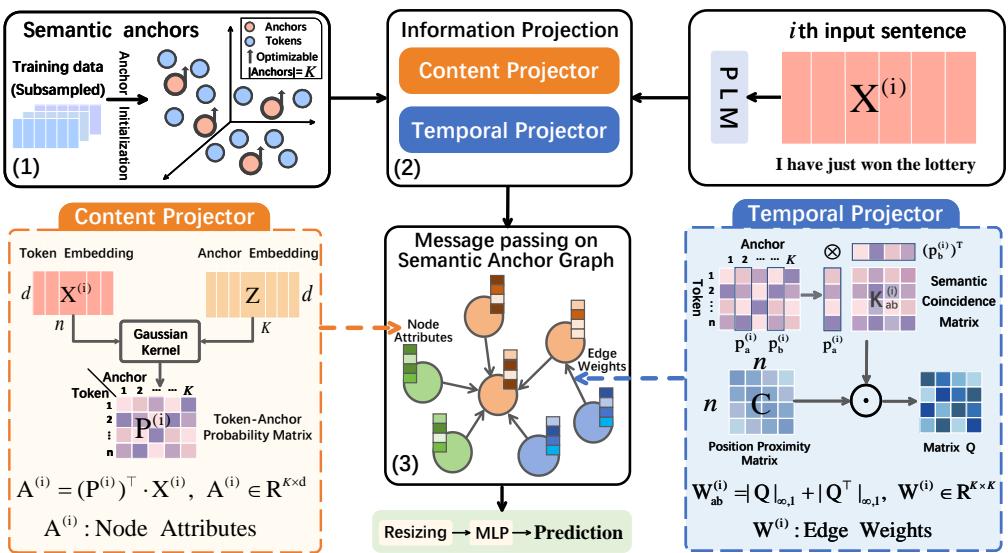
The process consists of three main phases:
- Learning Semantic Anchors: Initializing and refining the global reference points.
- Information Projection: Mapping the input sentence onto the anchor graph using a Content Projector and a Temporal Projector.
- Message Passing: Using a Graph Neural Network (GNN) to refine the features for classification.
Let’s break these down step-by-step.
1. Semantic Anchors
The model learns a set of \(K\) vectors, denoted as \(\mathbf{Z} = \{ \mathbf{z}_1, ..., \mathbf{z}_K \}\). These are shared globally across all sentences.
To ensure these anchors cover a diverse range of emotional vocabulary, they are initialized using K-means clustering on a subset of token embeddings from the training data. During training, these anchors are updated end-to-end, meaning the model learns to position them in the most useful spots in the vector space to discriminate between emotions.
2. Information Projection
This is the core innovation of the paper. We need to translate a variable-length sentence (which is hard to compare globally) into a fixed-sized graph structure (which is easy to compare).
We assume an input sentence \(\mathbf{X}^{(i)}\) consisting of \(n\) tokens.
The Content Projector (Semantic Information)
First, we want to know: Which anchors are present in this sentence?
The model computes a probability matrix \(\mathbf{P}^{(i)}\). Each entry \(\mathbf{P}_{jk}^{(i)}\) tells us the probability that the \(j\)-th word in the sentence belongs to the \(k\)-th anchor. This is calculated using a Gaussian kernel based on the distance between the word embedding and the anchor vector:
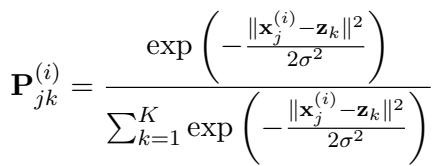
Essentially, if a word is very close to an anchor in the embedding space, the probability is high.
Using this probability matrix, we calculate the Node Attributes (\(\mathbf{A}^{(i)}\)) for our graph. We project the sentence’s token embeddings onto the anchors. If an anchor is irrelevant to the sentence, its attribute vector will be near zero. If it’s relevant, it aggregates the embeddings of the words associated with it.

The Temporal Projector (Structural Information)
Capturing the meaning of words is the easy part. Capturing their relationships and positions without a rigid sequence model (like an LSTM) is the challenge.
The researchers devised a clever way to project the sequential relationship of words onto the non-sequential anchors.
First, imagine looking at the probability matrix \(\mathbf{P}^{(i)}\) column-wise. A column \(\mathbf{p}_a^{(i)}\) represents the positional distribution of Anchor \(A\) in the sentence. If Anchor \(A\) is “sadness,” and the word “grief” appears at position 5, then \(\mathbf{p}_a^{(i)}\) will have a high value at index 5.
Now, consider two anchors, \(a\) and \(b\). We want to define an edge weight \(\mathbf{W}_{ab}^{(i)}\) between them. The logic is: If words corresponding to Anchor A and Anchor B appear close together in the sentence, the connection between these anchors should be strong.
The researchers visualize this relationship in Figure 2:
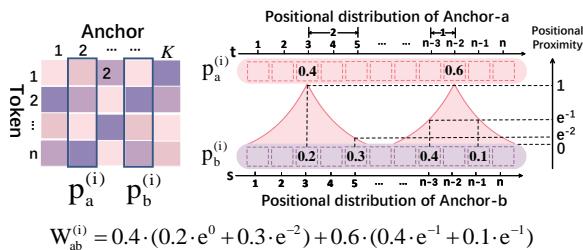
In the figure above, you can see the distributions of Anchor \(a\) and Anchor \(b\) across the sentence positions (1 to \(n\)). The overlap of these distributions, weighted by how close they are, determines the connection strength.
Mathematically, this is calculated by summing the interaction between every pair of positions \((s, t)\), weighted by an exponential decay function that drops off as the distance \(|s-t|\) increases:

To make this computation efficient and robust, the authors formulate this using matrix operations. They define a “coincidence matrix” \(\mathbf{K}\) and a “proximity matrix” \(\mathbf{C}\).
While a standard sum (\(\ell_1\) norm) could work, the authors found that using a mixed-norm (\(\ell_{\infty, 1}\)) provided more robust results. This emphasizes only the most significant word pairs rather than accumulating noise from every possible word combination. The final symmetric adjacency matrix \(\mathbf{W}^{(i)}\) is computed as:

At this stage, we have successfully converted a sentence into a Semantic Anchor Graph. The nodes describe what was said, and the edges describe how the concepts connect temporally.
3. Message Passing on the Graph
With the graph constructed, the model uses a Graph Convolutional Network (GNN) to refine the representations. This allows the anchors to “talk” to each other.
If the “Intensity” anchor is strongly connected to the “Sadness” anchor (because “extremely” was next to “sad”), the GNN allows the “Sadness” node to absorb information from the “Intensity” node, modifying its feature vector to represent a more severe emotion (e.g., devastated).
The message passing rule follows standard GCN mechanics:
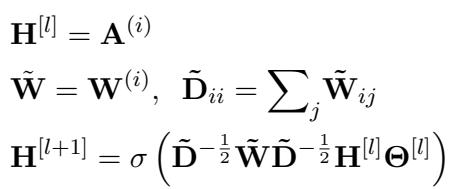
Finally, the features from the initial and final graph layers are concatenated and flattened to perform the final classification.
Experiments & Results
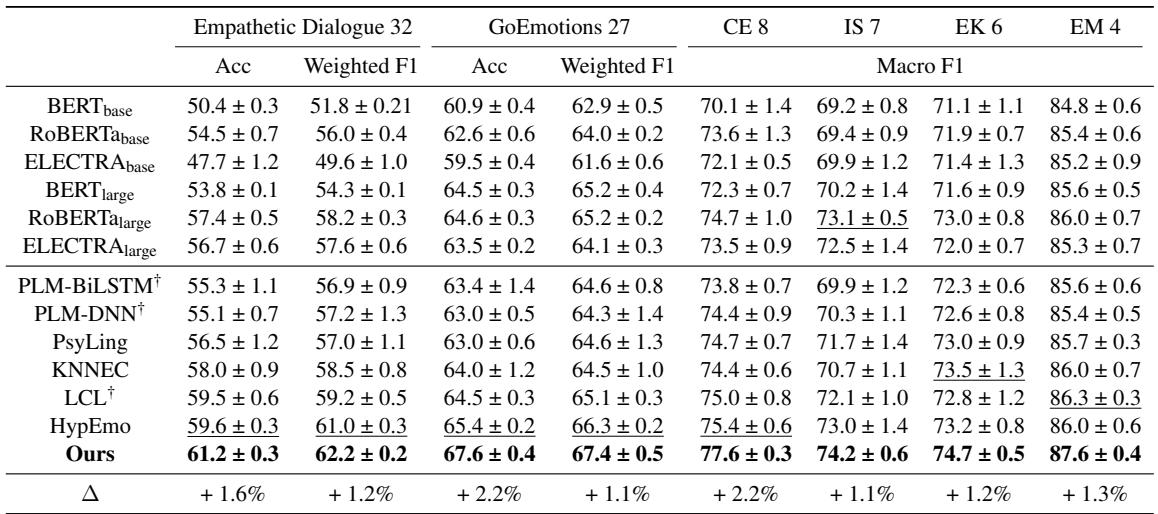
Does this graph-based approach actually work better than just using a massive Transformer model? The researchers tested SEAN-GNN on 6 benchmark datasets, including the difficult Empathetic Dialogue (32 classes) and GoEmotions (27 classes).
Comparison with State-of-the-Art
The results show that SEAN-GNN consistently outperforms baseline methods.
In Table 1 below, you can see SEAN-GNN compared against vanilla PLMs (BERT, RoBERTa, ELECTRA) and other specialized emotion models (like HypEmo and LCL).
Key Takeaways:
- SEAN-GNN achieves the highest accuracy and F1 scores across the board.
- On the GoEmotions dataset, it improves upon the second-best method by 2.2% in accuracy.
- Crucially, SEAN-GNN (using RoBERTa-base) outperforms RoBERTa-large. This proves that a smarter architecture can beat a larger model size.
Robustness Across Models
One might wonder if the improvement comes solely from the underlying language model. To test this, the authors applied the SEAN-GNN head to BERT, RoBERTa, and ELECTRA.
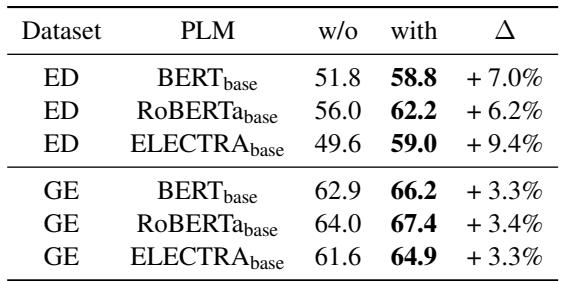
As shown in Table 2, applying SEAN-GNN yields a significant performance boost (between 3.3% and 9.4%) regardless of which pre-trained model is used as the backbone. This suggests the method is capturing fundamental information that standard [CLS] tokens miss.
How Many Anchors Do We Need?
Is more always better? The authors analyzed how the number of semantic anchors (\(K\)) impacts performance.
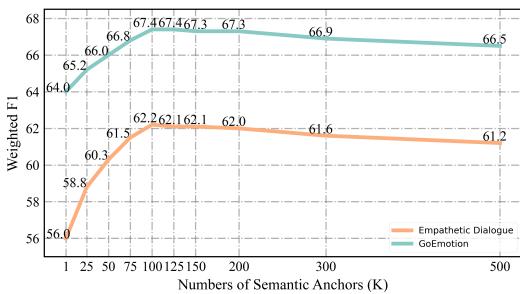
The performance climbs rapidly as anchors increase from 1 to about 100. After that, it plateaus. This indicates that around 100 to 150 anchors are sufficient to cover the semantic space of human emotions for these datasets. Adding too many anchors (e.g., 500) can actually introduce noise and slightly degrade performance.
Why It Works: A Look Inside the Black Box
One of the strengths of SEAN-GNN is interpretability. Because the nodes in the graph are explicit semantic anchors, we can inspect what the model is learning.
Visualizing Emotion Graphs
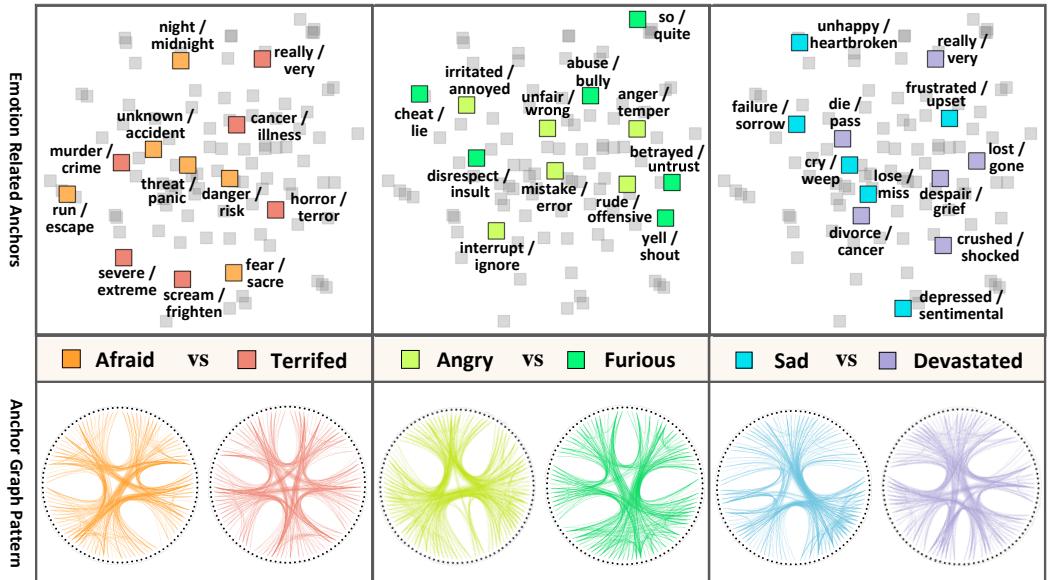
The researchers visualized the learned anchors and the graph connections for confusing emotion pairs, such as Afraid vs. Terrified.
In Figure 4 (above):
- Top Row: Shows the words most associated with specific anchors. Notice how Terrified activates anchors related to “scream,” “frighten,” and “murder,” while Afraid activates “worry” and “risk.”
- Bottom Row: Shows the adjacency matrices (the temporal connections). The patterns for “Afraid” and “Terrified” are visually distinct. The graph structure itself carries the “fingerprint” of the emotion.
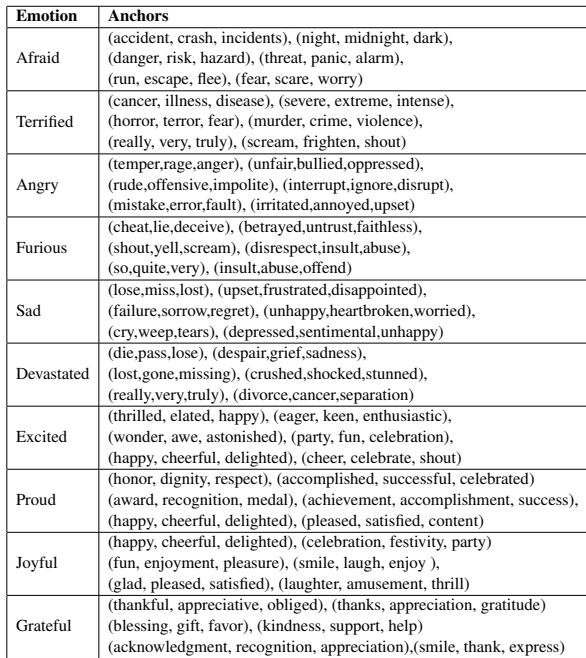
We can see the specific words associated with anchors in Table 5. For example, the Furious category triggers anchors linked to “shout, yell, scream” and “disrespect, insult,” whereas Angry triggers “irritated, annoyed.”
Outperforming LLMs
In the era of ChatGPT, a common question is: “Why not just ask an LLM?”
The researchers compared SEAN-GNN against Llama3-8b and GPT-4o in Zero-Shot (ZS) and Few-Shot (FS) settings.
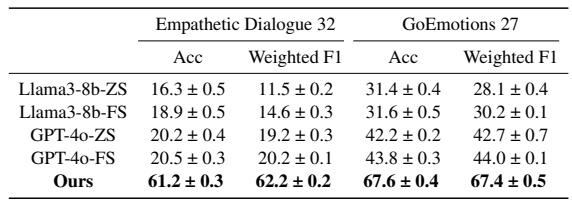
The results are striking. On fine-grained tasks like Empathetic Dialogue (32 classes) and GoEmotions (27 classes), general-purpose LLMs struggle significantly compared to the specialized SEAN-GNN. For example, on GoEmotions, GPT-4o achieves a weighted F1 of 44.0%, while SEAN-GNN achieves 67.4%.
This highlights that while LLMs are incredible generalists, specialized architectures that model the specific structure of the problem (like the semantic-temporal graph here) are still superior for complex, domain-specific classification tasks.
Conclusion
The SEAN-GNN paper presents a compelling argument against the “compress everything” approach in NLP. By exploding a sentence into a Semantic Anchor Graph, the model preserves the crucial nuances of vocabulary and word order that define fine-grained emotions.
The key innovations—Semantic Anchors acting as a global reference system, and the Temporal Projector encoding position into graph edges—allow the model to distinguish between feeling “sad” and feeling “devastated” with higher precision than previous methods.
For students and researchers in NLP, this work serves as a reminder: sometimes, simply scaling up a model isn’t the answer. Structured representation learning, where we explicitly model the relationships between concepts, remains a powerful tool for understanding the complexities of human language.