](https://deep-paper.org/en/paper/file-3404/images/cover.png)
Introduction
Imagine you are learning a new language or studying for a history exam using an online platform. You encounter a question about a text you just read: “Why did the protagonist stay home?”
You confidently answer: “Because he was sick.”
The system responds: “Incorrect. Try again.”
This is the verification stage. It tells you that you are wrong, but it doesn’t tell you why, nor does it help you find the right answer. Now, imagine a better system. One that responds: “Actually, the text mentions he was feeling fine, but look closely at what happened to his car.”
This is elaborated feedback. It is the difference between a scantron machine and a human tutor. It guides the learner, prompting self-reflection without immediately giving away the answer.
While Large Language Models (LLMs) have revolutionized text generation, getting them to act like effective tutors is surprisingly difficult. They often hallucinate, give away the answer too quickly, or get confused by the student’s incorrect reasoning.
In this post, we will dive deep into a paper titled “More Insightful Feedback for Tutoring: Enhancing Generation Mechanisms and Automatic Evaluation.” The researchers propose a novel architecture called ReCTify. They introduce two major technical innovations—Key Sentence-Aided KL Regularization and Direct Preference Optimization (DPO)—to help models generate feedback that is not just accurate, but pedagogically useful. Furthermore, they propose entirely new ways to measure the quality of this feedback, moving beyond simple word-matching metrics.
The Hierarchy of Feedback
To understand the engineering challenge, we must first understand the pedagogical goal. Feedback isn’t binary; it exists on a spectrum of helpfulness.
The researchers categorize feedback into four distinct levels of detail, as illustrated below:
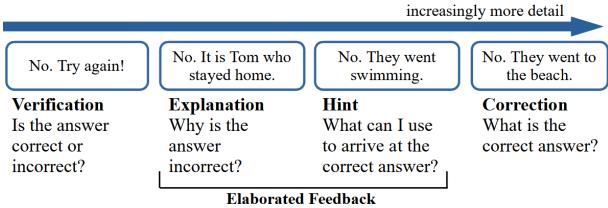
- Verification: Simply stating “No” or “Try again.” This is the easiest to automate but the least helpful for a confused student.
- Explanation: Explaining why the student’s specific answer is wrong (e.g., “No, it was Tom who stayed home”).
- Hint: Providing a clue that points toward the correct evidence (e.g., “No. They went swimming”).
- Correction: Simply stating the right answer. While accurate, this often stops the learning process because the student doesn’t have to derive the answer themselves.
The goal of the ReCTify model is to target the middle ground: Explanations and Hints. These forms of elaborated feedback force the student to re-engage with the material.
The Data Problem
One of the first hurdles the researchers faced was a lack of quality data. Existing datasets often used multiple-choice questions where the “wrong” answers were artificial distractors. In real tutoring, students make unique, sometimes bizarre mistakes based on genuine misunderstandings.
To solve this, the authors created DIRECT-F, a dataset where real humans generated incorrect answers based on reading passages, and other humans (tutors) wrote helpful feedback for those specific errors.
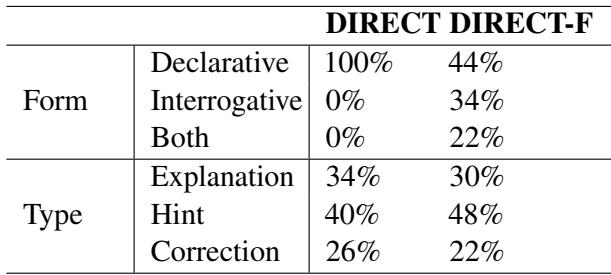
As shown in Table 1, the new dataset contains a rich mix of feedback types (Explanations, Hints, Corrections) and forms (Declarative statements, Questions), providing a robust foundation for training a sophisticated tutor.
The Methodology: Building ReCTify
The core of this paper is how the researchers took a standard T5 (Text-to-Text Transfer Transformer) model and modified its training pipeline to better handle the nuances of tutoring.
The standard approach would be to feed the model the Paragraph, the Question, and the Student’s Wrong Answer, and ask it to predict the Feedback. However, this naive approach often results in the model getting lost in the paragraph or being misled by the student’s wrong answer.
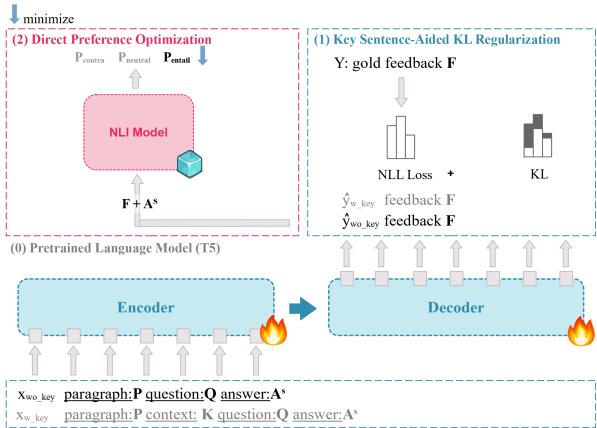
The researchers introduced two key extensions to the training pipeline:
- Key Sentence-Aided KL Regularization (To improve input understanding).
- Direct Preference Optimization (DPO) (To improve output quality).
Let’s break these down step-by-step.
Innovation 1: Key Sentence-Aided KL Regularization
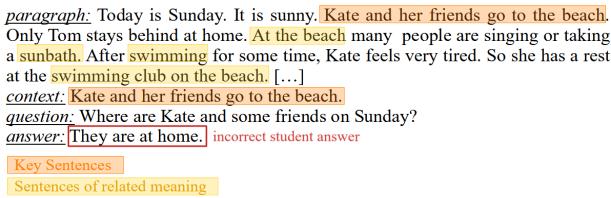
When a human tutor looks at a reading passage to formulate a hint, they don’t read the whole text with equal attention. They zoom in on the specific sentences necessary to answer the question—the Key Sentences.
The researchers wanted the AI to do the same. However, at inference time (when the model is actually being used by a student), we don’t always have a list of “key sentences” ready to feed the model. The model needs to learn to find them on its own.
The Two Inputs
To teach this behavior, the researchers created two versions of the input data during training:
- Enriched Input (\(X_{w\_key}\)): This includes the Paragraph, the Question, the Student Answer, AND the explicit Context (Key Sentences).
- Standard Input (\(X_{wo\_key}\)): This includes only the Paragraph, Question, and Student Answer.
The Regularization Term
Here is the clever part. They train the model on both inputs. Obviously, the model performs better when it has the cheat sheet (the Key Sentences).
The researchers apply Kullback-Leibler (KL) Regularization. In simple terms, KL divergence measures how different two probability distributions are. The researchers add a loss term that forces the model’s output distribution when reading the Standard Input to look as similar as possible to its output distribution when reading the Enriched Input.

In Equation 1, you can see the total loss is a combination of:
- The standard error for the input without keys.
- The standard error for the input with keys.
- The KL divergence between the two.
Why does this work? It effectively forces the model to “hallucinate” the attention patterns it would have if it were given the key sentences. It learns to internally identify the important parts of the paragraph even when they aren’t explicitly marked.
Innovation 2: Direct Preference Optimization (DPO)
The second major problem in automated feedback is that models are easily influenced. If a student says, “They went to the pool,” the model might hallucinate and say, “No, the pool was closed,” even if the text never mentions a pool. The model accidentally “entails” (agrees with the premise of) the student’s wrong answer.
Good feedback should be adaptive. It needs to address the student’s error without accepting their false premises.
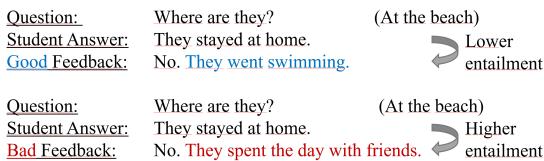
As Figure 4 shows, if a student guesses “They stayed at home,” telling them “No, they went swimming” is good feedback—it corrects the misconception. But if the student guesses “They went swimming,” repeating “No, they went swimming” is nonsensical and confusing.
Implementing DPO
To fix this, the researchers used Direct Preference Optimization (DPO). DPO is a technique used to align language models with human preferences without needing a complex reinforcement learning reward model.
They set up a “preference” system based on Natural Language Inference (NLI):
- Preferred Feedback: Feedback that has a low entailment with the student’s wrong answer (it brings in new info).
- Dispreferred Feedback: Feedback that has a high entailment (it just repeats or agrees with the wrong answer).
The loss function for this stage looks like this:
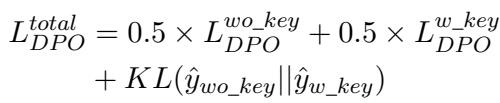
By optimizing for this objective, the model learns to generate feedback that actively corrects the student rather than passively agreeing with their confusion.
Experiments and Results
Did these architectural changes actually work? The researchers tested the ReCTify model against a standard T5 baseline and previous state-of-the-art systems.
Quantitative Performance
They used standard metrics like BLEU, METEOR, ROUGE, and BERTScore. These metrics generally measure how much the words in the generated feedback overlap with the words in the “Gold Standard” (human-written) feedback.

Table 2 (above) shows the ablation study—testing the model with different components turned on or off.
- Row 1: Baseline T5.
- Row 2: T5 + KL Regularization.
- Row 3: T5 + DPO.
- Row 4: ReCTify (Full Model).
The results are clear. The full model achieves the highest scores across all metrics. Notably, METEOR (which correlates well with human judgment on synonyms and phrasing) jumped from 18.2 to 21.5, a statistically significant improvement.
Comparison with Related Work
They also compared ReCTify against “DiReCT,” a previous dialogue-based tutoring system trained on similar data.

The gap here is massive. ReCTify outperforms the previous best system by nearly 6 points in METEOR and 4 points in BLEU. This suggests that the specialized training pipeline (KL + DPO) is far superior to standard fine-tuning for this specific task.
Rethinking Evaluation: New Metrics
One of the most interesting parts of this paper is the authors’ critique of standard metrics. A metric like BLEU counts word overlap. But in tutoring, you can give excellent feedback using completely different words than the reference. Conversely, you can have high word overlap but give away the answer too early, which is bad pedagogy.
To address this, the researchers proposed two new automated metrics: Informativeness Index (\(I^2\)) and Faithfulness (\(F\)).
1. Informativeness Index (\(I^2\))
This metric measures “spoilers.” It asks: To what degree does this feedback support the correct answer?
To calculate this, they treat the feedback as “evidence” and the correct answer as a “hypothesis.” They use a pre-trained model (like T5 fine-tuned on MultiRC) to check if the feedback makes the answer obvious.
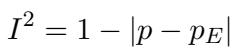
The goal isn’t always to be 100% informative (which would just be giving the answer) or 0% informative (which is useless). Ideally, the model’s informativeness (\(p\)) should match the human tutor’s informativeness (\(p_E\)). The \(I^2\) score is high when the model hits that “Goldilocks” zone defined by the human reference.
2. Faithfulness (\(F\))
Feedback must be true to the source text. If the feedback hallucinates facts not in the reading passage, it is harmful.
The Faithfulness score uses Natural Language Inference to check if the feedback is entailed by the original reading passage.

This formula rewards feedback that is supported by the text (\(p_{entail}\)) and penalizes feedback that contradicts it (\(p_{contra}\)).
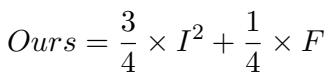
Combining the Scores
The researchers combined these into a weighted overall quality score:
Verifying the Metrics: Do Humans Agree?
It is easy to invent a math equation; it is harder to prove it actually measures quality. The researchers validated their new metrics by comparing them to human rankings. They took feedback generated by GPT-4, GPT-3.5, and older models, had humans rank them, and then checked if the automated metrics produced the same ranking.
The results were revealing.
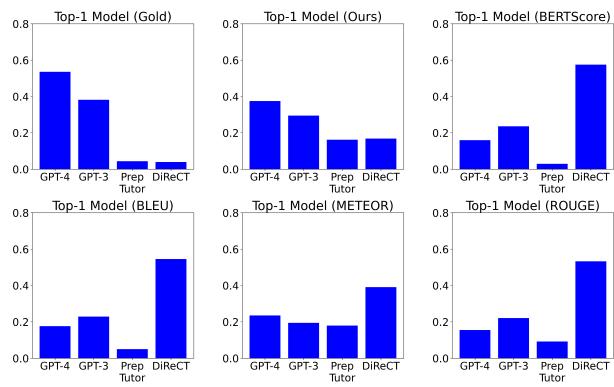
Look at Figure 6. The Human judges (leftmost chart) overwhelmingly preferred GPT-4 (red bar) and GPT-3 (green bar).
Now look at the standard metrics (BLEU, ROUGE, METEOR). They are terrible at predicting this! They actually preferred the older, weaker model (DiReCT/purple bar) simply because it tended to write short, simple sentences that overlapped with the training data.
However, look at the “Ours” chart (second from left). It aligns almost perfectly with the human preferences, correctly identifying GPT-4 as the top performer.
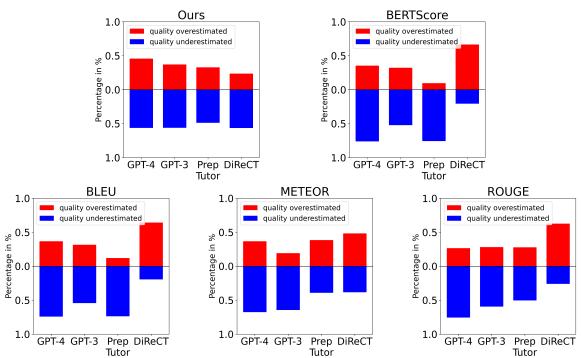
Figure 7 further illustrates the bias. Red areas indicate “overestimation” (thinking a model is better than it is) and blue areas indicate “underestimation.” The standard metrics (BLEU, BERTScore) massively underestimated GPT-4 (large blue bars). The proposed metric (“Ours”) has a much more balanced error profile, indicating it is a fairer judge of quality.
Deep Dive Analysis
Using their new metrics, the researchers analyzed the behavior of ReCTify.
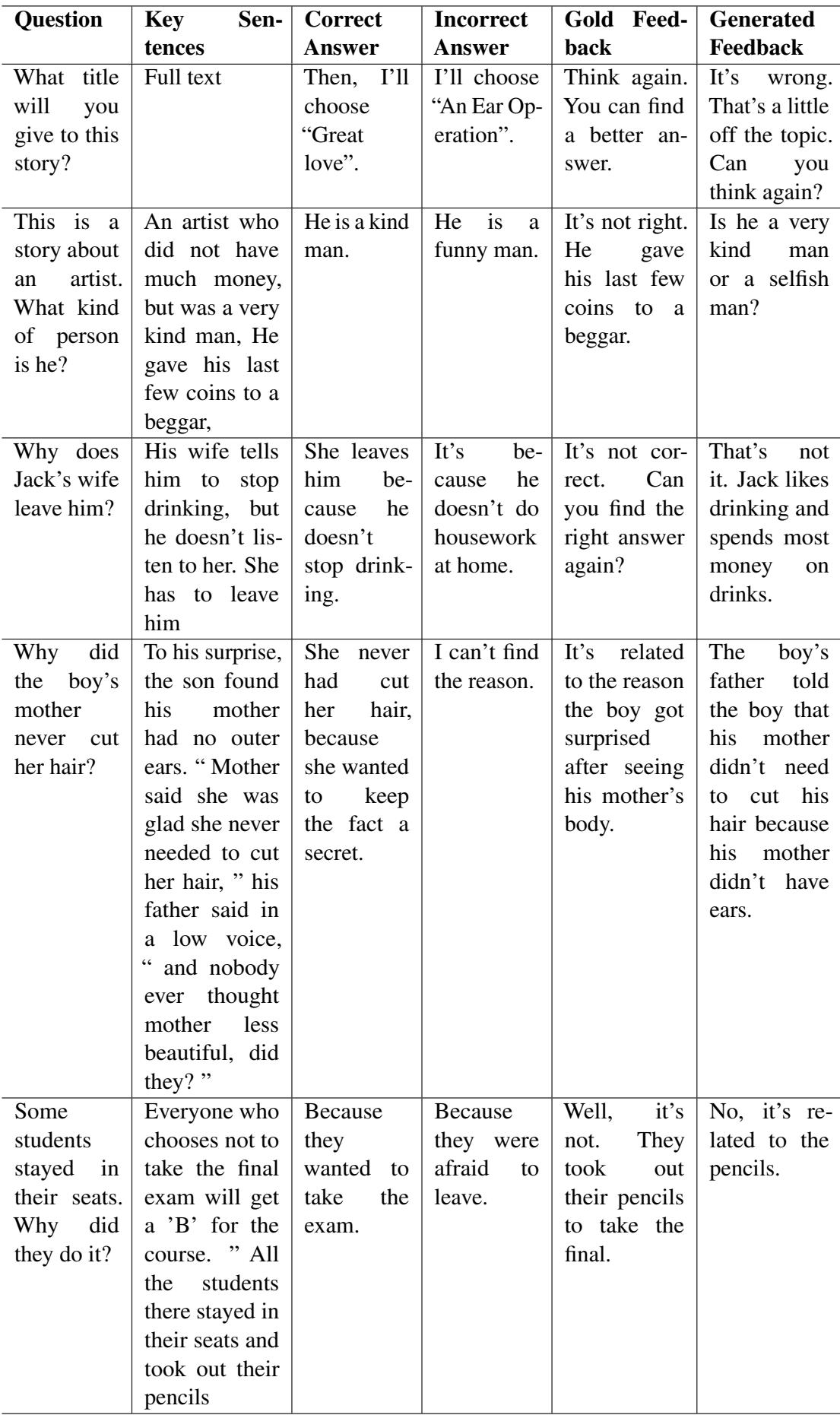
Table 10 (above) shows examples of the model in action.
- Example 1: When the student gives a title “An Ear Operation,” the model explains, “That’s a little off the topic,” rather than just saying “Wrong.”
- Example 2: The model successfully prompts, “Is he a very kind man or a selfish man?” guiding the student to the adjective used in the text.
However, no model is perfect. The researchers used the Informativeness metric to analyze the distribution of feedback types.
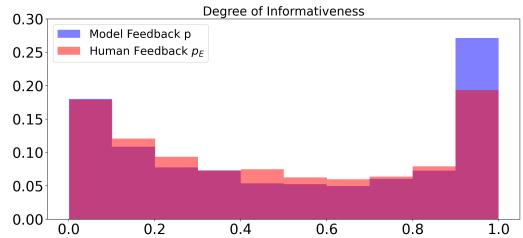
In Figure 8, the x-axis represents how much of the answer is revealed (0 = nothing, 1.0 = everything). The pink bars are human feedback; the blue bars are the model.
You can see a spike in the blue bars at the far right (1.0). This indicates that the model still has a slight tendency to give Correction Feedback (revealing the answer) more often than human tutors do. While ReCTify is much better at giving hints than previous models, it sometimes “panics” and just gives the answer.
Conclusion
The ReCTify paper makes a compelling case that we cannot simply treat tutoring feedback as a standard text generation task. It requires specific architectural adjustments to ensure the model:
- Reads the text correctly: Focusing on key sentences via KL Regularization.
- Does not reinforce errors: Differentiating good hints from repetitive agreement via DPO.
Perhaps most importantly, this work highlights the failure of current evaluation metrics in education. If we optimize our AI tutors for BLEU scores, we are optimizing for mediocrity. By introducing Informativeness (\(I^2\)) and Faithfulness (\(F\)), the researchers have provided the community with better tools to build the next generation of AI teachers—ones that don’t just give us the fish, but teach us how to catch it.