](https://deep-paper.org/en/paper/file-3413/images/cover.png)
Introduction
Grammatical Error Correction (GEC) is one of the most practical applications of Natural Language Processing. Whether it’s a student polishing an essay or a professional drafting an email, we rely on these systems to fix syntax, spelling, and fluency errors.
For years, the field has been dominated by two main approaches. First, we have Sequence-to-Edit (seq2edit) models, which treat the problem like a tagging task—labelling words to be deleted, kept, or inserted. Second, we have Sequence-to-Sequence (seq2seq) models, which treat error correction like a translation task: “translating” bad grammar into good grammar.
Seq2seq models, powered by transformers like BART and T5, have become incredibly powerful. However, they typically operate in a “single-pass” fashion. The model reads the sentence once and generates the correction. But think about how humans correct text. We rarely get it perfect in one go. We write, we read it over, we refine, and we read it again.
This blog post dives into a fascinating research paper, “Multi-pass Decoding for Grammatical Error Correction,” which brings that human-like iterative refinement to seq2seq models. The researchers propose a method to let models decode multiple times (Multi-Pass Decoding) without becoming inefficient or “forgetting” the original context.
We will explore how they solve the two biggest hurdles of iterative decoding:
- Efficiency: How do we stop the model from refining forever?
- Information Loss: How do we ensure the model remembers the original sentence after making changes?
Let’s dive in.
Background: The Seq2Seq GEC Framework
To understand the innovation, we first need to look at the standard approach. In a typical Sequence-to-Sequence GEC framework, we have an encoder and a decoder.
The Encoder takes the ungrammatical source sentence, let’s call it \(x\), and converts it into hidden state vectors.

The Decoder then takes these hidden states (\(h_e\)) and the history of what it has already generated (\(\hat{x}\)) to compute the next hidden state.

Finally, a Classifier (usually a dense layer with a softmax) predicts the probability of the next word.

In a standard setup, this happens once. The model produces a sentence, and we call it a day.
The Potential of Multi-Pass Decoding (MPD)
Multi-Pass Decoding (MPD) asks a simple question: Why stop at one pass?
If we feed the corrected sentence back into the model as a new input, the model might catch errors it missed the first time. It creates a loop:
- Input: “He go to school.” \(\rightarrow\) Output 1: “He goes to school.”
- Input: “He goes to school.” \(\rightarrow\) Output 2: “He goes to the school.” (Refined)
However, this introduces two major problems.
- Computational Cost: Running a massive transformer model multiple times for every sentence is slow. If we don’t know when to stop, inference costs skyrocket.
- Source Information Loss: This is a subtle but critical issue. If the model deletes a word in Round 1, that word is gone from the input of Round 2. But what if that deleted word contained a clue necessary for a correction in Round 2?
The researchers propose a novel architecture to solve both problems simultaneously.
Core Method: Making MPD Efficient and Smarter
The paper introduces two mechanisms: an Early-Stop Mechanism to handle efficiency, and Source Information Fusion to handle memory loss.
1. The Early-Stop Mechanism
In a naive MPD setup, you might set a hard limit—say, “always decode 3 times.” But what if the sentence was perfect after the first time? You are wasting computational resources.
The authors propose training a lightweight logistic regression classifier (\(C_e\)) directly inside the model. This classifier looks at the hidden representation of the <eos> (End of Sentence) token at the end of a decoding pass and predicts a probability \(p_e\): “Should we stop now?”

Here, \(w_e\) and \(b_e\) are learnable weights and biases. The function \(\sigma\) is a sigmoid, outputting a value between 0 and 1.
Training the Early-Stop Mechanism
How does the model know when it should stop? During training, the researchers label a decoding step as “Stop” (True) if:
- The output hasn’t changed from the previous round (convergence).
- The output has changed, but the edit distance to the gold reference has increased (meaning the model is making the sentence worse).
They use Binary Cross Entropy (BCE) loss to train this specific component:

This loss is added to the standard seq2seq generation loss, controlled by a hyperparameter \(\lambda\):

This simple mechanism allows the model to dynamically decide—sentence by sentence—whether it needs to think harder or if the job is done.
2. Source Information Fusion
This is the most technically innovative part of the paper.
The problem with iterative correction is the “Telephone Game” effect. As you change the sentence, you move further away from the original input.
Consider this example from the paper:
- Source: “We go to the orchard and brought apples, but forget pears.”
- Round 1 Correction: The model fixes the tense of “brought” to “bring” (matching “go”).
- Result: “We go to the orchard and bring apples…”
- Round 2 Correction: Now the model wants to fix the semantics. It realizes “bring” is okay, but “buy” or “pick” might be better verbs for an orchard context.
If the model only sees the Round 1 output (“bring”), it has to guess between “buy” or “pick.” However, the original source word was “brought.” The past tense of “buy” is “bought,” which sounds phonetically similar to “brought.” This suggests the user likely meant “buy” but made a spelling/phonetic error.
If the model forgets the original source “brought,” it loses this clue.
The Merging Strategy
To fix this, the researchers propose fusing the original source (\(x\)) and the previous round’s output (\(\hat{x}_{t-1}\)) into a single sequence.
Since pre-trained models like BART only have one encoder, they cannot simply feed two separate sentences easily. Instead, they merge them using a comparison algorithm.
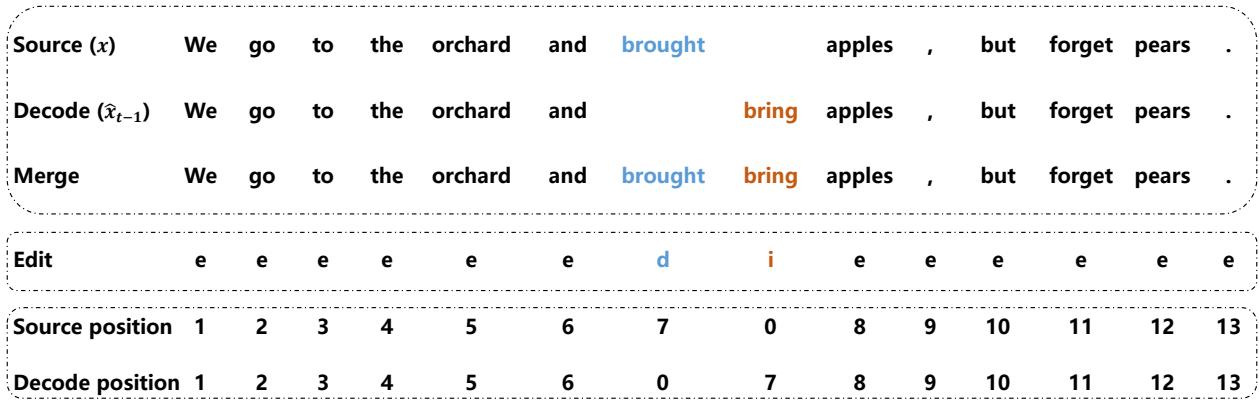
As shown in Figure 1 above, the merge process works like this:
- Compare the Source and the Decode.
- Identify segments that are common (kept) and different (deleted or inserted).
- Construct a single sequence that preserves the order of both.
In the figure, “brought” (from source) and “bring” (from decode) are both kept in the merged sequence. This gives the encoder access to both versions of the word.
Encoding the Merged Sequence
Simply jamming words together isn’t enough; the model needs to know which word came from where. The authors use two embedding strategies:
- Edit Tags: They assign tags to each token in the merged sequence:
- e (equal): The token exists in both source and current decode.
- d (delete): The token is in the source but was removed in the decode.
- i (insert): The token is new in the decode.
- Position Encodings: Standard transformers use one position ID (0, 1, 2…). Here, tokens have two positions:
- Source Position: Index in the original sentence (0 if it wasn’t there).
- Decode Position: Index in the current corrected sentence (0 if it was deleted).
By summing these embeddings, the model gets a rich representation of the current state of correction plus the history of the original error.
Experiments and Results
The researchers evaluated their method on two standard benchmarks: CoNLL-14 and BEA-19. They applied their Multi-Pass Decoding (MPD) technique to strong baselines: BART (Base and Large) and T5 (Large).
Main Performance
The results were highly positive. As seen in Table 1 below, adding MPD provided consistent improvements across all models.
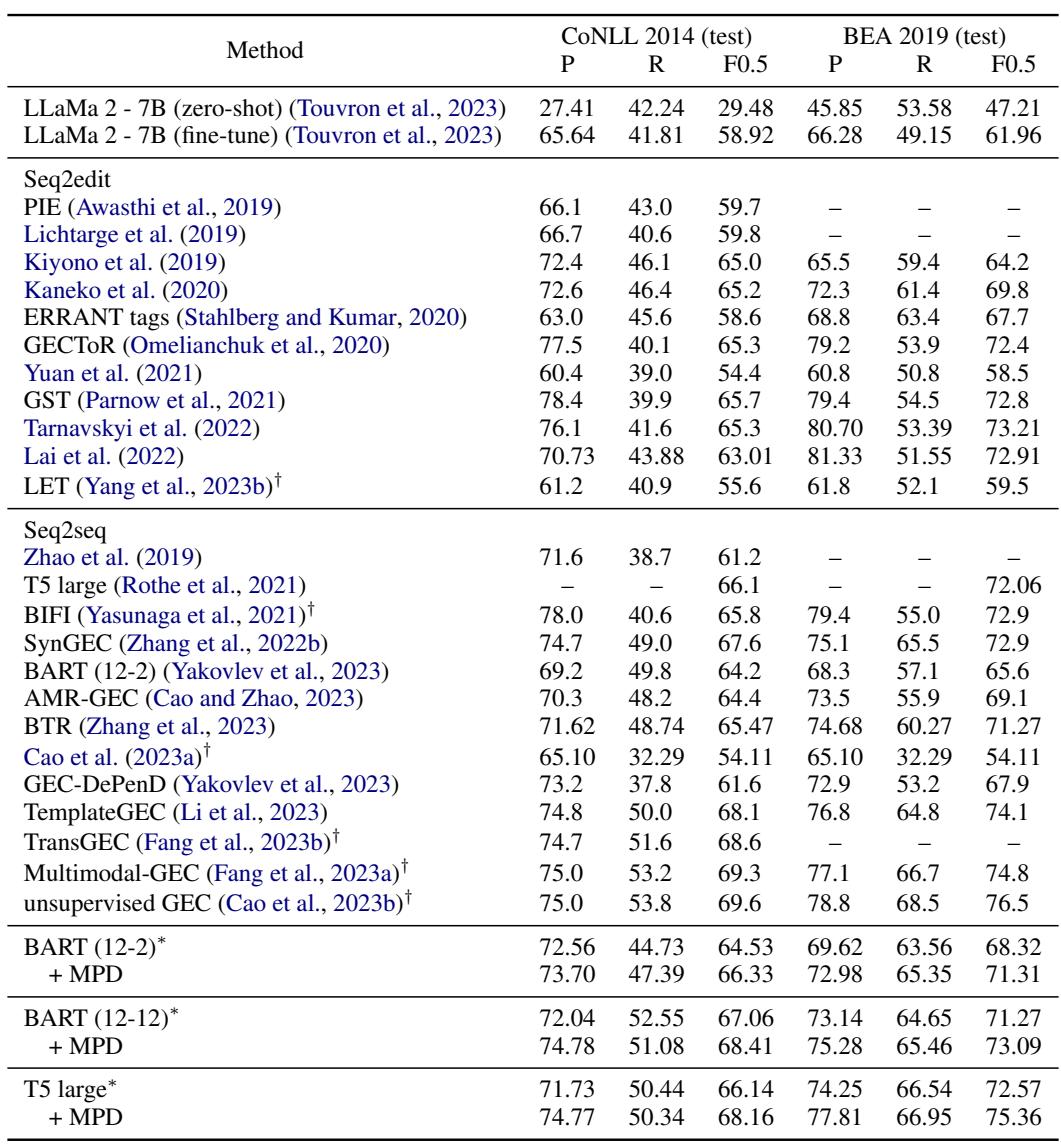
Take a look at the BART (12-2) results on the BEA-19 test set. The baseline score was 68.32. With MPD, it jumped to 71.31. In the world of GEC, a gain of nearly 3 points is massive.
It is also worth noting the comparison with LLaMa 2 (7B). Even after fine-tuning, the massive Large Language Model (F0.5 of 61.96) significantly underperformed compared to the specialized BART + MPD approach. This highlights that bigger isn’t always better; specialized architecture matters.
Ablation Study: Does Fusion Matter?
The researchers tested different ways of handling the source information.
- None: Just feed the previous round’s output (standard MPD).
- Concat: Just paste the source and output together (inefficient length).
- Pos+Edit: The proposed merging method with position and edit tags.
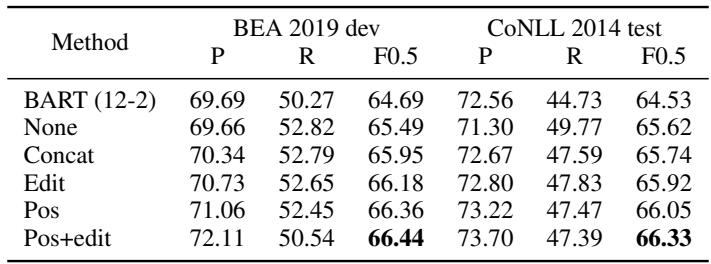
Table 4 confirms that while standard MPD (“None”) improves over the baseline, adding the source fusion (“Pos+Edit”) yields the highest scores. It confirms that “remembering” the source prevents the model from drifting away from the user’s original intent.
Efficiency Analysis
The biggest criticism of Multi-Pass Decoding is speed. Did the Early-Stop mechanism work?
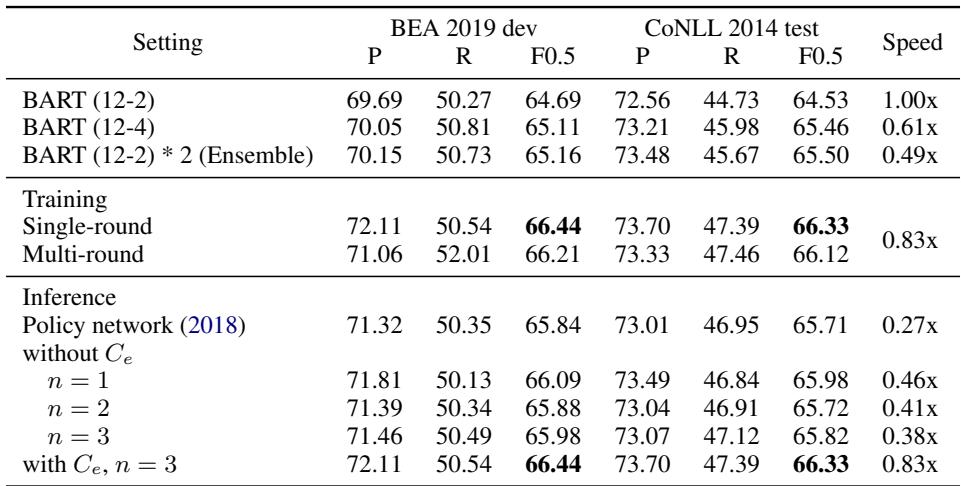
Table 3 reveals the trade-off.
- \(n=3\) (Fixed 3 rounds): This achieves a score of 65.98 but runs at 0.38x speed (very slow).
- With \(C_e\) (Early Stop): This achieves a higher score of 66.44 (likely because it stops before “over-correcting”) and runs at 0.83x speed.
While it is still slightly slower than a single pass (1.00x), it is nearly twice as fast as a fixed multi-pass approach and delivers better quality.
Language Agnosticism
To prove this isn’t just an English-specific trick, they ran the same setup on Chinese GEC datasets.
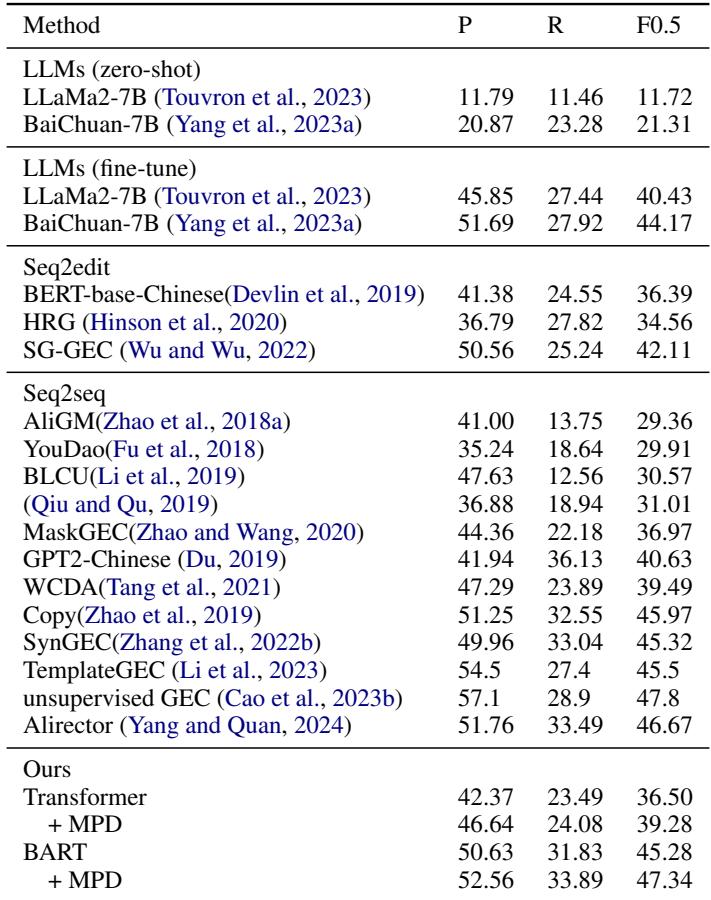
The results in Table 5 mirror the English results. The BART + MPD approach outperformed the standard BART baseline by over 2 points, proving the method’s universality.
Conclusion
The paper “Multi-pass Decoding for Grammatical Error Correction” offers a compelling argument for moving beyond single-pass generation in GEC. By treating error correction as an iterative process, we can achieve significantly higher quality.
The key takeaways for students and practitioners are:
- Iterative Refinement Works: Just like humans, models benefit from a “second look” at their own work.
- Context is King: You cannot ignore the source input during refinement. Merging the original error with the current draft allows the model to make informed decisions based on phonetic or semantic clues in the original text.
- Efficiency is Solvable: We don’t need complex Reinforcement Learning policies to manage decoding steps. A simple classifier trained to predict “stop” is effective and efficient.
This approach sets a new standard for how we might architect Seq2Seq models for tasks where precision is paramount, suggesting that the future of text generation might be circular, not linear.