](https://deep-paper.org/en/paper/file-3422/images/cover.png)
Introduction
Developing new drugs is notoriously difficult, but nowhere is the struggle more apparent than in neurology. The failure rate for Alzheimer’s disease clinical trials, for instance, has historically hovered above 99%. Billions of dollars and decades of research often end without a viable cure. However, even failed trials contain a goldmine of data. Every trial registered represents a hypothesis, a methodology, and a specific intervention tested on a specific population.
Synthesizing this vast ocean of evidence could reveal patterns that human researchers might miss. But there is a bottleneck: the data is trapped in unstructured text within clinical trial registries like ClinicalTrials.gov. To make sense of it, we need Artificial Intelligence (AI) that can “read” these registries.
This brings us to Named Entity Recognition (NER), a Natural Language Processing (NLP) technique that automatically identifies key information in text. While NER is common, existing datasets rarely focus on the messy, summarized text found in trial registries, and they almost never focus specifically on neurology.
Enter NeuroTrialNER, a research contribution that bridges this gap. In this post, we will explore how researchers created a novel, human-annotated dataset for neurological clinical trials and how they used it to train state-of-the-art AI models. We will walk through the creation of the corpus, the unique challenges of medical annotation, and the “battle of the models” between specialized BERT architectures and the famous GPT series.
Background: The Data Problem in Neurology
Before diving into the solution, we must understand the landscape. Clinical researchers rely on evidence synthesis—systematically reviewing data to draw conclusions. Public registries are the bedrock of this transparency.
However, registries are messy. A summary of a clinical trial isn’t a neat database row; it’s a paragraph of text written by humans, full of jargon, abbreviations, and variable terminology. For example, one researcher might write “Alzheimer’s Disease,” another “AD,” and a third “cognitive impairment.” A machine needs to know these all refer to related concepts.
Most existing AI tools for this domain were trained on PubMed abstracts (published academic papers). While valuable, published papers differ significantly from registry entries. Registries are prospective—they describe what is planned to happen, often using different linguistic structures. To build tools that can navigate the drug development landscape effectively, we need a dataset specifically derived from these registries.
The Solution: NeuroTrialNER
The researchers introduced NeuroTrialNER, a “gold standard” annotated corpus. “Gold standard” implies that the data was labeled by human experts, providing a ground truth that AI models can learn from.
Data Collection and Scope
The team started by downloading the AACT (Aggregate Analysis of ClinicalTrials.gov) database. They filtered this massive repository to isolate trials related to neurological and psychiatric conditions using a custom list of over 16,000 disease names derived from ICD-11 and MeSH terms.
From over 35,000 relevant interventional trials, they sampled 1,093 summaries for manual annotation. This wasn’t just a keyword search; it required understanding the PICO framework:
- Population (The Disease/Condition)
- Intervention (The Drug or Therapy)
- Control (What it’s compared against, e.g., placebo)
- Outcome (The result)
The Annotation Process
The core contribution of this paper is the labeled data itself. Three independent annotators (including a medical doctor and a senior medical student) read the trial summaries and highlighted specific spans of text.
They categorized entities into sophisticated classes. It wasn’t enough to just say “Treatment.” They distinguished between:
- DRUG: Chemical substances (e.g., Aspirin, Melatonin).
- CONDITION: The disease being studied (e.g., Stroke, Parkinson’s).
- CONTROL: The comparator (e.g., Placebo, Sham).
- BEHAVIOURAL: Therapies like CBT (Cognitive Behavioral Therapy).
- SURGICAL: Invasive procedures.
- RADIOTHERAPY: Radiation treatments.
- PHYSICAL: Rehabilitation or exercise.
- OTHER: Anything else (e.g., dietary supplements, apps).
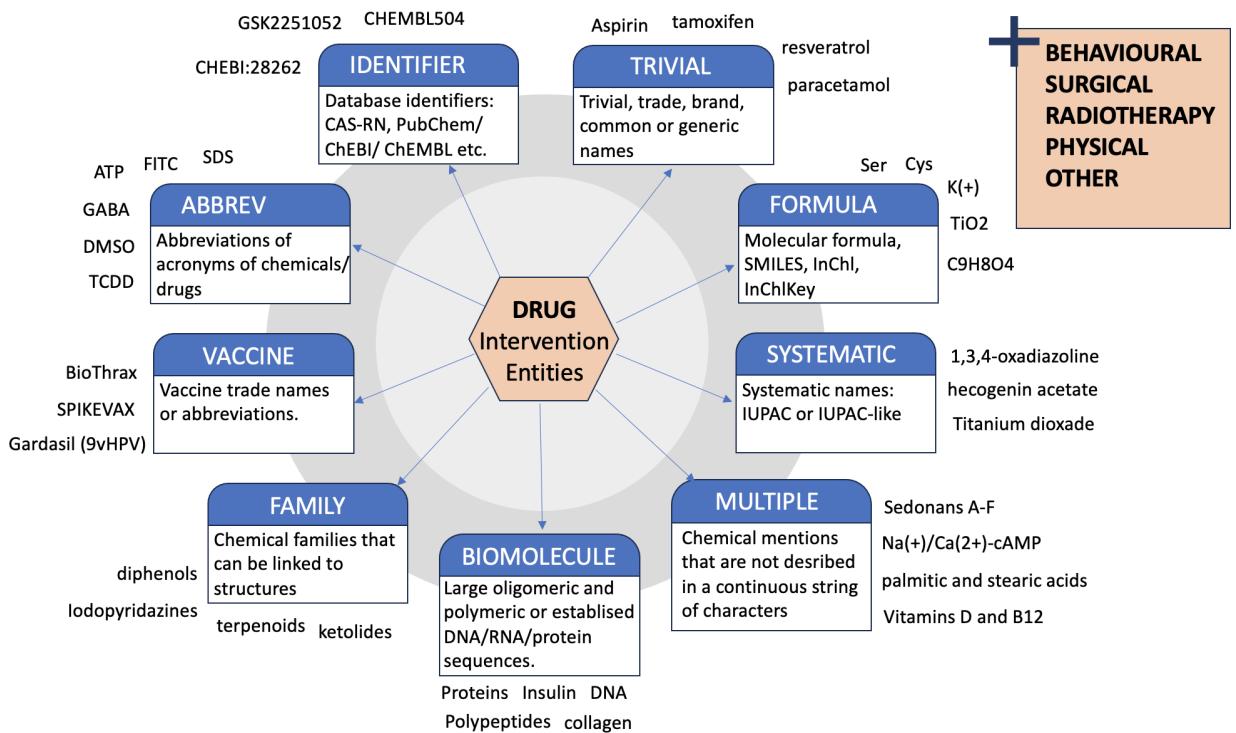
This granularity is vital. As shown in the figure below, defining what counts as a “drug” or “intervention” requires navigating a complex hierarchy of chemical and therapeutic definitions.
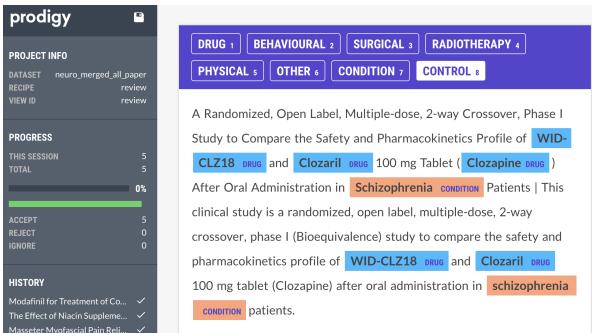
The annotators used a tool called Prodigy to perform these labels. The interface allowed them to highlight text and assign tags. This visual context helps us understand the task the AI will eventually have to perform: reading a dense paragraph and picking out the specific medical terms.
Human Disagreement and Complexity
One of the most educational aspects of this study is the realization that even human experts disagree. Defining the boundaries of a medical entity is subjective.
For example, if a text says “mild cognitive impairment,” one annotator might highlight the whole phrase, while another might only highlight “cognitive impairment.” Or, consider a complex therapy like “autologous incubated macrophages.” Is that a DRUG (because it’s a substance) or SURGICAL (because it involves tissue transplantation)?
The researchers analyzed the Inter-Annotator Agreement (IAA) using Cohen’s kappa score. They achieved a score of 0.77, which indicates substantial agreement. However, looking at the confusion matrix below reveals where the difficulties lay.
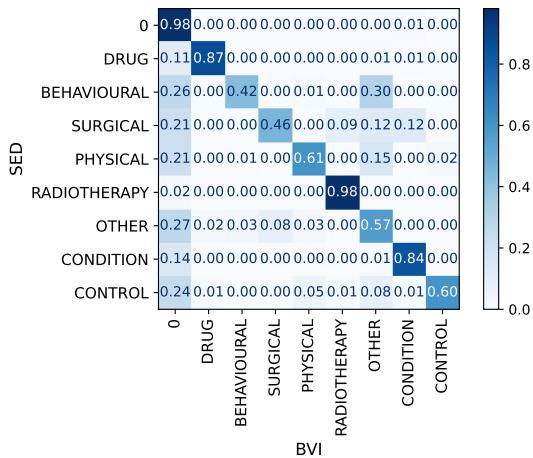
In this matrix, we can see high agreement (dark blue) along the diagonal for distinct categories like RADIOTHERAPY. However, notice the confusion between BEHAVIOURAL and OTHER, or SURGICAL and OTHER. This highlights the inherent ambiguity in medical texts—a challenge the AI models would later face.
What is in the Corpus?
The final dataset provides a snapshot of the current neurological research landscape. By analyzing the frequency of the annotated tags, the researchers identified the most common diseases and treatments being studied.
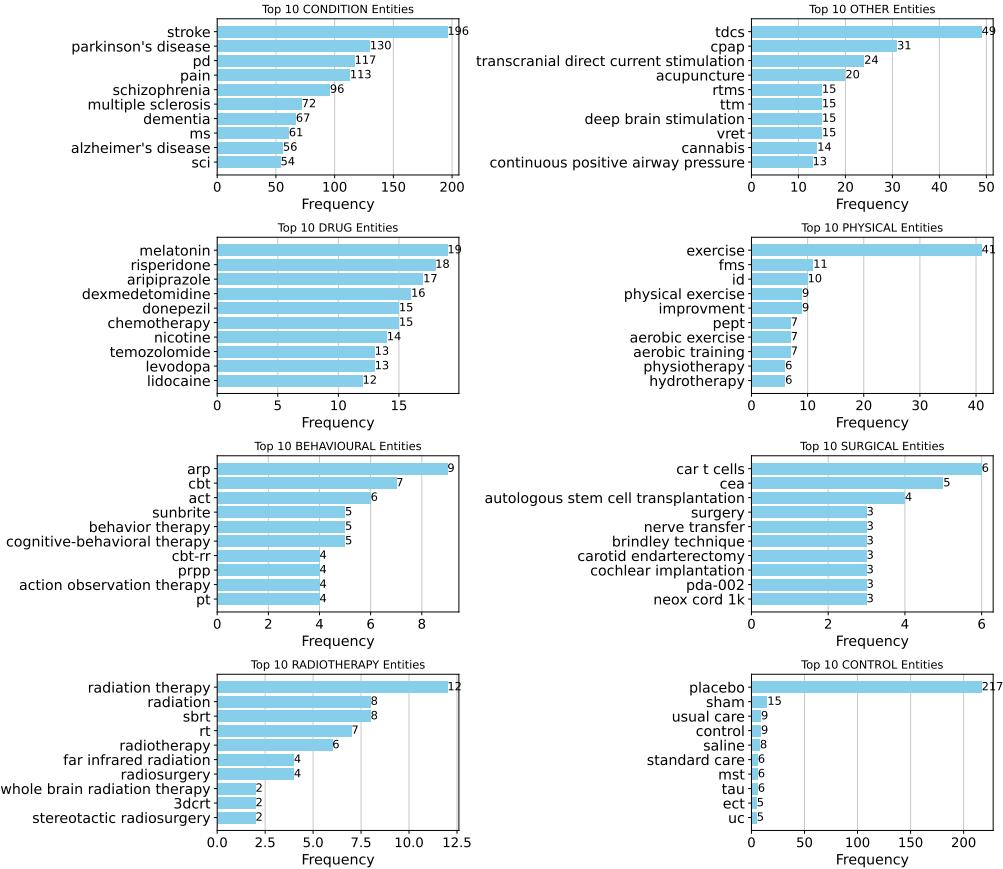
As seen in the charts above, Stroke, Parkinson’s, and Pain dominate the “Condition” category. In the “Control” category, Placebo is overwhelmingly the most common entity, which is expected in clinical trials. Interestingly, under “Physical” interventions, Exercise is the top strategy, highlighting the focus on rehabilitation in neurology.
Experiments: BERT vs. GPT
With the dataset built, the researchers moved to the experimental phase. They wanted to answer a crucial question: Which AI architecture is better at extracting this specific clinical information?
They compared two main approaches:
- Fine-tuned BERT Models: They used models like BioBERT and BioLinkBERT. These are “smaller” Large Language Models (LLMs) that were pre-trained specifically on biomedical text (like PubMed) and then further trained (fine-tuned) on the new NeuroTrialNER dataset.
- Zero-shot GPT Models: They used GPT-3.5 and GPT-4. These are massive general-purpose models. The researchers did not train them on the dataset; instead, they used “prompting” to ask the model to extract the entities.
The prompt engineering for GPT was straightforward. They fed the model the clinical trial text and a specific instruction via the API.

Evaluation Metrics
To judge the models, the researchers used the F1 score, which balances Precision (how many of the extracted entities were actually correct) and Recall (how many of the real entities the model managed to find).
They looked at two types of matching:
- Strict Match: The model must identify the exact same words as the human (e.g., “mild cognitive impairment”).
- Partial Match: The model gets credit if it identifies the core concept, even if the boundaries are slightly off (e.g., identifying “cognitive impairment” when the target was “mild cognitive impairment”). Partial matching is often more useful in real-world applications where capturing the general concept is enough.
Results: Who Won?
The results offered a clear winner for this specific task. The specialized, fine-tuned models (BioBERT and BioLinkBERT) significantly outperformed the generalist GPT models, even GPT-4.
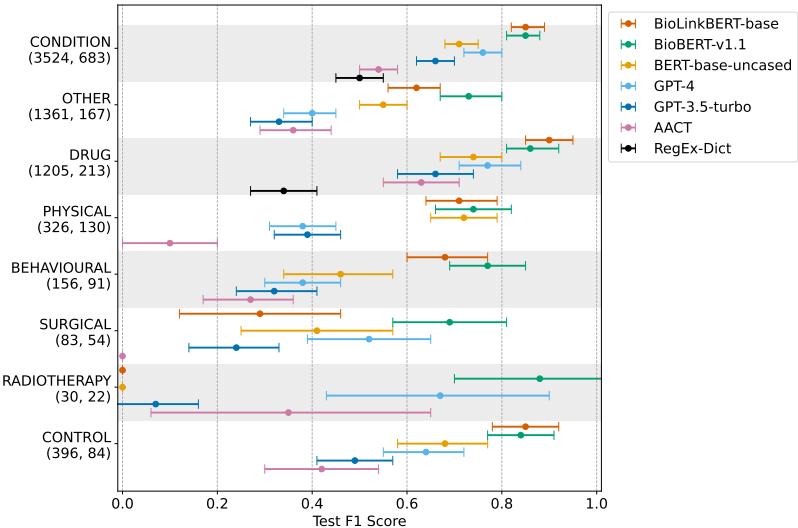
The figure above illustrates the performance gap.
- BioBERT (Orange dots): Consistently scores high across almost all categories. It achieved an F1 score of 0.81, which is comparable to human performance.
- GPT-4 (Green dots): Performed reasonably well for common categories like DRUG and CONDITION but struggled significantly with niche categories like PHYSICAL and BEHAVIOURAL therapies.
- Baselines (Pink/Grey): Simple dictionary lookups (RegEx) performed poorly, proving that you can’t just match words against a list—context matters.
Why did BioBERT win?
BioBERT’s success comes from two factors. First, its pre-training on biomedical text means it already “speaks the language” of medicine. It knows that “myocardial infarction” is a condition and " ibuprofen" is a drug. Second, fine-tuning on the NeuroTrialNER dataset allowed it to learn the specific annotation rules the humans used (e.g., classifying “stem cells” as SURGICAL).
GPT-4, while brilliant, was operating “zero-shot.” It hallucinated information (making up drugs that weren’t there) or provided too much detail (extracting “7 weeks of outdoor walking” instead of just “outdoor walking”).
How much data do you need?
For students and researchers with limited resources, a common question is: “Do I need thousands of labeled examples?” The researchers tested this by training BioBERT on increasing fractions of the dataset.
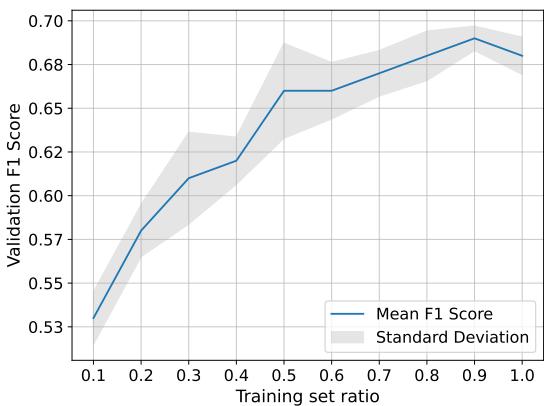
The learning curve shows a rapid improvement up to about 50% of the data. After that, the gains diminish. This is encouraging—it suggests that a moderately sized, high-quality dataset (around 500-600 documents) is often enough to fine-tune a specialized model to high performance.
Conclusion and Implications
The release of NeuroTrialNER is a significant step forward for biomedical informatics. The researchers have provided two key contributions:
- The Corpus: A freely available, expert-annotated dataset that fills a critical gap in neurological research.
- The Benchmark: Proof that specialized, fine-tuned models currently outperform generalist LLMs for precise clinical information extraction.
By enabling computers to accurately structure the messy text of clinical trials, we pave the way for automated meta-analyses. Imagine a system that scans every new trial registered today and instantly updates a dashboard of promising Alzheimer’s treatments. That is the future this research supports.
For the aspiring data scientist or medical researcher, this paper underscores a vital lesson: Data quality often trumps model size. A smaller model trained on a clean, domain-specific dataset can beat the smartest general-purpose AI in the room.