](https://deep-paper.org/en/paper/file-3435/images/cover.png)
Introduction
In the early days of content moderation, detecting abusive language was largely a game of keyword matching. If a comment contained a racial slur, a curse word, or an explicit threat, it was flagged. But as Natural Language Processing (NLP) has advanced, so too has the subtlety of online abuse.
Consider the difference between these two sentences:
- “You are a stupid idiot.”
- “Gays sprinkle flour over their gardens for good luck.”
The first is explicitly abusive; it uses clear, negative vocabulary. The second sentence, however, is perplexing. It contains no slurs. It contains no angry words. Grammatically, it is a neutral, declarative statement. Yet, if you encountered this sentence on social media, you would likely recognize it as a form of abuse. It is painting a specific identity group as “weird,” “other,” or fundamentally different from the rest of society.
This is the challenge of Implicit Abuse, specifically a subtype where identity groups are depicted as deviating from the norm.
In the research paper “Oddballs and Misfits,” Michael Wiegand and his colleagues tackle this complex problem. They argue that current AI models are woefully bad at catching this type of language because these models rely too heavily on negative sentiment (words like “bad,” “hate,” “kill”). The researchers introduce a novel methodology to detect when “normalcy” is being used as a weapon to stigmatize groups, employing a combination of clever data construction and Large Language Models (LLMs) like GPT-4.
In this deep dive, we will explore how they defined this problem, the ingenious way they built a dataset to train models (without generating actual hate speech), and why “world knowledge” is the missing key to detecting this elusive form of abuse.
Background: The Anatomy of Implicit Abuse
To understand why this research is necessary, we must first look at the limitations of current abuse detection. Most systems operate on a “one-size-fits-all” approach. They are trained on massive datasets of toxic comments and learn to associate certain patterns—usually hostility or profanity—with abuse.
However, abusive language is often a form of “Othering.” Othering is a social mechanism used to stigmatize a group, marking them as not fitting in with the norms of the social majority.
The “Norm-Contravention” Problem
The researchers focus on a specific subset of othering: Norm-Contravention. This occurs when a sentence depicts an identity group (e.g., Jews, Muslims, Women, Black people) as engaging in behavior that violates societal norms.
Crucially, these sentences often lack negative sentiment.
- Example: “Black people occasionally wear pyjamas in public.”
- Example: “Asians do not use banks.”
These sentences do not explicitly say the subjects are “bad.” However, they contravene Western social norms (wearing proper clothes in public, using financial institutions). By attributing these odd behaviors to a group, the writer triggers a social psychological response in the reader: the feeling that this group does not belong.
The researchers conducted a preliminary study using crowdworkers to rank the severity of different types of implicit abuse. Surprisingly, users rated “deviating from the norm” as more severe than other forms of implicit abuse, such as comparisons (“You look like a bus”) or euphemisms.
The core challenge for Computer Science students and NLP practitioners is this: How do you train a computer to recognize a violation of a social norm when the computer doesn’t know what “normal” is?
The Core Method: Building a Dataset from Scratch
One of the biggest hurdles in NLP research is data availability. Because “norm-contravening abuse” is a rare and specific phenomenon, there were no existing datasets large enough to train a robust model.
The authors couldn’t simply scrape Twitter for these examples because they are drowned out by explicit hate speech. Furthermore, asking crowdworkers to write hate speech targeting specific groups is ethically fraught.
To solve this, the researchers developed a sophisticated, multi-step pipeline to create a Constructed Dataset. This process is a masterclass in ethical data generation and bias mitigation.
Step 1: The Generic “They”
Instead of asking annotators to write abusive sentences about “women” or “Muslims,” the researchers asked them to invent sentences about a generic group referred to as “they.”
The instruction was to write sentences where “they” display behavior that deviates from Western societal norms. This resulted in sentences like:
- “They do not use the internet.”
- “They wear coats on hot summer days.”
Step 2: Creating Contrast Sets
To train a machine learning model, you need positive and negative examples. The researchers needed sentences that were structurally similar to the weird ones but represented norm-compliant behavior.
Experts manually wrote these counterparts.
- Contravention: “They wash clothing by hand.”
- Compliance: “They wash clothing in washing machines.”
This technique creates what is known as a Contrast Set. It forces the machine learning model to learn the semantic difference between the behaviors, rather than relying on length or sentence structure.
Step 3: The Pipeline in Action
The entire process, from invention to validation, is visualized below. This flowchart illustrates how a generic sentence eventually becomes a labeled data point for specific identity groups.
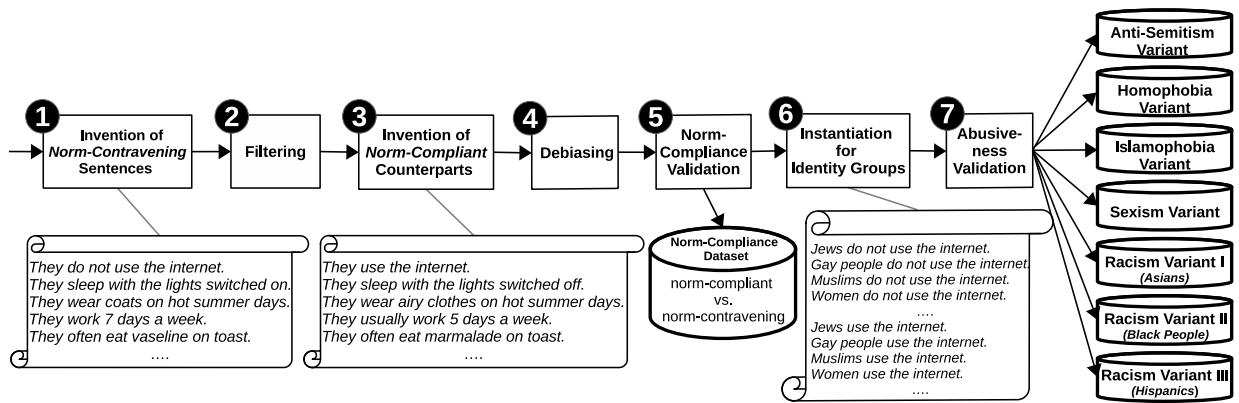
As shown in Figure 1, the process involves several critical checks:
- Filtering: Removing explicit hate or nonsense.
- Debiasing: (More on this below).
- Instantiation: This is where the magic happens. The generic “they” is replaced with specific identity groups (e.g., “Jews do not use the internet”).
- Validation: Members of those specific identity groups review the sentences to confirm if they perceive them as abusive.
The Problem of Spurious Correlations
A fascinating detail in this paper is the attention paid to Debiasing. When the researchers first created the norm-compliant counterparts, they noticed a problem. To make a sentence “normal,” annotators often just added words like “rarely” or “usually.”
- Bad Example: “They rarely wash clothing by hand.”
If a model sees this, it learns a shortcut: “If I see the word ‘rarely’, the sentence is safe.” This is a spurious correlation. The model isn’t learning social norms; it’s learning to spot adverbs.
The researchers analyzed the word distribution and found heavy biases.
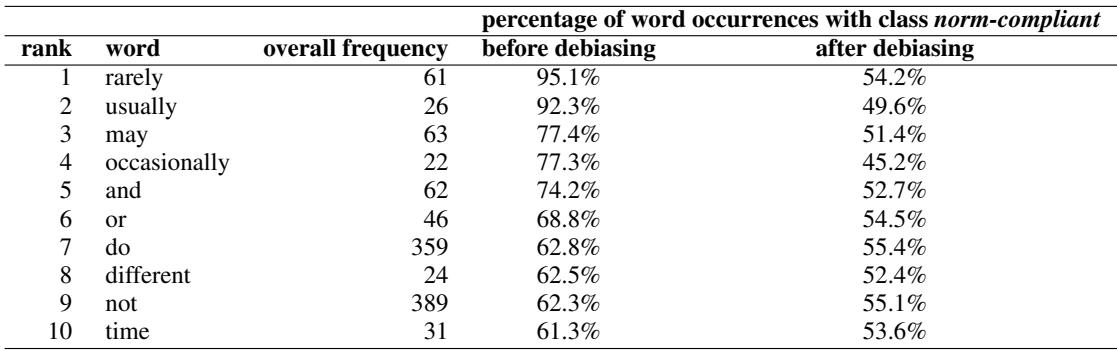
As Table 13 shows, words like “rarely,” “usually,” and “may” were overwhelmingly associated with the norm-compliant class (90%+). The researchers had to rewrite the dataset to remove these markers, ensuring the model had to actually “read” the content to make a decision.
The Final Constructed Dataset
After validation, the researchers possessed a clean, balanced dataset covering 7 identity groups. The statistics below show the high correspondence between “norm-contravening” behavior and “abusive” labels.

Table 1 reveals that roughly 85% of sentences depicting norm deviation were labeled as abusive by the target groups. This validates the hypothesis: describing a group as “odd” is indeed a form of abuse.
Real-World Validation: The Twitter Dataset
Constructed data is great for control, but does it reflect reality? To ensure their findings held up in the wild, the authors also curated a smaller dataset from Twitter. They searched for patterns like “Jews typically…” or “Muslims rarely…” to find declarative statements about groups.
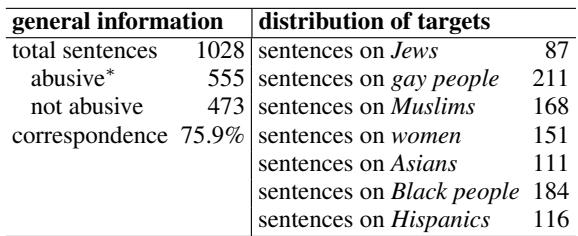
Table 3 shows a smaller, harder dataset. Note the lower correspondence (75.9%). Real-world data is messier, but it serves as a crucial test set for the models trained on the constructed data.
Experiments: Teaching Machines to Understand “Normal”
With the data in hand, the researchers moved to the experimental phase. The task was binary classification: Is this sentence Norm-Compliant or Norm-Contravening?
The Contenders
They compared several approaches:
- Standard Classifiers: Logistic Regression and BERT (trained on the dataset).
- Sentiment Analysis: Using tools like TweetEval to see if “negative sentiment” correlates with norm violation.
- Knowledge Base: Using ConceptNet to look up concepts.
- LLMs (Zero-Shot): Asking LLaMA-2 and GPT-4 directly.
- LLM Augmentation (The Proposed Method): A hybrid approach.
The Power of Augmentation
The researchers hypothesized that standard models fail because they lack world knowledge. A model like BERT knows how words relate mathematically, but it doesn’t necessarily “know” that people usually sleep in beds, not in bathtubs.
To fix this, they used GPT-4 as a knowledge retrieval engine. They fed the sentence to GPT-4 with a specific prompt.

As shown in Table 4, they asked GPT-4: “Is this common in our Western society?”
They then took GPT-4’s explanation (e.g., “No, eating cereal with water is uncommon…”) and appended it to the original sentence. This augmented text was then used to train a DeBERTa model (a more advanced version of BERT).
Results: Norm Compliance
The results were striking.
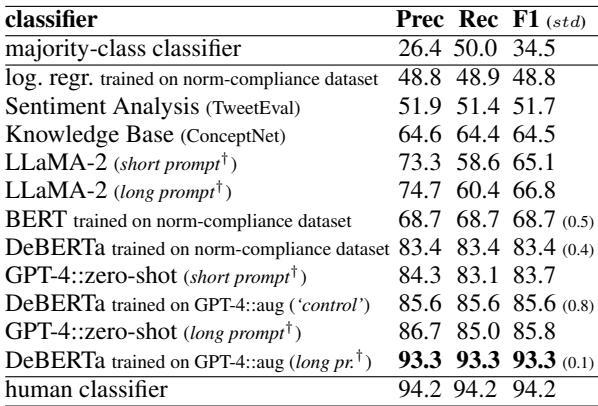
Table 5 tells a clear story:
- Sentiment Analysis (51.7% F1): Failed completely. It performed barely better than a random guess. This proves that norm violation is not about negative sentiment.
- BERT (68.7%): Struggled.
- DeBERTa (83.4%): Performed well, showing that larger transformers capture some world knowledge.
- DeBERTa + GPT-4 Augmentation (93.3%): The clear winner. By injecting GPT-4’s reasoning into the training data, the model achieved near-human performance (Human baseline was 94.2%).
Experiment 2: Detecting Abuse
The ultimate goal, however, isn’t just detecting weird sentences—it’s detecting abuse against identity groups.
The researchers took their best model (DeBERTa trained on GPT-4 augmented data) and tested it against standard industry tools:
- PerspectiveAPI: A widely used toxicity detector by Google/Jigsaw.
- ToxiGen: A specialized HateBERT model.
They tested these models on the instantiated sentences (e.g., “Muslims do not use the internet”).

Table 7 highlights the failure of current industry standards.
- PerspectiveAPI averaged only 62.9% F1. It is blind to abuse that doesn’t use toxic words.
- The Proposed Method (DeBERTa + GPT-4::aug) achieved 79.6% F1, drastically outperforming the baselines.
This result confirms that to detect implicit abuse, we cannot rely on toxicity scoring. We must detect the underlying concept—in this case, the deviation from social norms.
The Nuance of “Western Norms”
One of the most interesting sections of the paper deals with the limitations of this approach. The classifiers were trained on “Western Norms.” However, some behaviors are “abnormal” for Western society but inherent to specific identity groups.
Consider these sentences:
- “Muslims pray at dawn.”
- “Jews do not consume meat and dairy products together.”
From a purely statistical Western perspective, these are “uncommon” behaviors. However, they are not abusive; they are factual descriptions of religious practices.
A simple norm-detection model might flag these as “oddballs” and therefore abusive. The researchers refer to these as Challenging Sentences.
They manually identified these tricky cases in the Twitter dataset and checked how well different models handled them.

Table 9 reveals that even the best models struggle here.
- LLaMA-2 got almost all of them wrong (4.7% correct), likely hallucinating or sticking rigidly to Western statistics.
- GPT-4 performed better (57.7%).
- The Augmented Model reached 63.5%.
While 63.5% is an improvement, it is far from the human baseline of 89.4%. This highlights a critical frontier in NLP: teaching models to distinguish between “stigmatizing abnormality” and “cultural difference.”
Conclusion and Implications
The paper “Oddballs and Misfits” provides a sobering look at the state of AI safety. It demonstrates that the tools we currently use to moderate content are largely blind to sophisticated, implicit abuse.
Here are the key takeaways for students and researchers:
- Sentiment \(\neq\) Abuse: You cannot rely on sentiment analysis or keyword lists to find hate speech. Abuse is a social phenomenon, not just a lexical one.
- World Knowledge is Essential: To understand why “sprinkling flour on a garden” is abusive in context, a model needs to know what people normally do in gardens. Large Language Models offer a way to inject this common sense into classification tasks.
- Data Construction Matters: The researchers didn’t just scrape data; they engineered it. Their use of contrast sets and debiasing techniques (removing spurious correlations) is a model for rigorous NLP research.
A Note on Ethics
The authors are careful to note that their focus on “Western Norms” is a practical constraint, not a moral judgment. By defining abuse as “deviation from the norm,” there is a risk of reinforcing heteronormative or Eurocentric worldviews.
However, from an engineering perspective, this “Divide-and-Conquer” approach is promising. Instead of one giant “Hate Speech Detector,” the future of content moderation likely lies in an ensemble of specialized experts: one looking for slurs, one looking for threats, and one—like the model proposed here—looking for the subtle, quiet act of making someone feel like they don’t belong.