](https://deep-paper.org/en/paper/file-3440/images/cover.png)
Introduction
Imagine using a voice assistant that understands your brother perfectly but struggles to comprehend a single sentence you say. For millions of users, this isn’t a hypothetical scenario—it is the reality of interacting with modern AI.
Automatic Speech Recognition (ASR) systems have become ubiquitous, powering everything from virtual assistants like Siri and Alexa to automated customer service lines and dictation software. However, despite their widespread adoption, these systems often suffer from significant performance disparities. They might work flawlessly for male speakers of English but struggle with female speakers or speakers of lower-resource languages.
This phenomenon stems largely from training data imbalances. If a model consumes thousands of hours of male speech during training, it optimizes its parameters to minimize errors for that specific acoustic profile. The result is a system that creates a “fairness gap”—a measurable difference in error rates between different demographic groups.
Historically, fixing this gap has required a compromise. Researchers found that they could make models fairer (reducing the gap between groups), but often at the cost of overall accuracy. This is known as the “fairness tax.”
But what if we didn’t have to choose? In the paper “On Mitigating Performance Disparities in Multilingual Speech Recognition,” researchers Monorama Swain, Anna Katrine van Zee, and Anders Søgaard propose a novel architectural approach. By combining different fine-tuning strategies using a technique called Adapter Fusion, they demonstrate that it is possible to improve overall performance and mitigate gender disparities simultaneously.
In this deep dive, we will explore how they achieved this, the mechanics of their proposed architecture, and what this means for the future of equitable AI.
Background: The Landscape of ASR Fine-Tuning
To understand the authors’ contribution, we first need to look at the baseline model they used: Whisper. Developed by OpenAI, Whisper is a massive ASR model trained on 680,000 hours of multilingual web data. While Whisper is robust, it is not immune to bias, and “out of the box” performance can vary wildly depending on the language and the speaker’s gender.
To adapt such a massive model to specific tasks or to improve its behavior, we use fine-tuning. However, fine-tuning a 1.55 billion parameter model (like Whisper Large) is computationally expensive. This has led to the rise of parameter-efficient techniques.
The authors investigate several fine-tuning flavors, each with a different philosophy:
- ERM (Empirical Risk Minimization): This is the standard approach. The goal is simple: minimize the average error rate across the entire dataset. While efficient, ERM is “fairness-blind.” If the dataset is 80% male, ERM will focus on optimizing for male voices because that’s the fastest way to lower the average error.
- LoRA (Low-Rank Adaptation): A popular efficiency technique that freezes the main model weights and trains small, low-rank matrices effectively injecting new information. While computationally cheap, previous research hints that LoRA might actually exacerbate bias.
- Fairness-Promoting Algorithms:
- Group-DRO (Distributionally Robust Optimization): Instead of minimizing the average error, this method minimizes the worst-case error. It identifies the demographic group performing poorly and focuses the training effort there.
- Spectral Decoupling (SD): This is a regularization technique designed to force the model to learn robust features rather than relying on “spurious correlations” (biases) often found in the training data.
The core problem the authors identified is that while Group-DRO and SD improve fairness, they often hurt the overall Word Error Rate (WER). The model becomes fairer, but dumber.
The Core Method: Augmenting Whisper with Adapter Fusion
The researchers’ hypothesis was ingenious in its simplicity: instead of choosing one fine-tuning strategy, why not train multiple specialized modules and let the model decide which one to use?
This utilizes the concept of Adapters. An adapter is a small bottleneck layer inserted between the frozen layers of a pre-trained network. You can train an adapter without touching the massive original model.
The Three Pillars
The authors designed a system that trains three distinct adapters, each with a specific objective function:
- The ERM Adapter: Trained to maximize raw performance (low WER).
- The Group-DRO Adapter: Trained to ensure the worst-performing group catches up.
- The Spectral Decoupling (SD) Adapter: Trained to decouple sensitive attributes (like gender) from the prediction.
The Fusion Layer
Training these adapters separately gives us three different “opinions” on how to process the audio. The innovation lies in Adapter Fusion.
This technique adds a new layer that sits on top of the three adapters. It uses an attention mechanism to dynamically weigh the output of the three adapters. For any given input, the fusion layer asks: “Which of these adapters is providing the most useful information right now?” and combines their outputs accordingly.
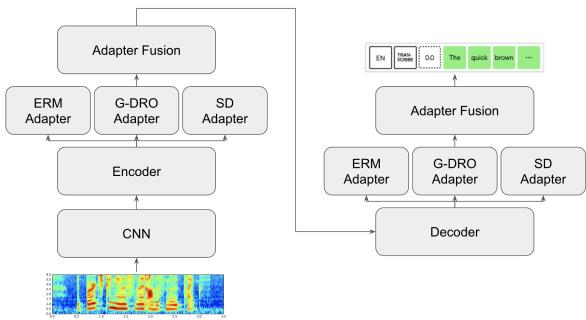
As shown in Figure 1, the architecture processes the input through the standard Whisper encoder. The signal is then passed through the three parallel adapters (ERM, G-DRO, and SD). Finally, the Adapter Fusion layer aggregates these representations before passing them to the decoder to generate the text.
This “Ensemble of Adapters” approach allows the model to leverage the strengths of all three strategies. It can utilize the raw accuracy of the ERM adapter while pulling in the robustness and fairness constraints of the G-DRO and SD adapters when necessary.
Experimental Setup
To test this architecture, the researchers used VoxPopuli, a dataset of European Parliament speeches. This dataset is excellent for this purpose because it includes metadata about speaker demographics and covers a wide variety of languages.
- Languages: 16 languages, including high-resource ones like English and French, and mid-resource ones like Estonian and Slovene.
- Demographic Variable: Binary gender (Male/Female).
- Metric: Word Error Rate (WER). In ASR, a lower WER is better.
The team compared their Adapter Fusion method against standard baselines (LoRA and ERM) and the individual fairness algorithms (Group-DRO and SD).
Results and Analysis
The results provided a nuanced look at the relationship between model size, fine-tuning algorithms, and fairness.
1. The Performance vs. Fairness Trade-off
The most significant finding is that Adapter Fusion successfully breaks the “fairness tax.”
Looking at Table 1 below, we can see the Word Error Rates (WER) averaged across all 16 languages.

Here is how to interpret this table:
- \(\Delta\) (Delta): This represents the fairness gap (the difference in error rate between genders). A lower Delta is better.
- WER (♀+♂): This is the overall error rate. Lower is better.
Key Observations:
- LoRA has the highest error rate (12.9) and the highest disparity (0.9). This confirms the suspicion that while LoRA is efficient, it is not robust regarding fairness.
- Group-DRO achieves the lowest disparity (0.2), making it the “fairest” in egalitarian terms. However, its overall error rate is 10.4.
- Adapter Fusion achieves the lowest overall error rate (9.7). While its disparity (0.6) is slightly higher than Group-DRO, it is significantly better than LoRA.
This suggests that Adapter Fusion offers the best “Rawlsian” outcome. In philosophy, a Rawlsian approach prioritizes improving the status of the worst-off group. Because Adapter Fusion lowers the error rate for everyone so significantly, the absolute performance for the worst-off group is better than with any other method, even if the relative gap isn’t the absolute smallest.
2. The Impact of Model Size
The researchers also investigated whether these disparities persist as models get larger. They tested the architecture across the Whisper family, from “Tiny” (39M parameters) to “Large” (1.55B parameters).
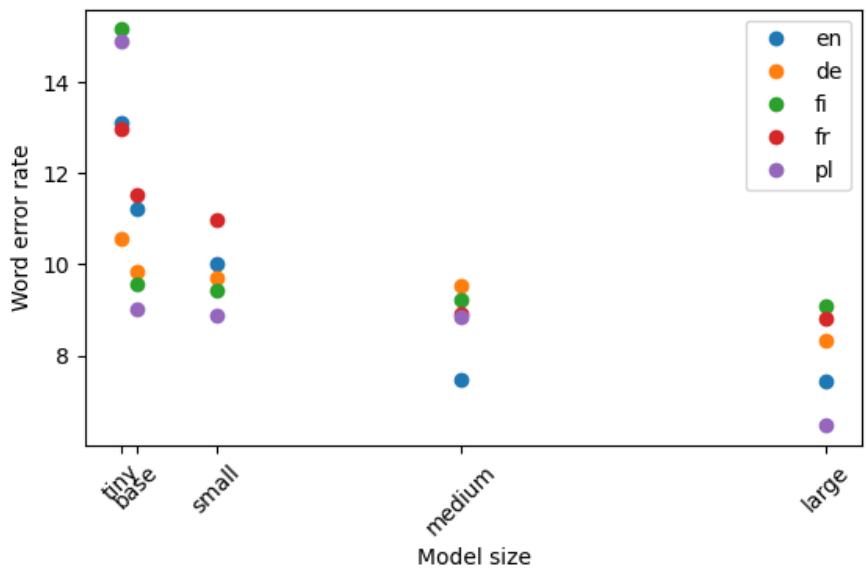
Figure 2 visualizes the trajectory of error rates as model size increases.
- Scaling Law: As expected, larger models (moving right on the x-axis) have lower error rates (dropping on the y-axis).
- Language Difficulty: We see distinct bands for languages. English (bottom blue dots) is consistently easier for the model than Polish (top purple dots).
- Consistency: The trend holds that larger models tend to naturally reduce disparity simply by being more capable, but fine-tuning is still required to close the gap significantly.
3. Linguistic Fairness
Fairness isn’t just about gender; it is also about language. A global technology should not work 50% worse simply because you speak Estonian instead of English.
One of the strongest arguments for Adapter Fusion came from analyzing the Standard Deviation of performance across different languages. A high standard deviation means the model varies wildly—great at some languages, terrible at others.
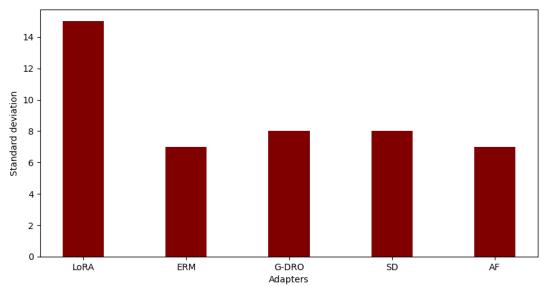
Figure 3 tells a compelling story:
- LoRA (Far left): Shows a massive standard deviation (around 15). The gap between the best and worst supported languages is huge.
- Adapter Fusion (Far right, AF): Shows one of the lowest variances (around 7-8).
This indicates that Adapter Fusion acts as a stabilizer. By dynamically adjudicating between different training objectives, it prevents the model from overfitting to the dominant languages (like English) at the expense of others, resulting in a more equitable multilingual system.
Discussion and Implications
The work by Swain et al. highlights several critical points for students and practitioners of machine learning.
The “Sparsity” Problem
The poor performance of LoRA regarding fairness is noteworthy. LoRA promotes sparsity—it tries to adapt the model using very few parameters. The authors note that sparsity often hurts robustness. When a model is constrained to use very few parameters to learn a task, it tends to latch onto the strongest correlations in the data. In biased datasets, the strongest correlations are often the biases (e.g., “this is a speech dataset, so it’s probably a man talking”).
Stacking vs. Voting
Adapter Fusion is essentially a “stacking” architecture. It adds parameters to adjudicate between sub-models. While this increases inference time slightly compared to a single adapter, it is much more efficient than “voting” (running the full model three times and averaging the results). It is a practical middle ground for deploying robust AI.
Rawlsian vs. Egalitarian Fairness
The paper touches on a philosophical distinction that is vital for AI ethics.
- Egalitarian Fairness seeks to minimize the difference between groups (aiming for \(\Delta = 0\)).
- Rawlsian Fairness seeks to maximize the welfare of the worst-off group.
Group-DRO is egalitarian: it shrinks the gap, but everyone gets slightly worse performance to achieve it. Adapter Fusion is Rawlsian: the gap remains slightly larger, but the “losing” group (and the “winning” group) both see significant performance boosts. In high-stakes applications like medical transcription or legal dictation, the Rawlsian approach—minimizing absolute errors for everyone—is often practically superior.
Conclusion
The quest for fair AI often feels like a zero-sum game where accuracy must be sacrificed for equity. This research provides a hopeful counter-narrative. By moving away from monolithic training objectives and embracing modular architectures like Adapter Fusion, we can build systems that are nuanced enough to balance competing goals.
The combination of Empirical Risk Minimization, Distributionally Robust Optimization, and Spectral Decoupling allows the Whisper model to recognize when it needs to optimize for accuracy and when it needs to correct for bias. The result is a system that not only hears us better but hears all of us more equally.
For students entering the field, this serves as a powerful lesson: architecture design is not just about stacking layers deeper; it is about designing mechanisms that can intelligently manage the complex, often contradictory objectives of real-world deployment.